
MEAN WELL LRS Series · 350 W Single Output · 8 Voltages 3.3–48 V · Built-in Fan · 3-Year Warranty
Mean Well LRS-350 Switching Power Supply
The Mean Well LRS-350 is the fan-cooled heavyweight of the LRS family: eight outputs from 3.3 V to 48 V with 60 A on the low-voltage rails — including a 5 V / 60 A / 300 W model for LED screen modules — from the same 30 mm chassis the LRS-200 uses, with a temperature-controlled fan that holds full load all the way to +70°C.
📱 / WhatsApp: +86-191-18802497 · Shenzhen, China · GMT+8
3.3–48 V
8 output voltages, one chassis
5 V / 60 A
300 W module-bus model
198–350.4 W
Rated power per the datasheet
50°C Fan ON
Temp-controlled, full load to +70°C
3 Years
Manufacturer warranty
Short answer
The Mean Well LRS-350 is a 350 W-class single-output enclosed switching power supply offered in eight DC voltages — 3.3 V/60 A (198 W), 4.2 V/60 A (252 W), 5 V/60 A (300 W), 12 V/29 A, 15 V/23.2 A, 24 V/14.6 A, 36 V/9.7 A and 48 V/7.3 A (up to 350.4 W) — in the same 215 × 115 — 30 mm chassis as the LRS-200 but with a built-in temperature-controlled DC fan, the first forced-air cooling in the LRS family. Per the official datasheet (2025-09-12 revision) the fan switches on at 50°C and off at 40°C, letting every model hold full load from −25 to +70°C; overload spans 110–140% with a 150% peak for 1 second on the 12–48 V models, and the 3-year warranty applies across the line. The 5 V model feeds LED display modules at 60 A — the same rating as CZCL’s A-300AB-5 — and like the LRS-200 it does not meet EN 61000-3-2 harmonics, which restricts some EU lighting applications.
What Is the Mean Well LRS-350 Switching Power Supply?
The Mean Well LRS-350 is a single-output enclosed-type AC-DC switching power supply rated for 350 W continuous output, the top of the LRS low-profile line: 30 mm high, 1U-compatible, and — unlike every smaller LRS — force-air cooled by a built-in DC fan under thermostatic control. The order code reads out the same way as its siblings: LRS-350-5 is the 350 W-class unit delivering 5 V, and the series spans 3.3 V to 48 V.
Two engineering decisions define the model. First, the fan: where the LRS-150 and LRS-200 rely on free convection and derate as ambient climbs, the LRS-350’s fan holds full rated load across the entire −25 to +70°C window, switching on only above 50°C and back off below 40°C — silent in a cool cabinet, self-managing in a hot one. Second, the current step on the low-voltage rails: 60 A on the 3.3, 4.2 and 5 V models against the LRS-200’s 40 A, which moves the series from per-module-group supplies into whole-cabinet territory.
First fan-cooled LRS
A long-life DC fan with ON/OFF thermal control (50°C on, 40°C off) keeps 350 W inside the same 30 mm profile the convection-cooled 150/200 occupy — no depth penalty, no derating curve at the top end.
60 A on the screen bus
240 W usable at 5 V per the 80% rule — one LRS-350-5 carries what two LRS-200-5 units would, halving supply count in dense module cabinets.
Serial-traceable, 3-year warranty
Same family safeguards: serial number verifiable on the MEAN WELL website, 100% full-load burn-in, 3-year manufacturer warranty.
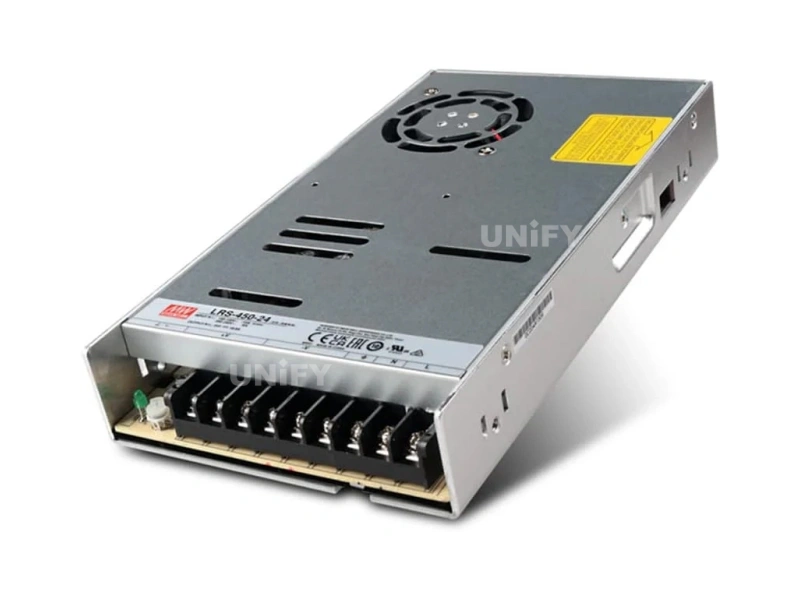
Model code on the label: LRS-350-24 = series 350 W class, 24 V output
MEAN WELL’s flicker-free constant-voltage design video covers the platform behavior LED loads depend on:
In the family lineup the LRS-350 sits at the top: the LRS-150 covers 12–48 V auxiliary buses, the LRS-200 adds the 3.3/4.2/5 V screen rails at 40 A, and the LRS-350 doubles down with 60 A and the fan. All three are siblings; the comparison table below prices the differences.
What Are the Mean Well LRS-350 Specifications?
All figures come from the official MEAN WELL LRS-350 specification sheet (2025-09-12 revision). As with the LRS-200, the series name is a class label, not a per-model rating: the 3.3 V model delivers 198 W, the 5 V model exactly 300 W, and the 24/48 V models 350.4 W.
| Model | Output | Rated power | Adj. range | Ripple max | Efficiency |
|---|---|---|---|---|---|
| LRS-350-3.3 | 3.3 V / 60 A | 198 W | 2.97–3.6 V | 150 mVp-p | 79.5% |
| LRS-350-4.2 | 4.2 V / 60 A | 252 W | 3.6–4.4 V | 150 mVp-p | 81.5% |
| LRS-350-5 | 5 V / 60 A | 300 W | 4.5–5.5 V | 150 mVp-p | 83.5% |
| LRS-350-12 | 12 V / 29 A | 348 W | 10.2–13.8 V | 150 mVp-p | 85% |
| LRS-350-15 | 15 V / 23.2 A | 348 W | 13.5–18 V | 150 mVp-p | 86% |
| LRS-350-24 | 24 V / 14.6 A | 350.4 W | 21.6–28.8 V | 200 mVp-p | 88% |
| LRS-350-36 | 36 V / 9.7 A | 349.2 W | 32.4–39.6 V | 200 mVp-p | 88.5% |
| LRS-350-48 | 48 V / 7.3 A | 350.4 W | 43.2–52.8 V | 200 mVp-p | 89% |
| Parameter | LRS-350 series |
|---|---|
| Input voltage range | 90–132 VAC / 180–264 VAC selected by switch; 240–370 VDC with switch on 230 VAC |
| Input frequency / current | 47–63 Hz; 6.8 A at 115 VAC, 3.4 A at 230 VAC (typ.) |
| Inrush / surge endurance / leakage | 60 A cold start at 115 and 230 VAC; 300 VAC surge for 5 s; <2 mA at 240 VAC |
| Setup / rise / hold-up time | 1500 ms / 50 ms full load; hold-up 16 ms at 230 VAC, 12 ms at 115 VAC (typ.) |
| No-load power draw | <0.75 W |
| Overload | 110–140% rated power; 150% peak for 1 s built in (12–48 V models, Note 7) |
| Overvoltage / overtemperature | 3.3–36 V models: hiccup, auto-recovery; 48 V model: shutdown, re-power to reset |
| Short circuit | Hiccup mode, recovers automatically after the fault clears |
| Cooling | Built-in DC fan, thermostatic: ON ≥50°C, OFF ≤40°C; forced-air full load −25 to +70°C |
| Withstand / insulation | I/P-O/P 3.75 kVAC; I/P-FG 2 kVAC; O/P-FG 0.5 kVAC; 100 MΩ at 500 VDC |
| Environment | −25 to +70°C, 20–90% RH non-condensing; storage −40 to +85°C; 5 G vibration; 2,000 m full load, 5,000 m derated |
| MTBF | 2,099.9K hrs min. (Telcordia SR-332); 328.6K hrs min. (MIL-HDBK-217F, 25°C) |
| Dimensions / weight | 215 × 115 × 30 mm (case 207A); 0.76 kg; 15 pcs per 12.4 kg carton |
| Safety standards | IEC/UL 62368-1; BSMI CNS15598-1; EAC TP TC 004; KC 62368-1 (-12/-24); GB 4943.1; BIS IS 13252; BS EN/EN 61558-1/-2-16 |
| EMC | Immunity: BS EN/EN 55035; BSMI CNS15936. Harmonics: does not meet BS EN/EN 61000-3-2 (datasheet Note 10) |
| Build and warranty | 100% full-load burn-in; 65 kHz switching; LED power indicator; 3-year warranty |
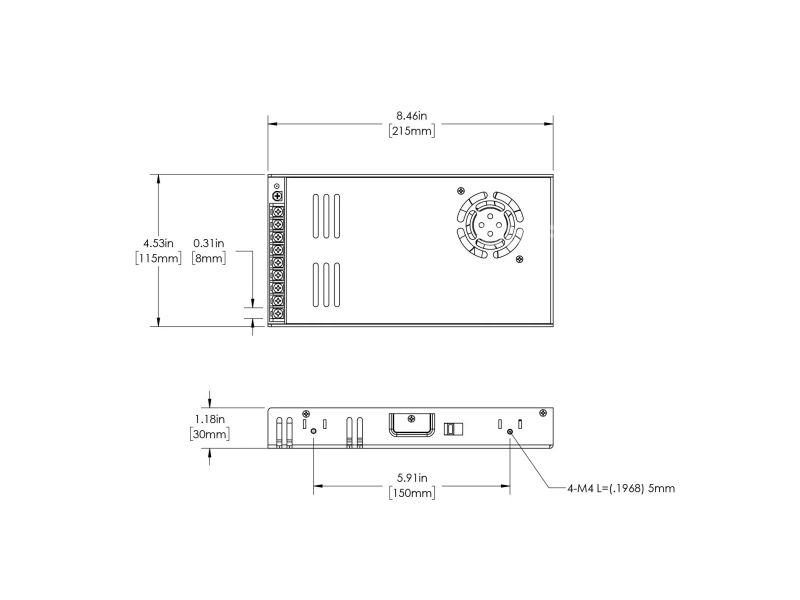
Same 215 × 115 — 30 mm case as the LRS-200; airflow direction is marked on the mechanical drawing
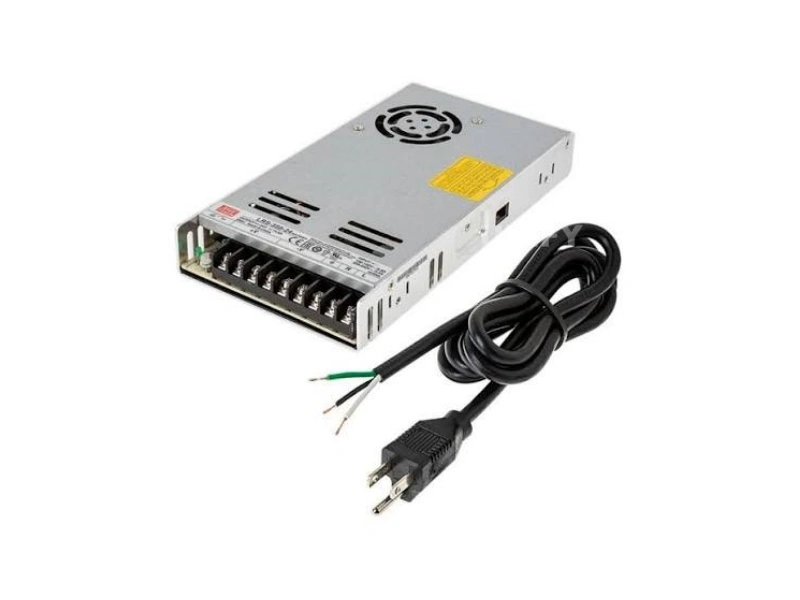
Fan grille on the top face, 9-pin terminal row along the front edge
Three field notes most listings skip
First, the fan is a maintenance part: it is the only moving component in the LRS line, and a dust-choked fan quietly converts the full-load-to-70°C promise back into a derating curve — periodic cabinet filter checks apply. Second, the peak-load clause stays voltage-specific: 150% for 1 second on the 12–48 V models only, not on the 3.3/4.2/5 V screen rails. Third, efficiency drops as voltage drops — 79.5% on the 3.3 V model against 89% at 48 V — so a wall of 3.3 V supplies burns measurably more watts per delivered watt than the same count at 24 V.
Which Mean Well LRS-350 Voltage Should You Order?
The eight models split into the same two families as the LRS-200, with bigger numbers:
3.3 / 4.2 / 5 V at 60 A — the screen bus
5 V feeds standard LED display modules at whole-cabinet scale (300 W rated, 240 W usable); 4.2 V serves common-cathode LED rails at 252 W; 3.3 V covers low-voltage designs. Against the LRS-200’s 40 A rails, one LRS-350 low-voltage unit replaces one and a half.
Trim discipline carries over unchanged: the +ADJ pot compensates cable drop inside the model’s window (4.5–5.5 V on the 5 V unit), it does not convert between voltage classes. On the 4.2 V rail the trim window matters doubly, because common-cathode screens ride their LED bus close to the limit — the common cathode LED technology guide explains the architecture before any screw gets turned. And at 60 A the wiring rules from the LRS-200 get stricter, not looser — three terminals per pole are the minimum landing for that current, covered in the installation section.
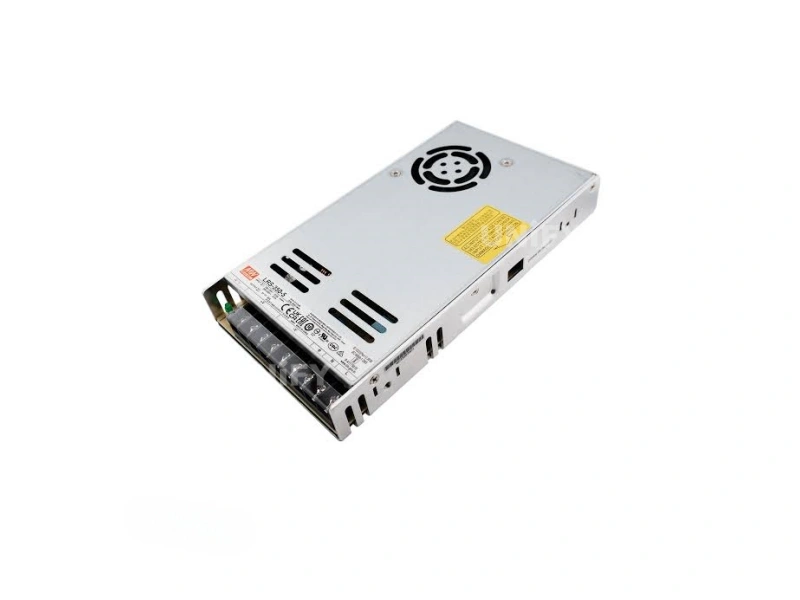
Same chassis across all eight voltages: fan grille top, terminals front, M4 flanges both sides
How Does the Mean Well LRS-350-5 Compare With the CZCL A-300AB-5?
The LRS-200-5 met the CZCL A-200AC-5 at 5 V / 40 A; the LRS-350-5 meets its big brother at 5 V / 60 A / 300 W — the exact rating of the CZCL A-300AB-5:
| Dimension | Mean Well LRS-350-5 | CZCL A-300AB-5 |
|---|---|---|
| Output | 5 V / 60 A / 300 W | 5 V / 60 A / 300 W |
| Cooling | Built-in fan, thermostatic 50°C on / 40°C off | Fan-cooled |
| Efficiency (published) | 83.5% (typ., datasheet) | Not stated (ask for batch data) |
| Protection character | Hiccup auto-recovery; 150% peak 1 s not on 5 V rail | Hiccup auto-recovery |
| MTBF (published, 25°C) | 328.6K h (MIL-HDBK-217F) | 200K h (MIL-217) |
| Working temperature | −25 to +70°C full load (fan) | −25 to +60°C |
| Input | 90–132 / 180–264 VAC by switch | 230 V-market window |
| Dimensions | 215 × 115 × 30 mm, 0.76 kg | 212 × 81.5 × 31.2 mm |
| Warranty | 3 years, serial-traceable | Project-dependent (ask with the quote) |
Same electrical job, two different bets. The LRS-350-5 bets on documentation: published efficiency, a published MIL-method MTBF figure that leads this pairing, the thermostatic fan holding full load to 70°C, the 115 V input switch, and global distribution at a public street price with a 3-year warranty. The A-300AB-5 bets on integration: a slimmer 81.5 mm-deep body that squeezes into narrower cabinets, and the CZCL harmony that the screen-side family — hubbed at the CZCL power supply collection, with the A-300AB-5 spec’d on its own page at CZCL A-300AB-5 LED switching power — has proven across rental and fixed installs. On the EU compliance point from the section below, neither unit’s harmonic story is clean here: the LRS-350 by Note 10, the A-300AB-5 only by its EN 61000-3-2 reference — check the project’s classification before promising either.
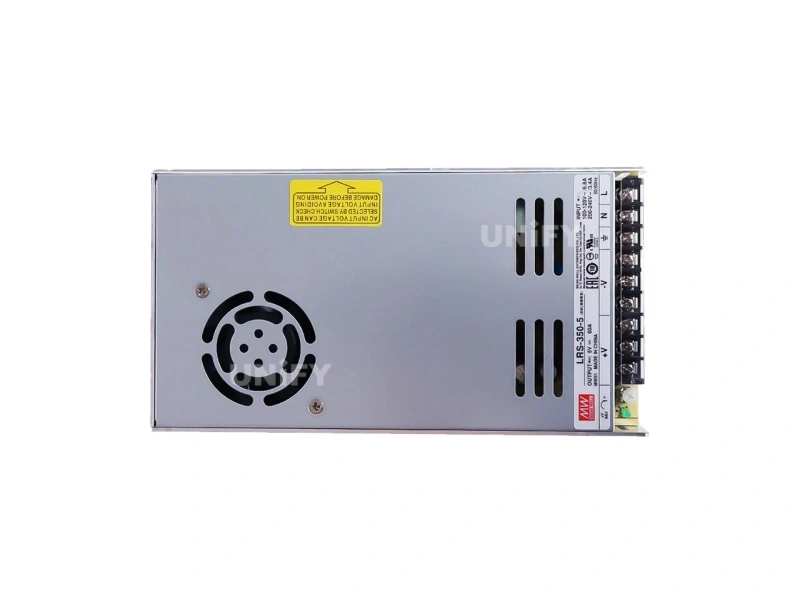
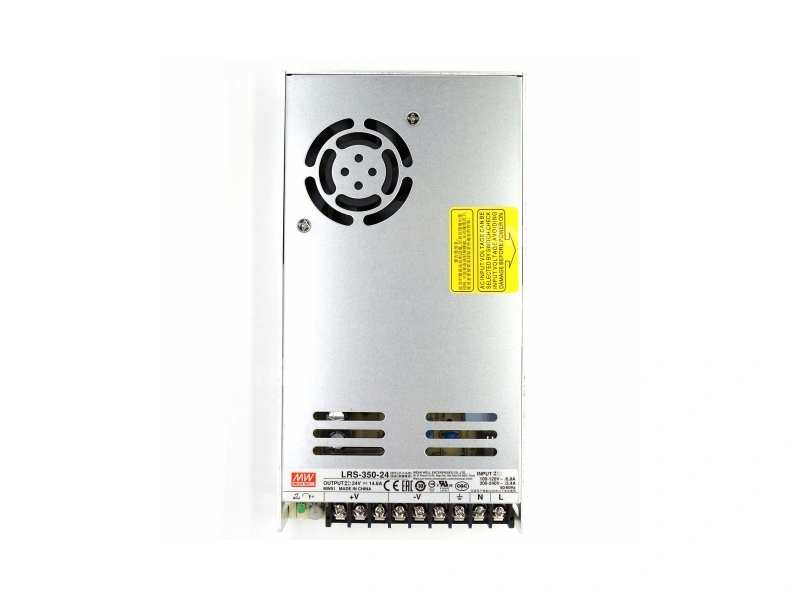
LRS-350-5: 5 V • 60 A • 300 W on the label
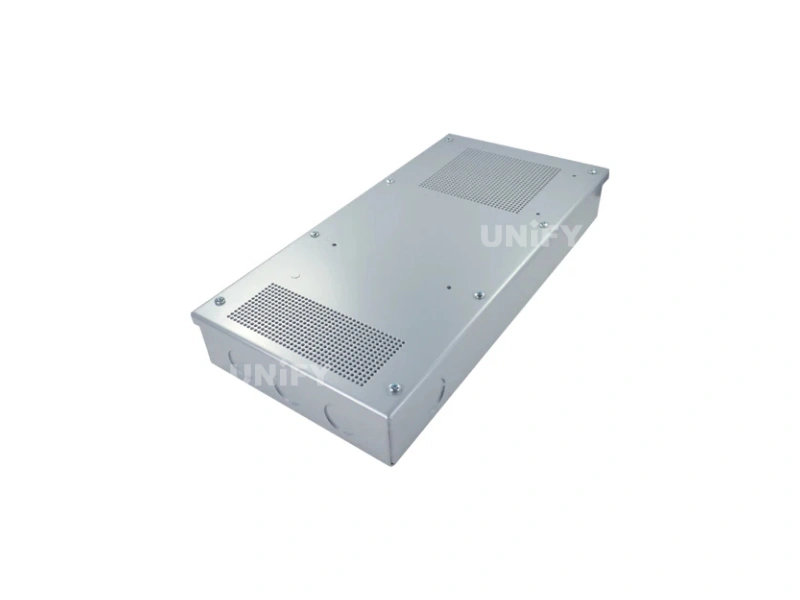
Base plate of the 5 V model: ventilation grid and mounting holes
How Does the Mean Well LRS-350 Fan Cooling Work?
The fan is the whole point of the model, so it is worth knowing exactly how it behaves. The control is thermostatic, tied to an internal sensor (RTH3): fan on at 50°C, fan off at 40°C. In a cool, ventilated cabinet the unit runs silent and convection does the work; as internal temperature climbs past 50°C the fan spins up on its own — no user setting, no jumper. That is what buys the headline spec: full rated load from −25 to +70°C ambient, where the convection-cooled LRS-150 and LRS-200 must derate at the hot end.
What the fan buys you
350 W in a 30 mm profile with no high-temperature cliff — sealed summer cabinets and vehicle engine-adjacent mounts keep their nameplate power instead of sliding down a curve.
What the fan costs you
One moving part: dust load on the blades quietly erodes the full-load promise, and a seized fan ends in the overtemperature protection — on the 3.3–36 V models a self-recovering hiccup, on the 48 V model a latch-off. Cabinet intake filters and an annual look inside are the maintenance price.
The teardown shows how little space the fan actually occupies behind the grille:
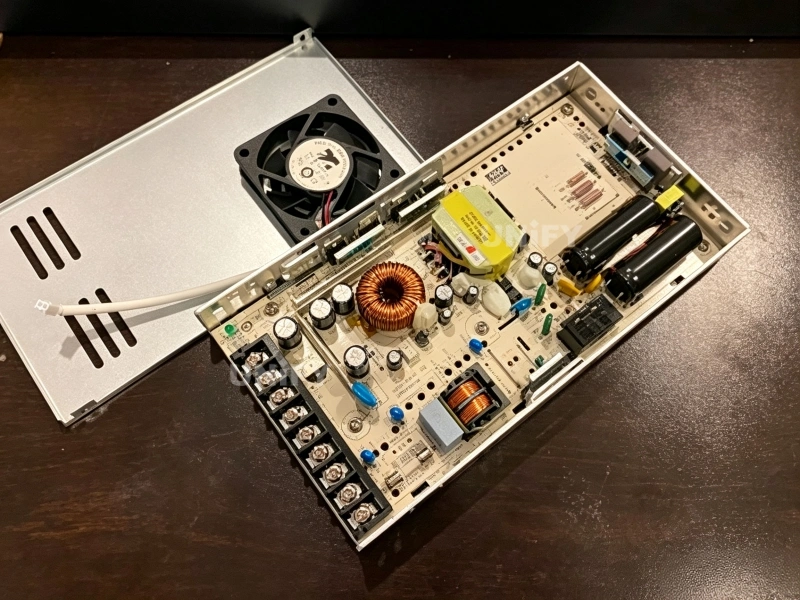
Inside the LRS-350: the DC fan sits at the short end, airflow crosses the sink toward the terminal edge
Respect the airflow direction when you mount it — the mechanical drawing marks the path, and blocking either end converts the fan’s work into noise and a hot spot rather than cooling. The 5 G vibration rating means the fan bearing is qualified for vehicle and pole mounts, but dust load, not vibration, is what kills cabinet fans in the field.
How Much LED Load Can a Mean Well LRS-350 Carry?
Apply the 80% rule to each model’s rated power:
| Model | Rated | 80% usable power | Usable current |
|---|---|---|---|
| LRS-350-3.3 | 198 W | 158.4 W | 48.0 A at 3.3 V |
| LRS-350-4.2 | 252 W | 201.6 W | 48.0 A at 4.2 V |
| LRS-350-5 | 300 W | 240 W | 48.0 A at 5 V |
| LRS-350-12 | 348 W | 278.4 W | 23.2 A at 12 V |
| LRS-350-15 | 348 W | 278.4 W | 18.56 A at 15 V |
| LRS-350-24 | 350.4 W | 280.3 W | 11.68 A at 24 V |
| LRS-350-36 | 349.2 W | 279.4 W | 7.76 A at 36 V |
| LRS-350-48 | 350.4 W | 280.3 W | 5.84 A at 48 V |
The five ecosystem voltages converge on 278–280 W usable — effectively one number to remember. On the screen bus, the 5 V model’s 240 W usable budget covers what two LRS-200-5 units carry, and a module string drawing 300 W wants two LRS-350-5 units on separate groups, never one at 100%. The screen-level arithmetic is worked through in the LED display power consumption guide and the per-cabinet counting method.
And the recurring honesty note: 150%-for-1-second peak capability remains a 12–48 V feature. The 3.3/4.2/5 V rails ride the ordinary 110–140% hiccup band — size module buses against the 240 W figure, not the 450 W peak story.
What Protections and Certifications Does the Mean Well LRS-350 Carry?
Short circuit and overload pulse in hiccup mode and recover automatically; overvoltage and overtemperature split by voltage class exactly as on the LRS-200: 3.3–36 V models pulse and self-recover, the 48 V model latches off until a re-power cycle. Isolation is 3.75 kVAC input-to-output with 100 MΩ insulation resistance — the official measurement method:
Compliance note the datasheet puts in writing — and most listings leave out
Identical to the LRS-200: per datasheet Note 10, the LRS-350 does not meet BS EN/EN 61000-3-2 harmonic-current limits, restricting EU public-grid use at 220 V or greater where the supply delivers more than 75 W continuously or forms part of a lighting system. Industrial cabinets, professional equipment and display systems outside the lighting classification remain the intended applications; EU lighting work belongs on the LRS-150 or a PFC-equipped series such as the CZCL A-400JQ-5P LED switching power.
Safety approvals mirror the LRS-200 — IEC/UL 62368-1, BS EN/EN 61558-1/-2-16, GB 4943.1, BIS, BSMI, EAC — an industrial/AV list without the household-appliance approval the LRS-150 carries. Ripple and noise is 150 mVp-p through 15 V and 200 mVp-p from 24 V up.
How Do You Install and Wire a Mean Well LRS-350 Safely?
The 9-pin block matches the LRS-200: pins 1–2 are AC L/N, pin 3 is FG, pins 4–6 are −V and pins 7–9 are +V. At 60 A the three-terminals-per-pole rule is not a recommendation — it is the only correct landing for that current.
1Set the input switch first. Confirm the 115/230 selector matches the grid before first energization — same failure signature as every LRS: dead at 230-position-on-115 V, damaged on the reverse.
2Mount with the airflow. All four M4 flanges, metal-to-metal, and the marked airflow direction kept clear at both ends — the fan needs an intake and an exhaust, not a shelf.
3Earth FG first. Ground, then L/N, then DC — the FG terminal carries the EMI filter return and the chassis bond.
4Spread the DC bus across all three terminals per pole. At 60 A, land the bus across pins 4–6 and 7–9 fully; twist and shorten the pairs.
5Verify unloaded, then load. Energize bare, meter the output against the +ADJ marking, then connect the cabinet — the verification habit in our replacement video below.
6Plan the fan service. Note the fan access when designing the enclosure — the unit that is easiest to blow out with compressed air at annual service is the unit that keeps its full-load rating. Enclosure planning sits in the LED screen cabinet guide.
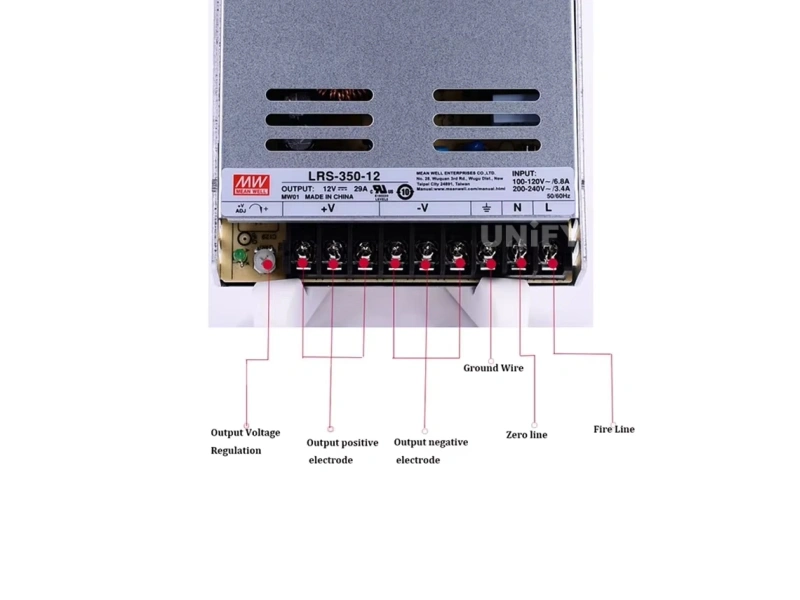
Terminal map on the LRS-350-12: ADJ, +V triple, −V triple, ground, N, L
How Does the Mean Well LRS-350 Compare With the LRS-150 and LRS-200?
The three-stage family picture, one table:
| Dimension | LRS-350 | LRS-200 | LRS-150 |
|---|---|---|---|
| Voltages | 8: 3.3–48 V | 8: 3.3–48 V | 5: 12–48 V (no 5 V) |
| Rated power | 198–350.4 W | 132–212.4 W | 150–158.4 W |
| Low-voltage rails | 60 A (5 V = 300 W) | 40 A (5 V = 200 W) | none |
| Cooling | Built-in fan, 50°C on / 40°C off | Convection | Convection |
| Full-load temperature | −25 to +70°C | −25 to +70°C (derates) | −30 to +70°C (derates) |
| Hold-up time (230 VAC) | 16 ms (typ.) | 16 ms (typ.) | 40 ms (typ.) |
| MTBF (MIL-HDBK-217F) | 328.6K hours | 279.4K hours | 558.2K hours |
| EN 61000-3-2 / EN 60335-1 | Not met / not covered | Not met / not covered | Class A ≤75% / covered |
Read as a decision path: need the 5 V module bus at cabinet scale — or full 350 W without a derating cliff — the LRS-350 is the pick, with the fan-service caveat. Need the screen bus at 40 A or auxiliary power in a silent sealed cabinet, the LRS-200. Pure 12–48 V auxiliary work in EU-visible installs, the LRS-150 stays the compliance-safe choice. MTBF crosses over at the top: the LRS-350’s 328.6K figure beats the LRS-200’s 279.4K, though both trail the convection-cooled 150 — fan models carry moving parts, and the reliability math says so.
What Problems Does a Failing Power Supply Cause?
Fan-cooled supplies add one failure mode the convection models do not have — here is the symptom map:
🌻 A unit that used to stay silent now runs its fan constantly
Internal heat rising earlier than it used to — aging electrolytics or dust-choked fins. Still within spec, but on borrowed time: schedule service before the season peaks.
⚡ Trips that clear with a power cycle (48 V model)
The latch-off behavior on overtemperature or overvoltage. If a 48 V rail keeps latching, check the fan and airflow first — the protection is telling you about heat before it tells you about hardware.
💡 Module rows dimming or flickering
Rail sag or hiccup pulsing under load — map it with the flickering and uneven brightness guides before touching the +ADJ screw.
The replacement workflow — isolation, metering, swap, verification — on an indoor screen cabinet, start to finish:
The full written procedure is in the power supply diagnostics and replacement guide.
How Much Does the Mean Well LRS-350 Cost?
Standard catalog part, public street price — stable against the 2026 component-cost story in the LED display supply chain price surge analysis:
| Model | Unit price (qty 1) | Volume price | Source |
|---|---|---|---|
| LRS-350-5 | $29.50 | $31.64 tier at 30+ (plan pricing) | WiredWatts / Sinaplug (US) |
| LRS-350-24 | $32.10 | Tiered by qty | Mouser (US) |
The bracket runs $29.50–$39 across channels. The per-watt arithmetic from the CZCL power supply price guide: at $29.50 for the 5 V model’s 300 W rated, an LRS-350-5 costs about 9.8 cents per rated watt; the 24 V model at $32.10 for 350.4 W lands near 9.2 cents. Between the LRS-200’s 12.3–15.5 cents and this 9.2–9.8 cents, the family price curve bends your way exactly where the power rises — the fan-cooled top of the line is also its cheapest power per watt.
Buying caution unchanged: verify the serial number on the MEAN WELL website before deployment — the LRS line is the most cloned series in the segment, and at 60 A a counterfeit isolation barrier is a fire inspection waiting to happen.
Mean Well LRS-350: Frequently Asked Questions
Does the Mean Well LRS-350 have a 5 V output for LED display modules?
Yes – the LRS-350-5 delivers 5 V at 60 A (300 W rated), the whole-cabinet module-bus rating. The series also carries 3.3 V and 4.2 V at 60 A, so all three screen-side rails double the LRS-200’s 40 A on the same footprint.
When does the LRS-350’s fan turn on and off?
Thermostatically: on at 50 degrees C internal temperature, off at 40 degrees C. In a cool cabinet it stays silent; in a hot one it manages itself. The control is what holds full rated load across the entire -25 to +70 degrees C window without derating.
Is the 150% peak-load capability available on the 5 V model?
No. Datasheet Note 7 scopes the 150%-for-1-second capability to the 12-48 V models. The 3.3/4.2/5 V rails ride the ordinary 110-140% hiccup band – size module buses against 240 W usable at 5 V, not against peak figures.
Why does the datasheet say the LRS-350 does not meet EN 61000-3-2?
Note 10, identical to the LRS-200: the series does not meet the harmonic-current limits, restricting EU public-grid use at 220 V or greater where the supply delivers more than 75 W continuously or forms part of a lighting system. EU lighting work belongs on the LRS-150 or a PFC-equipped series; industrial cabinets and display systems outside the lighting classification are the intended applications.
What happens if the LRS-350’s fan fails?
Internal temperature climbs until the overtemperature protection acts – a self-recovering hiccup on the 3.3-36 V models, a latch-off needing a re-power cycle on the 48 V model. A dust-choked fan erodes the full-load rating gradually; a seized one ends in protection trips. Annual compressed-air service keeps both away.
How should the 60 A output be wired?
Across all three terminals per pole – pins 4-6 are -V and pins 7-9 are +V on the 9-pin block. Landing 60 A on a single screw terminal is a heat failure in the making; the three-terminal spread exists precisely for this current.
How do I choose between the LRS-350, LRS-200 and LRS-150?
Follow the bus: 5 V module bus at cabinet scale or full power with no thermal cliff – LRS-350. Screen bus at 40 A or silent sealed-cabinet auxiliary power – LRS-200. Pure 12-48 V auxiliary work in EU-visible installs where harmonic and household compliance matter – LRS-150. All three carry the 3-year warranty.
How does the LRS-350-5 compare with the CZCL A-300AB-5 in reliability terms?
Under the MIL-HDBK-217F method at 25 degrees C the LRS-350-5 publishes 328.6 thousand hours minimum against the A-300AB-5’s 200 thousand – and the LRS-350-5 adds a published efficiency figure (83.5%) and full load to 70 degrees C against the CZCL’s 60. The CZCL counters with a slimmer cabinet profile and EU-market harmonic compliance. Compare within one method and decide on fit.
Related Power Pages and Guides
Mean Well LRS-200 (5 V / 40 A)
The convection-cooled sibling with the same eight voltages at 40 A – the silent-cabinet pick.
Mean Well LRS-150 (12–48 V)
The compliance-safe auxiliary pick: longer hold-up, EN 61000-3-2 Class A, household approval.
CZCL A-300AB-5 (5 V / 60 A)
The same-spec CZCL rival: slimmer body, fan-cooled, hiccup auto-recovery.
Power Supply Diagnostics & Replacement
From symptom to swapped unit: isolation, metering and verification workflow.
LED Display Power Supply (Mother Catalog)
The three-brand mother catalog: 27 model pages, 2026 price bands, architecture map and the 80% load math — start here.
UnifyLED LED Display Solutions
The full build picture: indoor and outdoor screens, control systems, cabinets and power architecture.
Need Mean Well LRS-350 Units for Your Project?
Tell us the load list, grid voltage and target market – we will confirm the voltage class, the EU compliance fit, and quote genuine serial-traceable stock with the 3-year warranty intact.