
COB LED Display Price 2026: A Price War on One Side, Price Hikes on the Other — Full Data and Buyer’s Guide
In 2026 the COB LED display price curve split in two. In March, TCL listed its 163-inch 4K MicroLED displays at $36,500 and $51,000 — roughly 70% below its own 2024 MicroLED pricing — igniting what industry analysts call the segment’s first true price war. On August 1, Leyard raised its entire COB product line by 5–10%, explicitly blaming PCB and driver IC costs. Between those two dates, close to 100 companies across the LED display supply chain filed price adjustment notices. This report compiles the two price forces, the Futuresource and Hangjianet forecasts behind them, the August 2026 COB launch wave, and a pricing checklist for buyers quoting either technology this year.
Short answer: COB LED display prices are moving in two directions in 2026. MicroLED-scale COB pricing is falling fast — TCL’s 163-inch 4K panels at $36,500 and $51,000 sit roughly 70% below 2024 levels — while commercial COB lines are rising 5–10% (Leyard, effective August 1) on IC and PCB inflation. Futuresource projects COB average selling prices down 30% by mid-2026 as production scales and a 57% share of the fine-pixel LED market by 2029. Hangjianet forecasts COB shipments of 220,000–240,000 m² per month by 2030, with P1.5-and-larger pitches taking 60% of volume.
What Is Driving the COB LED Display Price War in 2026?
A MicroLED display is a direct-view display built from unpackaged micro-scale LED chips, most often assembled in COB or COG form. The 2026 price war opened at InfoComm China in March, where TCL priced the Max163M at about $36,500 and the Max163M Pro at about $51,000 — a cut invidis characterized as a “MicroLED price shock” and roughly 70% below TCL’s 2024 MicroLED positioning. Analysts read the move as a direct challenge to the premium tier held by Samsung, LG, and Sony: the first time MicroLED has been priced as a mass-market product rather than a luxury one.
The same company then did the opposite at the commercial end. TCL Commercial Display issued a May 29 notice raising its COB series prices from June 1, citing higher LED bead, PCB, and chip costs. Leyard followed the same logic: a June 2 notice raised most LED display products 3–15%, and a July round raised the entire COB line 5–10% from August 1 — its SMD lines untouched — because “PCB and IC procurement costs continue to rise sharply.” Hangjianet tallies put the cumulative count near 100 companies with price notices by early July, some in their third or fourth round, with driver ICs and display control systems up 30–80% and terminal screen makers up 3–15%.
The defining detail: this hike cycle ran without strong end-market demand. It is cost-push, not demand-pull — the same mechanism documented in our 2026 LED display price surge and driver IC shortage reports. One company bucked the wave in the other direction: GQY Taiheng ran a limited 10%-off promotion in June while stating it does not compete as a price player. After the 2025 “volume-up, value-down” price war and 45-plus collective price corrections in H2 2025, concentration has risen sharply — Hangjianet puts the top four players above 65% share — and COB packaging took 52.1% of packaging sales value for the first time in 2026.
How Fast Is COB Replacing SMD in LED Displays?
COB (chip-on-board) is a packaging method that bonds bare LED chips directly onto the PCB and seals the module as one encapsulated surface — the architecture behind fine-pitch and MicroLED panels. The replacement rate is now measured in the tens of percent per year. Futuresource projects COB and COG together will take 57% of the fine-pixel LED market by 2029, up from a market where packaged LEDs (SMD, IMD, MiP) held more than 92% of shipments in 2024. The split by pitch is sharp: unpackaged formats win at P1.6 and below; packaged formats hold at P1.7 and above, where outdoor and rental economics still favor SMD.
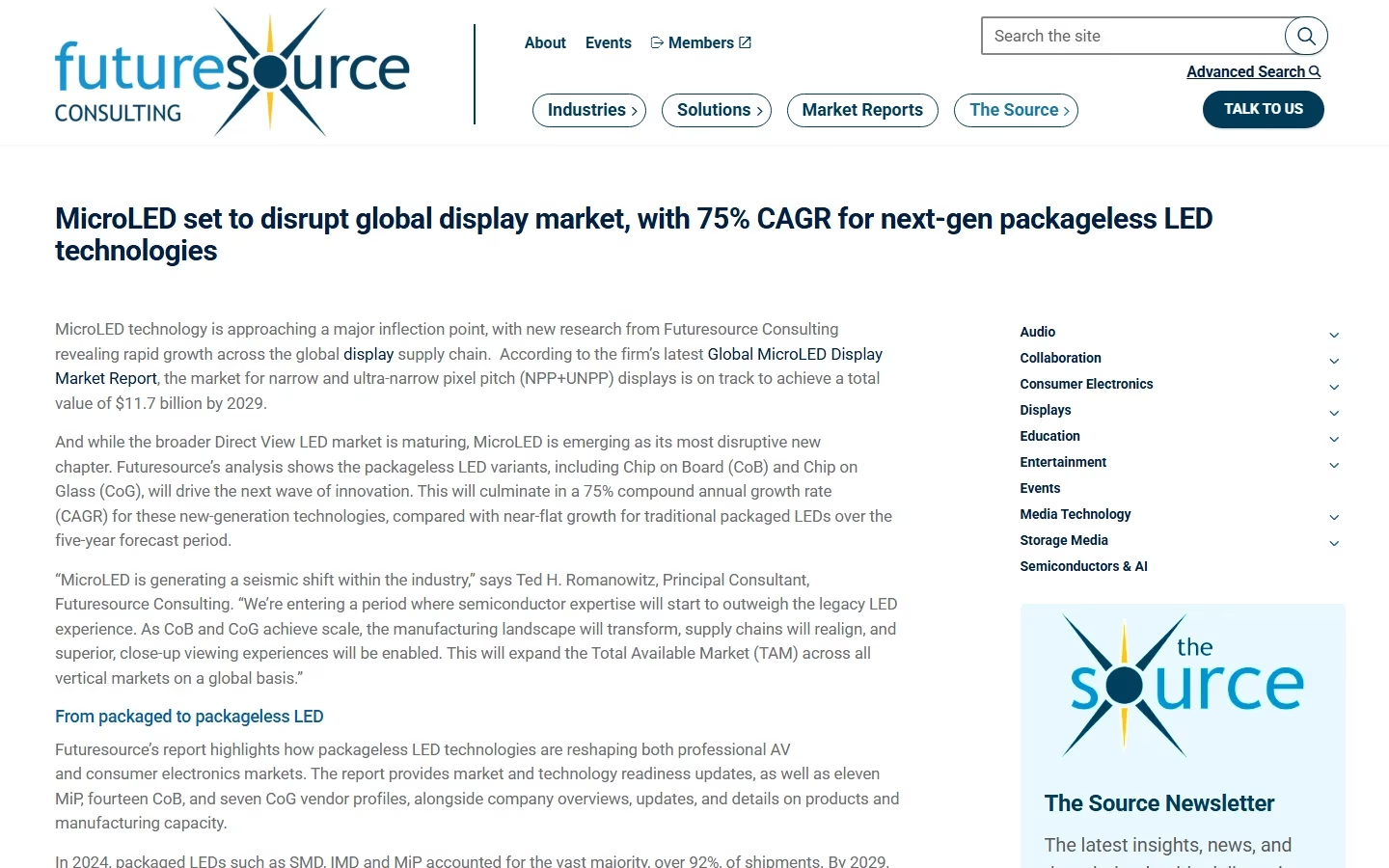
The financial curve is steeper. Futuresource forecasts COB at 66% CAGR to $5.1 billion by 2029, COG at 172% CAGR to $1.5 billion (small-batch in 2026, volume from 2029), and packageless technologies overall at 75% CAGR against near-flat growth for packaged LEDs. The narrow and ultra-narrow pitch market reaches $11.7 billion by 2029, inside a global LED display market growing 14.8% annually to $16.8 billion. Futuresource’s Ted Romanowitz calls the shift “a massive transformation.” A milestone passed quietly in 2025: flip-chip LEDs outsold traditional wire-bond LEDs for the first time.
Hangjianet Research’s COB/MiP report grounds the trend in shipment data: COB demand ran about 35,000 m² per month in 2025 (P1.2 leading at 17,000 m²), and its researchers project 220,000–240,000 m² per month by 2030 — five to six times current volume — with P1.5-and-larger pitches taking 60% and COB plus MiP combined reaching nearly half the industry. In China, COB already holds more than 40% of the small-pitch market, and projected street pricing of 6,000–7,000 RMB/m² for P1.25 and under 10,000 RMB for P0.9 is being called the segment’s consumerization tipping point. Five differences define what buyers are really paying for between the two technologies:
- Cost: a P1.2 SMD screen costs roughly 60% of a comparable COB solution today — but the gap narrows with every pitch step downward.
- Durability: COB modules seal the chips under encapsulation, with roughly 10x impact resistance and IP54-level protection versus exposed SMD beads.
- Contrast and surface: COB with nano-black coating reaches 15,000:1 and reads as a continuous surface; SMD reads as point light sources at close range.
- Repair: SMD allows single-bead replacement on site; COB repairs at module level — a maintenance cost trade-off, not a quality one.
- Pitch economics: below P1.0, SMD manufacturing cost rises steeply while COB keeps scaling — the structural reason COB wins the sub-P1.6 market.
Why Are COB LED Display Prices Moving in Two Directions at Once?
The two curves come from two different cost systems. Commercial COB prices in 2026 are carried upward by the same inputs inflating every LED display price hike: driver ICs up 30–80%, PCBs tied to record copper, packaging tied to gold and silver. That is a spot-market cost curve, and it hits every manufacturer buying month to month.
MicroLED pricing runs on a different curve — capacity. Panel giants HKC, BOE, and TCL CSOT have moved into COB/MicroLED at display-factory scale; TCL CSOT’s Suzhou MLED base has installed equipment covering P0.7 to P2.6, a “capacity for share” play that converts panel manufacturing economics into display pricing. Industry reporting puts mass-transfer yields at 99.99% or higher, and Futuresource expects COB average selling prices to fall 30% by mid-2026 as this capacity ramps. The result visible in August 2026: the premium end of the market deflates while the working commercial end — P1.2–P1.5 fixed installs — carries 5–10% cost-push increases. For a buyer, the practical meaning is that quoting both technologies against one project is now standard procedure, because the crossover point moves quarterly.
What Do the August 2026 COB LED Display Launches Reveal About the Next Buying Cycle?
Six manufacturers — Unilumin, Leyard, Absen, Ledman, Zhongqi Optoelectronics, and SightLED — launched COB and MicroLED products in August 2026, and the specifications show where the next price battle will be fought. Common-cathode driving is a drive architecture that powers red, green, and blue chips at separate supply voltages matched to each color, reducing wasted power; it is now the default claim across the launch wave. Unilumin’s UminiP Pro posts 10,000:1 contrast and 99% brightness uniformity, with RGB flip-chip common-cathode design saving 8% energy versus common-anode COB, a 4 kg cabinet at 39.75 mm, and 15–30 day delivery on standard models. Leyard’s TWM series pairs full flip-chip COB with common-cathode driving and its own film materials, holding panel temperature at or below 38°C after two hours at 600 nits in a 25°C room, in a 29.5 mm die-cast cabinet with 90° seamless corners. Absen’s KLCOB V3 — successor to a series with over 2 billion RMB in single-product sales — claims a 40% cut in full-lifecycle cost across image quality, safety, deployment, and energy.
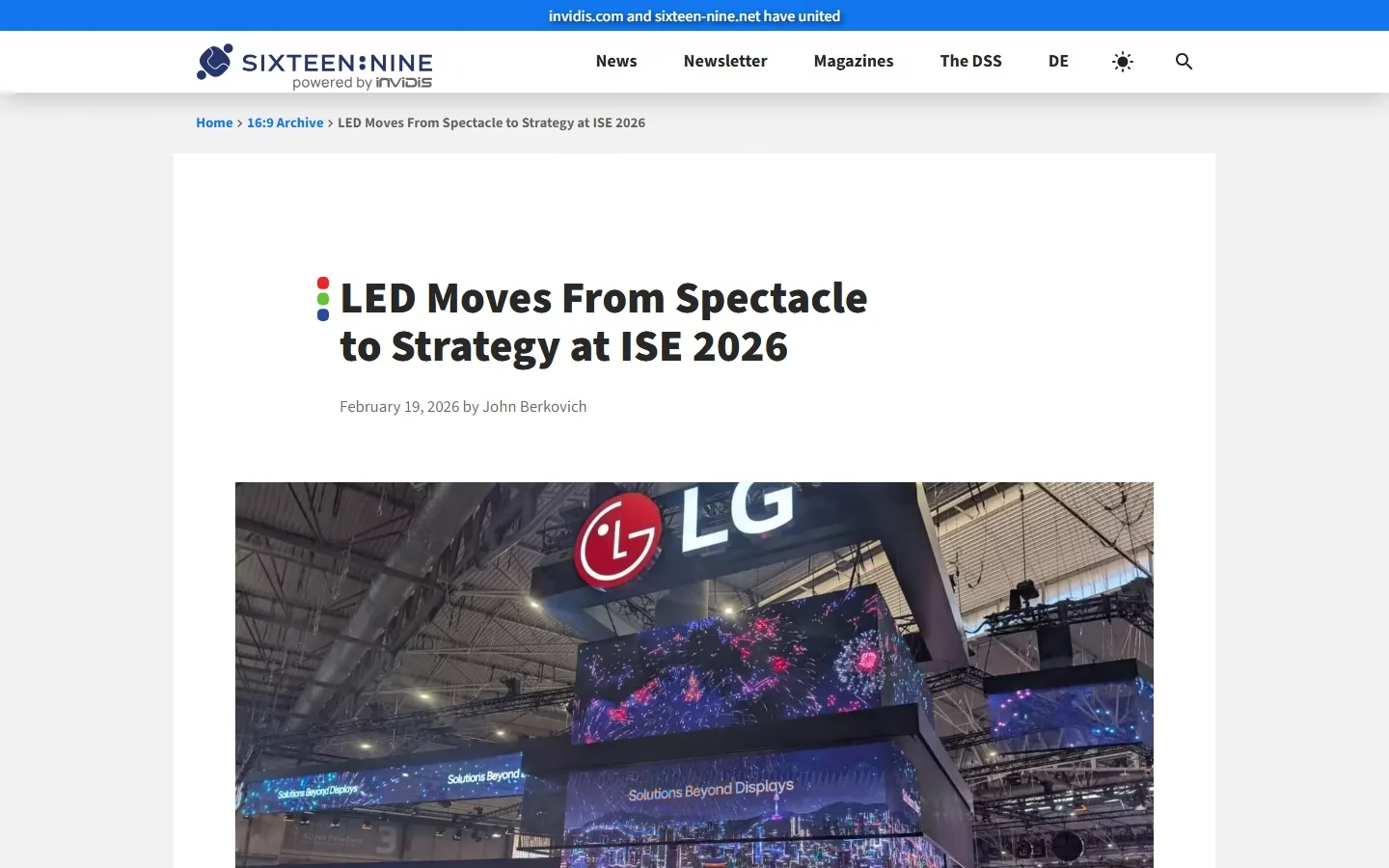
The pattern extends beyond China. At ISE 2026, SiliconCore showed 0.9 mm and 1.2 mm COB displays with Common Cathode IQ architecture cutting energy 10–40% versus comparable COB and up to 50% versus traditional SMD, and LG showed a 136-inch COG Active MicroLED at 1,444 Hz — invidis summarized the shift as LED moving “from spectacle to strategy,” with buyers now evaluating total cost of ownership, power draw, and servicing models ahead of raw brightness. For procurement, the August wave sets the 2027 spec baseline early: energy and thinness joined pitch and price as bid-defining parameters.
How Should Buyers Compare COB and SMD LED Display Prices in 2026?
A factory-direct COB LED display manufacturer is a supplier that runs its own bonding, calibration, and aging lines, quoting project owners without reseller markup. With prices moving in two directions and inputs inflating monthly, five checks separate a usable quotation from a paper one:
- Check the pitch boundary first: below P1.6 indoors, COB is the structural winner; for outdoor and rental at P1.7 and above, SMD still leads on brightness and cost.
- Demand a price-per-square-meter with a cost-component breakdown: with driver ICs up 30–80%, a lump-sum quote hides which inputs are floating.
- Confirm the maintenance model in writing: COB means module-level swaps and factory recalibration; SMD means on-site bead replacement — budget each model for the project’s operating life, not just install day.
- Compare energy, not just purchase price: common-cathode COB saves 8% or more versus common-anode designs — over a 24/7 control-room wall, that line item compounds.
- Lock pricing validity and verify pre-stocking: quotes without a stated validity window, or suppliers buying ICs on the spot market, carry the August 2026 hike risk directly into your project.
Unifyled operates as a source manufacturer across both technologies — SMD, COB, and GOB — with pre-stocked receiving cards, hub cards, and driver ICs at pre-escalation pricing, long-term volume agreements with PCB fabricators and LED packaging houses, and in-house SMT, calibration, and aging lines. For fine-pitch indoor projects, our indoor LED wall engineering team quotes COB and SMD options side by side against one specification, so buyers see the crossover point in their own project numbers instead of a vendor’s. For outdoor and rental LED screens, SMD economics still carry the day — and the same factory-direct cost structure applies.
Get a COB vs SMD Price Comparison for Your Project — Submit Your RFQ
Send your pitch, size, and operating hours, and Unifyled’s engineering team will return a side-by-side COB and SMD quotation with cost-component breakdowns and firm validity periods — before the next price notice lands. Covering outdoor fixed LED displays, fine-pitch indoor walls, conference LED display solutions, and factory-direct manufacturing.
Contact: unifyledscreen@gmail.com | WhatsApp: +86-191-18802497 | RFQ Form: unifyled.com/contact
References & Sourced From: COB LED Display Price 2026 Coverage
This analysis draws on primary-source reporting, company price notices, and industry research. All figures have been cross-verified against at least two independent sources where available.
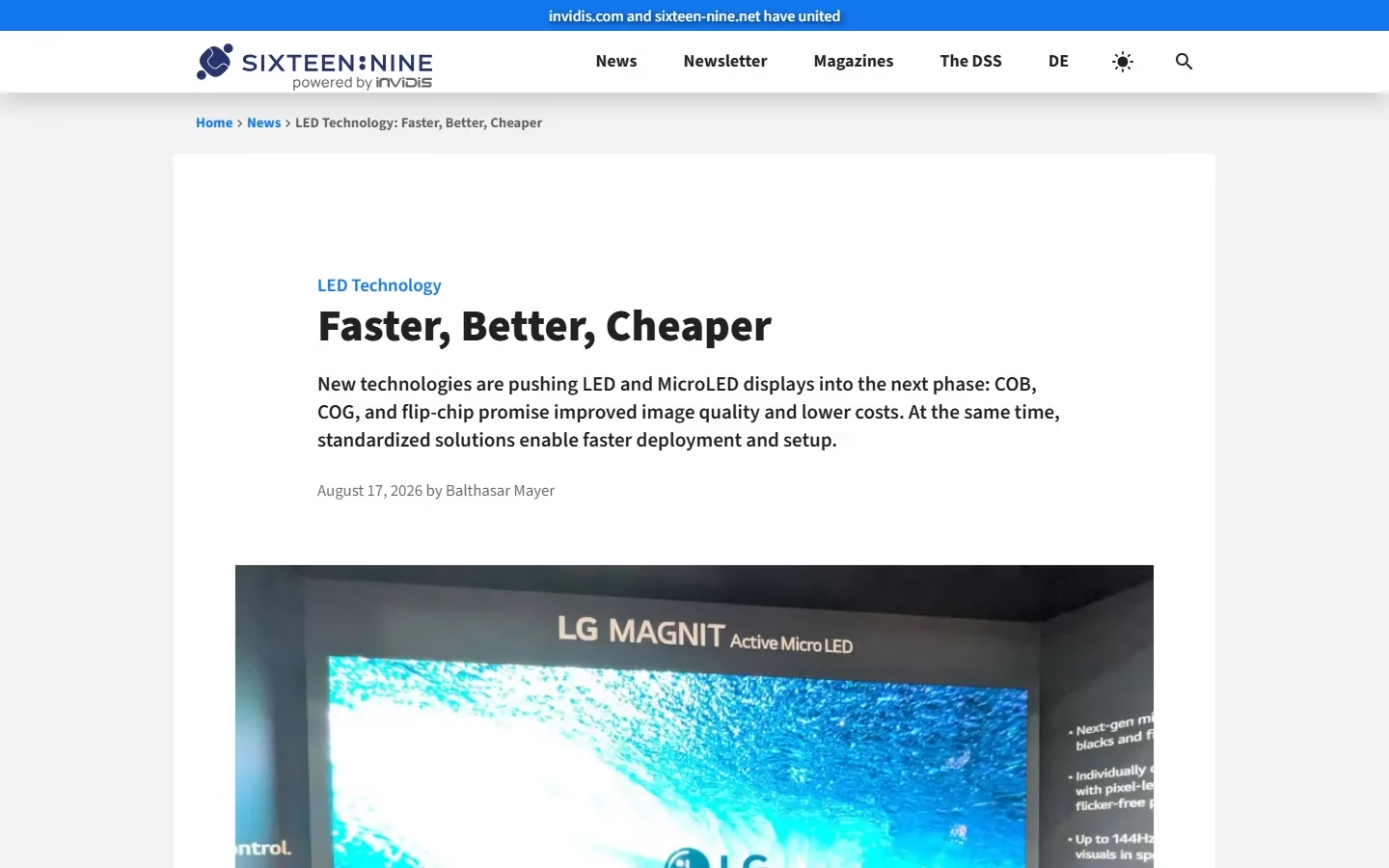
- invidis — “LED Technology: Faster, Better, Cheaper” (August 2026); “LED Moves From Spectacle to Strategy at ISE 2026” (February 19, 2026); “InfoComm China: TCL Ignites a MicroLED Price Shock” (March 2026). invidis.com
- Futuresource Consulting — “MicroLED Display Market Disruption Forecast with 75% CAGR” (2026); “Global LED Display Market Reignites Strong Growth 2029” (2026). futuresource-consulting.com
- Hangjianet Research (行家说 Research) — “《2026 COB/MiP显示调研报告(专刊)》”; industry price-notice tallies (June–July 2026). via OFweek
- OFweek Display — “2026H1复盘 | 影响LED显示产业走向的6大事件” (July 2026). display.ofweek.com
- LEDinside — “从应用拓展到规模化普及,谁在领跑MiniLED COB显示?” (April 30, 2026). ledinside.cn
- 洛图科技 (RUNTO) — “洲明、利亚德、艾比森六企推MicroLED、COB小间距新品” (August 2026). lmtw.com
- Sina Finance / 行家说 — “12家LED显示相关企业宣布调价” (June 5, 2026); “7月再掀涨价潮,12家LED显示产业链企业发函调价” (July 2026). finance.sina.com.cn
- 投影时代 (PJTime) — “洲明全新发布 UminiP Pro 共阴 COB 小间距 LED 显示屏” (August 2026). pjtime.com
- SiliconCore — Enlighten COB Common Cathode IQ energy data, presented at ISE 2026, cited via invidis.
Editorial disclaimer: This report has been compiled by the Unifyled Editorial Team from publicly available industry sources, official company notices, and third-party research. Price data and company actions referenced herein reflect information available as of August 18, 2026. This article does not constitute financial or procurement advice. Readers should verify current pricing directly with manufacturers before making purchasing decisions.
Related: World Cup 2026 LED Displays: Stadium-by-Stadium Project Data · LED Cinema Screen 2026: Direct-View LED Overtakes Projection · LED All-in-One Display Market 2026 · LED Display Industry H1 2026 Earnings Roundup · CIOE 2026 LED Display Recap: Micro LED From Lab to Production Line