
4K vs 8K: Is 8K Worth It for TVs and LED Walls? (2026)
The 4K vs 8K question has two different answers in 2026, depending on which market you are buying in. In consumer TVs, 8K has effectively stalled — most major TV manufacturers have scaled back or abandoned their 8K lines, and the content to feed them never arrived. In LED walls, “8K” means something completely different: a pixel count achieved by tiling fine-pitch panels, driven by 4K-class inputs, because no LED controller on the market accepts an 8K signal at all. This article explains the pixel math behind both markets, the Warner Bros study that settled the human-vision question, and what 8K actually costs on each side. As an LED screen manufacturer, Unify LED builds the LED-wall side of this comparison — including the mosaic configurations that produce 8K canvases.
Short answer: For TVs, 8K is not worth it in 2026 — the content does not exist, most viewers cannot see the difference at normal distances, and manufacturers are walking away. For LED walls, “8K” is not a TV-style resolution at all: it is a large canvas of 33 million pixels built from fine-pitch panels and fed by 4K inputs through multi-controller mosaic. An 8K LED wall makes sense when the project needs a very large, very close-viewed canvas — not because 8K content is waiting to be shown.
How Do 4K vs 8K Compare at a Glance?
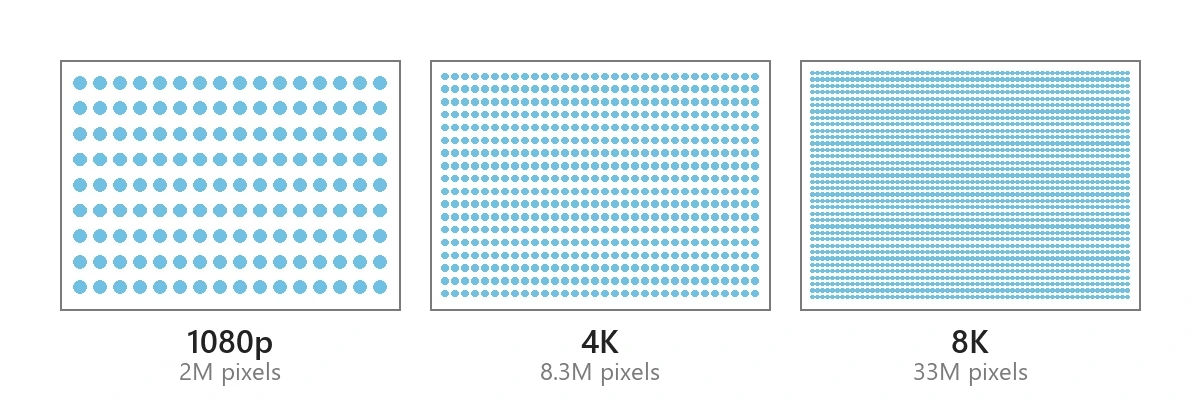
| Resolution | Dimensions | Total pixels | 2026 status |
|---|---|---|---|
| 1080p (Full HD) | 1920×1080 | 2.07 million | Rare in new TVs |
| 4K UHD | 3840×2160 | 8.29 million | The universal standard — streaming, Blu-ray, consoles |
| 8K UHD | 7680×4320 | 33.18 million | Abandoned by most TV makers; YouTube and PC gaming only |
Five differences do most of the deciding:
- Pixels. 8K has four times 4K’s pixel count — 33.18 million against 8.29 million — which is only visible as sharpness from very close distances.
- Content. 4K is the default everywhere; 8K native content is limited to YouTube videos and high-end PC gaming.
- Hardware. Every 4K device chain is mature; 8K needs premium panels, HDMI 2.1, and — on the LED side — multi-controller mosaics that no single input can feed.
- Price. 8K TVs carry a steep premium over equivalent 4K models; 8K LED walls are large fine-pitch projects priced per square meter.
- Direction. TV makers are leaving 8K in 2026; the LED industry uses 8K as a canvas-size label, not an input format.
What Do 4K and 8K Actually Mean?
4K is a resolution standard of roughly 4,000 horizontal pixels: 3840×2160 for consumer UHD televisions, and 4096×2160 for DCI cinema. It contains 8.29 million pixels and is the format nearly all modern content is mastered in.
8K is a resolution standard of roughly 8,000 horizontal pixels: 7680×4320 for 8K UHD televisions, and 8192×4320 for DCI 8K cinema. It contains 33.18 million pixels — four times 4K — and in 2026 it exists mostly on specification sheets: consumer 8K televisions are rare, and 8K native content is rarer. The fundamentals behind those numbers are in our LED screen resolution article.
Can You Actually See the Difference Between 4K and 8K?
The human-vision question was settled before 8K ever reached shelves. In Warner Bros’ 2019 double-blind study, conducted with the ASC and other industry bodies, 139 participants watched the same content on paired 4K and 8K displays — and most could not reliably tell the two apart at typical viewing distances. The 8K advantage appeared only on very large screens viewed from very close, which is exactly the configuration most living rooms never reach: the distance at which 8K’s extra sharpness becomes visible is roughly inside two meters for a 65-inch panel. Our LED display viewing distance article covers the same math for walls.
The result of that physics: 4K won the living room not because 8K was too expensive, but because at couch distance the extra 24 million pixels are invisible. Where they do become visible — giant screens, close viewing, workstation use — is where the LED wall version of 8K enters.
Why Have TV Makers Backed Away from 8K in 2026?
Follow the content. 4K is mastered into every streaming release, every UHD Blu-ray, and every console game; 8K has YouTube demo footage and a short list of PC titles, plus a handful of PS5 Pro games. A television format with no content survives on upscaling alone, and upscaling does not create detail — it interpolates it. On top of the content void, 8K panels cost substantially more than equivalent 4K models for a sharpness gain most viewers cannot see. The industry verdict landed in 2026: major manufacturers have largely abandoned 8K TV lines, and the independent press has said it plainly. 8K will return if content and cheaper panels ever arrive together; until then it is a specification, not a market.
What Does 8K Mean on an LED Wall?
On an LED wall, “8K” is a canvas size, not a signal format — and the distinction explains the entire market. No LED controller currently accepts an 8K@60 input: the ceiling across the industry is 4K@60 (HDMI 2.0/DP 1.2-class), as detailed in our 4K@60Hz, HDCP and HDR article. An 8K LED wall is therefore a 7680×4320 canvas of 33 million pixels that is fed by four 4K regions — typically four VX16S-class controllers linked in image mosaic, or one NovaPro UHD Jr processing an 8K×1K signal band. The wall displays 8K pixels; the source chain remains 4K.
In practice the wall is divided into quadrants: each controller owns a 3840×2160 region of the canvas, the four regions are synchronized into one picture, and the operator’s content — usually a 4K master scaled to the full canvas — is distributed across them. The operator never feeds “an 8K signal”; they feed four 4K signals that happen to form one 8K wall. That architecture is not a compromise — it is how large canvases have always worked, and NovaStar’s official splicing and mosaic walkthrough shows the configuration directly:
The bandwidth reality underneath: one HDMI 2.1 cable could theoretically carry 8K@60, but no LED controller has an HDMI 2.1 port — the interface story is in our HDMI vs DisplayPort vs DVI article.
How Many Pixels and How Much Space Does an 8K LED Wall Need?
The 33.18 million pixels of an 8K canvas translate into wall size through pixel pitch, and the math is sobering. At P0.9, each pixel occupies 0.81 square millimeters, so 33.18 million pixels need about 27 square meters — a wall roughly 7 by 3.9 meters for 16:9. At P1.2 the wall grows to about 48 square meters, roughly 9.2 by 5.2 meters. In other words, an “8K LED wall” is not a television with better resolution — it is a very large fine-pitch installation that happens to total 33 million pixels. The pitch-to-size relationship is covered in LED pixel pitch, and the fine-pitch product line behind these canvases is our fine pitch LED display series.
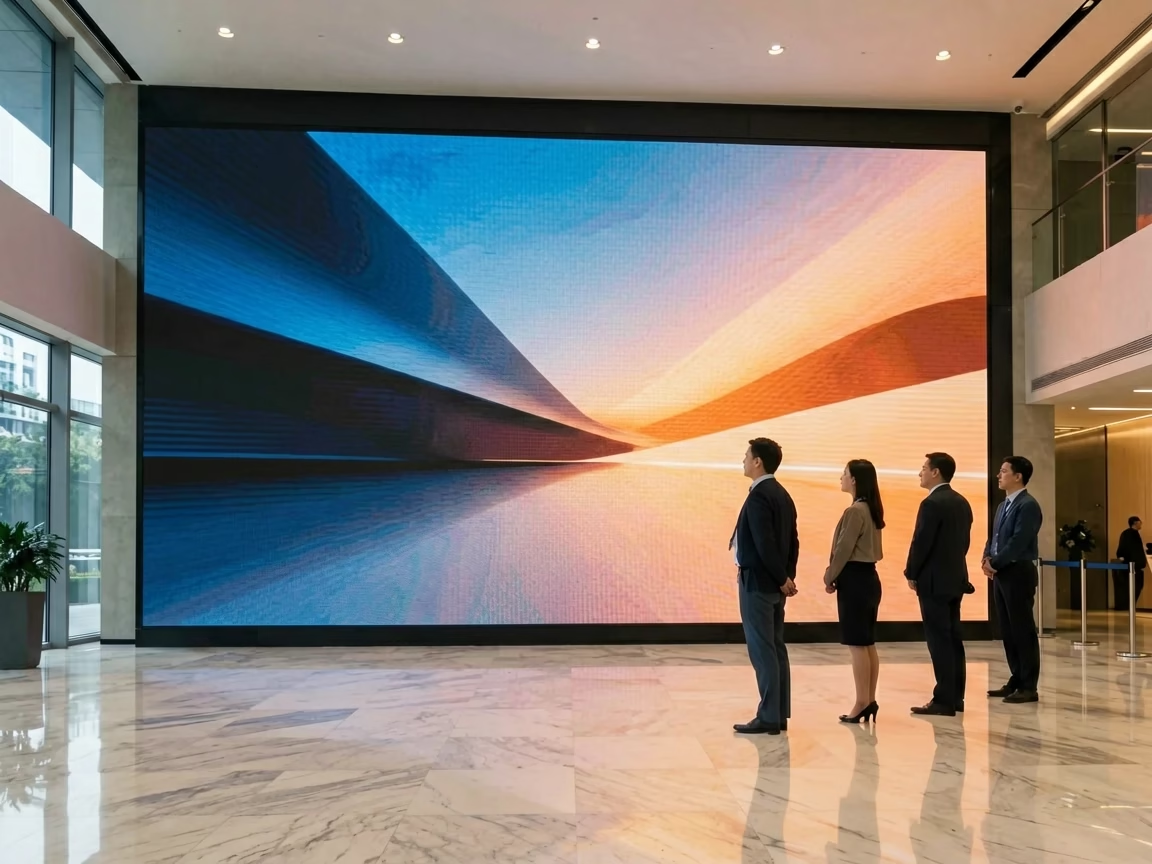
The practical decision follows: buy 8K because the wall must be that large and viewed that closely — a control room, a broadcast studio, an immersive attraction — not because an 8K label adds value by itself.
Where Does 8K Content Come From — and Where Does It Not?
Run down the sources and the 8K gap appears everywhere. Streaming: Netflix, Disney+, Apple TV+, and Prime Video top out at 4K — no major service delivers 8K. Discs: UHD Blu-ray is a 4K format with no 8K successor. Consoles: PS5 Pro supports 8K output but almost no games use it; Xbox and Switch 2 are 4K machines. That leaves YouTube, where 8K uploads exist mainly as camera demo footage, and PC gaming, where 8K is achievable only on very high-end GPUs. The asymmetry defines the market: a 4K screen plays everything ever mastered in the format; an 8K screen spends its life upscaling 4K. The HDR side of the same picture-quality story is in our HDR vs SDR article.
What Do 4K vs 8K Cost at Typical Sizes?
On the TV side, the premium is concrete: a capable 4K TV starts in the low hundreds of dollars and tops out in the low thousands for flagship OLED; 8K TVs begin where flagship 4K ends and climb from there — for a sharpness gain that the Warner Bros study says most viewers never see. The one TV niche where 8K earns its price is the workstation: CAD drawings, mapping software, and dense dashboards look measurably sharper at 8K pixel density, and that use case does not need 8K content to exist. On the LED side, the comparison is different in kind: fine-pitch walls are priced per square meter, and the P0.9-class panels an 8K canvas needs put the wall in the hundreds of thousands of dollars — a figure driven by the 27 to 48 square meters of fine-pitch surface, not by an 8K premium. In both markets the same rule holds: spend on 8K only when the size and viewing distance genuinely demand 33 million pixels.
What Do Buyers Frequently Ask About 4K vs 8K?
Is 8K worth it? For TVs in 2026, no — little content, high premium, and an invisible sharpness gain at normal distances. For LED walls, 8K is worth building only when the project needs a very large close-viewed canvas.
Can you see the difference between 4K and 8K? Only on large screens from close distances. Warner Bros’ double-blind study found most viewers could not distinguish the two at typical viewing distances.
Are 8K TVs dead? Effectively yes in 2026 — most major manufacturers have abandoned 8K lines while 4K remains the universal standard.
Is an 8K LED wall the same as an 8K TV? No. An LED wall reaches 8K by totaling 33 million pixels across fine-pitch panels and feeding them from 4K inputs through multi-controller mosaic. It is a canvas size, not an input format.
Can a PS5 Pro do 8K? The console supports 8K output, but very few games render at 8K — most titles run at 4K.
Does upscaling make 8K worth buying? Upscaling interpolates detail that was never captured; it improves a 4K picture but cannot create 8K information.
When will 8K come back? When 8K content, cheaper panels, and HDMI 2.1-class LED controllers arrive together. Until then, 4K remains the standard on both TVs and LED walls.
Is 8K better for gaming? In theory yes, in practice rarely. Rendering a game at native 8K requires a very high-end GPU, and even the PS5 Pro runs almost no titles at 8K. At desktop distances on a large monitor the extra sharpness is real; on a living-room TV at couch distance it is not.
4K vs 8K: Which One Should You Choose? Final Verdict
The 4K vs 8K decision in 2026 is decided before the spec sheet opens. For a television: 4K, without hesitation — it owns the content, the prices, and the human-vision math. For an LED wall: decide the size and the viewing distance first, and let the pixel count land where it lands; if the project genuinely needs 27 to 48 square meters of fine-pitch canvas viewed from close range, it will total 8K’s 33 million pixels on its own — and the correct next step is a mosaic and pitch consultation, not an 8K marketing label.
For LED wall projects where size, pitch, and resolution need to be matched to the room, send the dimensions and viewing distance through the Unify LED contact page — we will return the pitch, mosaic, and controller configuration that delivers the canvas the project actually needs.