
Mini LED vs Micro LED: What’s the Difference in TVs and LED Walls? (2026)
The Mini LED vs Micro LED comparison starts with a naming trap: Mini LED means two different things depending on which market you are in, while Micro LED means one thing everywhere. On a TV, Mini LED is a backlight — an LCD screen lit by thousands of tiny LEDs. In the LED display industry, Mini LED is a chip-size class used in COB fine-pitch modules — a direct-view product with no LCD involved. Micro LED is always the same: a self-emissive display where every pixel is a microscopic LED chip. This article separates the two Mini LEDs, compares each against Micro LED, and gives the buying rules for both markets. As an LED screen manufacturer, Unify LED builds the LED-wall side of this comparison — COB fine-pitch modules are the commercial form of Mini LED.
Short answer: For TVs, Mini LED is the sensible buy in 2026 — thousands of backlight zones deliver near-OLED contrast at LCD prices, while Micro LED TVs remain six-figure ultra-premium products. For LED walls, Mini LED in its COB module form is the commercial fine-pitch standard today, and Micro LED is the premium frontier with better contrast but much higher cost and limited availability. The rule that survives both markets: Mini LED is the technology you can buy today; Micro LED is the technology the industry is building toward.
How Do Mini LED vs Micro LED Compare at a Glance?
| Parameter | Mini LED (TV backlight) | Mini LED (LED wall module) | Micro LED |
|---|---|---|---|
| Architecture | LCD + LED backlight zones | Direct-view LED modules (COB/MIP) | Direct-view, self-emissive — every pixel is an LED |
| Chip size | ~100–200 µm | ~100–200 µm | Below ~50–100 µm |
| Contrast | High — limited by zone count; halo around bright objects | High (COB 10,000:1-class) | Per-pixel — no halo, near-infinite |
| Brightness | High for TVs (1,000–2,000+ nits) | 600–1,000+ nits sustained | 1,000–3,000+ nits sustained |
| Availability | Mass-market — mainstream TVs | Commercial standard for fine pitch (P0.4–P1.5) | Ultra-premium — limited production |
| Price position | Mid-range to premium TVs | Per-square-meter fine-pitch walls | Six-figure TVs; premium commercial |
Five differences do most of the deciding:
- What it is. Mini LED is a backlight on a TV and a chip class in an LED wall; Micro LED is a self-emissive display in both.
- Light control. Mini LED dims in zones (halo possible around bright objects); Micro LED controls every pixel individually (no halo).
- Chip size. Mini LED chips run ~100–200 microns; Micro LED chips run under 50–100 microns — the size gap that defines the two classes.
- Manufacturing. Mini LED is in mass production today; Micro LED’s mass-transfer process remains the industry’s hardest production problem.
- Price. Mini LED is the product you can buy; Micro LED is the product you can admire.
What Do Mini LED and Micro LED Actually Mean?
Mini LED is a class of LED chips roughly 100 to 200 microns across, used in two different products: as the backlight of an LCD television, where thousands of them form dimming zones behind the liquid crystal panel; and as the light source in direct-view LED display modules, where COB or MIP packaging puts thousands of them directly onto a module board that becomes the screen itself.
Micro LED is a display technology in which each pixel is a microscopic inorganic LED chip, typically under 50 to 100 microns, that emits its own light — no backlight, no liquid crystal, no color filter. Every pixel switches on and off independently, which is the mechanism behind its near-infinite contrast. The scientific framing comes from the Nature review Mini-LED, Micro-LED and OLED displays: present status and future, which places the two chip classes on one continuous scale: mini-LEDs (mLEDs) enhance LCD dynamic range or serve as sunlight-readable emissive displays, while micro-LEDs (µLEDs) push the same inorganic materials to pixel scale. The packaging side of that scale is covered in our LED packaging technology article.
Why Does Mini LED Mean Two Different Things?
The confusion is not a marketing accident — it is two industries using the same chip class for opposite purposes. The television industry took Mini LED chips and put them behind LCD panels: a Mini LED TV is still an LCD television, with better contrast because the backlight can dim in thousands of small zones instead of one big one. The LED display industry took the same chip class and put it on the front: a Mini LED module is a direct-view screen where the chips are the pixels, with no LCD anywhere. So a “Mini LED” purchase could be a $600 television or a fine-pitch video wall — same two words, different product category entirely. The closest neighbor comparison in the LED-wall world is SMD vs COB vs GOB, which covers the packaging choice behind those modules.
How Does Mini LED Work as a TV Backlight?
As a backlight, Mini LED is the LCD’s best answer to OLED. A conventional edge-lit LCD uses one strip of LEDs; a Mini LED LCD uses thousands of individual LED zones behind the panel, so dark areas of the picture can dim while bright areas stay bright. The result is contrast far beyond edge-lit LCDs, brightness beyond OLED — Mini LED TVs routinely sustain 1,000 nits and peak higher, which is why they win bright rooms — and none of OLED’s burn-in risk. The trade-off is the zone structure itself: a bright object on a dark background lights up its whole zone, producing a faint halo, and zone count decides how visible that halo is. Premium Mini LED TVs minimize it with thousands of zones; budget models with hundreds of zones show it plainly. In 2026 this is the mainstream premium TV answer: near-OLED contrast, higher brightness, lower price.
How Does Mini LED Work in LED Walls?
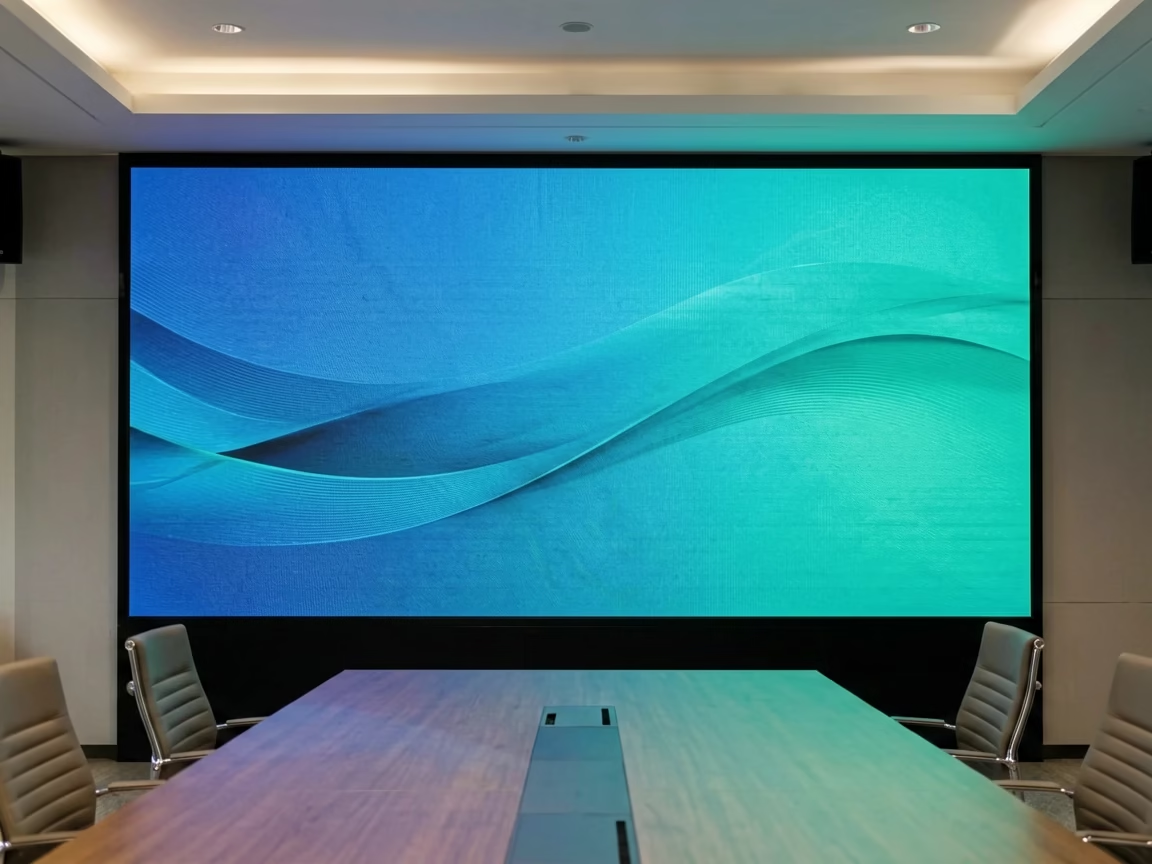
In the LED display industry, Mini LED is the chip class behind the fine-pitch boom. A COB module packs Mini LED chips directly onto the board and seals them in resin, producing pixel pitches from P0.4 to P1.5 — the range that serves boardrooms, broadcast studios, and control rooms viewed from two meters or less. MIP (Micro in Package) packaging takes the same chips and mounts them in small packages for easier assembly. Both are direct-view: the module surface is the screen, with none of the LCD stack that defines the TV version. This is the commercial form of Mini LED, and it is what our COB LED screen line builds:
What Makes Micro LED Different at the Chip Level?
Micro LED shrinks the same inorganic LED material below the Mini LED threshold — under 50 to 100 microns — until a single chip can serve as a single pixel. The display then has no zones, no backlight, and no liquid crystal: every pixel is its own light source, which yields the near-infinite contrast of OLED with the brightness and longevity of inorganic LED. The obstacle is manufacturing: placing millions of micrometer-scale chips onto a substrate with near-perfect accuracy — the mass-transfer problem — is the hardest production challenge in the display industry, and it is why Micro LED sits where it does: astonishing in demos, available in six-figure TVs and premium commercial installations, and not yet mass-market. The OLED-side comparison of that trade-off is in Micro LED vs OLED.
Which Is Better for a TV: Mini LED or Micro LED?
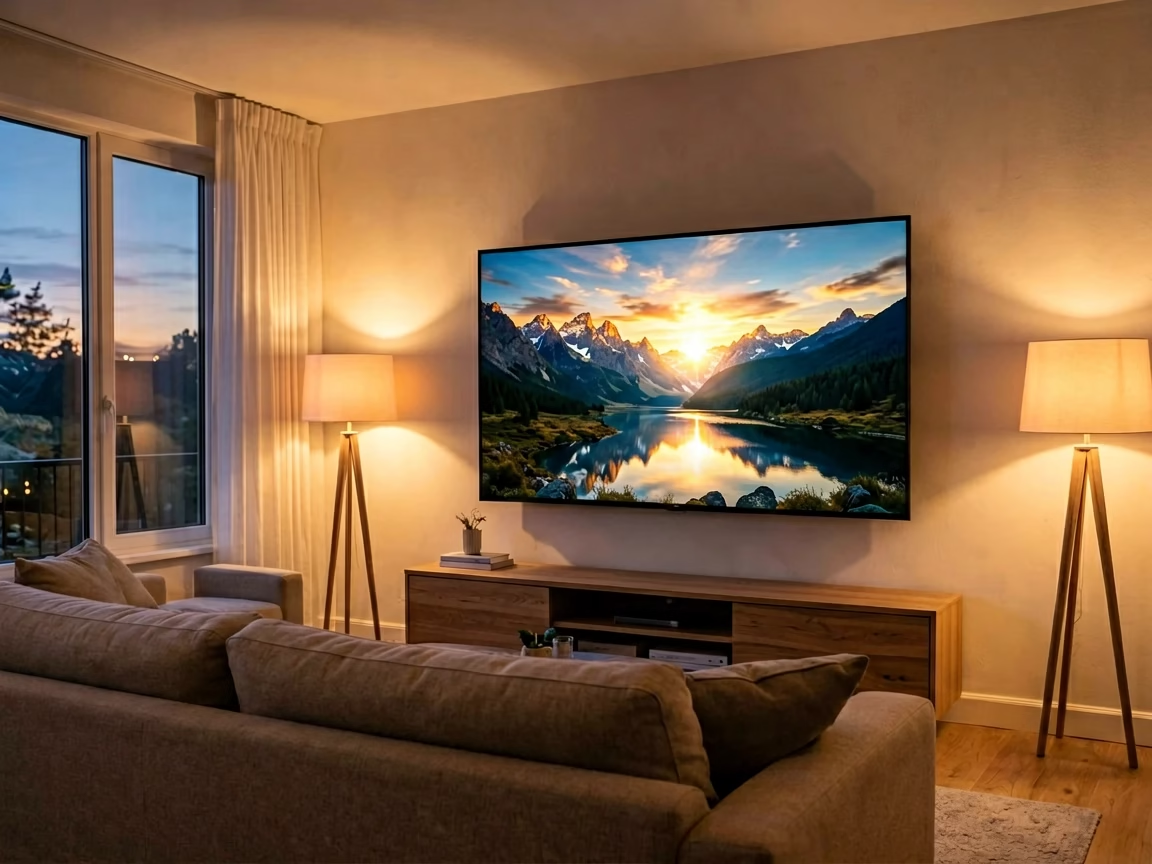
For televisions in 2026, Mini LED wins the practical comparison. It is sold at every premium price point from a few hundred dollars up, delivers brightness OLED cannot match, and its contrast lands close enough to OLED that most viewers stop noticing the difference. The zone counts tell the quality story inside the category: entry Mini LED sets carry a few hundred dimming zones, flagship models carry thousands, and the halo behavior tracks the zone count directly. Micro LED TVs exist — modular, six-figure, and extremely bright — but they compete with nothing at Mini LED prices, and the content ecosystem treats them as luxury objects rather than products. The TV answer in one line: Mini LED is the best contrast-to-price ratio on the market; Micro LED is what you buy when price is not part of the decision.
Which Is Better for an LED Wall?
For LED walls, the comparison runs the same direction but with a different vocabulary. Mini LED COB modules — P0.9 to P1.5 — are the commercial fine-pitch standard today: proven in production, serviceable module-by-module, and priced per square meter like any LED product. A failed module swaps in minutes with a magnetic tool, and spare modules ship with every wall. Micro LED walls sit a step ahead on contrast and a large step behind on availability, with production volumes that keep them in flagship projects. The practical choice for a boardroom, a studio, or a lobby is a Mini LED COB wall; Micro LED is the premium option for projects that must show per-pixel blacks and can wait for supply. The pitch-to-viewing-distance math behind both is in our fine pitch LED display guide.
What Do Buyers Frequently Ask About Mini LED vs Micro LED?
Are Mini LED and Micro LED the same thing? No. Mini LED is a chip-size class used as a TV backlight or in direct-view modules; Micro LED is a self-emissive display where every pixel is a microscopic LED.
Which is better for a TV? Mini LED, on price and availability. Micro LED TVs are six-figure luxury products; Mini LED delivers near-OLED contrast at mainstream prices.
Which is better for an LED wall? Mini LED COB modules are the commercial standard today. Micro LED walls offer per-pixel contrast but at premium prices and limited supply.
How small are the chips? Mini LED chips measure roughly 100–200 microns; Micro LED chips under 50–100 microns.
Why does my Mini LED TV show halos? That is blooming: bright objects light up their whole dimming zone. More zones reduce it, and the most expensive Mini LED panels push it below the threshold of notice.
Do Mini LED displays burn in? No. Both Mini and Micro LED use inorganic LEDs with no image-retention mechanism — the same durability advantage covered in Micro LED vs OLED.
When will Micro LED become affordable? When mass-transfer yields improve enough for volume production — the industry’s stated goal for the next five to eight years, and the gate every Micro LED price forecast stands behind.
Does a Mini LED TV have an LCD panel? Yes. The Mini LED part is the backlight behind the liquid crystal panel. If the product is a television, Mini LED always means backlight; if it is a module or a wall, Mini LED means direct-view chips.
Mini LED vs Micro LED: Which One Should You Choose? Final Verdict
The Mini LED vs Micro LED decision resolves by market and budget. For a TV: Mini LED, unless the budget has an extra zero — it owns the contrast-to-price ratio, the brightness, and the shelves. For an LED wall: Mini LED COB for the project that starts Monday, Micro LED for the flagship that starts next year. Both markets point at the same underlying truth: Mini LED is the present tense of LED display technology, and Micro LED is its future tense — worth watching, worth specifying when the project and the supply line up.
For LED wall projects, send the room dimensions and viewing distance through the Unify LED contact page — we will return the pitch and module recommendation, Mini LED COB or Micro LED, matched to the budget and the deadline.