
NDI vs SDI: Which Video Transport Does Your Production Need?
NDI vs SDI is the transport question every production asks once the camera count grows past the point where HDMI cables stop being the answer. SDI is the broadcast cable standard with deterministic timing; NDI is the IP standard that turns any network port into a video input. Both run inside RGBlink’s range today — the M1 production switcher, the mini-ISO all-in-one and the X3 wall processor each implement one side or both — which makes the brand a useful lens for the decision. This guide compares latency, distance, bandwidth and genlock with dated sources on both sides, then maps each protocol to the RGBlink devices that speak it. Data sources: RGBlink official specification sheets and user manuals (V1.x, 2024–2026), the RGBlink product pages on this site, Vizrt NDI ecosystem documentation, Datavideo’s NDI/HX and 12G-SDI infrastructure guide, Epiphan and Telycam bandwidth references, and 2026 industry guides from Ikan and Videoguys.
Short answer: SDI is a point-to-point serial video link over coax — deterministic, near-zero latency, no encoding, one camera per cable, about 100 m per run. NDI is an IP video protocol that sends video over ordinary network switches — any source to any destination through one cable plant, at the cost of encode latency and bandwidth planning. Broadcast studios and frame-accurate LED walls lean SDI; multi-camera venues, PTZ fleets and reconfigurable setups lean NDI. RGBlink spans the bridge with the M1 (NDI|HX2 in a production switcher), the mini-ISO (NDI plus 3G-SDI on one desk) and the X3 (12G-SDI into a 4K wall processor).
NDI vs SDI: What Is the Difference?
SDI is a serial digital interface that carries uncompressed video, embedded audio and sync over one coax cable. A camera with a 3G-SDI output plugs into a switcher with a 3G-SDI input and the picture is there — no encode step, no network, no discovery; the signal is deterministic, which is why broadcast engineering trusts it for timing-critical paths. SDI generations scale with data rate: HD-SDI, 3G-SDI for 1080p60, 6G and 12G-SDI for 4K. NDI is a network video protocol from the Vizrt ecosystem that compresses and packetizes video so it can travel over standard Ethernet: any NDI source on the network is discoverable by any NDI destination, so a laptop running NDI Tools, a PTZ camera with NDI output and a switcher with NDI input all find each other without a patch bay.
NDI vs SDI: What Do Latency and Genlock Mean in Live Use?
Latency is where the two protocols differ most in practice. SDI carries uncompressed video with no encode-decode stage, so its latency is deterministic — Datavideo’s infrastructure guide puts 12G-SDI’s behavior in the “only a few” frames class, and Ikan’s 2026 protocol guide describes SDI latency the same way: fixed and predictable. NDI’s latency depends on which variant encodes the stream. Full-bandwidth NDI is designed for sub-frame latency on a properly configured network, while the bandwidth-efficient NDI|HX and HX2 variants — H.264/H.265 long-GOP encodes — trade that speed for a fraction of the bitrate: Datavideo measures NDI/HX latency in the 80 ms to 200 ms range. For camera returns and live switching of fast action, that difference is felt; for streams, sub-control-room monitoring and record paths it rarely matters.
Genlock is the second divider. SDI carries timing that lets every device in a chain share one frame clock, which is why studios genlock cameras, switchers and recorders together. NDI over standard copper networks has no genlock, and practitioners are blunt about the consequence: broadcast head-ends and frame-accurate multiwall systems stay on SDI (or on IP standards built for sync such as SMPTE 2110), while NDI handles the flexible layer around them. If your LED wall must cut sources on a locked frame clock, keep the wall’s front end on SDI or HDMI and treat NDI as the source-feed layer.
NDI vs SDI: How Do Distance and Bandwidth Compare?
Distance favors NDI the moment the run grows. A single SDI run is a single cable: over quality broadcast coax, 3G-SDI reaches about 100 m and 12G-SDI less than that, so a camera 300 m away needs a signal run with repeaters or converters in between. NDI lives on the network: each Ethernet segment is also about 100 m, but switches extend the path indefinitely, so a camera across a building or a venue is one network hop from the switcher — the reason PTZ fleets and multi-room installations moved to NDI in the first place. You still pull cable; you just pull network cable once and run every video signal over it.
Bandwidth is the price of that freedom. Uncompressed SDI demands no planning per stream but owns a cable per camera. NDI concentrates all streams on shared links: Epiphan documents roughly 100 Mbps per 1080p30 full-NDI stream and Telycam’s guide puts 1080p60 at 100–150 Mbps, rising past 250 Mbps for 4K60, while NDI|HX2 shrinks a stream to a few Mbps with higher encode latency. Four 4K60 full-NDI cameras on one switch port will not fit a 1 GbE link — the network must be sized per stream count and resolution, or the sources must run NDI|HX2. SDI never asks this question; NDI always does.
NDI vs SDI: Which One Belongs in Your Signal Chain?
The practical answer is a three-port reality: HDMI for local consumer sources, SDI for cameras and broadcast paths, NDI for network flexibility. Decide per stage rather than per whole system:
- Studio and broadcast stages choose SDI. Deterministic latency, genlock and the industry’s spare-parts depth make 3G-SDI and 12G-SDI the default for camera chains, head-ends and any path that must stay frame-accurate.
- Multi-camera venues choose NDI. When the camera count passes the practical cable limit, sources sit anywhere on the network, discovery replaces patching, and PTZ control and video share one cable plant.
- LED walls keep the display front end on SDI or HDMI. A wall processor’s output timing is locked to the receiving chain; NDI feeds the processor as inputs, while the wall-facing output stays on conventional video. The RGBlink X3’s 12G-SDI input module exists exactly for that split.
- Hybrid is normal. The right systems run SDI cameras into a switcher, hang NDI sources off the network, and let one device arbitrate — the video switcher vs video processor guide explains where each device class sits in that chain.
NDI vs SDI: How Do RGBlink Devices Use Both?
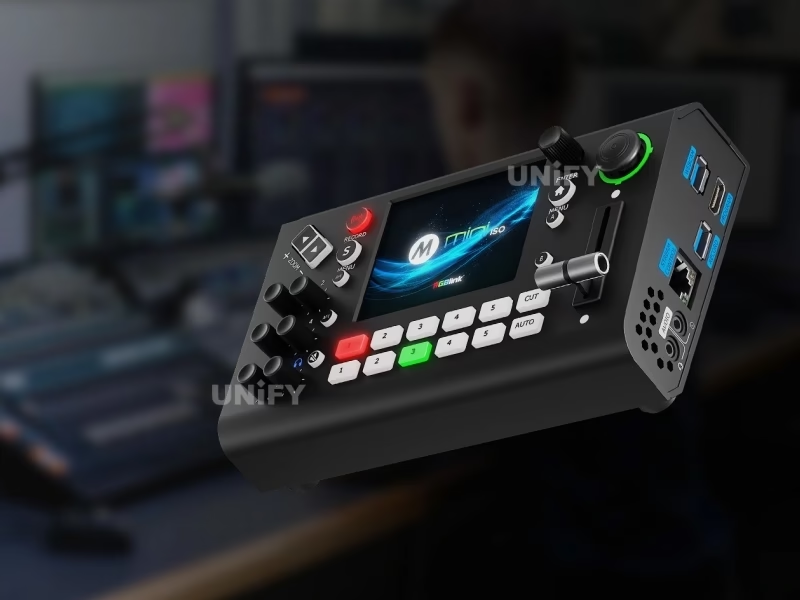
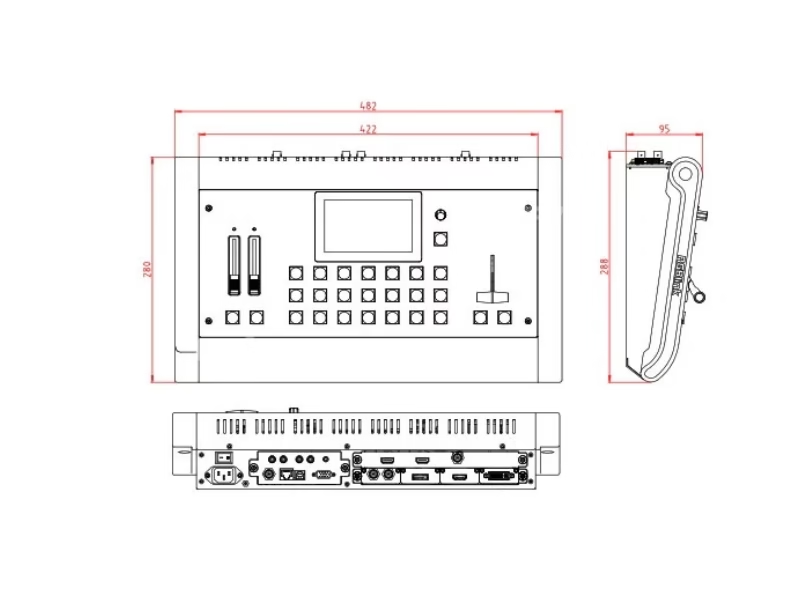
Three current RGBlink products put the protocols to work, and each uses them the way its job demands. The RGBlink M1 is the production switcher for NDI-first stages: two NDI|HX2 connections expandable to four, internal pixel scaling, program output over HDMI and USB 3.0, and Genlock and tally for the studio workflows that still demand SDI-style timing discipline. The RGBlink mini-ISO is the hybrid desk: ten inputs that include four 3G-SDI, one NDI and UVC side by side, so SDI PTZ cameras and network sources share one touchscreen console at $599. The RGBlink X3 is the wall side of the argument: its modular input bay accepts a 12G-SDI module that takes a single 12G, dual 6G or quad 3G input with switchable 2SI/SQD encoding, bringing broadcast SDI into a 4K/HDR wall processor whose outputs stay locked to the LED chain.
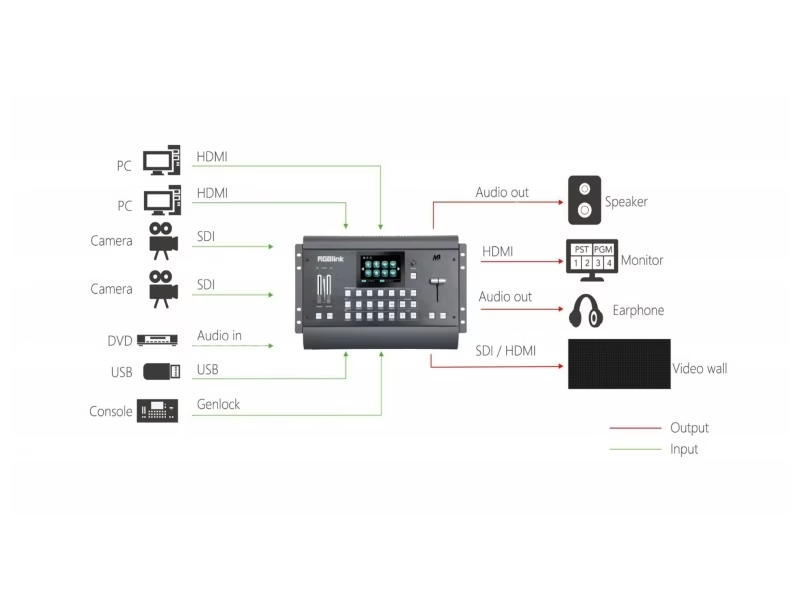
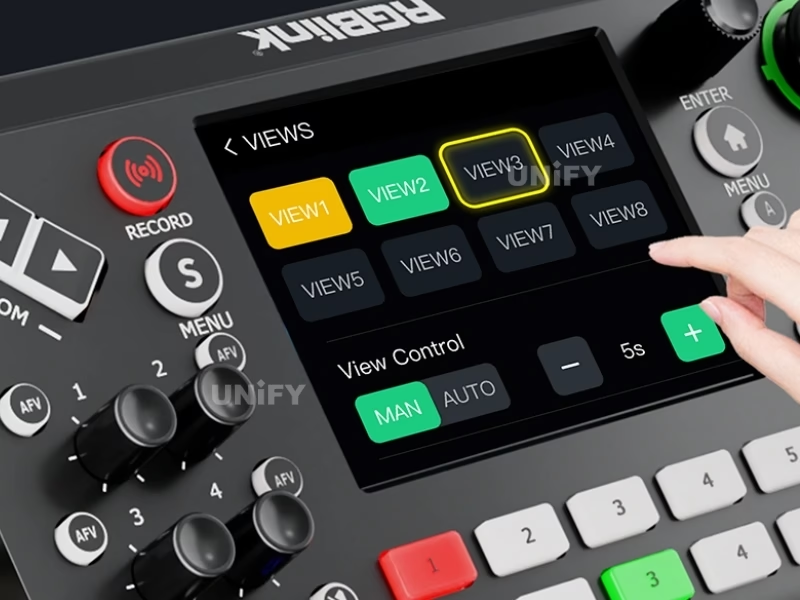
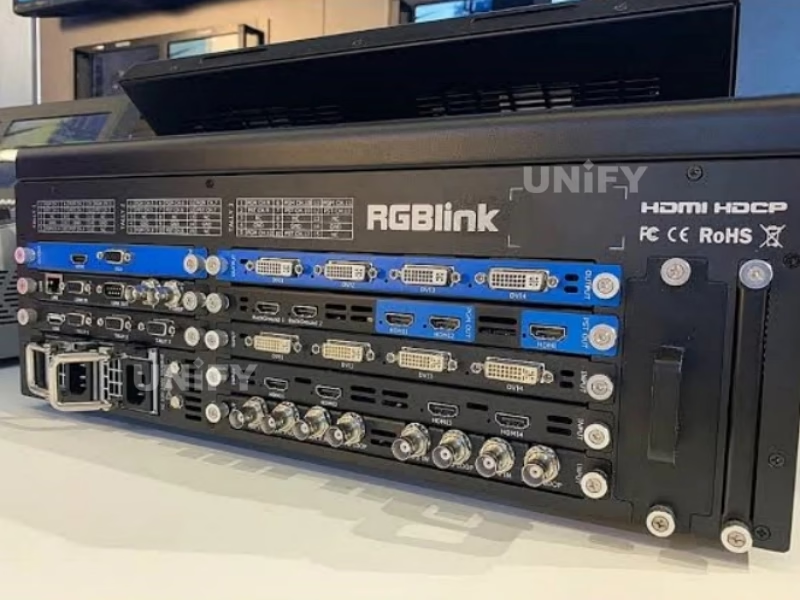
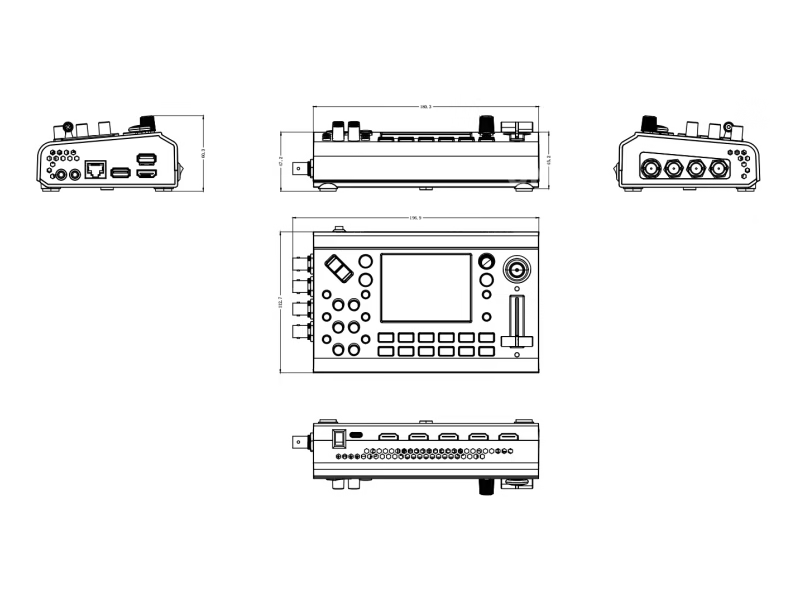
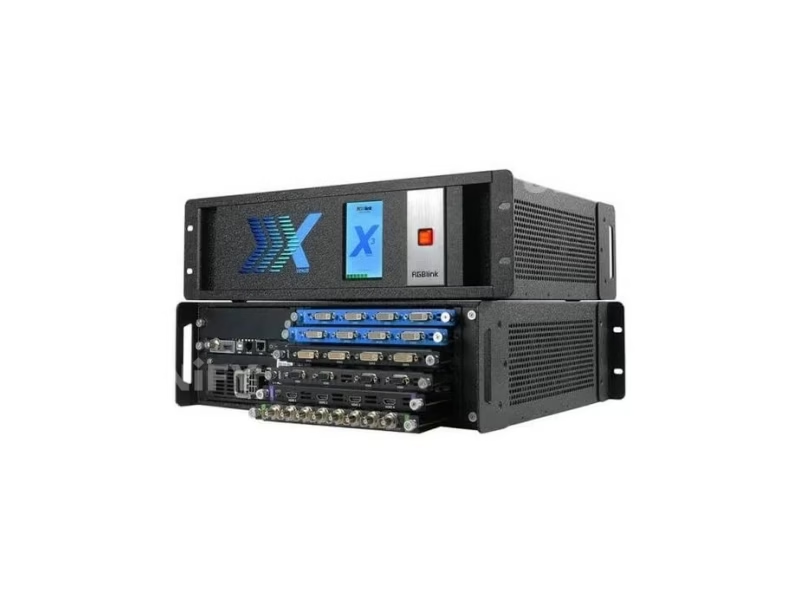
Read the trio as one story: the M1 brings NDI into a Genlock-capable production desk, the mini-ISO puts SDI and NDI on a portable console at switcher prices, and the X3 takes broadcast SDI into the wall. A venue can run PTZ cameras and laptops to the M1 or mini-ISO over the network, send the program to the X3 over 12G-SDI, and keep every timing-critical leg on the protocol that owns it. The RGBlink vs ATEM Mini comparison shows why the SDI and NDI inputs matter against the HDMI-only competition.
NDI vs SDI: What Do Buyers Ask?
Conclusion: NDI vs SDI — Which Transport Should You Choose?
NDI vs SDI stops being a contest once the production is described: SDI is the deterministic cable layer for cameras, broadcast paths and frame-accurate LED walls; NDI is the flexible network layer for distributed sources, PTZ fleets and any setup that changes shape between events. Budget, distance and timing decide the mix, and the RGBlink range is built to sit on both sides of it — the M1 switching NDI|HX2 with Genlock discipline, the mini-ISO putting SDI and NDI on one portable console, the X3 accepting 12G-SDI at the wall. Choose the protocol per stage, not per brand, and the signal chain will stay honest.
Buying a switcher or processor for a networked production room? Talk to us — we are the LED screen manufacturer behind unifyled.com, and we test the NDI and SDI paths against the displays we ship.