
Can You Make a Transparent Digital Display? How Transparent LED Screens Work
A transparent digital display is a screen that shows an image while the scene behind it stays visible. The real question behind can you make a transparent digital display is whether the screen survives daylight, glass load, cleaning, and a five-year service life. This guide from an LED screen manufacturer separates the four commercial build paths, the DIY versions, the 2026 cost bands, and the specification points that decide whether a transparent screen looks like part of the building.
Short answer: Yes, you can make a transparent digital display. The commercial routes are transparent LED strip screens, adhesive transparent LED film, transparent LCD or OLED panels, and projection film. Transparent LED is the usual choice for glass walls and storefronts because it scales to any size and reaches 1,500–8,000 nits; transparent LCD and OLED are limited to smaller panels and controlled indoor light. A DIY transparent LCD is possible by removing the polarizer, but it is a demonstration, not a building product. Specify transparency, pixel pitch, brightness, weight, and glass load — not the word “transparent” alone.
1. Can You Make a Transparent Digital Display? The Direct Answer
A transparent digital display is a display that forms an image on a see-through substrate, so a viewer sees both the lit pixels and the scene behind the panel. The image is real, not a reflection.
You can make one in four commercial ways. Transparent LED uses rows of LED bars or a bonded LED film with open gaps between the lamps. Transparent LCD uses a liquid-crystal panel with a transparent backlight assembly. Transparent OLED uses self-emitting organic pixels on a clear substrate. Projection film uses a coated optical film and a projector. Each route has a different transparency range, brightness ceiling, panel size limit, and service model.
The practical answer depends on three project facts: what is behind the glass, how far the viewer stands, and how much extra load the glass can carry. The UnifyLED LED display factory lists transparent LED at P3.91–P7.81 for glass walls and retail, the range most storefront projects start from.
2. What Types of Transparent Digital Display Can You Actually Buy?
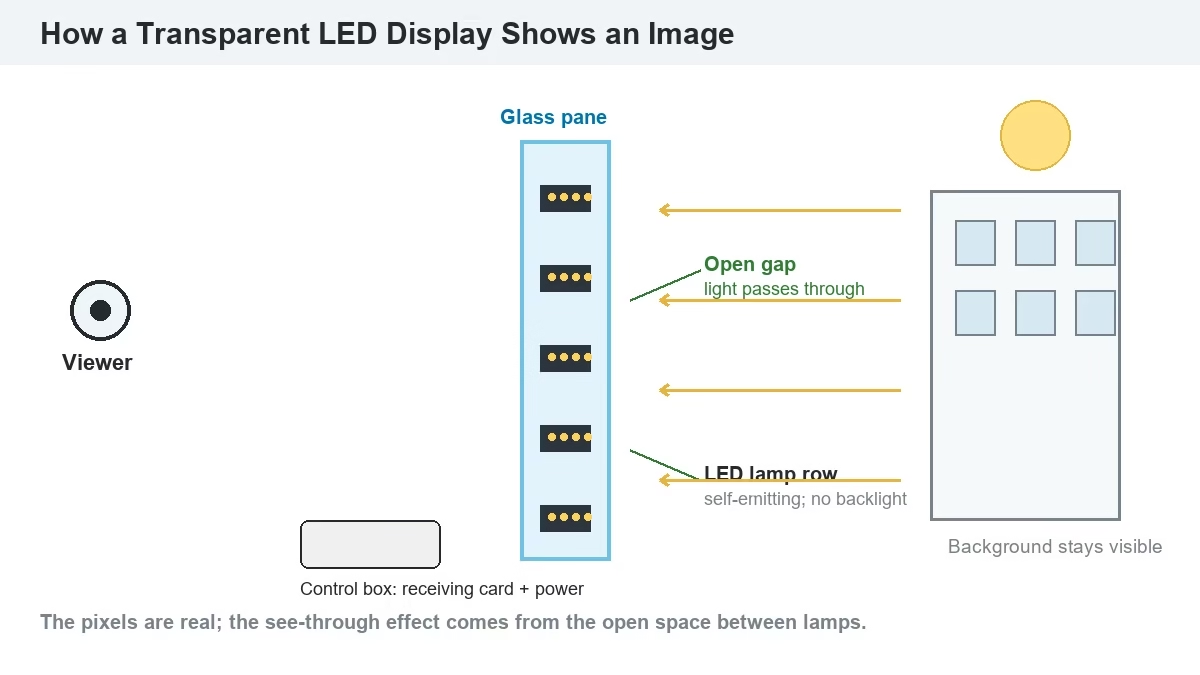
A transparent LED display is a display built from LED bars, cabinets, or film mounted on a clear carrier, with the LEDs spaced apart so light passes between them. The lamps are self-emitting, so there is no backlight to block the view. This is the only transparent technology that scales from a 2 m shop window to a full building facade.
What Is a Transparent LED Strip Display?
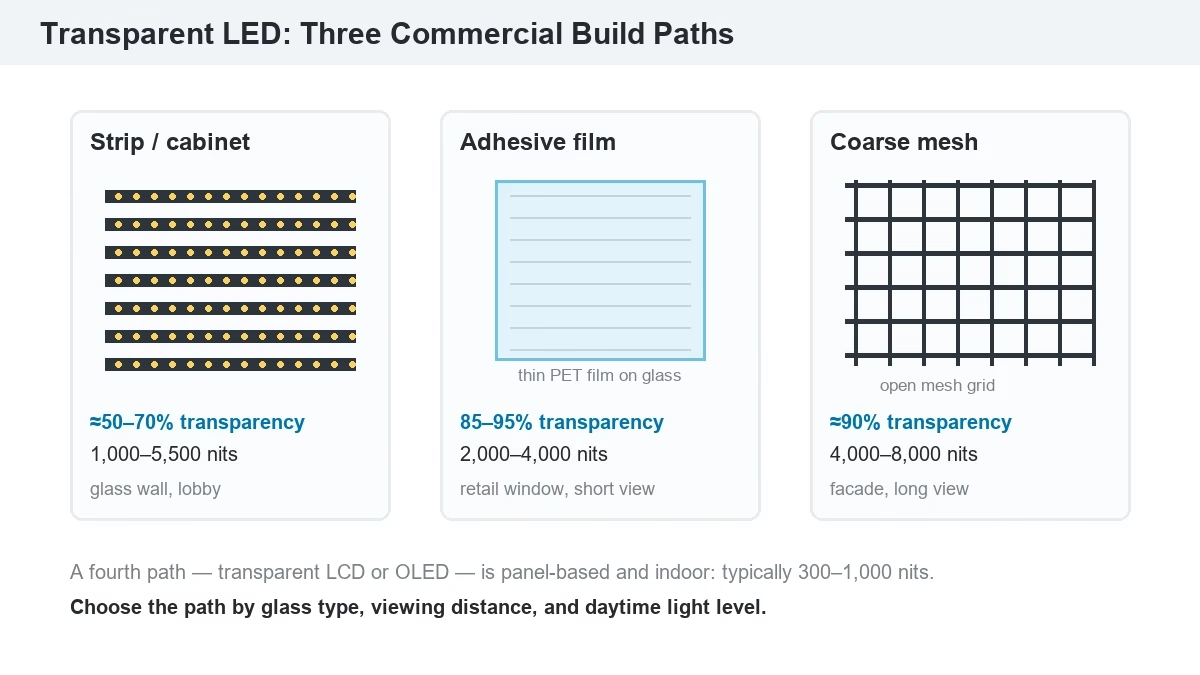
A transparent LED strip display is a set of slim aluminum cabinets, each holding horizontal LED bars, hung in front of or inside a glass pane. Typical strip products run P3.91–7.81, reach about 70% transparency, weigh around 11 kg/m², and offer 1,000–5,500 nits depending on the indoor or sun-facing version (LEDScreenFactory 2026 price survey). The cabinet gives the screen a fixed module grid, a serviceable rear or front access path, and a predictable seam between cabinets.
What Is a Transparent LED Film Display?
A transparent LED film display is a thin PET film carrying LED lamps and a transparent circuit, bonded directly to existing glass. Film reaches 85–95% transparency because the lamps are small and widely spaced. Brightness typically runs 2,000–4,000 nits, and the bond line, glass flatness, and edge sealing decide how long it stays clear. Film fits when the glass must stay visually untouched and the viewing distance is short.
What Is a Transparent LCD or OLED Display?
A transparent LCD display is a liquid-crystal panel with a transparent backlight and polarizers, so the background stays visible when pixels are off. A transparent OLED display is a self-emitting panel on a clear substrate. Both deliver higher pixel density than transparent LED at small sizes, which suits museum cases and retail plinths. Both are limited by panel size and brightness: transparent OLED typically sits around 300–1,000 nits (IQBoard 2026), which is indoor light, not a sun-facing facade.
| Type | Transparency | Brightness | Best use | Main limit |
| Transparent LED strip | ≈50–70% | 1,000–5,500 nits | Storefront glass, lobbies, facades | Visible cabinet grid at close range |
| Transparent LED film | 85–95% | 2,000–4,000 nits | Retail windows, existing glass, short viewing distance | Lower brightness; surface bond quality decides life |
| Transparent LED mesh | Up to ≈90% | 4,000–8,000 nits | Building facade, long viewing distance | Coarse pitch; image only reads from far away |
| Transparent LCD | ≈40–70% | 300–1,000 nits | Museum cases, product plinths, indoor signage | Small panel sizes; needs controlled light |
| Transparent OLED | ≈40–60% | 300–1,000 nits | Premium indoor retail, exhibitions, automotive | Panel cost and size; not for daylight facades |
| Projection film | ≈70–90% | Depends on projector | Dark indoor windows, staged reveals | Washed out by ambient light; needs projector space |
Four key differences decide the shortlist:
- Transparent LED is the only path that scales to a full facade at daylight brightness. Strip and mesh products are built in cabinets, so the screen can follow the building.
- Transparent LED film maximizes transparency but gives up peak brightness. It is a glass-first product, not a billboard replacement.
- Transparent LCD and OLED win on pixel density at small sizes but lose on daylight and scale. They belong inside a controlled light environment.
- Projection film is an optical effect, not a self-emitting display. It can look convincing in a dark room and disappears in a bright one.
The commercial transparent LED range is visible in the factory video below: a vertical panel playing bright content, then dark content that lets the room behind it return.
3. Can You Make a Transparent Digital Display Yourself? DIY vs Commercial
A DIY transparent display is a one-off build made by removing layers from a standard LCD or by wiring a small LED matrix on a clear board. It can work as a demonstration. It does not carry the brightness, sealing, calibration, or service life a client expects from a storefront or a lobby.
The most common DIY route is an LCD polarizer removal. An LCD switches liquid-crystal cells between two polarizing filters, with a backlight behind them; remove the rear polarizer and backlight, and the panel becomes partly see-through. The image is dim because it now depends on ambient light, the contrast collapses, and the panel is fragile once the factory seal is gone. A second route is an addressable LED matrix on a transparent PCB; it works for a small art piece, but the pitch is coarse, the driver is exposed, and there is no calibration or weather protection. A third route is projection film, an optical effect rather than a self-emitting screen.
Commercial transparent LED film is applied on site, but the film itself is a factory product. The difference from DIY is the transparent conductive layer, lamp bonding, driver architecture, edge sealing, and the warranty that come with a manufactured roll. The video below shows what a glass-bonded film project involves.
Three reasons DIY does not scale to a commercial transparent display:
- Brightness: a DIY LCD has no controlled light source, so it loses the image in daylight; a transparent LED strip or film is specified in nits for the light level on site.
- Structure: a bare panel or hand-wired matrix has no load path, no edge protection, and no way to survive wind or cleaning on a facade.
- Service: a factory screen has replaceable modules, a control box, and a spare-parts list; a DIY build has none of those, so one failed row becomes a full rebuild.
4. How Does a Transparent Digital Display Show an Image Without Blocking the View?
A transparent digital display works by leaving space between the light-emitting pixels. On a transparent LED screen, each lamp sits on a bar or film, and the area between lamps stays open, so light from the scene passes through to the viewer. The pixels are bright enough to be seen against the background, while the gaps keep the background readable.
The design variable is pixel pitch, the center-to-center distance between pixels. A fine pitch puts more pixels into each square meter and gives a sharper image at close range, but it closes more of the open area and lowers transparency. A coarse pitch opens the view but limits how close the viewer can stand before the image breaks into dots. Transparent LED products usually sit between P3.91 and P7.81 for strip screens, with film and mesh products reaching coarser pitches and higher transparency. The diagram below shows the relationship: the image is formed by the lit lamps, not by a continuous sheet of glass.
Contrast is the second variable. An opaque LED wall has a black face between the lamps, so black content reads as black. A transparent screen has no black backing, so a “black” pixel is simply an open window to the background. Contrast on transparent screens commonly falls between 200:1 and 500:1 (IQBoard 2026), against 3,000:1 or higher on a good opaque LED wall. Content has to be designed for that: bright brand colors, bold outlines, large type, and solid shapes read well; dark gradients, fine text, and low-contrast photography disappear into the background. The same principle applies to camera capture — if the screen will be filmed, specify a high LED display refresh rate and test with a phone camera before handover.
What Limits a Transparent Digital Display in Real Projects?
Five limits belong in the brief: contrast (black reads transparent; 200:1–500:1), brightness (5,500–8,000 nits brings power and heat), resolution (P3.91 reads from about 4 m), background (busy scenes create moiré), and glass load (tempered glass cannot be drilled). If the project needs true black, specify an opaque P1.86 indoor fine pitch LED display instead.
5. How Much Does a Transparent Digital Display Cost in 2026?
A transparent digital display is priced by construction, not by the word “transparent.” The same 10 m² opening can carry a coarse mesh, a strip cabinet, a bonded film, or a fine-pitch panel, and the installed cost can differ by a factor of ten.
| Construction | Typical 2026 price | Source |
| Coarse transparent mesh | From ≈$150/m² | LEDScreenFactory 2026 price survey |
| Transparent LED strip, glass wall | $400–$1,200/m² factory-direct | LEDScreenFactory 2026 price survey |
| Transparent LED film | $740–$2,220/m² (film body, EXW Shenzhen) | DOIT VISION 2026 |
| Fine-pitch transparent retail build | $1,800–$4,800/m² through integrators | iamledwall 2026 |
| Transparent LCD / OLED panel | Panel-based premium; a consumer transparent OLED TV is near $60,000 | IQBoard 2026 |
The screen body is not the installed price. A controller, cables, power distribution, mounting frame, labor, commissioning, and shipping add roughly 10–25% (LEDScreenFactory 2026 price survey). A transparent LED project commonly lands at 2–3× the cost of a comparable opaque screen at the same pitch (IQBoard 2026), because the substrate, open lamp layout, and lower production volume carry a premium. Price the body, control system, structure, and installation as four separate lines.
6. How Is a Transparent Digital Display Installed on Existing Glass?
A glass-mounted transparent LED installation is a sequence of survey, load check, mounting, cabling, and commissioning. The order matters: the glass is inspected before any bracket or film touches it, and the power and signal routes are planned before the first module goes up.
What Glass Survey Does a Transparent LED Display Need? The survey records the glass type (tempered, laminated, or insulated glazing), pane thickness, frame detail, edge clearance, and seal condition. It checks flatness, because a film needs a smooth surface and a cabinet frame needs a true plane. The team calculates the added load from the screen, hardware, and wind pressure, then compares it with the glass and structure capacity. On tempered glass, no new holes are drilled; the frame is clamped, bonded, or self-supporting.
How Do You Route Power for a Transparent LED Display? Power and signal run to a serviceable control box at the side or bottom of the glass. The route must avoid stress on the glass edge, and an outdoor entry needs a drip loop and a sealed gland. The box holds the receiving card, power supplies, and network connection; it needs ventilation and an access panel. A box hidden behind a sealed ceiling is a maintenance problem waiting to happen.
The installation sequence is: survey and load check, install the frame or prepare the glass surface, mount the cabinets or bond the film, route power and signal, line up the seams, run a white and grey field test, then commission the controller and content. The video below shows the glass-bonded film sequence, including the load check, edge clearance, and control-box location.
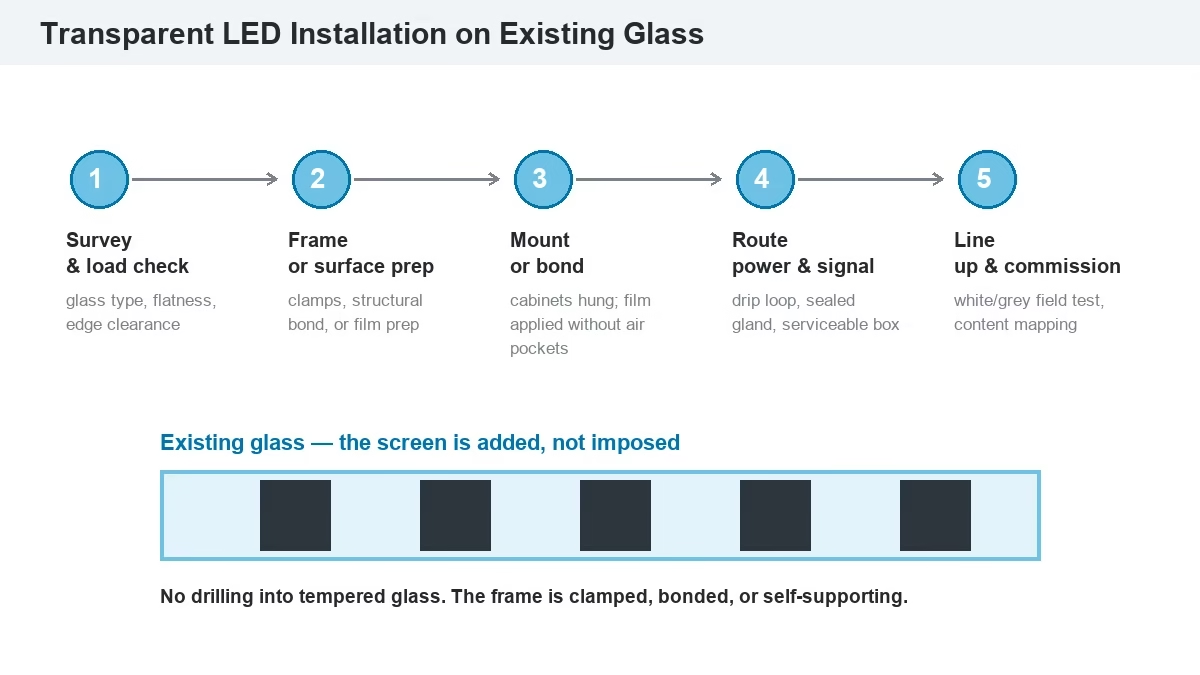
For a cabinet screen, the alignment target is a continuous line at every cabinet joint. For a film screen, the target is a bond with no air pockets, no lifted edges, and no visible seam between film strips. Both are checked on a white field, where dust and bubbles show, and on a grey field, where brightness differences between modules show. The screen is not finished when the image appears; it is finished when the field test passes.
How Do You Maintain a Transparent Digital Display After Installation?
Power off before cleaning; use a soft microfiber cloth with mild soap and water, never abrasives, solvents, or a pressure washer. On film, keep the cloth damp and work along the film direction. Keep spare modules, a receiving card, and a power supply on site, and run a white and grey field after any module swap. Confirm the LED display warranty terms and spare-part lead time before handover; the LED screen maintenance guide covers the removal sequence.
7. Which Transparent Digital Display Specification Should You Put in the Quote?
A transparent digital display quote should list the performance values that decide whether the screen works on the site. The list below is the minimum; add the site’s light level and the glass survey to the same document.
| Specification | What to write | Why it matters |
| Pixel pitch | P3.91, P7.81, or the project-specific pitch | Sets viewing distance and transparency |
| Transparency | Measured percentage, not a range from a brochure | Decides how much of the view stays open |
| Brightness | Nits at the site’s daytime light level | Prevents a washed-out facade at noon |
| Refresh rate | ≥1,920 Hz, higher for camera-facing glass | Stops scan lines on video and photos |
| Weight and load | kg/m² plus mounting hardware and wind load | Passes the glass and structure check |
| Power | Maximum and average W/m² | Sizes the circuit and the heat load |
| IP rating | Indoor or outdoor, front and rear | Matches the weather and cleaning method |
| Control system | Brand, model, and spare-part availability | Decides service and content workflow |
| Warranty and spares | Years, module price, lead time, on-site stock | Protects the operating budget |
Use the LED screen calculator to check pixel count and power, and the LED screen size guide to match the screen to the opening. For a non-rectangular or curved glass surface, the P3.076 indoor flexible LED display shows what a flexible module can do, but a transparent screen is a separate specification. The LED display FAQ covers common buying questions.
8. What Are the Most Common Transparent Digital Display Questions?
Are transparent digital displays real? Yes. Transparent LED, LCD, and OLED panels are shipping products; projection film is an optical alternative, not a self-emitting screen.
How transparent is a transparent LED display? Strip screens run about 50–70% transparency, film reaches 85–95%, and coarse mesh reaches about 90%, depending on pitch and lamp density.
Can a transparent digital display be used outdoors? Yes, if it is a transparent LED strip or mesh with an outdoor IP rating and 5,500–8,000 nits. Transparent LCD and OLED are indoor products.
How much does a transparent digital display cost? Screen bodies run from about $150/m² for coarse mesh to $4,800/m² for fine-pitch retail builds; add 10–25% for control, structure, installation, and shipping.
Can you make a transparent digital display at home? A DIY LCD polarizer removal can demonstrate the effect, but it is dim, fragile, and has no weather sealing or warranty; commercial projects use factory-built LED strip or film.
9. References & Sourced From: Transparent Digital Display Technology
Sources checked 2026-11-09:
- IQBoard — Can You Make a Transparent Digital Display?: transparency 50–90%, pitch 2–15 mm, brightness 1,500–8,000 nits, contrast 200:1–500:1, cost 2–3× opaque LED.
- Omdia — Transparent display revenue to reach $100.2 million by 2032 (2025): 9.3% CAGR.
- DOIT VISION — Transparent LED Film Screen Price 2026: $740–$2,220/m² film body, 90–95% transparency.
- iamledwall — Transparent LED screen cost per square meter (2026): $1,800–$4,800/m² for fine-pitch retail builds through integrators.
- LEDScreenFactory — Transparent LED Screen Price Guide 2026: strip $400–$1,200/m², mesh from about $150/m², 10–25% adders.
- Kinglight — Complete Guide for Transparent LED Display: construction overview.
10. Conclusion: Can You Make a Transparent Digital Display for Your Project?
You can make a transparent digital display, and the technology is mature enough for commercial work. The decision is which construction fits the glass, the light, and the viewing distance. Choose transparent LED strip or mesh for a facade or large storefront, transparent LED film when the glass must stay visually untouched, and transparent LCD or OLED when the panel is small and the light is controlled. Treat a DIY build as a demonstration, not a specification.
Before you request a quote, measure the opening, record the glass type and load limit, note the daytime light level, and decide the viewing distance. Those four facts turn a vague request into a spec. Send the measurements and a photo of the glass to unifyledscreen@gmail.com or contact the LED screen manufacturer team for a transparent LED configuration and a line-item budget.