
How to Choose a Huidu LED Control System: Async, Dual-Mode or Sync?
UnifyLED · LED Control System Guide · Updated August 2026
How to choose a Huidu LED control system — async, dual-mode or sync — is the first decision any integrator makes after the screen plan is done, and it is the one that most often gets made wrong. This guide turns the decision into three questions: what feeds the screen (stored programs or live input), where the controller lives (inside the cabinet or outside it), and how many pixels the wall needs — then maps the answers onto Huidu’s four control architectures: async player boxes, dual-mode players, synchronous processors and control cards.
Short answer: Choose an async player box (HD-A3) when the screen plays scheduled content with no live input; a dual-mode player (HD-A5, HD-A6L) when the same screen needs occasional live HDMI; a synchronous processor (HD-VP210 to HD-VP830) when the wall is live most of the time; and a control card (W single-dual, C16C, C36C) when the controller must live inside a small cabinet — then match the loading budget to the screen’s pixel count using the 655,360-pixels-per-port rule that Huidu’s own documents confirm.
What Are the Four Architectures of a Huidu LED Control System?
Huidu builds every LED control system on one of four architectures, and every product on this site fits one of them:
1. Async player boxes — the HD-A3
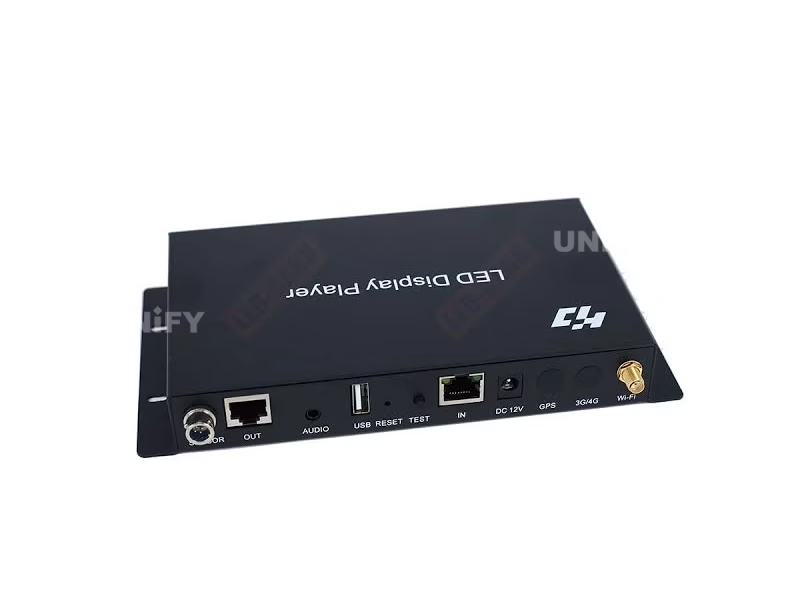
An Android-based playback box that stores programs in 8 GB of flash and plays them with no PC at the wall. The HD-A3 drives 655,360 pixels from one Gigabit output, hardware-decodes 17 video formats at 60 Hz, and manages fleets through the cloud with no IP configuration. It is the cheapest full-color async box in the line (USD 135 verified) and the default for pure advertising and information screens.
2. Dual-mode players — the HD-A5 and HD-A6L
The same async engine plus a synchronous HDMI path that auto-scales live input — no video processor needed. The HD-A5 covers 1.3 million pixels with two outputs; the HD-A6L tops the line at 2.6 million pixels with four outputs, HDMI splicing, up to six 1080P windows, dual-band Wi-Fi and wireless casting. These are the boxes for sites that run scheduled content all week and go live on event days.
Huidu Official — how to set up the dual-mode player to play both modes at the same time
3. Synchronous processors — the HD-VP210 to HD-VP830
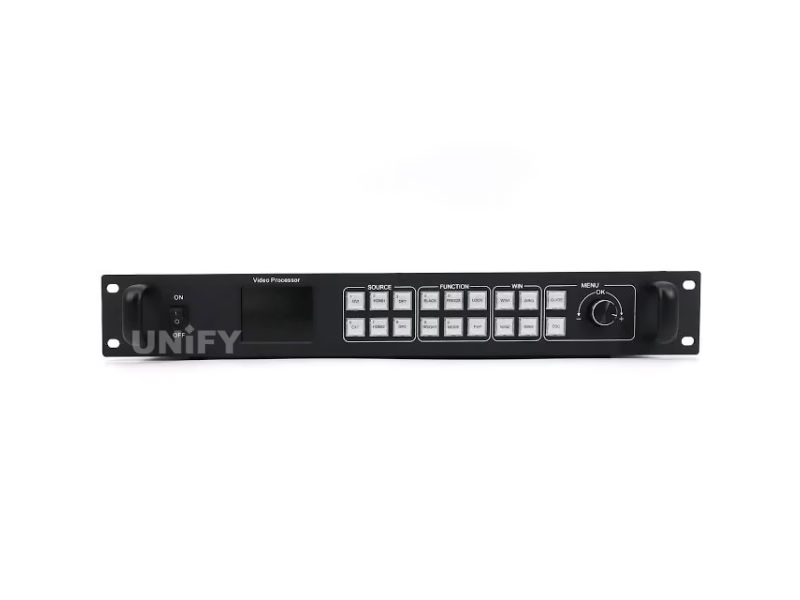
Real-time processors that display live input frame-by-frame at 60 Hz. The VP ladder climbs four rungs: the HD-VP210 (1.3M, 2 ports), the HD-VP410 (2.3M, 4 ports), the HD-VP620 (3.9M, 4K input) and the HD-VP830 (5.2M, three windows, RS232). These are the boxes for broadcast, control rooms and live events — the architecture that mirrors a computer onto the wall.
4. Control cards — W single-dual and C16C/C36C full color
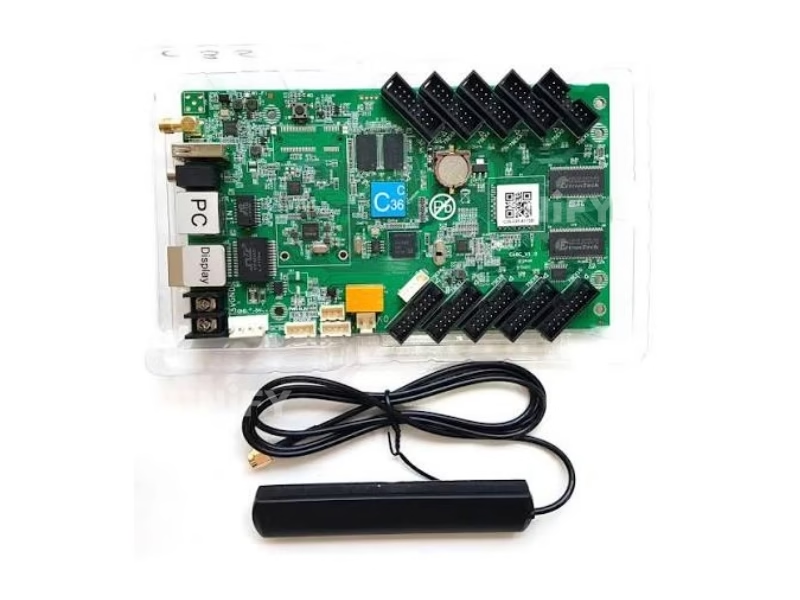
Boards that live inside the LED cabinet. The HD-W62 handles single-dual color fascia at 65,536 pixels; the HD-C16C and HD-C36C are full-color cards with ten HUB75E interfaces each — sending card, receiving card and Wi-Fi on one PCB, with a built-in relay for remote power control. One card replaces three devices on a small screen.
The four architectures are not a ranking — they are a map. Each one is the right answer for a different kind of project, and the rest of this guide walks the three decision axes that place a project on the map: content source, form factor and loading capacity. The 12 product pages on this site each document one of these models in depth; this guide is the framework that points to the right page.
When Should Your Huidu LED Control System Use Asynchronous or Synchronous Control?
The first and largest decision is the content source. An asynchronous controller plays pre-stored programs and needs no operator; a synchronous controller displays a live input in real time and needs a source at all times. The decision table:
If the answer is “both at different times”, the dual-mode architecture is the bridge — and the synchronous vs asynchronous LED control guide on this site draws the underlying line in full. The official videos below show both ends working: the async path with the HD-A3 configuration workflow (73,000+ views), and the sync path with the A-series synchronous mode explained.
Huidu Official — configuration tutorial of HD-A3 and receiving card in HDPlayer
Huidu Official — how synchronous mode works in Huidu LED player box
When Does a Huidu LED Control System Need a Player Box or a Control Card?
The second decision is where the controller lives. Player boxes sit outside the cabinet, are serviceable in minutes, and scale to the biggest walls. Control cards live inside the cabinet, need no enclosure, and save one or more separate devices. The trade:
The rule of thumb: screens that fit inside a cabinet bay — the majority of small signage — favor the card; screens that need HDMI sync, splicing or serviceable external hardware favor the box. The C16C video below shows the one-card-three-roles architecture that makes the card side of the decision compelling for small full-color screens.
Huidu Official — the asynchronous LED control card HD-C16C
How Much Loading Capacity Does Your Huidu LED Control System Need? The 655,360 Per-Port Math
The third decision is arithmetic: every Huidu document on this site confirms 655,360 pixels per Gigabit port — the HD-VP210 derivation, the HD-VP620 V2.1 “650,000 per port”, the HD-VP830 and HD-A3 V3.0 printing 655,360, and the HD-A5 at two port-loads. Count the screen’s pixels, divide by 655,360, and the minimum port count answers itself:
The same math explains the width limits: 8192 pixels of width × 64 high = 524,288 exactly on the C36C, and 65,536 × 40 = 2,621,440 on the A6L. Screen power planning follows in the LED display power consumption guide.
Two practical notes on the per-port rule. First, budget with headroom: a screen plan that lands at 1.29M pixels is a 2-port job in arithmetic but a 4-port job in practice, because the VP410-class processors and the A6L carry the next tier of features — splicing, multi-window, SDI — that the bare port count does not show. Second, the width limits are the same math read sideways: an 8192-wide lintel at 64 high is exactly one C36C, while the same width on the C16C leaves only 25 pixels of height. When a quote feels tight on either axis, step up one rung before the cabinet order — re-engineering after fabrication is the expensive way to learn the rule.
How to Choose a Huidu LED Control System by Application
Four worked examples show the decision tree end to end:
Example 1 — a pharmacy cross screen (full color, ~0.4 × 0.5 m). Pixel budget: roughly 300,000. Content: scheduled promotions, hours, health tips — no live input. Decision: async architecture, card form factor (it must live inside the cross), and the HD-C36C fits the budget with its ten HUB75E interfaces and relay power control. The official pharmacy cross case (38,974 views) shows the one-card install.
Huidu Official — C15C C16C controller working for full color pharmacy cross LED screen
Example 2 — a storefront screen with occasional live events (full color, ~1.2 m × 0.6 m). Pixel budget: ~600,000. Content: promos all week, live product launches on event days. Decision: dual-mode architecture — the HD-A5 plays the schedule and auto-scales the HDMI input when a source appears, no video processor.
Example 3 — a broadcast studio wall with SDI sources (full color, ~3 m × 2 m). Pixel budget: ~2M. Content: live camera chains all day. Decision: synchronous architecture — the HD-VP830 takes dual HDMI plus SDI, runs three windows and carries 5.2M with headroom, with RS232 for the control room.
Example 4 — a single-dual color door lintel (text-only). Pixel budget: ~50,000. Content: scrolling text. Decision: async card, and the HD-W62 family at USD 15.50 is the right tool — full-color hardware would be wasted on text. The ultra-long lintel case below shows why the full-color card class exists for the 8192-wide cousin.
Huidu Official — ultra long door lintel screen controller HD-C36C case
Where Does a Huidu LED Control System Fit Against Novastar and Colorlight?
The same decision framework maps across brands. On the synchronous side, the HD-VP210 competes with the Novastar MCTRL300 and the Colorlight X2 in the 1.3M class — Huidu’s edge is the 3-in-1 packaging and the documented panel workflow. On the asynchronous side, the HD-A3 faces the Novastar TB range; Huidu’s edge is the one-card C-series and the relay power control. The full three-way comparison is the next guide in this series, and the existing Colorlight vs Novastar analysis on this site sets the baseline. One ecosystem note: Huidu controllers pair with Huidu receiving cards — confirm the receiving-card side with your order so the chain is matched from the start. The 655,360-per-port arithmetic applies to the receiving-card side as well: each Gigabit output port feeds its chain at the same ceiling, which is why Huidu’s own documents (V2.1 on the VP620, V3.0 on the A3) print the figure directly.
The cost dimension closes the decision. The full Huidu line spans USD 15.50 (the W62 single-dual card) to USD 560 (the VP830 flagship), and the architecture decision drives most of that spread: an async card install can cost less than USD 100 of control hardware per screen, while a sync processor install typically runs USD 115–560 plus the live source it serves. Our price report for the full Huidu range follows later in this series — for now, the decision order is architecture first, form factor second, loading third, and price last, because a screen built on the wrong architecture cannot be fixed by swapping models within it.
How to Choose the Right Huidu LED Control System: Final Thoughts
How to choose a Huidu LED control system — async, dual-mode or sync — comes down to three questions, and the same framework carries across the brands: the decision axes (content source, form factor, loading) apply identically to NovaStar and Colorlight hardware, which is what the next guides in this series will compare head to head. What feeds the screen? Stored programs point to async (the HD-A3), live input to sync (the HD-VP210 family), and both to dual-mode (the HD-A5 or HD-A6L). Where does the controller live? Inside the cabinet favors the control cards (C16C/C36C, or the W62 for single-dual color). How many pixels? Count the wall, divide by 655,360, and the port class picks the model. Answer those three, and the Huidu architecture — and the right product page on this site — is settled. Unify LED is an LED screen manufacturer in Changsha, China, supplying Huidu control systems at factory level with a 2-year warranty — tell us the screen plan and we will match the architecture for you.
Related: browse the full Huidu LED controller catalog — 12 models across four product lines, free HDSet / HDPlayer / HD Show software, cloud remote control without a subscription, and factory-direct pricing.