
LED Cinema Screen 2026: The Year Direct-View LED Overtook Projection as the Cinema Standard
For more than a century, cinema meant projection. In 2026, that assumption is breaking at scale. Germany’s Cinecitta Nuremberg is installing the world’s largest LED cinema screen — 30 meters wide by 16 meters high, 8K-plus resolution — while Samsung has pushed its Onyx line to a 14-meter format, and China Film Technology’s new CINITY X brings DCI 4K 120 fps cinema-grade LED to home and commercial spaces. On the delivery side, AOTO Electronics has signed 208 LED cinema screen orders with 118 delivered across nearly 50 cities. The LED cinema screen market, valued at $2.3 billion in 2024, is forecast to reach $6.53 billion by 2033 (SkyQuest, 12.3% CAGR). This report compiles the record installations, the market data, and a checklist for buyers specifying cinema-grade direct-view displays in commercial projects.
Short answer: LED cinema screens moved from showcase to standard in 2026. The world’s largest installation — 30 m by 16 m at Cinecitta Nuremberg, 8K-plus — completes this fall; Samsung’s Onyx line now scales to 14 meters at 4K 120 Hz; CINITY X carries DCI CTP 1.5.0 HDR certification into home and commercial spaces; and Chinese manufacturers lead delivery with 208 AOTO LED cinema screen orders signed and 118 installed. The market grows from $2.3 billion (2024) to $6.53 billion by 2033, according to SkyQuest, and China issued its first national policy encouraging cinema LED upgrades in June 2026.
What Is Driving the LED Cinema Screen Market Past Projection in 2026?
A cinema LED screen is a direct-view LED display, certified for cinema use, that replaces a projector and screen combination with one emissive panel wall. Four forces moved it from flagship-novelty to market growth: performance, economics, non-ticket revenue, and policy.
Performance is the first force. Samsung’s cinema LED panels reach 300 nits peak brightness — roughly six times the DCI projection reference — with 100% color volume at peak brightness and true black levels. Ten times the luminance of typical projection, DCI-P3 color gamut, and contrast that a projector cannot match change what a screen can sell: live sports, concerts, esports, and corporate events on the same surface that runs films.
Economics is the second. LED panels carry a rated lifetime of 100,000-plus hours with no lamp or bulb replacement, against projector lamps that dim and need swapping every few thousand hours. Operating cost math is shifting as LED pricing falls along the curve documented in our 2026 LED display price analysis.
Non-ticket revenue is the third. A projector screen is dark until the film runs; a cinema LED wall is a media surface that sells advertising, live broadcasts, and premium events in the hours between screenings. Exhibitors are buying the screen as a platform, not a display.
Policy is the fourth. In June 2026, China’s Film Bureau and market regulator issued the first national-level policy explicitly encouraging cinemas to upgrade to LED projection systems. Market research firm SkyQuest values the global LED cinema screen market at $2.3 billion in 2024, rising to $6.53 billion by 2033 at a 12.3% CAGR.
How Big Are the New LED Cinema Screens in 2026?
The 2026 install base is defined by three record steps: the world’s largest, the premium large-format push, and the compact DCI-certified tier.
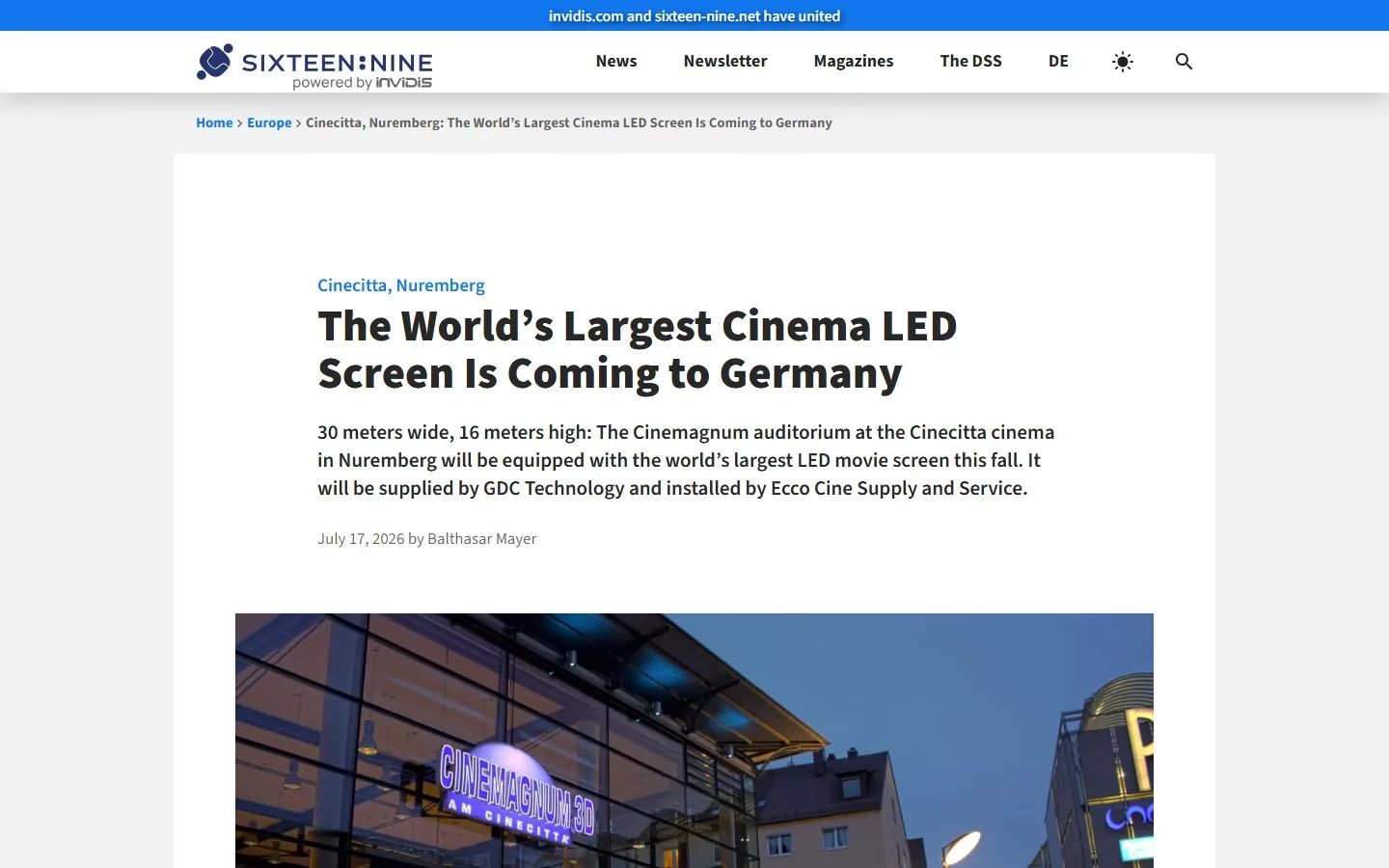
World’s largest: Cinecitta Nuremberg, Germany. A 30 m wide by 16 m high curved LED screen is being installed flush with the wall and ceiling of the Cinemagnum auditorium, completing in fall 2026. The 8K-plus surface uses microperforated LED panels that remain acoustically transparent — sound passes through the screen — while holding DCI Direct View HDR image quality. The screen is supplied by GDC Technology and Tricorne, installed by cinema integrator Ecco Cine Supply and Service, which also signed exclusive DACH-region distribution for Tricorne’s Premium LED line. Tricorne’s cinema LED launched only six months ago and has already been installed in 25 theaters worldwide.
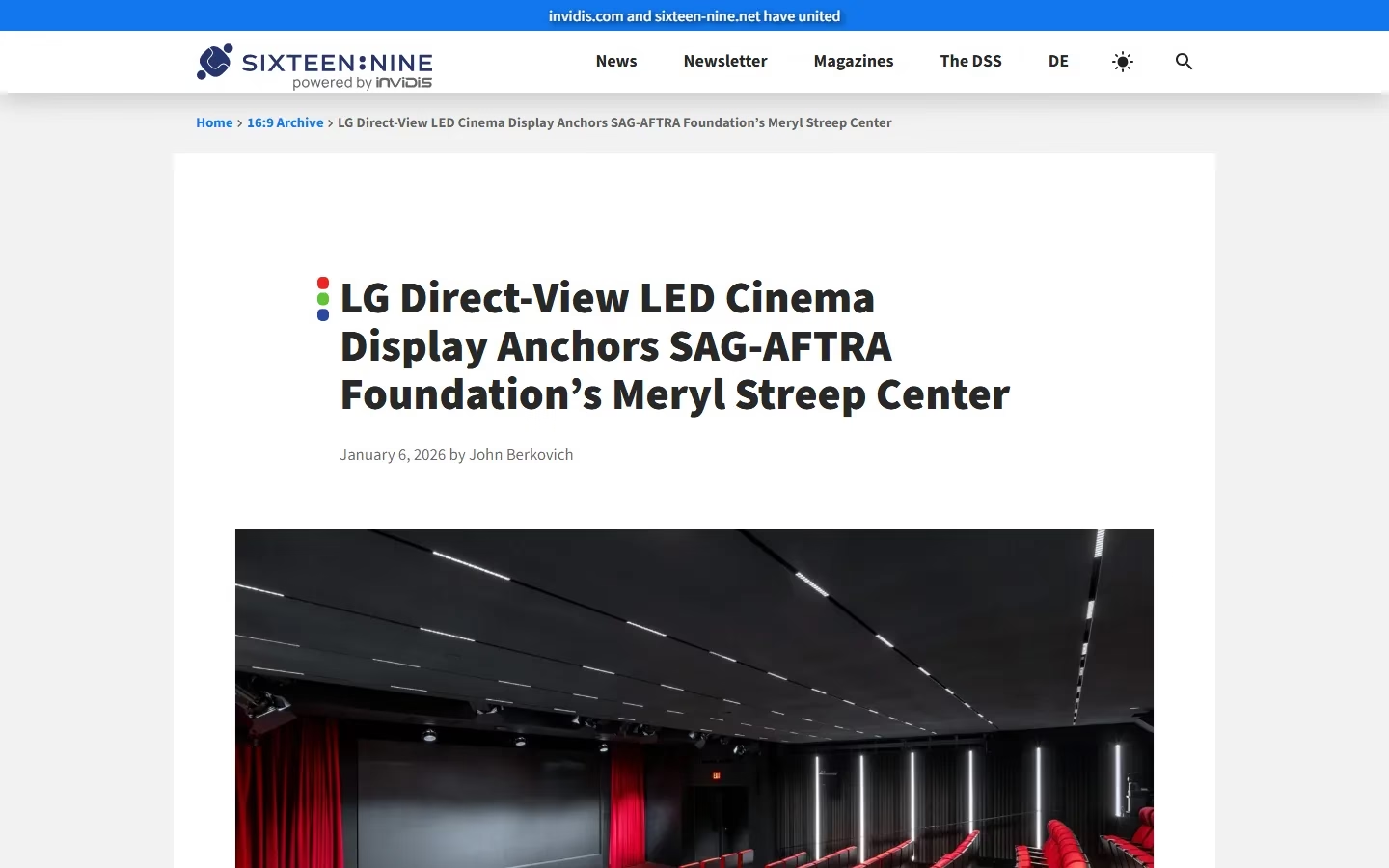
Premium large format: Samsung Onyx at 14 meters. At CinemaCon 2026, Samsung extended its Onyx Cinema LED line — the world’s first DCI-certified cinema LED, on screens since 2017 — with a 14-meter format for premium large-format auditoriums. Specs: up to 4K at 120 Hz, 300 nits peak, 3.3 mm pixel pitch, and a modular design scaling to 20 meters by adding cabinets. Onyx has also moved beyond multiplexes: the SAG-AFTRA Foundation’s new Meryl Streep Center in the United States is anchored by an LG direct-view LED cinema display — a cinema-grade wall in an institutional building, not a theater.
Compact tier: CINITY X at 171 and 228 inches. China Film Technology’s CINITY X, premiered at BIRTV in August 2026, is a DCI-certified LED display system in two sizes — 3.8 m (171-inch) and 5.1 m (228-inch) — that meets full DCI 4K (4096 × 2160) at 120 fps, 200,000:1 contrast, 100% DCI-P3, 1,000 nits peak, and DCI CTP 1.5.0 HDR direct-display certification. MIP packaging drives the pixel density; the built-in CINITY OS handles device and business integration; the panel doubles as a 4K 120 Hz/144 Hz gaming display. The “X” stands for boundary-free placement: home cinemas, conference venues, showrooms, and any space that wants theatrical HDR without a projector.
Why Are Chinese Companies Leading the LED Cinema Screen Rollout?
Chinese manufacturers lead on volume, not just price. AOTO Electronics reports 208 LED cinema screen orders signed cumulatively through June 30, 2026, with 118 delivered and deployments in nearly 50 cities worldwide — China, the UK, the United States, South Korea, Japan, Turkey, Mexico, and Finland among them. Its H1 2026 LED display revenue grew 60.04% year-on-year, cinema-related revenue rose 19.55%, and the company has raised 265 million RMB to build Micro LED COB smart-manufacturing capacity in Huizhou plus an R&D center for Micro LED home cinema, AI and XR virtual production, COG panels, and CPO control systems.
Three structural reasons explain the lead. First, packaging cost curves: the same MIP and COB economics that are scaling fine-pitch LED — covered in our LED packaging technology analysis and the COB LED display price 2026 report — apply directly to cinema panels, and China holds the largest share of that supply chain. Second, delivery density: 118 installed screens across 50 cities is a service-and-installation footprint no European or American brand matches yet. Third, policy tailwind: the June 2026 national policy converts a fragmented retrofit opportunity into a coordinated one, and cinema operators buying in volume prefer suppliers with verified theater-grade delivery records. The early-market state — analysts note that no single supplier has settled the market — is precisely where a delivery-led challenger overtakes an incumbent.
What Do LED Cinema Screen Specs Mean for Commercial Display Buyers?
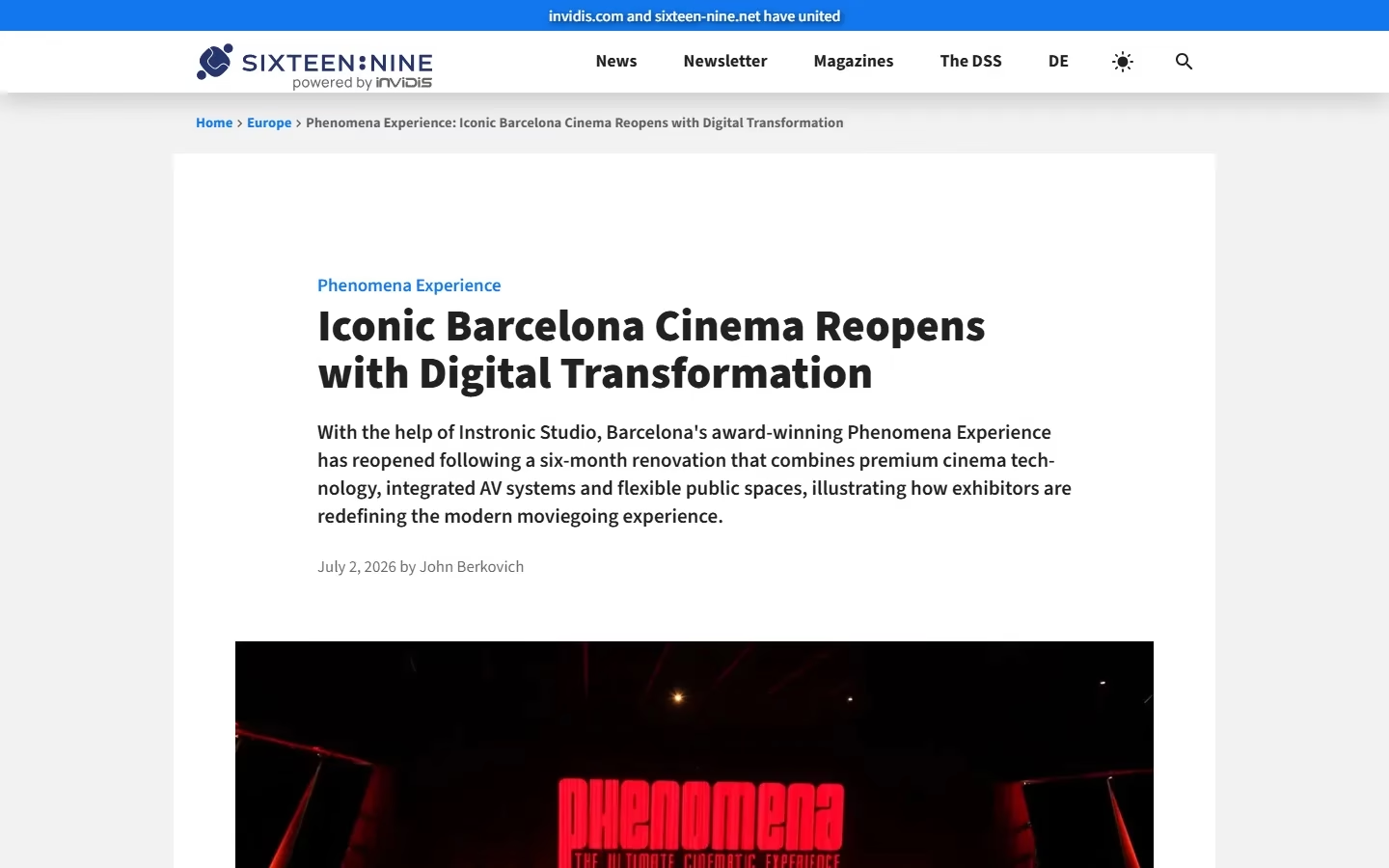
The cinema spec is now a commercial spec. CINITY X proves that DCI-grade direct-view — 200,000:1 contrast, 100% DCI-P3, HDR certification — can ship in a 171-inch package for a boardroom, a lobby, or a showroom, not just a 14-meter theater wall. The SAG-AFTRA Meryl Streep Center shows an institutional owner choosing a cinema-grade LED wall as the centerpiece of a building. And Barcelona’s Phenomena Experience reopened in July 2026 as a digital-transformation case study, replacing aging projection infrastructure with direct-view displays in a heritage building.
For commercial buyers, the practical implication is a new spec tier. A “cinema-grade” quotation now means DCI or CTP certification claims, 120 Hz-plus refresh, HDR direct-display support, and a service model built around 100,000-hour operation rather than lamp swaps. The same display you specify for a flagship showroom can double as a 4K 120 Hz gaming and conference surface — the reason CINITY X explicitly lists both. European venue projects such as Barcelona Phenomena show the retrofit path is open; the economics follow the same LED cost curve that already reset pricing on indoor LED walls and conference LED display solutions.
How Should Buyers Evaluate LED Cinema-Grade Displays in 2026?
A cinema-grade LED display is a direct-view LED wall whose specification — contrast, color gamut, refresh, HDR, certification — meets theatrical standards rather than signage standards. Five checks separate a real cinema-grade quotation from marketing:
- Ask which certification backs the claim. DCI CTP 1.5.0 HDR direct-display certification (as carried by CINITY X) or DCI-certified product history (Samsung Onyx since 2017) is verifiable; unspecified “cinema quality” is not.
- Read the contrast and color numbers. 200,000:1 contrast, 100% DCI-P3, and HDR direct-display capability are the 2026 floor for cinema-grade; brightness should be quoted in nits at peak, not in marketing multiples.
- Verify refresh and motion handling. 120 Hz at 4K is the cinema baseline; 144 Hz for interactive and gaming surfaces is now common in the compact tier.
- Check the service model. 100,000-hour rated life only matters if modules, power supplies, and calibration support exist in your region — ask for the local service footprint, not the global headquarters.
- Confirm the revenue model before the pixel model. The screen’s value includes non-ticket use — advertising, events, broadcasts. Require the control platform and input ecosystem that make alternate content operational.
Unifyled builds and supports cinema-format LED displays and fine-pitch direct-view walls for venues, showrooms, and premium commercial spaces, from the same factory-direct structure that carries buyers through the 2026 cost cycle: pre-stocked receiving cards and driver ICs, long-term supplier agreements, and in-house SMT, calibration, and aging lines. Whether a project needs a full venue wall, an indoor LED wall for a flagship space, or rental LED screens for event-based presentation, the quoting standard is the same: certified specs, documented cost components, and firm validity periods.
Spec a Cinema-Grade LED Display — Submit Your RFQ
Send your venue dimensions, viewing distance, and content plan, and Unifyled’s engineering team will return a cinema-grade quotation with certified specs, cost-component breakdowns, and firm validity periods. Projects range from full auditorium walls to conference LED display solutions, outdoor fixed LED displays, and showroom centerpieces.
Contact: unifyledscreen@gmail.com | WhatsApp: +86-191-18802497 | RFQ Form: unifyled.com/contact
References & Sourced From: LED Cinema Screen 2026 Coverage
This analysis draws on primary-source reporting, company announcements, and industry research. All figures have been cross-verified across at least two independent sources where available.
- invidis — “Cinecitta, Nuremberg: The World’s Largest Cinema LED Screen Is Coming to Germany” (July 17, 2026); “LG Direct-View LED Cinema Display Anchors SAG-AFTRA Foundation’s Meryl Streep Center” (January 6, 2026); “Phenomena Experience: Iconic Barcelona Cinema Reopens with Digital Transformation” (July 2, 2026). invidis.com
- SkyQuest Technology Consulting — “LED Cinema Screen Market Segment Analysis” (2026). skyquestt.com
- Samsung Business Insights — “LED vs. laser projection: The future of cinema” (April 17, 2026); CinemaCon 2026 Onyx 14-meter announcement. insights.samsung.com
- 紫光数字科技/扬子晚报 — “CINITY X等迎来首秀,中影科技亮相BIRTV2026” (August 2026). yangtse.com
- 中国照明网 — “奥拓电子拟募资2.65亿加码MicroLED COB” (August 2026). lightingchina.com.cn
- 搜狐/奥拓电子 — “奥拓电子2026半年报:LED显示收入暴涨60%” (August 2026). sohu.com
- OFweek 显示网 — “奥拓电子、福日电子发布上半年业绩” (August 2026). display.ofweek.com
Editorial disclaimer: This report has been compiled by the Unifyled Editorial Team from publicly available industry sources, official company announcements, and third-party research. Market data and project details referenced herein reflect information available as of August 24, 2026. This article does not constitute financial or procurement advice. Readers should verify current specifications and pricing directly with manufacturers before making purchasing decisions.
Author: Unifyled Editorial Team | Published: August 2026 | Category: LED Industry News, Cinema LED Displays
Related: World Cup 2026 LED Displays: Stadium-by-Stadium Project Data · LED All-in-One Display Market 2026 · LED Display Industry H1 2026 Earnings Roundup · CIOE 2026 LED Display Recap: Micro LED From Lab to Production Line