
Micro LED vs OLED: Which Display Technology Should You Choose in 2026?
The Micro LED vs OLED comparison starts with a naming problem. Both are self-emissive — every pixel makes its own light — but one is built from organic compounds that wear out, and the other from inorganic LEDs that do not. That single material difference decides brightness, lifespan, burn-in, and the sizes each technology can reach. This article compares the two technologies as they stand in 2026, sorts out the “Micro RGB” confusion that entered the market this year, and gives the decision rules for both consumers and commercial buyers. As an LED screen manufacturer, Unify LED builds the commercial side of this comparison — COB fine-pitch walls are the same Micro LED technology at larger scale.
Short answer: Under 97 inches, in a dark room, with mixed content, OLED is the better buy — cheaper, widely available, and the best dark-room picture in production. Above 110 inches, in bright light, or running static content 24/7, Micro LED wins — OLED physically stops at 97 inches, while Micro LED tiles to any size, sustains ten times the full-screen brightness, and carries no burn-in with a ~100,000-hour lifespan. Decide the size and the duty cycle first; the technology then chooses itself.
How Do Micro LED vs OLED Compare at a Glance?
| Parameter | OLED | Micro LED |
|---|---|---|
| Pixel material | Organic compounds | Inorganic LED chips (gallium-based) |
| Backlight | None — self-emissive | None — self-emissive |
| Practical size range | 42″ – 97″ single panels | Modular tiles — any size and shape |
| Sustained brightness | 200–400 nits full-screen (600–1,000 nits HDR peaks) | 1,000–3,000 nits typical; 4,500+ nits demonstrated in wearables |
| Lifespan to half-brightness | ~30,000–60,000 hours | ~100,000 hours |
| Burn-in | Yes — organic degradation under static content | None — inorganic LEDs do not retain images |
| Serviceability | Whole panel replacement | Module-level swap |
| Price position | Mass-market premium ($1,200 for 55″; ~$15,000–25,000 for 97″) | Ultra-premium / commercial (six figures for consumer TVs; per-square-meter for walls) |
Three rows in that table decide nearly every real-world purchase: size range (one technology stops at 97 inches), sustained brightness (the other wins by ten times), and lifespan (the difference between replacing the wall and keeping it). The rest of this article works through each row in the context of actual buying decisions. For the brightness units themselves, see our LED screen brightness article.
Five differences do most of the deciding:
- Size. OLED is a single panel that tops out at 97 inches; Micro LED tiles modules into any size and shape.
- Brightness. OLED sustains 200–400 nits full-screen; Micro LED sustains 1,000–3,000 nits — the gap that decides bright rooms and outdoor windows.
- Lifespan. OLED reaches half-brightness around 30,000–60,000 hours; Micro LED around 100,000 hours.
- Burn-in. Organic OLED pixels degrade unevenly under static content; inorganic Micro LED pixels do not retain images at all.
- Price. OLED is mass-market from about $1,200; Micro LED is ultra-premium for consumers and priced per square meter for commercial walls.
What Is the Difference Between Micro LED, Micro RGB, and Mini LED?
Before comparing further, one 2026 confusion needs to be cleared up, because the names have started colliding in retail.
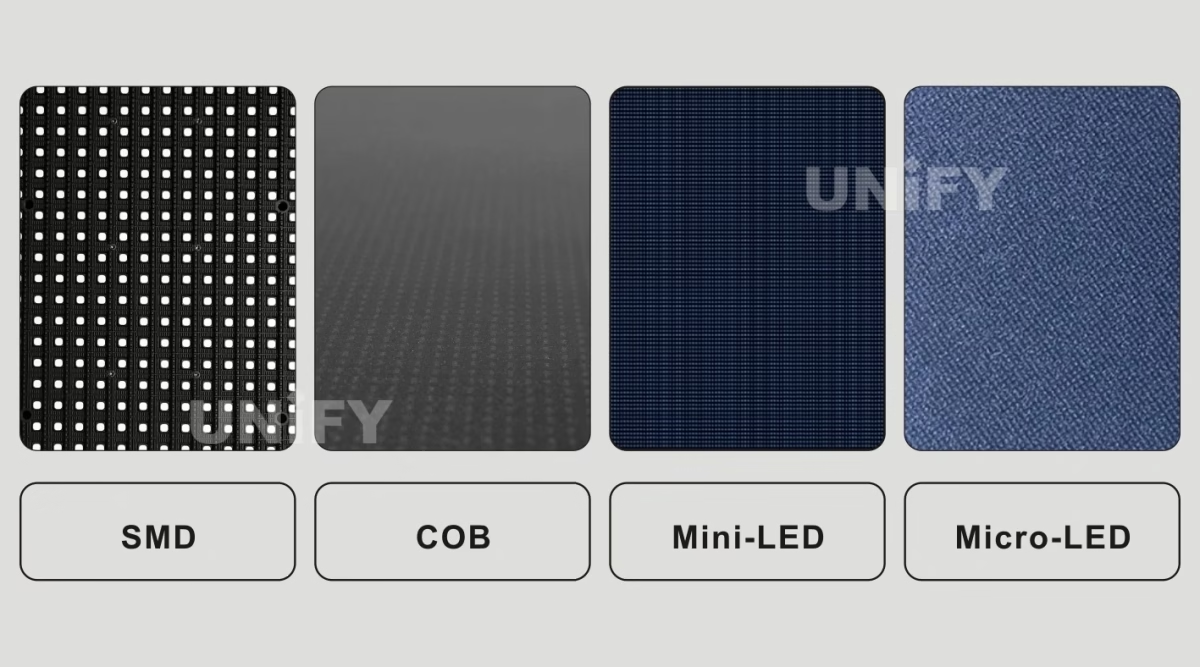
Micro LED is the real self-emissive technology: microscopic inorganic LED chips, each acting as its own pixel, transferred by the millions onto a substrate. It is the technology in Samsung’s 110-inch-plus modular TVs, Sony’s Crystal LED line, and commercial COB video walls.
Micro RGB LCD is an LCD television with a micro RGB LED backlight. Samsung’s R95H, Sony’s XR90M2, and LG’s MRGB95B — the “Micro RGB” models that competed against OLED in the Value Electronics 2026 TV shootout — are backlit LCD panels, not Micro LED displays. The backlight is micro-scale; the pixels are still liquid crystal. The naming collision is real, the technology gap is not small, and spec sheets that blur the two are worth a second read.
Mini LED is the older version of the same idea: an LCD with thousands of LED backlight zones for better local dimming. Mini LED, Micro RGB, and Micro LED are three different things, in that order of both price and capability. Our Mini LED vs QLED article covers the backlight side of that family.
How Does Each Technology Actually Work?
OLED (Organic Light-Emitting Diode) is a self-emissive display technology: each pixel is made of organic compounds that glow when current passes through them, with no backlight involved. That structure gives it the deepest blacks of any production display — an off pixel emits nothing. The same structure is the weakness: organic materials age, the blue sub-pixel ages fastest, and pixels that run brighter than their neighbors dim unevenly over time.
Micro LED is a self-emissive display technology built from microscopic inorganic LED chips, each acting as its own pixel — the same gallium-based material family as video wall LEDs, shrunk to chip scale. The engineering challenge moves to manufacturing: transferring millions of LED chips onto a substrate with near-perfect yield is expensive, which is why Micro LED remains an ultra-premium product while OLED is a mass-market one. The packaging technologies that make it commercial — COB and related chip-on-board processes — are covered in our LED packaging technology article.
On the performance margins, both technologies are fast: OLED response time is under a millisecond, and Micro LED, as a direct LED, is effectively instant — neither produces the motion blur that LCD panels do. Viewing angles are close too: premium OLED holds 178 degrees, while Micro LED and COB walls sit in the 160–170 degree range — a gap visible on a spec sheet and barely visible in a room.
Why Does OLED Win Below 97 Inches?
Under 97 inches, OLED is the market answer. It is available everywhere at every price point from $1,200 up — Omdia counted over 6 million OLED TV shipments in 2023 alone — and it is thin, light, and delivers the best dark-room picture of any production display. Its 600–1,000 nits of HDR peak brightness is more than enough for a home theater or a dim corporate room. The largest practical OLED is LG’s 97-inch flagship — panel yield above that size collapses, which is where the technology ends and Micro LED begins. For a living room, a gaming setup, or a broadcast reference monitor, OLED is the default choice in 2026 and will stay that way for years.
Why Does Micro LED Win Above 97 Inches and in Commercial Use?
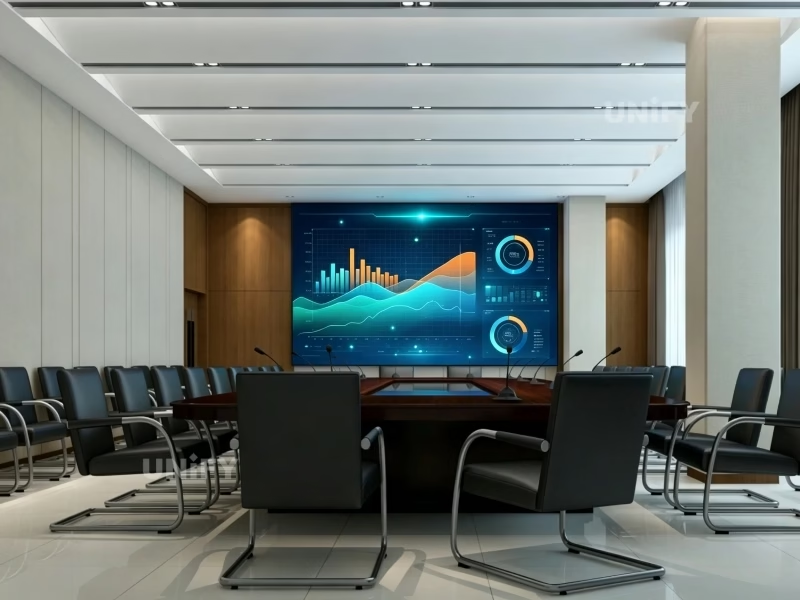
Above 97 inches, the question stops being close. Micro LED is modular — built from small tiles joined into any size and shape — so it scales from a 110-inch home cinema to a 30-meter stadium wall without a bezel. In commercial use the advantages compound: sustained brightness of 1,000–3,000 nits keeps content readable in storefronts and lobbies where an OLED’s 200–400 nits washes out; the inorganic LEDs run static logos and tickers 24/7 with no burn-in; and a failed module swaps out in minutes instead of replacing a whole panel. That is why commercial “Micro LED” installations are COB fine-pitch walls in practice — the same self-emissive LED technology at pitches from P0.6 to P1.2, which is exactly what our COB LED screen line builds. The pitch ladder decides the viewing distance: P0.9–P1.2 suits boardrooms viewed from two meters, P0.6–P0.7 suits control rooms and broadcast from arm’s length — the full scale is in our fine pitch LED display guide. The installation reality:
And the cabinet-level view, showing the modular serviceability OLED panels do not have:
How Big Is the Micro LED vs OLED Burn-In Gap in 2026?
Burn-in is the comparison’s most emotional question, and the physics has not changed. OLED pixels age as they emit; a static logo or ticker keeps the same pixels lit for thousands of hours, they dim faster than their neighbors, and the ghost of the logo becomes permanent. Manufacturers have pushed back hard — pixel-shifting algorithms, logo dimming, screen-saver routines, and improved materials have extended real-world life — but mitigation is not elimination. Micro LED has no organic material to age unevenly: static content produces no differential wear, which is the entire reason the technology owns 24/7 digital signage. For a home TV showing mixed content, OLED burn-in is a manageable risk; for a menu board, an airport schedule, or a broadcast ticker, it is a design error. The fine-pitch comparison that matters here is SMD vs COB vs GOB.
How Long Does Each Technology Last?
Lifespan follows the same material divide. OLED panels typically reach half-brightness around 30,000 to 60,000 hours, with the blue sub-pixel the limiting factor. Micro LED is rated around 100,000 hours to half-brightness. Translated into operating years at 12 hours of daily use: roughly 7 to 14 years for OLED, and roughly 22 years for Micro LED. The gap matters most in commercial accounting, where a wall’s five-year total cost includes the replacement the OLED would need and the Micro LED avoids — and the difference compounds when the content is static, which is the case that accelerates OLED aging and does not affect Micro LED at all.
What Do Micro LED vs OLED Cost at Common Sizes?
Price is where the two technologies live on different planets in 2026:
| Size target | OLED | Micro LED |
|---|---|---|
| 55″–65″ | $1,200–$3,500 — mass market | Not sold |
| 77″–83″ | $2,500–$8,000 | Not sold |
| 97″ | $15,000–$25,000 — largest OLED | Not sold |
| 110″–163″ | Not available | Six-figure modular TVs — the only option |
| Commercial walls (any size) | Not a product category | COB fine-pitch walls, priced per square meter — the standard commercial answer |
Two price rules follow. Below 97 inches, OLED is the entire market and Micro LED does not participate. Above 110 inches, Micro LED is the entire market and OLED does not participate. The overlap band is one size — roughly 97 to 110 inches — where a wealthy home buyer chooses between LG’s largest OLED and the entry modular Micro LED TVs, and where the brightness, lifespan, and burn-in advantages of Micro LED justify a six-figure price for buyers who expect the wall to outlast the house.
What Do Buyers Frequently Ask About Micro LED vs OLED?
Is Micro LED worth the price over OLED? Below 97 inches, no — OLED is better value by a wide margin. Above 110 inches, or for commercial 24/7 use, OLED is not an option at all, so the question answers itself.
Does Micro LED burn in? No. Inorganic LEDs do not retain images; static content produces no differential wear. This is the technology’s core commercial advantage.
Is Micro RGB the same as Micro LED? No. Micro RGB is an LCD backlight technology — the 2026 Samsung, Sony, and LG “Micro RGB” TVs are LCD panels. Micro LED is self-emissive.
Which is better for a home theater? OLED. The sizes, prices, and dark-room black levels all favor it, and mixed content keeps burn-in risk low.
Which is better for a business? Micro LED — as a COB video wall. Sustained brightness, no burn-in under static content, module-level repair, and any size from a lobby wall to a stadium.
When will Micro LED prices come down? TrendForce projections point to five to eight years for meaningful cost reduction as mass-transfer yield improves. Until then, the crossover stays around the 100-inch mark.
Are there Micro LED products that are not TVs? Yes — commercial COB fine-pitch walls, transparent displays, automotive panels, and the first wearables (the Garmin Fenix 8 Pro uses a Micro LED display).
Do both technologies support HDR? Yes. Consumer OLED supports HDR10 and Dolby Vision; Micro LED displays support HDR10 and HLG, with commercial COB walls pairing HDR processing from the controller side — the full HDR signal-chain conditions are in our 4K@60Hz, HDCP and HDR explained article.
Micro LED vs OLED: Which One Should You Choose? Final Verdict
The Micro LED vs OLED decision in 2026 is a size and duty question, not a picture-quality question. Under 97 inches, in a dark room, with mixed content: OLED, without debate — it is better, cheaper, and everywhere. Above 110 inches, in bright light, or running static content around the clock: Micro LED — because OLED physically stops where Micro LED begins. The middle is thin, and the buyer’s rule is simpler than the marketing: decide the size and the duty cycle first, and the technology chooses itself. One check closes the commercial side: if the content includes a static logo, a ticker, or a schedule board, the burn-in question alone eliminates OLED — and that single test answers most business purchases before the price sheet is ever opened.
For commercial Micro LED projects, send your wall dimensions and content plan through the Unify LED contact page — we will return the COB pitch, brightness, and size recommendation for the space.