
NovaStar Armor Series · Flagship Receiving Card
Novastar A8s LED Wall Receiving Card
512×384@60Hz flagship receiving card with exclusive LED Image Booster — 22bit+ grayscale (64× improvement), HDR10/HLG, any-angle rotation, LVDS transmission, and 5-fold hardware redundancy. EMC Class B compliant for the most demanding LED video wall installations.
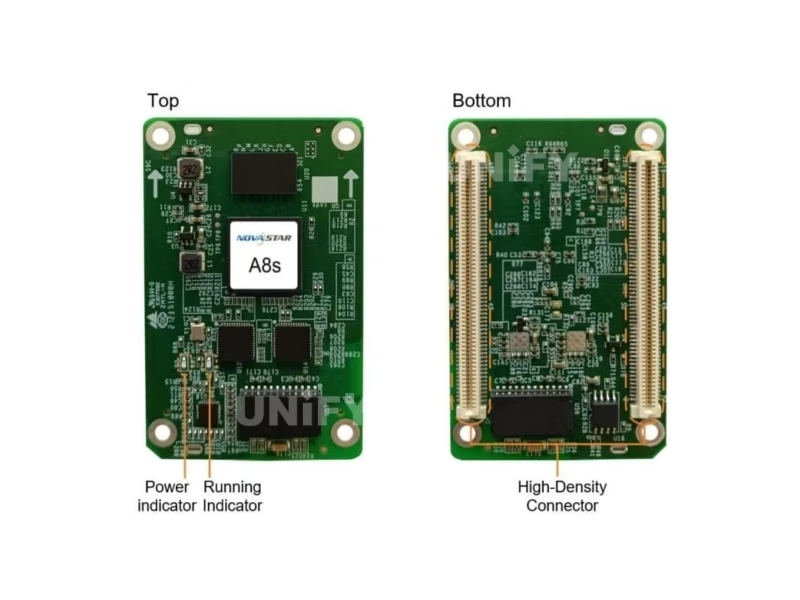
What Is the Novastar A8s LED Wall Receiving Card?
The Novastar A8s LED Wall Receiving Card is NovaStar’s flagship small-form-factor receiving card — part of the Armor Series — and the most technologically advanced option in NovaStar’s general-purpose receiving card lineup. A single card supports resolutions up to 512×384@60Hz with 32 groups of parallel RGB data (64 serial, expandable to 128), making it the highest-spec receiving card in its class.
What separates the A8s from every other receiving card is the LED Image Booster — NovaStar’s exclusive three-function image processing engine. It combines Color Management (real-time gamut switching between Rec.709/DCI-P3/Rec.2020), Precise Grayscale (individual correction of 65,536 grayscale levels per driver IC), and 22bit+ (64× grayscale improvement) into a single processing pipeline. The result: the smoothest gradients, the most accurate colors, and the deepest shadow detail of any NovaStar receiving card.
The A8s also supports HDR10 and HLG — the only general-purpose NovaStar receiving card with HDR capability — along with any-angle image rotation (when paired with the MCTRL R5 controller), LVDS transmission for reduced cabling, and a 5-fold redundancy architecture unmatched in the market. As a LED screen manufacturer supplying professional-grade control systems, we specify the A8s for projects where image quality is non-negotiable. For architecture comparison, see our guide on synchronous vs asynchronous LED control.
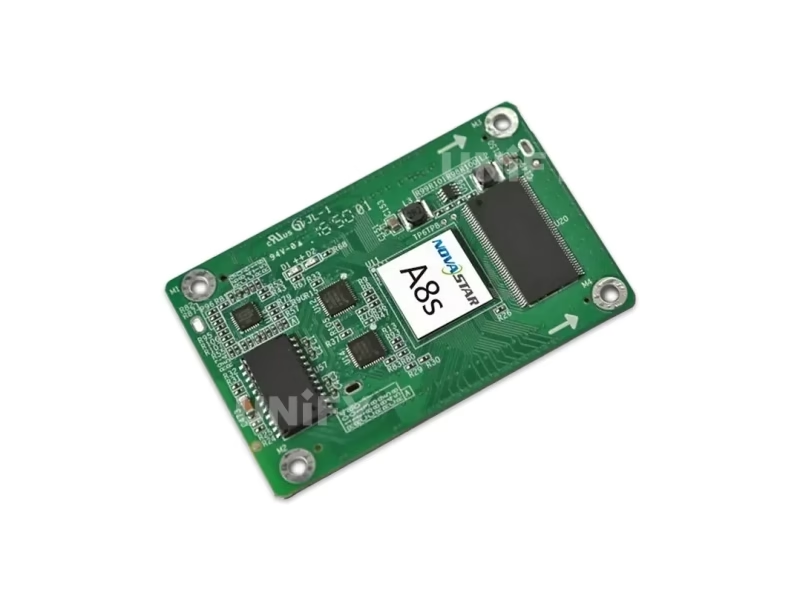
Novastar A8s LED Screen Receiving Card Technical Specifications
Verified against official NovaStar A8s Receiving Card Specifications V2.2.0 (November 2021)
| Parameter | Specification |
|---|---|
| Max Resolution | 512×384@60Hz |
| Image Processing Engine | LED Image Booster — Color Management + Precise Grayscale + 22bit+ |
| Grayscale Improvement | 22bit+ — 64× improvement (vs standard 8bit) |
| Precise Grayscale | Individual correction of 65,536 levels (16bit) per driver IC |
| HDR Support | HDR10 + HLG |
| Parallel RGB Data Groups | 32 (64 serial, expandable to 128) |
| Latency | 1 frame (PWM driver ICs with built-in RAM) |
| Image Rotation | 90° increments + Any-angle rotation (with MCTRL R5 + SmartLCT) |
| LVDS Transmission | Supported (dedicated firmware required) |
| 3D Function | Supported (with compatible sending card) |
| Input Voltage | DC 3.8 V to 5.5 V |
| Rated Current / Power | 0.6 A / 3.0 W |
| Dimensions | 70.0 × 45.0 × 8.0 mm |
| Net Weight | 17.3 g |
| Operating Temperature | –20°C to +70°C |
| Operating Humidity | 10%–90% RH, non-condensing |
| Certifications | RoHS, EMC Class B |
Novastar A8s LED Image Booster: Color Management, Precise Grayscale & 22bit+
The LED Image Booster is NovaStar’s exclusive image processing engine — exclusive to the A8s and A10s Plus. It addresses the three root causes of poor LED image quality: inaccurate color, inconsistent grayscale at low brightness, and visible banding in smooth gradients.
Color Management — Real-Time Gamut Switching
Freely switch the screen’s color gamut between Rec.709, DCI-P3, and Rec.2020 in real time. For broadcast studios using Rec.709 cameras, for digital cinema referencing DCI-P3, or for HDR content requiring Rec.2020 — the A8s adapts instantly, no external color processor needed. See our LED display grayscale guide for the full technical background.
Precise Grayscale — 65,536-Level Correction
Individually corrects each of the 65,536 grayscale levels (16bit) of the driver IC. Fixes brightness spikes, dips, color cast, and mottling at low grayscale conditions. This is the function that makes dark scenes in HDR content look smooth instead of blocky. NovaLCT V5.4.0+ required.
22bit+ — 64× Grayscale Improvement
Improves LED display grayscale by 64 times compared to standard 8bit processing. At low brightness — nighttime outdoor displays, dimmed indoor walls — standard cards lose visible grayscale steps, creating banding in skies and gradients. 22bit+ preserves smooth transitions at any brightness level. The key technology behind LED screen brightness optimization.
Novastar A8s LED Display Receiving Card Key Features: HDR, Calibration & Advanced Display Quality
Beyond the LED Image Booster, the A8s packs capabilities found on no other NovaStar general-purpose receiving card.
HDR10 + HLG Support
The only general-purpose NovaStar receiving card with HDR. Faithfully reproduces the original brightness range and color space of HDR video sources. HLG compatibility enables direct camera-to-display broadcast workflows. HDR content on outdoor outdoor LED screens maintains highlight detail even at 6,000+ nits.
Pixel-Level Calibration + Smart Module
Brightness and chroma calibration per pixel via NovaStar’s high-precision system. Smart module support: module ID management, coefficient storage, temperature/voltage/flat-cable monitoring, LED error detection, and run-time recording. Auto-uploads calibration from replacement modules on power-up — no recalibration after LED screen maintenance swaps.
1-Frame Latency + 3D + RGB Gamma
Video source latency reduced to 1 frame (PWM ICs with built-in RAM). 3D output with compatible sending card. Individual red/green/blue gamma adjustment — controls non-uniformity at low grayscale and white balance offset for lifelike imagery. NovaLCT V5.2.0+ required.
Novastar A8s Rotation & LVDS: Creative Display & Simplified Cabling
Two features unique to the A8s among NovaStar’s general-purpose cards — any-angle rotation for creative LED geometry, and LVDS transmission for clean, long-distance module connections.
Any-Angle Image Rotation
Beyond standard 90° increment rotation (0°/90°/180°/270°), the A8s supports rotation at any angle when paired with SmartLCT and the MCTRL R5 LED display controller. This enables diamond-pattern walls, angled architectural displays, and multi-orientation creative LED installations — all driven from a single receiving card type. For standard installations, 90° rotation works with any sending card.
Requires: SmartLCT + MCTRL R5 controller for any-angle mode. Standard 90° rotation works with all NovaStar sending cards.
LVDS Transmission
Low-Voltage Differential Signaling (LVDS) reduces the number of data cables from the hub board to each module, increases maximum transmission distance, and improves signal quality and electromagnetic compatibility (EMC). For fine-pitch indoor LED display screens with dense cabinet layouts, LVDS simplifies internal wiring dramatically — fewer cables, fewer failure points, cleaner installation.
Requires: Dedicated firmware program. Not available on A5s or A5s Plus.
Novastar A8s 5-Fold Redundancy Architecture: Unmatched Reliability
The A8s is the only NovaStar receiving card with five independent redundancy mechanisms. In mission-critical installations — broadcast, control rooms, stadiums — a single-point failure at the receiving card level is not acceptable.
Dual Card Backup
Two cards on one hub board. Primary fails → backup takes over immediately. Status monitored in NovaLCT.
Loop Backup
Cards + sending card form loop. Cable fault anywhere → signal reaches via redundant path. Indicator flashes 8×/0.5s when active.
Dual Program
Two firmware copies at factory. Update fails → backup program loads. Prevents bricking.
Dual Config
Parameters stored in app + factory areas. Restore factory defaults if application config corrupted.
Dual Calibration (A8s Only)
Calibration coefficients stored in app + factory areas. A5s Plus lacks this — unique to A8s.
Novastar A8s vs A5s Plus: Which Receiving Card Should You Choose?
Both cards share the same 512×384 resolution and 32-parallel data architecture. The differences are entirely in image processing, rotation capability, cabling, and redundancy depth.
| Feature | A5s Plus | A8s |
|---|---|---|
| Max Resolution | 512×384@60Hz | 512×384@60Hz |
| Grayscale Engine | 18bit+ (4×) | 22bit+ (64×) |
| LED Image Booster | No | Yes (3-function) |
| Precise Grayscale | No | 65,536-level correction |
| HDR Support | No | HDR10 + HLG |
| Image Rotation | 90° increments | Any angle (with MCTRL R5) |
| LVDS Transmission | No | Yes |
| Redundancy Depth | 4-fold | 5-fold (+calibration backup) |
| Dimensions | 70.0×45.0×8.3mm | 70.0×45.0×8.0mm |
| Best For | General professional LED walls | Broadcast, HDR, creative displays, 24/7 mission-critical |
Decision rule: If your project involves HDR content, creative/non-standard display geometry, broadcast cameras, or 24/7 operation where any downtime is unacceptable → choose the A8s. If you need professional calibration and reliability at the best price-to-performance ratio → the A5s Plus remains an excellent choice.
Novastar A8s Indicator Diagnostics & Health Monitoring
The single green Running indicator provides 6 distinct patterns for field diagnosis. Combined with bit error detection, temperature/voltage monitoring, and dual power supply status detection — zero external tools needed.
| Indicator | Color | Pattern | Meaning |
|---|---|---|---|
| Running | Green | Flash 1×/1s | Normal — Ethernet OK, video source available |
| Running | Green | Flash 1×/3s | Ethernet connection abnormal |
| Running | Green | Flash 3×/0.5s | Ethernet OK, no video source |
| Running | Green | Flash 1×/0.2s | Backup firmware active |
| Running | Green | Flash 8×/0.5s | Loop backup active |
| Power | Red | Always on | Power input normal |
Novastar A8s Software & Calibration: NovaLCT + SmartLCT
The A8s requires NovaLCT V5.4.0+ for LED Image Booster functions. SmartLCT is required for any-angle rotation with the MCTRL R5.
NovaLCT V5.4.0+ (Windows)
Configure receiving card parameters, LED Image Booster settings, upload calibration coefficients, manage rcfgx files, monitor card health. Free from NovaStar software downloads.
SmartLCT (Rotation)
Required for any-angle rotation with MCTRL R5 controller. Enables creative display geometry — diamond patterns, angled walls, multi-orientation installations. Standard 90° rotation works with NovaLCT alone.
Health Monitoring Suite
Bit error detection, temperature/voltage monitoring, dual power supply status, cabinet LCD data, Ethernet port quality. All accessible from NovaLCT — no external diagnostic hardware required.
Novastar A8s Application Scenarios: Where the Flagship Receiving Card Excels
Broadcast Studios & HDR Production
HDR10/HLG support + 22bit+ grayscale + 1-frame latency. The only NovaStar receiving card combining HDR and broadcast-grade low latency. HLG enables direct camera-to-wall workflow. The definitive choice for studio indoor LED display screens used on camera.
Stadiums & 24/7 Mission-Critical Walls
5-fold redundancy — dual card + loop + program + config + calibration backup. No other receiving card offers this depth of failover protection. For LED screen installations where downtime is not an option.
Creative & Architectural LED Displays
Any-angle rotation + LVDS transmission. Diamond walls, angled facades, multi-orientation installations — all driven by one card type. LVDS reduces cabling complexity in dense layouts. Pair with MCTRL R5 for full creative capability.
Premium Corporate & Retail LED Walls
22bit+ and Precise Grayscale deliver visibly superior image quality at close viewing distances. Color Management ensures brand colors display accurately across all screens. For lobbies, flagship stores, and executive boardrooms where image quality is the brand.
Why Source Your Novastar A8s from UnifyLED?
The A8s is NovaStar’s flagship receiving card. Your supplier determines whether you receive genuine, batch-tested cards with full firmware and calibration support.
Genuine Armor Series — Factory-Direct
As a professional LED screen manufacturer and NovaStar distributor, every A8s card is sourced directly from NovaStar’s production line. Original blister packaging, latest firmware, never grey-market or refurbished.
Batch QC + LED Image Booster Verification
10% per-batch testing includes: power-on indicator pattern verification, Ethernet communication test, calibration coefficient upload, and 22bit+ grayscale gradient test. Full-batch testing available for 10+ box orders.
Image Booster Configuration Support
Color Management gamut setup, Precise Grayscale correction profiles, and 22bit+ calibration workflows — our engineering team provides direct support for A8s-specific features that other suppliers can’t help with.
Bulk Order Logistics
80 cards per factory packing box. Volume pricing for 10+ boxes. Worldwide shipping from Shenzhen with full customs documentation. Express 5–10 days, economy 15–25 days.
Novastar A8s Pricing & Bulk Order Information
What’s Included
- Original NovaStar A8s (latest firmware)
- Blister-packaged individually
- 80 cards per factory packing box
- Batch QC + Image Booster verification
- Rcfgx file preparation support
- Lifetime technical support
Get Your A8s Quote
Response within 2 hours (GMT+8)
unifyledscreen@gmail.com
WhatsApp / Phone
+86-191-18802497
Frequently Asked Questions About the Novastar A8s LED Wall Receiving Card
What is the LED Image Booster and how does it improve image quality?
The LED Image Booster is NovaStar’s exclusive three-function processing engine available only on the A8s and A10s Plus. It combines Color Management (real-time gamut switching), Precise Grayscale (65,536-level correction), and 22bit+ (64× grayscale improvement). Together they deliver more accurate colors, smoother gradients, and deeper shadow detail than any other NovaStar receiving card.
What is the difference between the A8s and A5s Plus?
The A8s adds: LED Image Booster (22bit+ vs 18bit+), HDR10/HLG, any-angle rotation (with MCTRL R5), LVDS transmission, precise grayscale correction, and a 5th redundancy layer (calibration coefficient backup). See the comparison table above for full detail.
Does the A8s support HDR content?
Yes — HDR10 and HLG. It is the only general-purpose NovaStar receiving card with HDR support. Requires a sending card that supports the HDR function to correctly parse HDR video sources.
Can the A8s rotate images at any angle?
Yes — standard 90° increment rotation works with any NovaStar sending card. Any-angle rotation requires SmartLCT software and the MCTRL R5 LED display controller.
What software do I need to configure the A8s?
NovaLCT V5.4.0+ (Windows) for LED Image Booster functions and standard configuration. SmartLCT for any-angle rotation with MCTRL R5. Both are free downloads from novastar.tech.
Can the A8s work with non-NovaStar sending controllers?
No. Like all NovaStar receiving cards, the A8s communicates using NovaStar’s proprietary protocol and requires a NovaStar sending controller.
What are the power requirements?
DC 3.8V to 5.5V input. Rated current: 0.6A. Rated power consumption: 3.0W. Recommended power input is 5.0V.
Ready to Source the Novastar A8s LED Wall Receiving Card?
LED Image Booster. 22bit+ grayscale. HDR10/HLG. Any-angle rotation. 5-fold redundancy. Factory-direct pricing, Image Booster configuration support, global logistics.
unifyledscreen@gmail.com | +86-191-18802497
Technical Deep-Dive
LED Image Booster & HDR: How Receiving Card Technology Defines LED Display Quality — The Novastar A8s Engineering Analysis
Published: August 2026 | 10 min read | UnifyLED Engineering Team
LED display quality is not primarily determined by LED modules. It is determined by the receiving card — specifically, by what the card does to the video signal between receiving it from the sending controller and outputting it to the driver ICs. Most B2B buyers evaluate modules by pixel pitch, brightness, and refresh rate, but those are module specifications. What the audience actually sees — color accuracy, gradient smoothness, shadow detail, motion clarity — is overwhelmingly a function of receiving card processing quality. The A8s, with its exclusive LED Image Booster engine, represents the current ceiling of what a NovaStar receiving card can do to a video signal. This article analyzes the three Image Booster functions, quantifies the visual impact of 22bit+ vs standard processing, and explains why HDR on an LED wall requires hardware-level receiving card support — not just an HDR-capable video source.
The Signal Chain: Where Image Quality Is Won or Lost
The video path in an LED display is: source → sending controller → Ethernet → receiving card → driver IC → LED. The receiving card sits at the critical junction: it receives a digital video stream, decodes it, applies calibration and processing, and outputs pixel-level signals to the driver ICs. A cheap receiving card with basic 8-bit processing discards information at this stage — information that no amount of module quality can recover. The A8s’s 22bit+ processing preserves 64 times more grayscale information than standard 8-bit cards. For a premium retail display viewed from 2 meters, this is the difference between a sky gradient that looks smooth and one that shows visible bands. For more on the fundamentals, see our guide on LED display grayscale.
Why HDR on LED Requires Hardware-Level Receiving Card Support
HDR10 and HLG are not just “brighter” — they use perceptual quantization (PQ) and hybrid log-gamma curves that require the receiving card to correctly interpret metadata and map the extended brightness range to the LED’s physical capabilities. A standard receiving card receiving an HDR signal will either clip highlights, crush shadows, or misinterpret the color space entirely. The A8s’s hardware HDR pipeline ensures faithful reproduction of the original brightness range and color space. For outdoor advertising, this means HDR content maintains specular highlight detail even when the display is running at 6,000+ nits. For LED display refresh rate and processing, receiving card capability is the limiting factor — not the sending card.
22bit+ Quantified: What 64× Grayscale Actually Means
An 8-bit signal has 256 levels per color channel. At 100% brightness, all 256 levels are visible. At 20% brightness — typical for nighttime outdoor operation — only about 50 levels remain visible. The human eye can detect banding when adjacent grayscale steps differ by more than ~2%. With only 50 levels, adjacent steps differ by 2% on average — right at the threshold of visible banding. 22bit+ processing effectively quadruples the bit depth to 22 bits = ~4.2 million levels. Even at 20% brightness, ~840,000 levels remain available — far beyond the human eye’s ability to detect banding. The result: perfectly smooth gradients at any brightness, on any display size. For a comprehensive analysis of visual parameters, see our LED screen brightness guide.
Download the Novastar A8s LED Wall Receiving Card Specifications
Official NovaStar A8s datasheet V2.2.0. Includes LED Image Booster specifications, pinout diagrams, dimension drawings, and indicator patterns.
Explore the Complete Novastar Controller & Receiving Card Range
From receiving cards to multimedia players and sending controllers.
Receiving Cards
Resources
unifyledscreen@gmail.com | +86-191-18802497 | Worldwide Shipping