
COB vs MIP: Which LED Packaging Technology Should You Choose in 2026?
The COB vs MIP comparison is the fine-pitch industry’s main event in 2026. Both are packaging routes for direct-view LED modules — two different answers to the same question of how to pack millions of pixels into a board — and the LED industry has settled on both as its two primary paths forward. COB, chip-on-board, is the proven incumbent: bare chips bonded straight onto the board and sealed in resin, the reliability leader. MIP, Micro LED in Package, is the challenger: micro chips pre-packaged into surface-mount units, combining fine-pitch capability with SMD-style repairability. This article compares the two from a buyer’s perspective — structure, pitches, repairs, and what is actually available to purchase today. As an LED screen manufacturer, Unify LED builds COB fine-pitch walls as its current commercial line and tracks MIP’s ramp closely.
Short answer: Buy COB for mission-critical fixed installations today — it is the reliability and durability leader, proven at P0.4–P2.0, with module-level repair that any technician can do. Buy package-level MIP if field repairability at the pixel level matters and the project sits at P1.2–P3.0, where MIP is in commercial production now. Treat chip-level MIP — the sub-P0.4 frontier — as a 2027–2028 roadmap, not a purchase. The honest 2026 rule: COB is what you can rely on today; MIP is the route that will matter more every year after.
How Do COB vs MIP Compare at a Glance?
| Parameter | COB (Chip-on-Board) | MIP (Micro LED in Package) |
|---|---|---|
| Structure | Bare chips bonded directly to the PCB, sealed in resin | Micro chips pre-packaged into SMT-compatible units |
| Commercial pitch range | P0.4 – P2.0 | P1.2 – P3.0 (package-level, now); sub-P0.4 (chip-level, 2027–28 roadmap) |
| Chip size | Typically above 100 µm | Can encapsulate below 60 µm |
| Repair | Module-level swap (~200×200 mm), no special tools | Pixel-unit level, specialist tools and trained technician |
| Protection | IP54, 5H-hardness surface | IP54 |
| Contrast | 10,000:1+ | 10,000:1+ |
| HDR / wide color | BT.709 standard | HDR10, BT.2020 — needs high-end controller hardware |
Five differences do most of the deciding:
- Repair granularity. COB replaces a whole module; MIP can replace one pixel unit — with specialist tooling.
- Production maturity. COB is a proven commercial process; package-level MIP is ramping, chip-level MIP is a roadmap.
- Pitch frontier. COB holds the fine-pitch crown today; MIP’s chip-level route is how the industry plans to go below P0.4.
- Chip size. COB works with chips above roughly 100 microns; MIP packaging accepts chips below 60 microns.
- Ecosystem cost. COB runs on standard NovaStar-class controllers; MIP’s full HDR performance asks for the high-end controller tier.
What Do COB and MIP Actually Mean?
COB (Chip-on-Board) is an LED packaging method in which bare LED chips are mounted directly onto the printed circuit board, wire-bonded, and encapsulated in resin as one integrated unit — no individual lamp packages, no brackets, just a sealed chip surface.
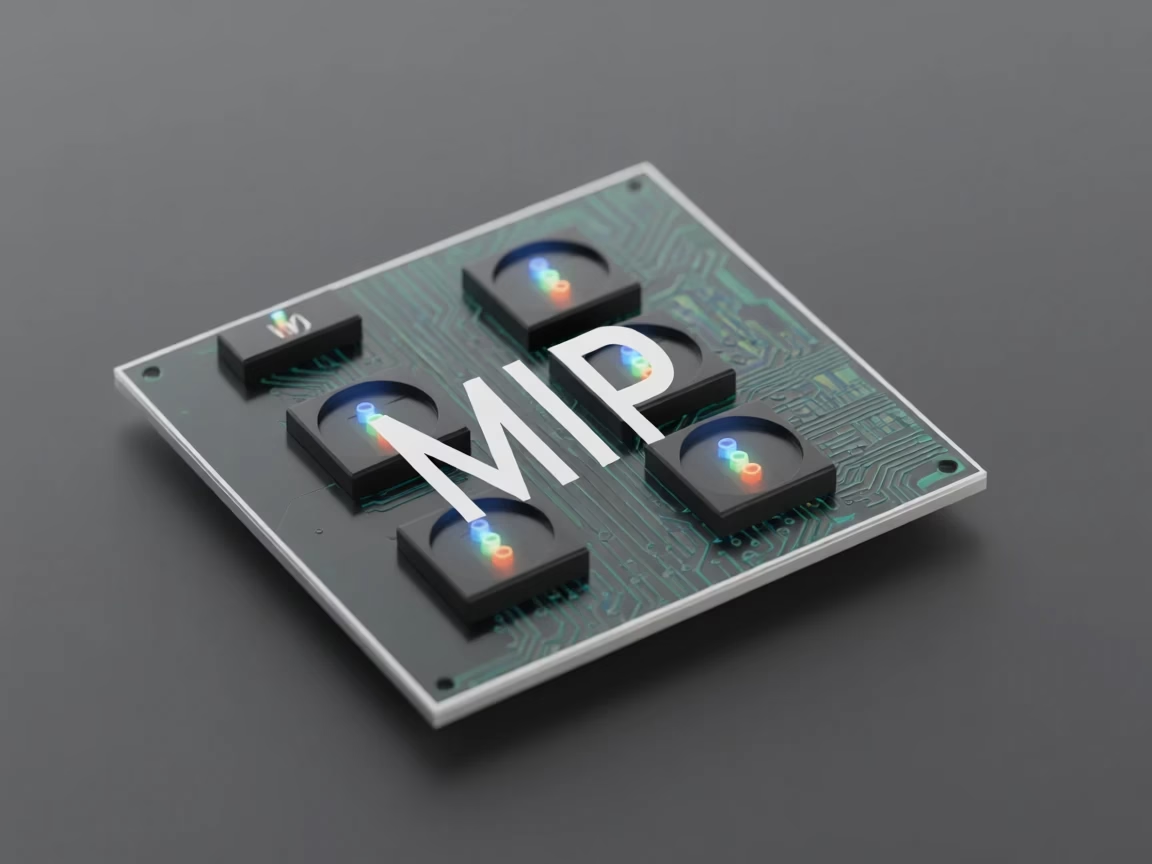
MIP (Micro LED in Package) is an LED packaging method in which micro-scale LED chips are first packaged into small surface-mount-compatible units, then placed onto the board with standard SMT assembly — a “whole-to-individual” approach that gives each pixel unit its own package while keeping fine-pitch density. The broader packaging family — SMD, GOB, IMD, and how they relate — is mapped in our LED packaging technology article.
How Does Each Technology Actually Work?
COB’s process is direct: chips are bonded to the board, connections are wire-bonded in place, and the entire surface is sealed under epoxy. The result behaves like one solid component — nothing exposed, nothing to knock off, and a flat black surface that reads as high contrast. Its cost profile is manufacturing-side: repairability is deliberately traded for durability, and the smallest practical chip size sits around 100 microns because the wire-bonding and encapsulation steps get harder below that.
MIP’s process is staged: micro chips are mass-transferred into individual packages first, each unit is inspected and binned the way SMD lamps are, and the packaged units are assembled onto the board through ordinary SMT lines. That staged structure is MIP’s entire commercial logic — it reuses the SMD industry’s existing production and repair infrastructure while pushing toward finer pitches, and it accepts chips below 60 microns that COB’s direct-bonding process cannot handle.
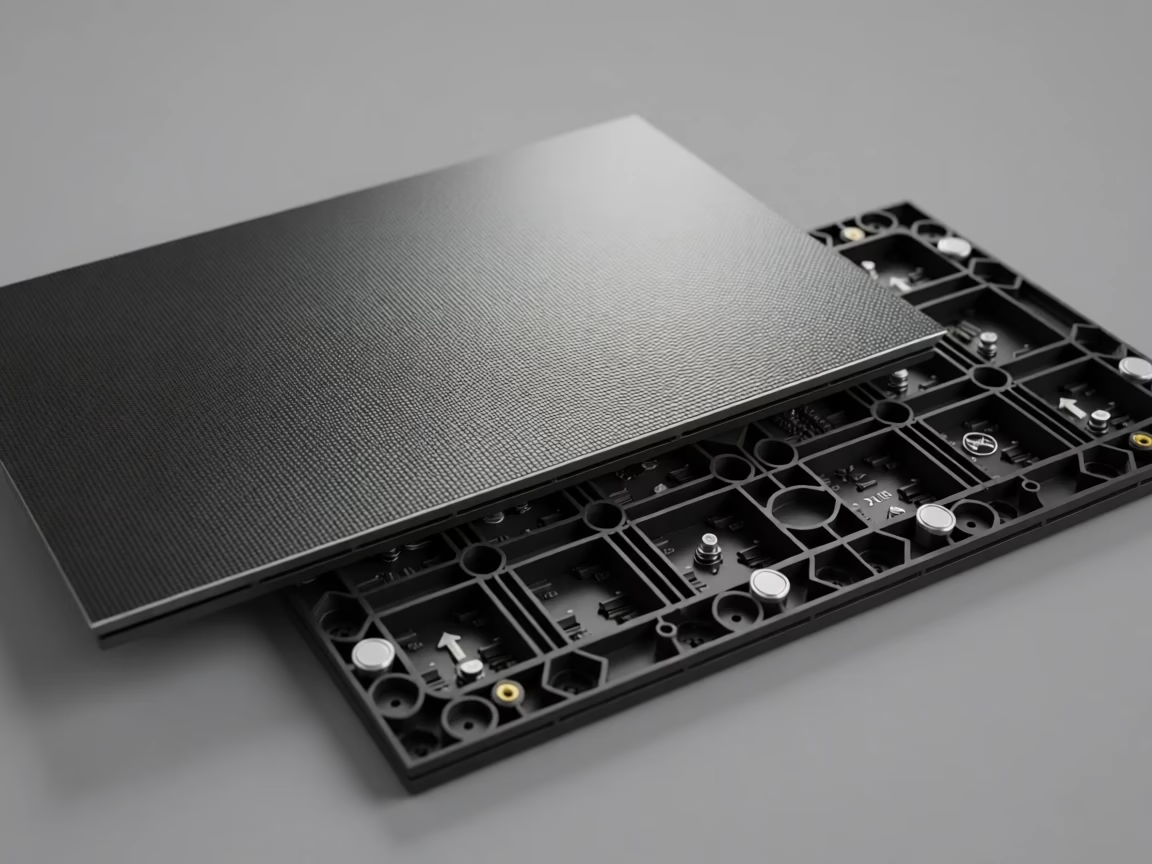
The COB side in production — this is the Pro Max COB line on the assembly floor:
Why Did ISLE 2026 Declare COB and MIP the Two Main Routes?
At ISLE 2026, the industry’s flagship trade show, the major LED manufacturers — Unilumin, Leyard, Absen, and the Shenzhen brands — devoted their premium floor space almost entirely to COB and MIP products, and the show floor settled the debate: SMD remains for coarse pitches, and fine pitch belongs to these two. The manufacturer statements carried the same split. On MIP: “MiP offers many advantages including light mixing, uniformity, low cost of repairs, and reduced difficulty for spot testing. COB can only encapsulate chips with bilateral size greater than 100μm, while MiP can encapsulate chip sizes below 60μm.” On COB: it remains “the absolute leader in reliability and stability.” Two routes, two engineering bets — and the market now treats both as legitimate answers.
For a buyer, the ISLE consensus has one practical meaning: both technologies now carry a competitive supplier base, so neither choice strands a project on a single vendor. The question is no longer “which technology will survive” — both will — but “which one matches the pitch, the service model, and the budget,” which is the framework the rest of this article uses.
Which Pitches Does Each Technology Serve Today?
The pitch map is where the practical decision lives. COB is commercial from P0.4 to P2.0 — which is why it owns boardrooms, broadcast studios, and control rooms. Package-level MIP is commercial from roughly P1.2 to P3.0, overlapping COB’s upper range and extending upward into SMD territory. Chip-level MIP — the route that would push below P0.4 — remains in development, with industry production targets pointing at 2027 to 2028. A buyer reading spec sheets should translate that map into one question: is the pitch I need available from this technology today, or is it on the roadmap?
One naming detail completes the map: COB below P0.9 is usually sold as “Micro COB,” standard COB covers P1.0 to P2.0, and both live in the same fine-pitch product family covered by our fine pitch LED display guide — while the chip-size question that separates these packages from their Mini LED cousins is in Mini LED vs Micro LED.
How Do Repairs Actually Work in the Field?
Repairability is where the two technologies invert their strengths, and the field reality matters more than the spec sheet. A COB module fails, you swap the module — roughly 200 by 200 millimeters — with a magnetic tool in minutes, and the spare modules ship with the wall. A MIP panel with one dead pixel can be repaired at pixel-unit level, which sounds better until the conditions are counted: the repair needs specialist tooling and a trained technician, not a stagehand. The trade-off is honest on both sides: COB spends a whole module to fix one pixel; MIP saves the module but spends skill and equipment. For rental fleets with trained crews, MIP’s granularity wins; for fixed installs serviced by local integrators, COB’s five-minute module swap is the safer economics.
The five-year numbers follow the same logic. A COB wall keeps repair costs predictable: a spare module stock of a few percent of the wall covers failures, and any on-site technician executes the swap. A MIP wall pushes repair cost into the service contract — the specialist tooling and trained technician are real line items — but spends less hardware per failure. Projects that can staff a trained crew amortize MIP’s advantage; projects that cannot should price COB’s module spares into the quote instead.
How Do Image Quality and Protection Compare?
On the headline numbers the two are close: both reach 10,000:1-class contrast, both carry IP54 protection, and COB’s 5H-hardness resin surface remains the durability benchmark. The differences sit in the fine print. MIP claims HDR10 and BT.2020 wide color where COB lists BT.709 standard — but MIP’s full HDR ceiling requires the high-end controller tier, Brompton-class or top NovaStar hardware, so the display-side capability only materializes when the signal chain pays for it. COB’s sealed surface also keeps its advantage against physical contact and cleaning, which is why it remains the default for touch-heavy and high-traffic spaces. For the controller side of that HDR chain, see our 4K@60Hz, HDCP 2.2 and HDR article.
What Should You Buy for a Project in 2026?
The decision framework is four questions. First, pitch: under P0.9, COB is the only commercial answer today. Second, environment: mission-critical fixed installs, touch-heavy or high-traffic spaces point to COB’s sealed durability. Third, repair model: fleets with trained technicians who can exploit pixel-level repair should look at package-level MIP; everything else leans COB’s module swap. Fourth, timeline: if the project spec demands sub-P0.4, the honest answer is to wait for chip-level MIP rather than force a purchase. On our side, the current commercial line is COB — the COB LED screen series — with MIP availability tracked as it ramps.
What Do Buyers Frequently Ask About COB vs MIP?
What does MIP stand for? Micro LED in Package — micro-scale LED chips pre-packaged into surface-mount units before board assembly.
Is MIP better than COB? Not across the board. MIP leads on pixel-level repairability, color uniformity, and sub-60-micron chip capability; COB leads on durability, proven reliability, and fine-pitch availability today. The application decides.
Which is cheaper? At overlapping pitches the prices run close, with COB generally ahead on mature production yields and MIP betting on SMT infrastructure reuse. The five-year cost picture includes repair economics, where the two diverge as described above.
Can MIP panels be repaired on site? Yes, at pixel-unit level with specialist tooling and a trained technician — more granular than COB’s module swap, but more demanding of skill.
Does MIP work with standard LED controllers? Package-level MIP runs on standard NovaStar-class controllers. Its full HDR10 and BT.2020 performance requires the high-end controller tier.
What happened to SMD? SMD remains the standard for coarse pitches and rental mainstream. The fine-pitch side of the market has moved to COB and MIP — the split covered in SMD vs COB vs GOB.
When will chip-level MIP arrive? Industry production targets point to 2027–2028 for sub-P0.4 mass production. Until then, the commercial MIP story is the package-level line at P1.2 and above.
Is Micro COB different from COB? Micro COB is COB below P0.9 — the same chip-on-board process pushed to finer pitch. Standard COB covers P1.0 to P2.0. The two share structure, protection, and module-level repair.
COB vs MIP: Which One Should You Choose? Final Verdict
The COB vs MIP decision in 2026 resolves by what the project needs to be: reliable today, or repairable at the frontier. COB is the choice for mission-critical fixed installations — proven at every fine pitch the market sells, sealed against the environment, and repairable by any technician with a spare module. Package-level MIP is the choice where pixel-level repair and SMT-ecosystem economics matter, at P1.2 and above. Chip-level MIP is the industry’s next act, not this year’s purchase. Buy what is proven, watch what is ramping, and let the pitch and the repair model — not the marketing — pick the technology.
For fine-pitch LED wall projects, send the pitch, environment, and service model through the Unify LED contact page — we will return the packaging and controller recommendation that matches the project’s real operating conditions.