
Mooncell · 2-in-1 Processor for Small & Mid-Size Walls
Mooncell MVB4S Pro 2-in-1 LED Video Processor
The Mooncell MVB4S Pro 2-in-1 LED Video Processor combines a video processor and a sending card in one unit: 4 Gigabit Ethernet outputs, a 2.6-million-pixel loading capacity, a 3840×1920 canvas, dual-picture display and quick screen mapping that configures the wall without a PC.
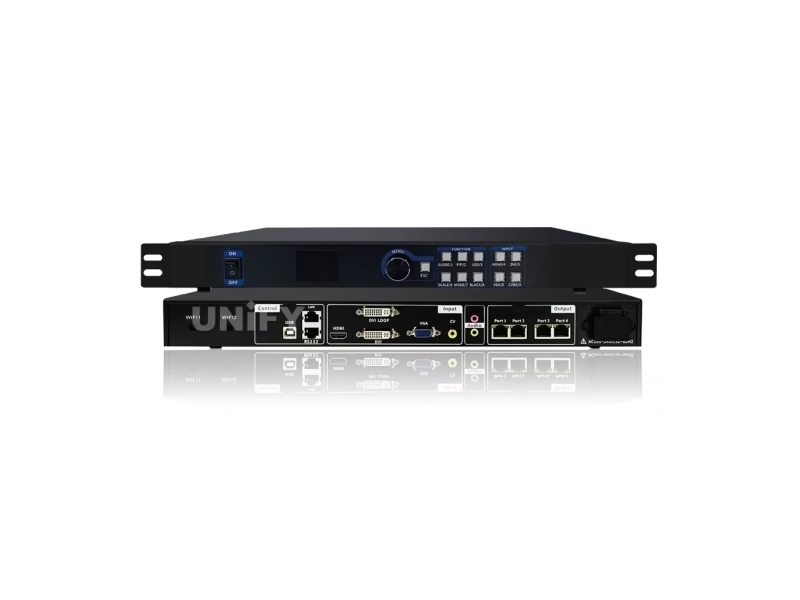
Product Overview
What Is the Mooncell MVB4S Pro 2-in-1 LED Video Processor?
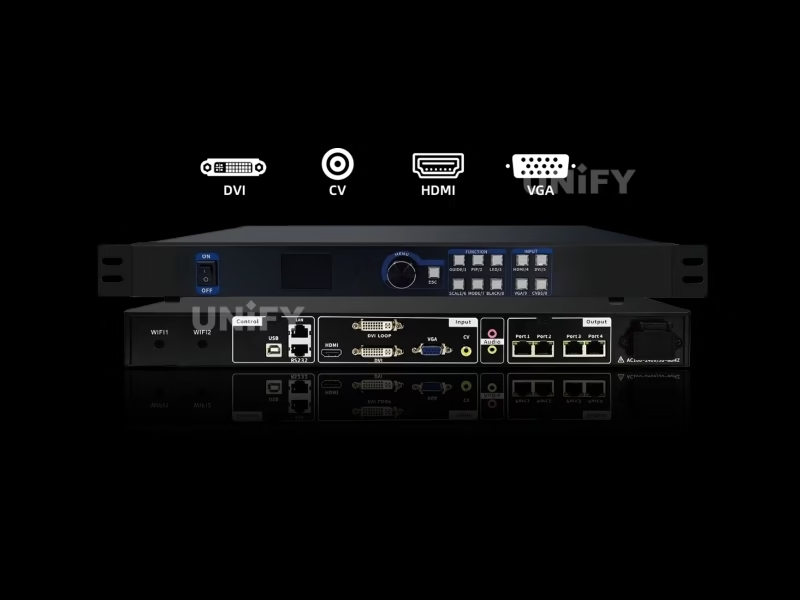
The Mooncell MVB4S Pro 2-in-1 LED Video Processor is a video processor and sending controller in a single 1U unit: four video inputs are processed, scaled and mixed into a composed canvas, and four Gigabit Ethernet outputs drive Mooncell receiving cards directly, up to 2.6 million pixels with a 3840×1920 output ceiling. The “2-in-1” means the processing stage and the sending stage share one chassis, one power supply and one configuration — the architecture Mooncell targets at small and mid-size LED installations: shopping malls, hotels, exhibitions and television studios. This page uses the official Mooncell MVB4S Pro Specification V4.0 as its data source.
Short answer: The Mooncell MVB4S Pro is a 2-in-1 LED video processor and sending controller with 4 video inputs (2× HDMI 1.3, DVI with loop-out, VGA), dual-picture display (PIP/POP), 12-bit image processing, 4 Gigabit Ethernet outputs, a 2.6-million-pixel loading capacity with a 3840×1920 output ceiling, quick screen mapping that configures the wall without PC software, timed signal switching, engineering time lock and cloud platform management. It is the mid-size complement to the M40 flagship in Mooncell’s 2-in-1 family.
In the Mooncell lineup the MVB4S Pro sits at the middle of the MVB 2-in-1 series, above the MVB2S and MVB4S and below the MVB4S Plus (which adds USB playback). The Mooncell M40 2-in-1 LED Video Processor covers the large-format end with 40 ports and 26M pixels; this unit is the one specified for the 1.3M–2.6M class. On the playback side, the Mooncell C2 LED display control system remains the server-class choice for scheduled content, and the LED video processor category page maps the wider class.
Mooncell’s own walkthrough of the MVB4S 2-in-1 processor — the direct sibling of the Pro:
Mooncell Official — MVB4S 2-in-1 LED Video Processor overview
Specifications
What Are the Mooncell MVB4S Pro 2-in-1 LED Video Processor Specifications?
Data from the official Mooncell MVB4S Pro Specification V4.0 (released June 2025, hardware revision V2.0).
Video Inputs, Processing & Outputs
Management, Control & Physical
Model Selection
Which Mooncell MVB4S Pro Processor Do You Need: MVB2S, MVB4S, MVB4S Pro or MVB4S Plus?
Mooncell sells the MVB 2-in-1 family in four steps that differ by loading class, port count and playback ability. The MVB4S Pro column is this page’s subject; sibling figures follow Mooncell’s published model data — and one figure in particular circulates wrong on listings: the MVB4S loads 2.5M pixels, the MVB4S Pro loads 2.6M. Listings that swap the two change the cabinet count.
Why the 2.5M/2.6M distinction matters: at P2.5, 100,000 pixels is roughly 0.6 m² of screen — one cabinet row. A wall designed to the MVB4S’s 2.5M figure and quoted against an MVB4S Pro (2.6M) loses nothing; the reverse direction — a design built on a misquoted 2.6M and shipped a 2.5M unit — shortchanges the canvas by one cabinet row. Verify the model name and the loading figure on the invoice, and ask the supplier to state the specification revision.
Rule of thumb: buy the MVB2S for single-screen entry projects; the MVB4S where 2.5M is genuinely enough; the MVB4S Pro for mid-size walls that want quick mapping, dual picture and the full 2.6M; and the MVB4S Plus when the venue also needs USB-drive playback without a separate player. Above 2.6M, the step-up is the Mooncell M40 2-in-1 LED Video Processor at 26M pixels.
Exclusive — Quick Screen Mapping
What Is Quick Screen Mapping on the Mooncell MVB4S Pro 2-in-1 LED Video Processor?
The feature that sells this unit on site. Quick screen mapping — quick screen connection in the official sheet — completes the LED wall configuration from the front panel: the processor detects the receiving cards, builds the connection map and takes the wall live without a laptop running configuration software. For a venue technician arriving at an unconfigured wall, that is the difference between a 15-minute bring-up and a laptop hunt during load-in. The FUNCTION keys cover the workflow:
GUIDE
Set the output canvas — define the wall’s width and height in pixels before mapping.
PIP
Toggle the secondary window — press once to show it, again to close it. The dual-picture shortcut.
LED
Screen patrol — step through the wall to verify every receiving card is connected and communicating.
SCALE
Window settings shortcut — scale and position the active window against the canvas.
MODE
Scene loading shortcut — recall saved scenes for different program segments.
BLACK
One-key black screen — blank the wall instantly when content must not be seen.
Two management features pair with the quick-map workflow. The engineering time lock protects the configuration — a rental unit or a leased venue cannot be re-flashed by accident or by a departing integrator. Cloud platform management lets a central operator check and operate multiple devices remotely, the pattern documented in cloud-based remote content updates for LED displays. The full commissioning sequence around this class is covered in LED display configuration and system debugging.
Mooncell’s AutoLED tutorial on creating windows on the LED screen — the PC-side counterpart of the same workflow:
Mooncell Official — AutoLED: create a new window on an LED screen
Engineering Advantages
What Are the 6 Core Capabilities of the Mooncell MVB4S Pro 2-in-1 LED Video Processor?
Dual-Picture PIP / POP
HDMI and DVI display simultaneously — picture-in-picture or picture-outside-picture, with size and position adjustable from the panel or software.
Overlay & Keying for Subtitles
Graphic/text overlay and keying synthesis compose subtitles and image effects over the live picture — the studio and conference feature list most processors charge extra for.
12-Bit Processing & De-Interlacing
12-bit internal processing with interlaced motion-adaptive handling removes smearing and jaggies from PAL/NTSC sources — legacy cameras look clean on modern walls.
DVI Loop-Out & Cascading
DVI LOOP passes the source to the next device in line, and multi-unit cascade splicing grows the canvas beyond one unit’s 2.6M.
Timed Switching & Brightness
Timed signal switching and timed brightness adjustment run the venue day automatically — malls dim at closing without an operator touching the panel.
Cloud Management & Time Lock
Cloud platform management for remote oversight and an engineering time lock that stops configuration being re-flashed — the rental-and-lease protection net.
Sizing Guide
How Many Pixels Can the Mooncell MVB4S Pro 2-in-1 LED Video Processor Drive?
The MVB4S Pro loads 2.6 million pixels with a 3840-pixel width ceiling and a 1920-pixel height ceiling — and the two limits bind together, because 3840×1920 is 7.4M pixels, far above 2.6M. Practical canvases sit inside both limits; the widest legal format is the 3840×640 band the processor accepts as an ultra-wide input:
Each network port carries 655,360 pixels at 1280×512 — the same per-port standard as the Colorlight X-series sending class and the M40 — so a 4-port wall is four 1280×512 segments, and per-pixel scaling maps the input to the wall without distortion. For walls beyond one unit, cascade splicing links multiple MVB4S Pro units into a larger synchronized canvas. The LED screen for events guide covers the pitch and viewing-distance context before the canvas is locked.
Category Comparison
How Does the Mooncell MVB4S Pro Compare to a Sending Card Like the Colorlight X4?
The honest comparison for the MVB4S Pro is not a bigger processor — it is the sending controller class at the same loading level. The Colorlight X4 LED video controller, for example, also loads 2.6M pixels across 4 Gigabit outputs. The difference is what sits in front of the outputs:
The four differences that change a purchase decision:
- Processing depth. The MVB4S Pro scales, mixes and keys in the box; a sending card transports whatever the upstream processor gives it. Multi-source venues need the 2-in-1; single-source walls can run either.
- Dual picture. PIP/POP on the MVB4S Pro versus single-input transport on the X4 class — the studio split-screen workflow is a 2-in-1 feature.
- Commissioning. Quick front-panel mapping versus PC-software configuration. On a rental truck or a shopfitting deadline, that is the row that decides.
- Management. Engineering time lock and cloud platform management on the MVB4S Pro protect leased and remote installations; a bare sending card has no equivalent.
The mirror comparison in the Huidu ecosystem is documented on the Huidu HD-VP210 video processor page — the same 2-in-1 architecture at a different loading tier. If the project needs live multi-source mixing above 2.6M, the step-up is the Mooncell M40.
On-Site Operation
How Do You Operate the Mooncell MVB4S Pro 2-in-1 LED Video Processor on Site?
Three control surfaces cover the unit, per the official manual. The front panel handles daily operation and — uniquely in this class — first-time wall configuration via quick mapping. The AutoLED software handles detailed layout work. USB-B, LAN and RS232 open the unit to PCs and control rooms.
LCD & Knob
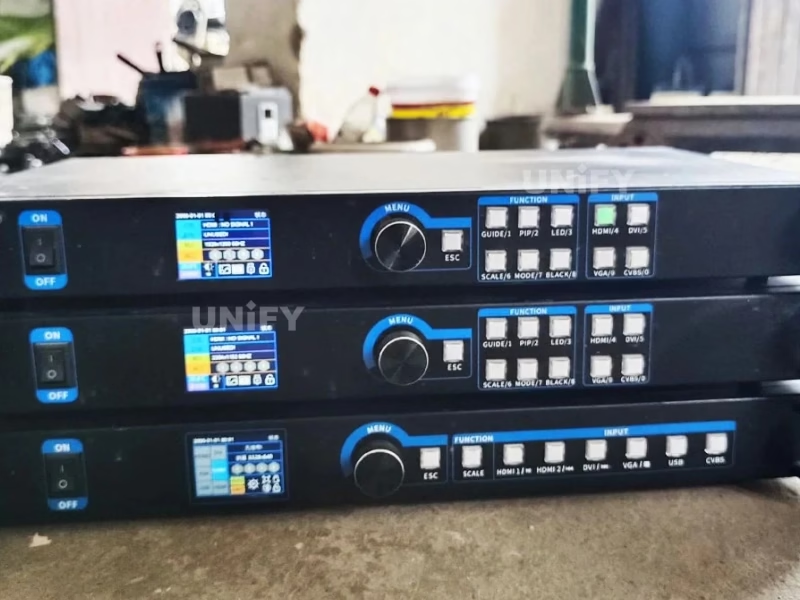
160×128 LCD shows status and menus; the knob navigates and adjusts — press to enter, rotate to select, long-press to release the menu lock. ESC returns.
Source Keys
HDMI1 / HDMI2 / DVI / VGA with per-source LED state: blue flashing means selected but no signal — a fast visual check that the right source is live.
Port Indicators
Network port LEDs: both on = power but no receiving card detected; both off = no power; yellow steady + green flashing = communicating normally.
AutoLED Software
Detailed window layout, EDID management and receiving-card configuration over USB-B — the PC-side of the workflow the panel covers for quick jobs.
Protocols
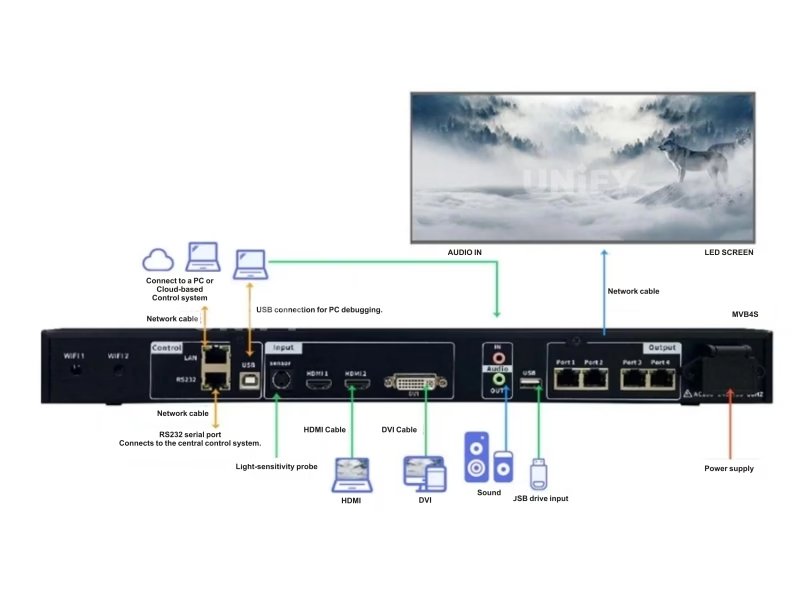
RS232 serial connects to central control; LAN is the debug port. The integration patterns follow control system software and hardware conventions.
Self-Check & Patrol
Voltage and temperature self-detection plus the LED screen-patrol key — faults surface on the panel before they surface on the wall. See basic debugging of LED displays.
The network-port LED language is worth learning by heart — it is the first diagnostic on any wall fault, and the patterns are documented in the official manual’s interface section.
Applications
Where Is the Mooncell MVB4S Pro 2-in-1 LED Video Processor Used?
Malls & Hotels
Atrium and lobby walls run timed brightness and scene schedules automatically; the 3840-wide band format fits concourse strips. One unit covers the typical mid-size atrium.
Exhibitions & Museums
Quick mapping reconfigures a wall between shows without a PC; dual picture pairs content with a live camera; the time lock keeps the venue’s configuration intact between rentals.
TV Studios & Conference
Overlay and keying compose subtitles over the live picture; dual-picture PIP shows speaker and slides; DVI loop-out daisy-chains the source to the next display device.
Rental & Events
A 1U, 2.8 kg, 20W unit is a touring case item; quick mapping brings a rental wall up in minutes; the cloud platform lets a depot check units remotely — see LED screen for events.
Mooncell’s case footage of the interactive floor and creative-screen class this unit serves in exhibitions:
Mooncell Official — interactive floor LED and creative screen case
Factory Strength
Why Buy the Mooncell MVB4S Pro 2-in-1 LED Video Processor From an LED Display Factory?
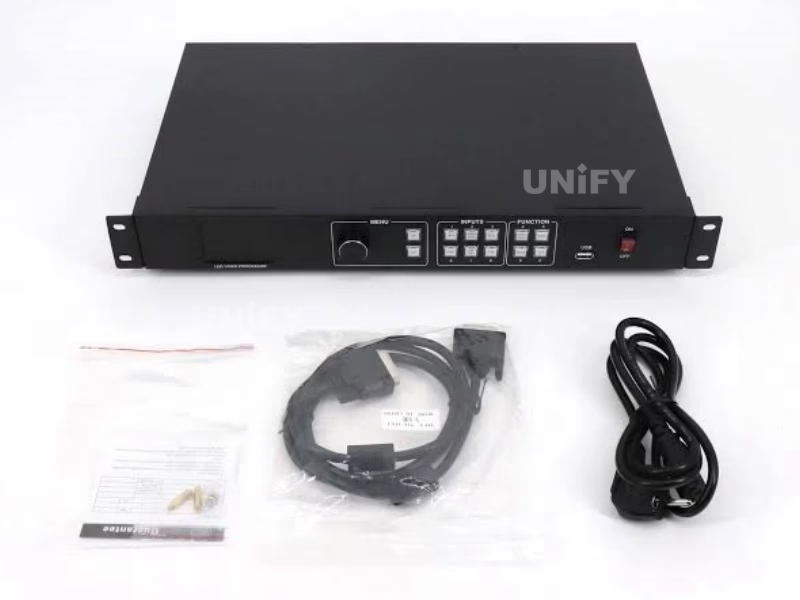
A processor bought from a parts channel arrives as a box with a manual. Buying through a full-line LED screen manufacturer adds the three things a mid-size project actually needs:
1. Verified hardware, correctly identified. Every MVB4S Pro we supply is sourced through Mooncell’s authorized channel and tested on live LED modules before dispatch. The MVB4S-versus-MVB4S-Pro 2.5M/2.6M confusion documented above is exactly the kind of mislabel an unverified channel can ship — we verify the model and the specification revision on the invoice.
2. Quick-map support that finishes the job. We pre-load the receiving-card configuration where the project allows, and support the on-site quick-mapping handover remotely. That is the difference between a processor that arrives and a wall that displays on schedule. Our quality control of LED display process applies the same rigor to every batch.
3. Lifecycle economics. At 20W in a 1U chassis, the MVB4S Pro is the cheapest long-term item on the BOM. We back it with a 2-year warranty and spare units for the project’s operating life, and the control layer sits inside the LED screen lifespan math as a fixed cost.
B2B Procurement
How Much Does the Mooncell MVB4S Pro 2-in-1 LED Video Processor Cost?
Price transparency, stated plainly: the MVB4S Pro appears in distributor listings from roughly $198 (distributor listings reviewed August 2026), before receiving hardware. The spread across channels is volume and support terms, not hardware differences — the same unit trades at both ends of the range. Factory-direct tiers for B2B buyers:
Market context: the LED display control system market reached US$659 million in 2025 and is projected to grow at 13.6% CAGR to US$1.59 billion by 2032 (QYResearch, Global LED Display Control System Market Report). For the wider processor range — including the 40-port flagship — see the Mooncell M40 2-in-1 LED Video Processor page. Ask for a factory-direct quote at your quantity.
FAQ
What Do Buyers Ask About the Mooncell MVB4S Pro 2-in-1 LED Video Processor?
What Assurance Comes With the Mooncell MVB4S Pro 2-in-1 LED Video Processor?
Every MVB4S Pro ships with Mooncell original packaging and compliance documentation.
Ready to Specify the Mooncell MVB4S Pro 2-in-1 LED Video Processor?
Factory-direct pricing, genuine Mooncell stock, quick-map handover support and 2-year warranty.
unifyledscreen@gmail.com | +86-191-18802497
Technical Deep-Dive
What Should Engineers Know Before Buying the Mooncell MVB4S Pro 2-in-1 LED Video Processor?
Published: August 2026 | 13 min read | UnifyLED Engineering Team
The Mooncell MVB4S Pro 2-in-1 LED Video Processor is the unit that most often gets mis-sold in the Mooncell catalog: it looks like a sending card, it is priced like a sending card, and it is a video processor with a sending stage inside. This guide is written for engineers and procurement teams specifying the 1.3M–2.6M class in 2026, using the official Mooncell MVB4S Pro Specification V4.0 as the data source — including the quick-mapping workflow and the model-lineup confusion that listing copy routinely gets wrong.
Short answer: The Mooncell MVB4S Pro is a 2-in-1 LED video processor and sending controller: 4 inputs (2× HDMI 1.3, DVI with loop-out, VGA), dual-picture PIP/POP, 12-bit processing with overlay and keying, 4 Gigabit outputs, 2.6M pixel loading at 3840×1920, quick screen mapping without a PC, timed switching, engineering time lock and cloud platform management. It costs from roughly $198 in distributor listings and fits mid-size walls in malls, hotels, exhibitions and studios.
Chapter 1 — Definition: The 2-in-1 at the Middle of the Lineup
The MVB4S Pro is a synchronous video processor: it takes live inputs, scales and mixes them, and transmits the composed canvas over Gigabit Ethernet to receiving cards. The 2-in-1 architecture puts the sending stage in the same chassis, so the unit is specified, shipped and configured as one device — the same architecture argument that carries Mooncell’s flagship M40 up to 26M pixels, scaled down to the 2.6M class. It is the synchronous side of the synchronous vs asynchronous LED control split: live video in, composed canvas out.
Positioning matters for procurement. In Mooncell’s MVB family the MVB4S Pro sits between the entry MVB2S (1.3M pixels, 2 ports) and the MVB4S Plus (which adds USB playback to the same 2.6M platform), one step above the plain MVB4S (2.5M). For projects above 2.6M the family steps up to the Mooncell M40 2-in-1 LED Video Processor, and on the playback side the Mooncell C2 LED display control system serves scheduled content. The three pages together are the Mooncell chain story.
Chapter 2 — Loading: What 2.6 Million Pixels Buys
The MVB4S Pro loads 2.6 million pixels across four Gigabit ports, with a 3840-pixel width ceiling and a 1920-pixel height ceiling. Because 3840×1920 is 7.4M pixels — far above the loading figure — the two limits bind together and the practical canvases sit inside both: a 3840×640 band is the widest legal format at 2.46M pixels; a 1920×1350 canvas is 2.59M; a 1600×1600 square is 2.56M. The per-port standard is 655,360 pixels at 1280×512, identical to the Colorlight sending class and to the M40, which keeps cabling math consistent across a mixed-ecosystem estate.
In real screen sizes, 2.6M at P2.5 is roughly a 4.8 × 3.4 m 16:9 wall, at P3 it is 5.8 × 4.1 m, and the 3840-wide band at P3 is an 11.5 × 1.9 m concourse strip — the shopping-mall format this unit is specified for. Per-pixel scaling maps the input to the wall without geometric distortion, and multi-unit cascade splicing grows the canvas when a project passes 2.6M. For pitch and viewing-distance planning before the canvas is locked, the LED screen for events guide covers the numbers.
The ultra-wide input path deserves its own line. The VGA port accepts up to 3840×640@60Hz natively and the DVI port accepts custom resolutions to the same 3840 limit — a source already rendered as a long band passes through without the processor inventing black bars. For mall concourse and hotel lobby walls whose content is designed as a strip, that is the difference between a clean feed and a letterboxed compromise. The same custom-resolution path works through EDID management, so a PC or media server can be told to output the wall’s exact format rather than a standard 16:9.
Chapter 3 — Quick Screen Mapping: The Feature That Sells It
Quick screen mapping — quick screen connection in the official sheet — is the MVB4S Pro’s answer to the oldest cost in LED installation: commissioning time. A wall of receiving cards normally needs PC software to detect cards, set the canvas and build the connection map. The MVB4S Pro does the same sequence from the front panel: set the canvas with GUIDE, let the processor detect the cards, patrol with LED, and take the wall live — no laptop, no software install, no license hunt. For a venue technician or a rental depot, that workflow turns a 60-minute commissioning into a 15-minute bring-up.
The FUNCTION keys map directly onto the daily operations: PIP toggles the secondary window, SCALE adjusts window size, MODE recalls scenes, BLACK blanks the wall instantly. The engineering time lock sits behind the panel — it stops the configuration being re-flashed, which for rented and leased installations is the difference between a protected asset and a field that resets itself. Cloud platform management extends the same control remotely, the pattern covered in cloud-based remote content updates for LED displays. The wider commissioning workflow is in LED display configuration and system debugging.
The timed functions complete the unattended picture. Timed signal switching changes the active source on schedule — a mall wall that shows a branded loop by day and a promotional feed after hours; timed brightness adjustment dims the wall at closing time and restores it at opening. Combined with the scene recall on MODE, the MVB4S Pro runs a venue’s daily program without an operator touching the panel, which is exactly the duty cycle shopping-centre and hotel operators expect from the control layer.
Chapter 4 — MVB2S vs MVB4S vs MVB4S Pro vs MVB4S Plus
The MVB family is four steps, and the middle two are routinely confused:
- MVB2S. 1.3M pixels, 2 Gigabit outputs — the entry class for single-screen installs. If the wall fits one 1280×512-per-port budget and never grows, this is the honest buy.
- MVB4S. 2.5M pixels, 4 outputs. The base 4-port model — and the figure most often misquoted as the Pro’s 2.6M on listings.
- MVB4S Pro. 2.6M pixels, 4 outputs, quick mapping, dual picture, time lock and cloud management — the mid-size workhorse documented on this page.
- MVB4S Plus. The Pro platform plus USB-drive playback and a multimedia player — for venues that want stored-content playback without a separate player.
The procurement rule is simple: write the model name and the loading figure onto the purchase order, and ask the supplier to state the specification revision. A 2.5M unit quoted against a 2.6M design shortchanges the canvas by roughly one cabinet row at common pitches — small on paper, awkward at load-in.
Chapter 5 — The Sending-Card Comparison: Same Load, Different Job
The natural comparison for the MVB4S Pro is the sending controller at the same loading level — for example the Colorlight X4 LED video controller, also 2.6M pixels across 4 Gigabit outputs. The difference is the processing stage. The X4 is a transport device: it sends whatever the upstream processor delivers. The MVB4S Pro scales, mixes, keys and overlays in the box, then sends — which is why it carries dual picture, subtitles and quick mapping, and why a multi-source venue buys one device instead of two. Single-source walls fed by an existing processor can run either; the 2-in-1 earns its place when the source count or the commissioning budget decides.
Vendors that carry both Mooncell and Colorlight stock usually keep a simple answer to the which-class question: if the wall already has a processor upstream and needs only transport, a sending card is the honest line item; if the wall needs sources mixed, subtitles composed or quick commissioning, the 2-in-1 replaces two devices for roughly the same money. The MVB4S Pro’s $198-class street price makes that arithmetic unusually easy — processing and sending for the price of sending alone, which is why the 2-in-1 is the faster-moving line in this tier.
Mooncell’s tutorial on connecting the LED screen with AutoLED — the PC-side of the same commissioning workflow:
Mooncell Official — AutoLED: how to connect the LED screen
Chapter 6 — Operation: Panel, Software, Protocols
The front panel is a complete operator station: a 160×128 LCD, knob navigation with long-press menu release, source keys whose blue-flash state shows selected-but-no-signal at a glance, and the FUNCTION row — GUIDE, PIP, LED, SCALE, MODE, BLACK — that covers the daily operations without menus. The port LEDs carry the first diagnostic language: both on means powered but no receiving card detected, yellow-steady with green-flashing means communicating normally. A technician who reads those LEDs has already isolated half the wall faults before opening a laptop.
The AutoLED software is the detailed-layout layer over USB-B: window positioning, EDID management and receiving-card configuration. RS232 connects the unit to central control, and the LAN port is the debug path. The integration patterns follow the conventions documented in control system software and hardware, and the fault patterns in basic debugging of LED displays.
Chapter 7 — Price and Total Cost of Ownership in 2026
The MVB4S Pro appears in distributor listings from roughly $198 (distributor listings reviewed August 2026), which puts the 2-in-1 inside the price band of a premium sending card — the value argument writes itself: processing and sending for the cost of sending alone. The spread across channels is volume and support terms; the unit itself is the same hardware at both ends. We quote three tiers — sample (1–2 units), project (3–9 units, receiving-card pre-configuration) and volume (10+, factory-direct contract with a spare-unit program).
On the TCO side the numbers are small and stable: 20W rated power, a 1U 44 mm chassis at 2.8 kg net, and no moving parts. The category context is the same one that carries the whole control layer: the LED display control system market reached US$659 million in 2025 and is projected to grow at 13.6% CAGR to US$1.59 billion by 2032 (QYResearch, Global LED Display Control System Market Report). The LED screen lifespan math treats the processor as the long-lived part: we warrant it for 2 years and stock spares for the project’s operating life.
A checklist for the purchase order: the processor, receiving cards sized to the per-port load (655,360 pixels per port), CAT5E/6 for the four network runs, and the DVI cable for the loop-out chain if the project daisy-chains displays. A quote that names the model — MVB4S Pro, not MVB4S — and the specification revision is a quote you can hold a supplier to, and holding the line on the 2.5M/2.6M distinction is the single cheapest way to avoid a short canvas at load-in.
The pattern across the MVB family is consistent: every step up buys capacity or capability, and the Pro is the step that buys both — the full 2.6M load and the quick-mapping workflow that changes how a wall gets commissioned. For multi-site operators, the cloud platform and the time lock turn a processor purchase into a fleet-management decision, which is a conversation most distributors never start.
Conclusion
The Mooncell MVB4S Pro 2-in-1 LED Video Processor is the mid-size answer to the same question the M40 answers at stadium scale: process the sources, send the canvas, do both in one box. Specify it with three numbers in hand — 2.6M pixels, 3840×1920, four ports — and with the model name written against the loading figure, because the MVB4S-versus-Pro 2.5M/2.6M confusion is a real listing hazard. Buy it through a verified LED screen manufacturer that tests on live modules and supports the quick-map handover, and the wall comes up in minutes — which is the entire point of this unit.
LED Control System Range
Which LED Control and Processing Products Should You Explore Next?
Video processors, control servers, sending controllers and free resources on UnifyLED.
Mooncell Series
2-in-1 Processors
Guides & Resources
Where Can You Download Mooncell MVB4S Pro Resources?
The official Mooncell MVB4S Pro Specification V4.0 — the data source for every figure on this page.