
Mooncell · Server-Class Multimedia Playback & Control
Mooncell C2 LED Display Control System
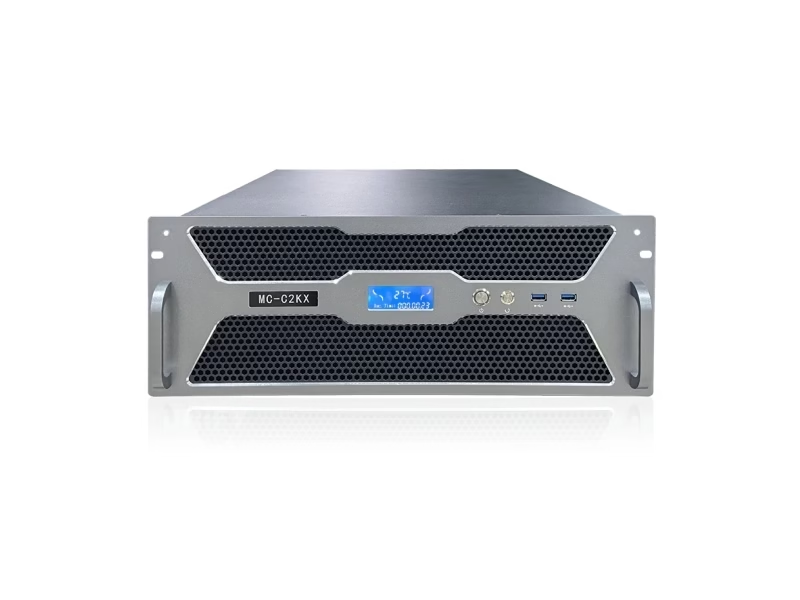
The Mooncell C2 LED Display Control System is a server-class multimedia playback and control platform: four DP outputs at 4096×2160@60Hz, 8K hardware decoding, 16GB DDR4, an industrial 4U chassis, and creative-splicing software that drives irregular LED screens pixel-to-pixel.
Product Overview
What Is the Mooncell C2 LED Display Control System?
The Mooncell C2 LED Display Control System is a multimedia playback and control server: an industrial 4U computer with a professional graphics card that plays, edits, schedules and outputs media directly to LED display receiving hardware at up to 4096×2160@60Hz per DP output. It belongs to the category engineers call an asynchronous playback system — the server, not a live PC, is the content source — and it exists to solve what ordinary media players cannot: pixel-to-pixel resolution on very large canvases, creative-spliced irregular screens, and multi-server redundancy. This page uses the official Mooncell MC-C2 Specification V3.1 as its data source.
Short answer: The Mooncell C2 LED Display Control System is a server-class multimedia playback and control server with 4× DP outputs at 4096×2160@60Hz, 8K hardware decoding, 16GB DDR4 memory, an Intel Core processor, an industrial 4U chassis, and C2 playback software that supports timeline editing, unlimited layers, irregular-screen splicing with arbitrary rotation, NDI capture, scheduled playback, iPad control and fail-over redundancy. It is the Mooncell product chosen for creative LED displays, high-resolution control rooms and immersive venues where a standard media player runs out of capability.
In the Mooncell ecosystem the MC-C2 is the server tier above the compact players. Mooncell sells synchronous sending boxes and controllers for live video walls, and MP-series media players for single-source signage; the MC-C2 multimedia server covers the projects in between — large creative canvases, control-room walls and multi-screen venues. If your content is a laptop or camera feed arriving in real time, you are describing a synchronous vs asynchronous LED control architecture, and the C2 is the asynchronous side of that choice. For projects that scale and switch live inputs before the display, a LED video processor handles that layer instead.
A word from Mooncell itself on who builds this system:
About Mooncell — Shenzhen Mooncell Electronics Co., LTD
Specifications
What Are the Mooncell C2 LED Display Control System Specifications?
Data from the official Mooncell MC-C2 Specification V3.1 (Shenzhen Mooncell Electronics Co., Ltd). Specific configurations vary by project — the tables below record the documented values.
Video Output & Processing (Official V3.1)
Signal Capture & Interfaces (Optional Capture Cards)
Hardware, Physical & Environment
Model Selection
Which Mooncell C2 Model Do You Need: C2K, C2X or C2KX?
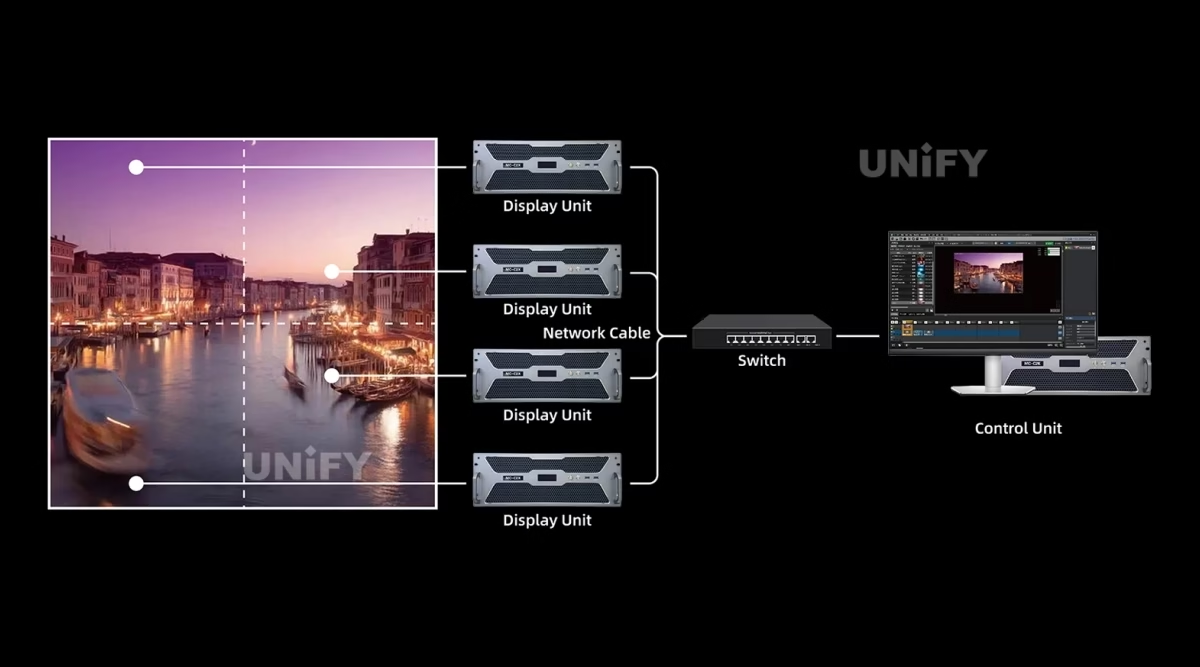
The C2 series ships in three hardware variants that divide on one question: does one server do the control and the display job, or two servers split them? The letter rules are simple — K is the control end, X is the display end, and the number of Xs is the number of output channels (the specification sheet states the letter “X” represents the output channel count of the player).
The decision in four numbered differences:
- Architecture. One MC-C2KX does control and display in one chassis. Split systems pair an MC-C2K (control end) with one or more MC-C2X units (display ends) — the model for multi-server canvases where control and output run on separate machines.
- Output channel count. The K control end has a single HDMI 1.4 output for its monitor; X units carry the 4× DP outputs that drive the LED receiving hardware. Every X in the model name adds output channels.
- Scaling path. All-in-one (C2KX) suits a single-venue canvas up to 4× 4K. Growing beyond that means adding C2X display servers — each adds four more 4K outputs to the synchronized wall.
- Generation note. Mooncell’s current catalog lists newer MC2K / MC4K / MC8K server models (specifications V4.x, up to 8× 4K outputs and DP 1.4). The C2 series (V3.1) remains in distribution — confirm which generation a quote refers to, because the two families differ in output count and connector standard.
Rule of thumb: buy the MC-C2KX for a single creative or control-room canvas; split C2K + C2X when the project needs a dedicated control desk plus display servers; and compare the current MC2K/MC4K/MC8K generation before finalizing any order. If this is your first time choosing between playback classes, the asynchronous LED media player selection guide maps the tiers from player to server.
Category Comparison
What Makes the Mooncell C2 LED Display Control System Different From a Media Player?
The question every buyer asks when they see the price gap. The C2 is not a faster player — it is a different machine class. Players are compact boxes built around an embedded chipset; the C2 is a 4U industrial server built around a full PC architecture. The table compares the C2 against the typical LED media player class (for reference, the Huidu HD-A3 async control player and Huidu HD-A5 dual-mode player pages document that class in detail):
The four differences that change a purchase decision:
- Canvas size. A player’s single HDMI output limits the wall to what one 4K signal can carry. The C2’s four DP outputs create a 4×4K synchronized canvas — the difference between a shopfront screen and a multi-screen venue.
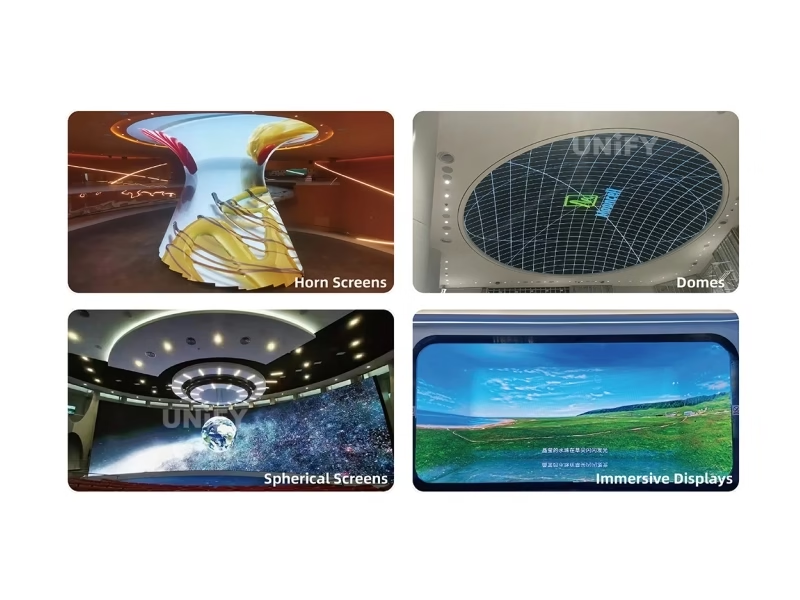
- Geometry. Players cut rectangles. The C2 rotates, slices polygons and geometrically corrects content for spheres, domes, horns and irregular LED shapes — the entire creative-display category a player cannot touch.
- Live signal. Only the server class takes NDI streams and multi-channel capture cards; a player plays stored files and nothing else.
- Reliability architecture. Fail-over backup and multi-server frame sync exist on the C2, not on players. For a control room or show venue where dark time is not negotiable, that is the deciding point — see LED display system redundancy & backup.
Mooncell’s own overview of its asynchronous product range, where the server tier sits above the players:
Mooncell Official — Asynchronous Product Usage Guide
For the full tier-by-tier comparison of playback hardware, see asynchronous LED media players compared — the C2 occupies the top row.
Engineering Advantages
What Are the 6 Core Capabilities of the Mooncell C2 LED Display Control System?
4× 4K60 DP Outputs, Pixel-to-Pixel
Four simultaneous DP outputs at 4096×2160@60Hz — source resolution maps one-to-one onto the LED canvas, with no scaling losses.
Unlimited Layers & Timeline Editing
Timeline-mode editing with unlimited layers, grid templates, geometric transforms and effects — flash, blur, borders, marquee — composed without touching the main output.
Irregular-Screen Splicing
Arbitrary image rotation and splicing across different shapes and angles — spheres, domes, horns and 3D displays — with multi-point geometric correction and unified color gamut.
NDI & Multi-Signal Capture
Optional capture cards take HDMI, SDI, DVI, VGA, YPbPr or CVBS — up to 8× 2K or 4× 4K — plus NDI network streams, all windowed into the canvas.
Online Sync & Fail-Over Backup
Outputs synchronize online without tearing; a backup mode provides redundancy and fail-over — the architecture for venues that cannot go dark.
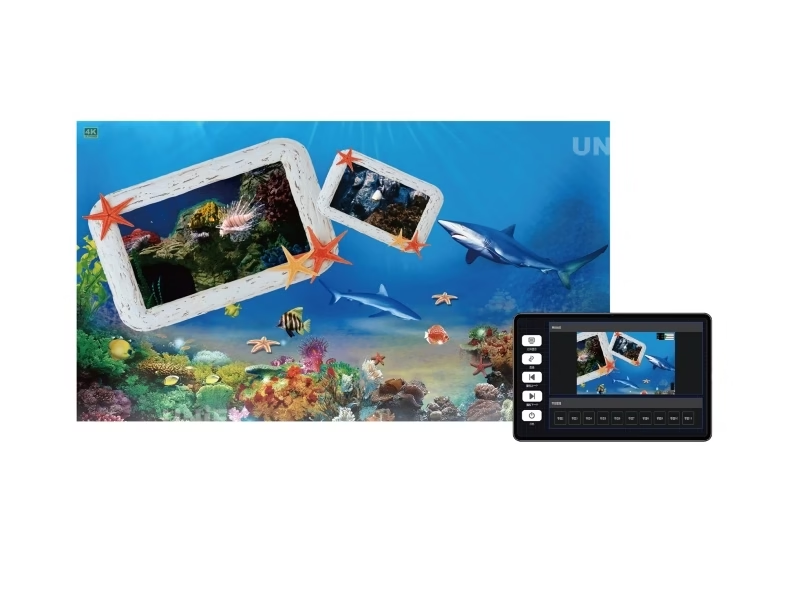
iPad & Central Control
iPad control for centralized management, central-control protocols for scene switching, scheduled task playback and power on/off scripts for automatic operation.
Creative Display
How Does the Mooncell C2 LED Display Control System Drive Irregular LED Screens?
This is the C2’s home turf. Standard controllers divide a rectangular grid; the C2 divides anything. The software model: content is composed on a virtual canvas, then sliced — polygonal slicing, arbitrary rotation, geometric transformation — and mapped onto the physical LED surfaces, whatever their shape. Multi-point geometry correction fixes warped installation planes, and overall color-gamut unification keeps modules from different batches looking like one display.
Sphere & Dome Screens
Full-sphere and hemispherical LED installs, sliced from the virtual canvas with rotation compensation.
Disc & Circular Displays
Circular and disc-shaped screens with angular content regions — a flagship Mooncell solution category.
Horn & Sculptural Screens
Free-form sculptural LED — horn trees, architectural shapes — each panel independently positioned and oriented.
Naked-Eye 3D & Immersive
3D billboard content and 5D/6D immersive rooms, where preview mode lets operators check programs without disturbing the live wall.
A Mooncell-installed horn-tree creative display, running on this control platform:
Mooncell Official — Giant Horn Tree LED Display showcase
Virtual screens take the concept further: the C2 can stage camera-spliced shots, close-ups and live streams as virtual screen regions — useful when one physical wall must appear as several logical displays. Content planning for venues of this kind starts with the indoor LED display buying guide before the geometry work begins.
Sizing Guide
How Many Pixels Can the Mooncell C2 LED Display Control System Drive?
The C2’s output math is four independent 4096×2160@60Hz channels. Because playback is pixel-to-pixel, the answer to “how big a screen” is the canvas you compose in software — the table converts the four configurations into real LED wall sizes per pitch:
Two things matter about this table. First, the canvas resolution is the design choice — a 33.2-megapixel 2×2 canvas at P2.5 is a 19.2 × 10.8 m wall, at P1.8 it is 13.8 × 7.8 m, and the same canvas scales down in pixels for tighter pitches. Second, each output channel carries its own 4K signal, so the receiving hardware sees four clean 4K inputs rather than one stretched stream — which is what keeps the wall pixel-sharp at close viewing distances. For the receiving-card side of this chain, the load math follows synchronous vs asynchronous LED control rules on where the signal is generated.
If the project grows past one server’s canvas, the C2 ecosystem scales by adding display-end units: each additional server adds four more synchronized 4K outputs to the wall. The multi-sending-card backup and cascade guide documents the same scaling logic for the sending side.
Configuration
How Do You Set Up and Schedule Content on the Mooncell C2 LED Display Control System?
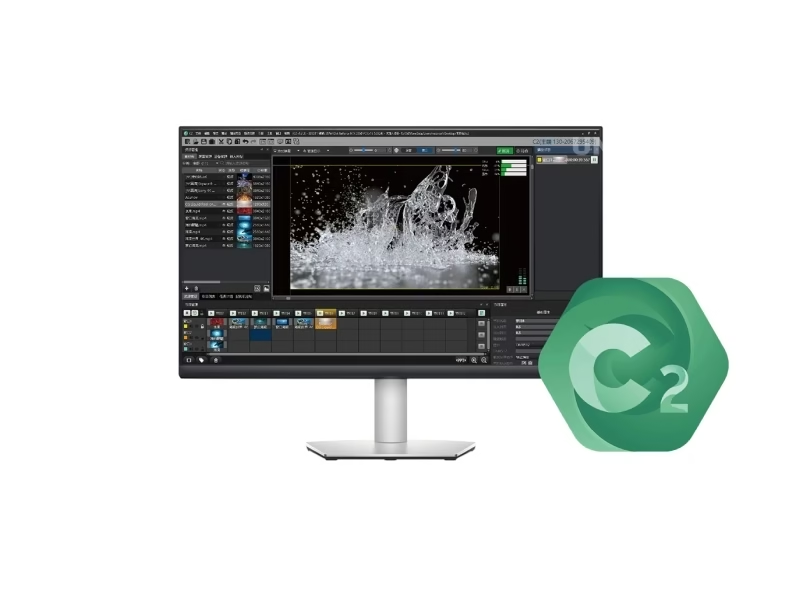
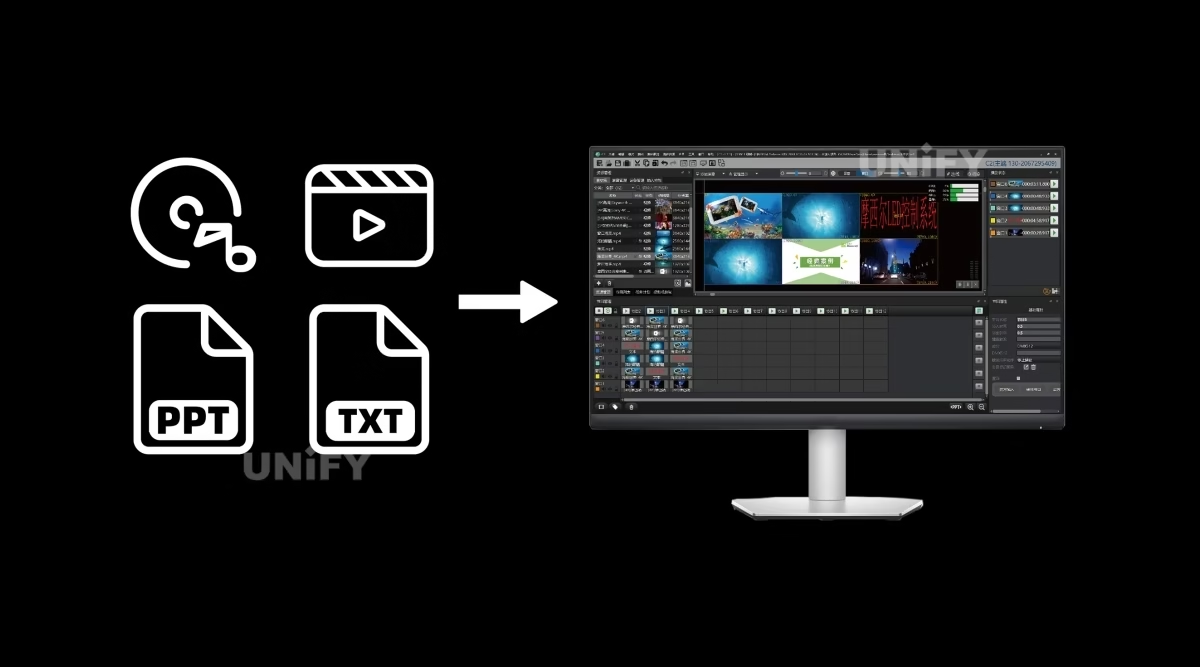
The C2 runs two cooperating software layers. The C2 playback and control software is the production layer: timeline-mode editing, unlimited layers, grid templates, effects, virtual screens and preview mode — programs are composed and previewed without affecting the live main output, then switched when ready. The Mooncell AutoLED software is the hardware layer: it detects the LED cabinets, sets module parameters and maps the receiving cards to the outputs, the same way sending controllers are commissioned. A typical deployment runs in five steps:
Rack the server & wire outputs
Mount the 4U chassis, connect AC 100–240V, run each DP output to the LED receiving hardware or fiber extenders, and link the network ports (1Gb and 2.5Gb) to the control LAN.
Configure the LED hardware
Use AutoLED to detect sending boxes and receiving cards, load the cabinet module parameters and save them to the cards — the commissioning step our engineers pre-run before shipping.
Build the program in the C2 software
Compose the timeline: layers, grid templates, media files, web pages, PPTs and text — including irregular-screen slicing and virtual screens for creative canvases.
Preview, then switch
Check the program in preview mode — it plays without touching the live output — then take it to the main screen when the timing is right.
Automate the schedule
Set scheduled task playback, power on/off scripts and automatic startup — the wall runs its own day without an operator, with scheduled playback on async LED displays as the reference for the pattern.
Mooncell’s tutorial on connecting the LED screen with AutoLED, the hardware-commissioning layer:
Mooncell Official — AutoLED tutorial: connect the LED screen
For distributed sites, the same software stack handles remote content delivery: cloud-based remote content updates for LED displays explains how multi-venue operators push new programs to servers like this one without visiting the rack.
Applications
Where Is the Mooncell C2 LED Display Control System Used?
Command & Dispatch Centers
Pixel-to-pixel walls for control rooms and data operations centers, with fail-over backup so the situational display survives a hardware failure.
Exhibitions & Museums
Creative canvases, disc screens and immersive installations; iPad control lets exhibition-hall staff manage multiple devices from the floor.
KTV, Bars & Immersive Rooms
5D/6D rooms, 360° spaces and venue walls running scheduled playlists with scene switching via central control — see LED screen for events.
Broadcast & Conference
Studio walls and conference reporting centers taking NDI or SDI feeds alongside playback, with 5.1/7.1 audio for the venue sound system.
Two installations that show the C2 class at work — a 28-meter sphere and a naked-eye 3D display:
Mooncell Official — case: a sphere with 28 meters in diameter
Mooncell Official — Naked Eye 3D LED Display showcase
Factory Strength
Why Buy the Mooncell C2 LED Display Control System From an LED Display Factory?
A control server bought from a parts channel arrives as a box with a manual. Buying through a full-line LED screen manufacturer adds the three things a B2B project actually needs:
1. Verified hardware, matched to your wall. Every C2 we supply is sourced through Mooncell’s authorized channel and tested on live LED modules before dispatch, with the receiving hardware it will drive. The spec revisions documented above — V3.1 vs V4.x, C2 vs MC2K/MC4K/MC8K — are exactly the confusion points an unverified channel can sell into.
2. Pre-loaded configuration and commissioning support. We pre-run the AutoLED commissioning — module parameters, receiving-card mapping, canvas layout — before shipping, and support the remote handover at your site. That is the difference between a server that arrives and a creative wall that displays on schedule. Our quality control of LED display process applies the same rigor to every batch.
3. Lifecycle economics. The C2 is a server, and servers are service items: we back it with a 2-year warranty, keep spare units for the project’s operating life, and treat the control layer as a fixed cost in the LED screen lifespan calculation — a failed unit is replaced, not debated.
B2B Procurement
How Much Does a Mooncell C2 LED Display Control System Cost?
Stated plainly: the C2 has no list price, because it is configured per project. Unlike commodity controllers with published street pricing, the C2 is quoted on its configuration — chassis variant (C2K / C2X / C2KX), capture cards, storage, and the LED hardware it must drive. That is why the right procurement question is not “what is the price” but “what configuration matches the project” — send us your canvas size, screen shapes and source list, and you receive a configuration sheet with a quote. The tiers we quote against:
Market context for the category: the LED display control system market reached US$659 million in 2025 and is projected to grow at 13.6% CAGR to US$1.59 billion by 2032 (QYResearch, Global LED Display Control System Market Report), with creative and irregular-screen demand as a growth driver — the segment this server class serves. If your project also needs live-input processing upstream, factor in a LED video processor before requesting the quote.
FAQ
What Do Buyers Ask About the Mooncell C2 LED Display Control System?
What Assurance Comes With the Mooncell C2 LED Display Control System?
Every C2 ships with Mooncell original packaging, licensed software and compliance documentation.
Ready to Specify the Mooncell C2 LED Display Control System?
Config-matched quotes, genuine Mooncell stock, pre-loaded commissioning support and 2-year warranty.
unifyledscreen@gmail.com | +86-191-18802497
Technical Deep-Dive
What Should Engineers Know Before Buying the Mooncell C2 LED Display Control System?
Published: August 2026 | 14 min read | UnifyLED Engineering Team
The Mooncell C2 LED Display Control System is the model most often misclassified in the LED industry: callers ask for it as if it were a faster media player, and it is not. It is a server — a 4U industrial computer with a professional graphics card — built to play, splice and schedule content for LED canvases that ordinary players cannot touch. This guide is written for engineers and procurement teams who need to specify and buy the C2 in 2026, using the official Mooncell MC-C2 Specification V3.1 as the data source, because the C2’s value is exactly the capability that does not fit on a one-line datasheet.
Short answer: The Mooncell C2 is a server-class asynchronous multimedia playback and control system with 4× DP outputs at 4096×2160@60Hz, 8K hardware decoding, 16GB DDR4 and an Intel Core processor in a 4U industrial chassis. It runs C2 playback software (unlimited layers, timeline editing, irregular-screen splicing, virtual screens, scheduled tasks) and Mooncell AutoLED for hardware commissioning, supports NDI and capture-card input, iPad and central-control operation, and fail-over redundancy. It is quoted per configuration rather than per unit, because the hardware is matched to the canvas it drives.
Chapter 1 — Definition: What the C2 Is and What It Does
The Mooncell C2 LED Display Control System is an asynchronous playback and control server: media is stored and rendered on the server itself, and the wall shows what the server sends — no laptop or live PC required after commissioning. That places it on the asynchronous side of the synchronous vs asynchronous LED control split, one tier above the compact players that serve shopfronts and menus. The C2’s hardware is a full PC architecture: an Intel Core processor, 16GB DDR4, a 500GB SSD, a professional graphics card with EDID management, stereo XLR audio, and Windows 10 Enterprise as the base OS. The chassis is a 4U industrial server, 482 × 450 × 178 mm, weighing 14.5 kg gross — dimensions that make sense only when you read them as server room equipment rather than player boxes.
Two structural facts matter for procurement. First, the C2 is a content machine, not a signal machine: it plays, composes and schedules; it does not scale or switch live inputs the way a video processor does — that layer is optional upstream hardware. Second, the C2 drives LED receiving hardware through its own output stage, so the receiving cards and cabinets must be commissioned in the same Mooncell toolchain (AutoLED). The ecosystem decision is a chain decision, which is why we pair every C2 quote with the receiving hardware it will drive.
Chapter 2 — Loading: What Four 4K Channels Buy
The C2’s output is four independent DP channels at 4096×2160@60Hz, driven simultaneously by one graphics card. Because playback is pixel-to-pixel — the software composes at the canvas resolution and the outputs deliver it 1:1 — the loading question becomes a canvas-design question. Four channels arranged 2×2 give a 7680×4320 canvas, 33.2 megapixels: at P2.5 that is a 19.2 × 10.8 m wall; at P1.8 it is 13.8 × 7.8 m; at P1.5 it drops to 11.5 × 6.5 m. Arranged 1×4, the same four channels make a 16384×2160 strip — 41 m wide at P2.5 — the format for concourse and lobby bands.
The subtlety most specifications gloss over: each channel carries its own clean 4K signal, so the receiving side sees four discrete inputs rather than one stretched stream. That is what keeps close-viewing walls pixel-sharp, and it is why the C2 appears in control rooms where operators read fine data at arm’s-length distance. For canvases beyond one server, the architecture scales by adding display-end C2X units — each adds four more synchronized 4K outputs, with the control end running the whole wall. The same scaling logic on the sending side is documented in the multi-sending-card backup and cascade guide.
Chapter 3 — Server vs Player: The Class Difference
The C2 is compared with LED media players more often than with anything else, and the comparison is where buyers overpay or under-buy. A media player is a compact embedded box: one HDMI output, a fixed layer budget, rectangular regions, and stored-file playback. The C2 is a server: four 4K outputs, unlimited layers on a timeline, polygonal slicing and rotation for irregular geometry, 8K decoding, NDI and capture-card input, and fail-over redundancy. The reference class is documented on our own pages — the Huidu HD-A3 async control player and Huidu HD-A5 dual-mode player — and the tier map in asynchronous LED media players compared puts the server class at the top.
The practical test is geometry and canvas size. If the project is a rectangular wall under one 4K input, a player is the honest answer and the asynchronous LED media player selection guide walks that choice. If the project involves a sphere, a dome, a horn-shaped sculpture, multiple 4K inputs, live NDI feeds or a wall that must not go dark, the server class is not a luxury — it is the minimum viable architecture. Buying a player for a creative canvas fails at commissioning; buying a server for a shopfront overpays the BOM.
Chapter 4 — Irregular Screens: The C2’s Home Turf
Standard controllers divide a rectangle. The C2 divides anything. Its software model is a virtual canvas: content is composed freely — layers, grid templates, effects like flash, blur, borders and marquee — then sliced and mapped onto the physical LED surfaces with arbitrary rotation, polygonal slicing and geometric transformation. Multi-point geometry correction fixes warped installation planes, and overall color-gamut unification keeps modules from different production batches rendering as one display. Virtual screens extend the idea to optics: camera-spliced shots, close-ups and live streams can be staged as logical screen regions on one physical wall.
Mooncell’s case library shows the category: a 28-meter diameter sphere, horn-tree sculptures, disc and circular displays, naked-eye 3D billboards, and 5D/6D immersive rooms. These are not exotic afterthoughts — they are the projects where a standard control system simply has no answer, and where the C2 class earns its place on the BOM. An immersive 5D/6D room installation running on the same platform family:
Mooncell Official — 5D/6D Immersive Rooms case video
Chapter 5 — Models and Generations: C2K, C2X, C2KX and the V4.x Successors
The C2 series splits on one architectural question: does a single server do control and display, or do dedicated machines split the jobs? The model letters are mnemonic — K is the control end, X is the display end, and each X in the name is an output channel. The MC-C2K is a control-end server with a single HDMI 1.4 output to its monitor and integrated graphics for the control display; the MC-C2X is the display-end server with 4× DP 1.2 outputs; the MC-C2KX combines both roles in one chassis, the configuration that covers most single-venue canvases.
The generation note matters more in procurement than any parameter: Mooncell’s current catalog lists a newer MC2K / MC4K / MC8K server family at specification revisions V4.x, offering up to 8× 4K outputs on DP 1.4 with H.265 hardware decoding. The C2 series (V3.1) remains in distribution, and both families run the same playback software. When a supplier quotes “Mooncell multimedia server,” ask for the exact model and specification revision — the two families differ in output count, connector standard and decode capability, and a quote that does not name the revision is incomplete.
Chapter 6 — Sources and Control: NDI, Capture Cards, iPad and Central Control
A playback server that only plays files is half a product; the C2’s input and control side is what makes it a control system. Optional capture cards bring live sources in — HDMI, SDI, DVI, VGA, YPbPr or CVBS, up to 8 channels of 2K or 4 channels of 4K at 4096×2160@60Hz — and NDI network streams are captured directly, so cameras, switchers and IP feeds land as windows in the same canvas as stored content. That is the difference between a signage player and a venue control system: the wall can carry playback and live camera side by side, in layers.
Control covers the people who operate the venue. iPad control gives exhibition-hall staff a floor-level interface for centralized management and quick program switching. Central-control protocols (TCP/UDP) integrate the C2 into third-party building or show control for scene switching and screen playback. Scheduled task playback and power on/off scripts let the system run its own day — the pattern is the same one documented in scheduled playback on async LED displays, scaled from a box to a server. For distributed venues, content is pushed over the network the way cloud-based remote content updates describe.
Chapter 7 — Commissioning and Operation: The Two Software Layers
The C2 runs two cooperating layers. The C2 playback and control software is the production layer — timeline editing, unlimited layers, grid templates, effects, virtual screens and preview mode. Preview mode is the operational detail that saves venues: programs are checked in preview without affecting the live main output, then taken when the timing is right. The Mooncell AutoLED software is the hardware layer — it detects sending boxes and receiving cards, loads module parameters and maps the canvas to the outputs, the same commissioning flow used across Mooncell’s sending products. The tutorial that shows that connection step is embedded in the configuration section above.
One habit prevents most field problems: after any commissioning or content change, back up the configuration and store it with the project documentation. Servers hold state in more places than a player box — OS settings, graphics driver, software schedules and card parameters — and a stored backup turns a failure event into a reload, not a re-commission. The backup-and-restore discipline for LED control hardware is covered in LED display system redundancy & backup, which also explains when the C2’s fail-over mode is worth configuring from day one.
Chapter 8 — Price and Total Cost of Ownership in 2026
The C2 has no list price, and that is not an evasion — it is the honest consequence of a configured product. Chassis variant, capture cards, storage and the receiving hardware it drives all change the quote, and any supplier quoting a flat unit price is quoting a specification they invented. The procurement process that works: send the canvas size, screen shapes and source list; receive a configuration sheet with a price; compare configurations rather than prices. We quote three tiers — sample (1–2 units, standard configuration), project (3–9 units, config-matched builds with pre-loaded commissioning) and volume (10+ units, factory-direct contract with a spare-unit program).
The category context supports the investment. The LED display control system market reached US$659 million in 2025 and is projected to grow at 13.6% CAGR to US$1.59 billion by 2032 (QYResearch, Global LED Display Control System Market Report), with creative and irregular-screen demand as a named growth driver. On the TCO side, a server is a service item: we carry the C2 under a 2-year warranty with spare units for the project’s operating life, and the control layer typically outlasts the LED modules it drives — LED screen lifespan is set by the modules, not the electronics in front of them.
Conclusion
The Mooncell C2 LED Display Control System is the server-class answer to the question players cannot solve: how do you drive a large, irregular, multi-source LED canvas as one synchronized pixel-to-pixel display? Specify it with three numbers in hand — four 4K60 outputs, a 33.2-megapixel full-canvas ceiling, and the 4U server footprint — and with the model letter (K, X or KX) and specification revision (V3.1 vs V4.x) written into the quote. Buy it through a verified LED screen manufacturer that pre-commissions the receiving side and backs the unit with warranty and spares, and the control layer becomes the part of the creative project nobody thinks about again.
LED Control System Range
Which LED Control and Playback Products Should You Explore Next?
Media players, controllers, receiving card guides and free software resources on UnifyLED.
Async Players & Servers
Synchronous Controllers
Guides & Resources
Where Can You Download Mooncell C2 Resources?
The official Mooncell MC-C2 Specification V3.1 — the data source for every figure on this page.