
Colorlight i5A-F LED Receiving Card
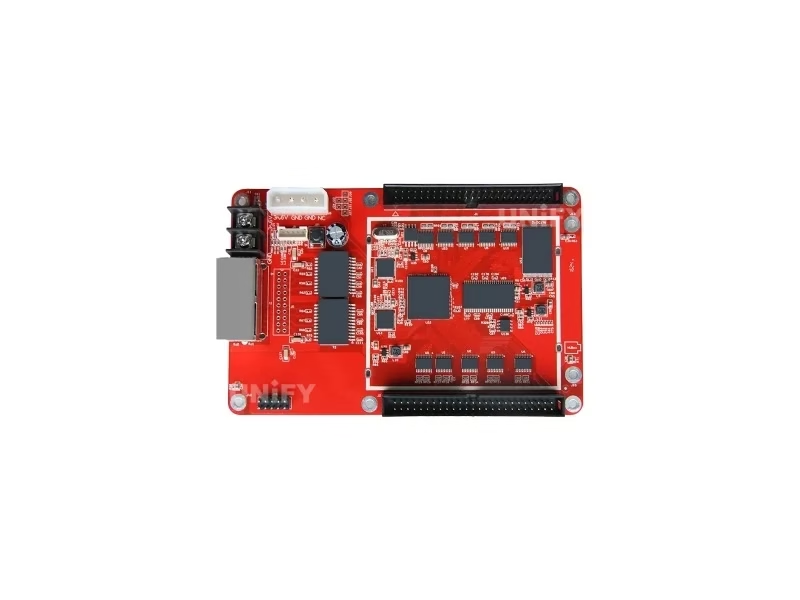
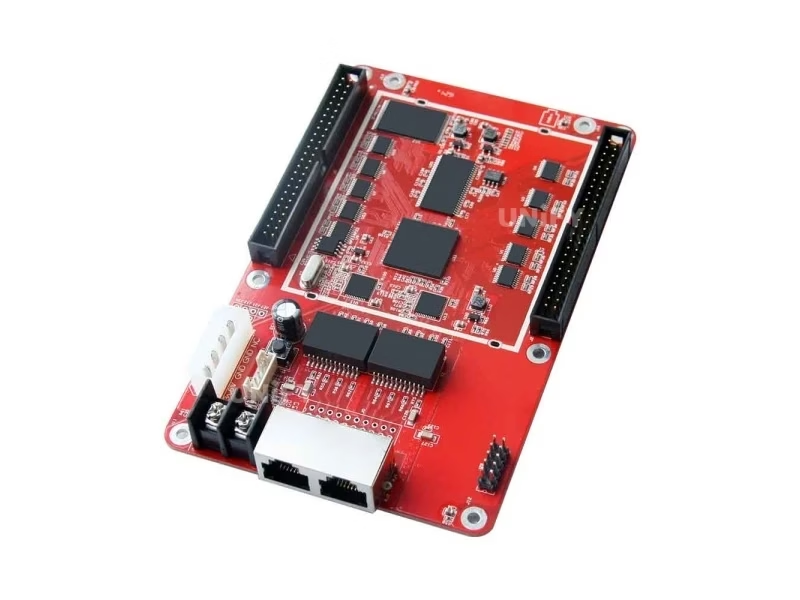
The Colorlight i5A-F LED Receiving Card is Colorlight’s dual-mode receiving card: synchronous and asynchronous operation on one card, with 2Gbit onboard memory that takes over automatically when the sending signal drops — the wall loops its stored content instead of going black. Built for stadium screens, advertising walls and unattended installations where a black screen costs revenue.
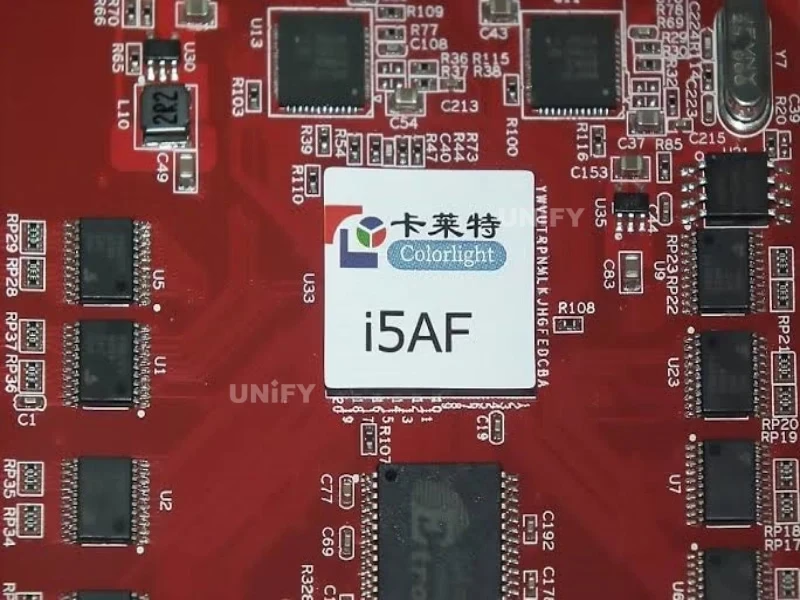
What Is the Colorlight i5A-F LED Receiving Card?
The Colorlight i5A-F LED Receiving Card is a dual-mode receiving card: the same card runs the synchronous system (driven by a sending controller) and the asynchronous system (playing content from its own 2Gbit onboard memory), switching between them automatically. When the sending signal is interrupted, the card falls back to asynchronous mode and loops its stored content — the wall never goes black. That single behavior defines the card’s market: stadium screens, advertising walls, exhibition displays and unattended installations where downtime is measured in lost revenue. The dual-mode concept sits at the heart of the synchronous vs asynchronous LED control decision — the i5A-F is the card that answers “both.”
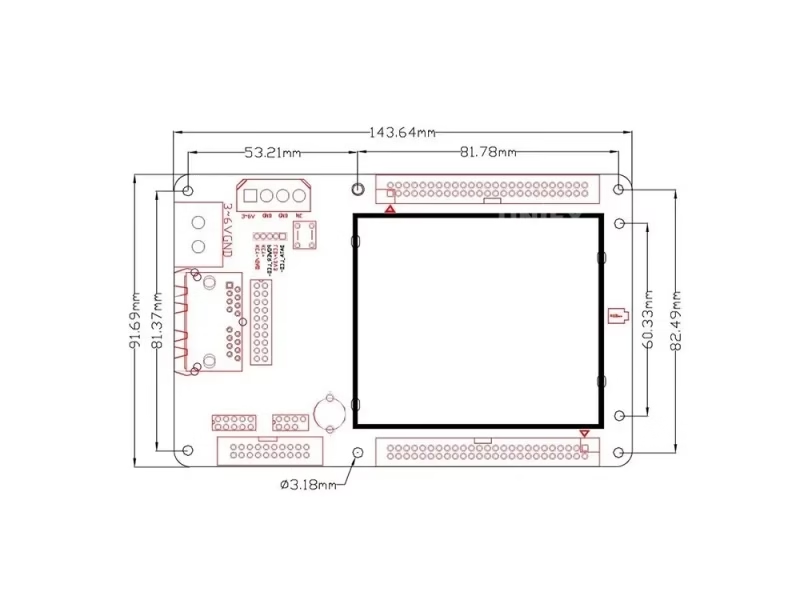
Short answer: The Colorlight i5A-F is a 143×93mm, 100g dual-mode receiving card with 2Gbit onboard memory for offline playback, a 512×128 full-color control area (1/8 scan), up to 4,000Hz refresh (static 64×64 at 4096 grayscale), 65,536 grayscale levels, 16 groups RGBR’ plus 20 groups RGB (expandable to 32), built-in temperature sensor and relay, loop backup and dual-machine backup, and DC 5V power. Market pricing runs $37–$55.
A note on data sources: the figures on this page are compiled from Colorlight’s official dual-mode backup solution documentation and cross-verified across multiple distributor specification sheets, which agree with each other. Where marketplace pages contradict each other — refresh rate, control area, voltage — the correction table below documents the conflict and the figure we verify against. Brand positioning from Colorlight: “5A” means any row, any column, any scan, any chips, any shape.
Colorlight’s official dual-mode product family overview:
Colorlight Official — A200 Sync and Async Cloud Networking Player video
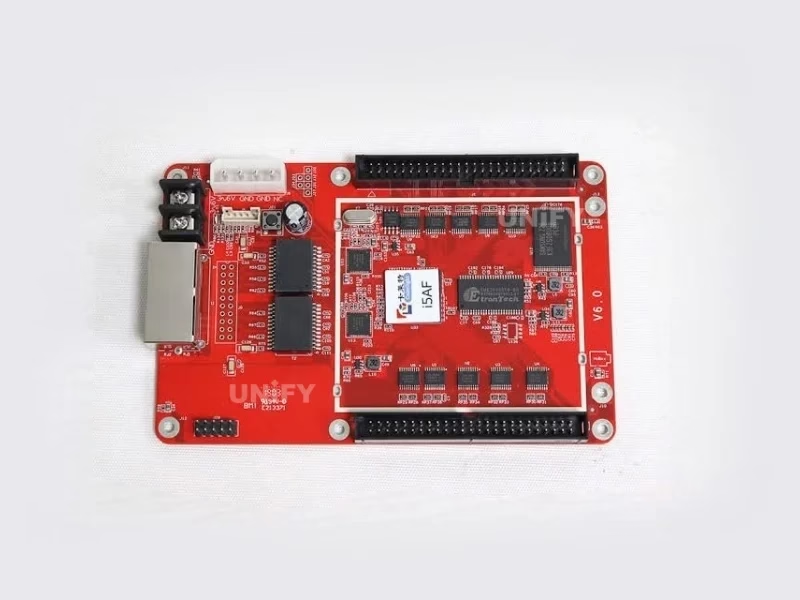
What Are the Colorlight i5A-F LED Receiving Card Specifications?
Data compiled from Colorlight product documentation and cross-verified distributor specification sheets (jekazled / eager-led / led-estore — consistent across sources).
Control & Display Quality
Interfaces, Physical & Environment
Why Do Colorlight i5A-F LED Receiver Card Spec Sheets Disagree?
In August 2026 listings we reviewed, the i5A-F carries three recurring conflicts — and each traces back to the same cause: listing authors copying figures from the sibling i5A-905:
Why these errors cost money: a camera-facing wall specified against a copied 16,000Hz figure buys a 4,000Hz card and flickers on camera; a module plan built on 256×256 misses the 512×128 1/8-scan capability the card actually offers; a power design on the wrong voltage range fails in the field. The countermeasure: confirm the card’s own specification sheet — or ask the supplier which card’s figures they are quoting.
How Does the Colorlight i5A-F Compare to the i5A-905 LED Receiving Card?
Two cards, two different jobs. The i5A-905 is the high-refresh compact card; the i5A-F is the never-goes-black dual-mode card:
The decision in three numbered differences:
- Downtime tolerance. If the wall must never go black — stadium, advertising, unattended — the i5A-F’s dual-mode fallback is the requirement. If downtime is acceptable, the i5A-905 saves budget.
- Refresh demand. Camera-facing walls need the i5A-905’s 16,000Hz. Walls viewed by the public at street level run fine on the i5A-F’s 4,000Hz ceiling.
- Monitoring architecture. The i5A-F’s built-in temperature sensor and relay remove the multifunction card from the BOM — a per-cabinet saving that compounds on large walls.
The sibling page documents the 905 side in full: Colorlight i5A-905 LED Receiving Card.
How Does the Dual-Mode Fallback Work on the Colorlight i5A-F LED Receiving Card?
The i5A-F’s defining behavior, step by step:
Normal operation — synchronous mode
The card runs as a standard receiving card, driven by the Colorlight sending controller — full live video, frame by frame.
Content pre-load — the 2Gbit memory
Fallback content is loaded onto each card’s 2Gbit onboard memory in advance. Playback duration depends on the content’s bitrate — confirm the fit during commissioning.
Signal loss — automatic switch
When the sending signal is interrupted, the card switches to asynchronous mode automatically and loops the stored content — the wall never shows black, never shows “no signal.”
Signal return — flicker-free switch back
When the sending signal returns, the card switches back to synchronous mode — the transition is designed to be flicker-free on both directions of the switch.
The revenue math that justifies the card: a stadium perimeter board or an advertising wall earns per minute of uptime. A sending-side failure on a standard card means black screens until a technician arrives; on the i5A-F, the same failure costs nothing visible — the audience sees the fallback loop. The card pays for itself the first time it holds the screen during a failure. The synchronous vs asynchronous LED control guide compares the two architectures the i5A-F combines.
How Do the Built-In Sensors and Relay Work on the Colorlight i5A-F LED Receiver Card?
The i5A-F carries a temperature sensor and a relay on the card itself — capabilities that on other Colorlight cards require a separate multifunction card. The architecture difference:
🌡 Temperature Sensor
Cabinet temperature monitored per card — overheating cabinets flagged before modules fail.
🔌 Relay — Remote Power
The relay switches equipment power on and off remotely — an unattended wall reboots from the control room.
📦 BOM Simplification
No multifunction card to buy, mount and cable — one part fewer per cabinet, multiplied by every cabinet on the wall.
🖥 LCD + Indicator
A monitoring expansion interface and LCD interface plus status lamp and test button — field diagnosis on the card.
Colorlight’s official monitoring course:
Colorlight Official — LED Wall Health Monitor course video
For comparison, the multifunction-card architecture the i5A-F replaces:
Colorlight Official — Multi-function Card iM9 course video
How Does Backup Work on the Colorlight i5A-F LED Receiving Card?
Three layers, per the cross-verified specification sheets:
Loop backup — Port A + Port B
The two RJ45 ports form a signal loop: a cut cable anywhere still reaches every card from the other direction. Network port exchange adds routing flexibility.
Dual-machine backup
Two sending controllers feed the chain and the receiving layer switches between them — the top of the backup stack, per the specification sheets.
The dual-mode layer on top
Even if both sending paths fail, the 2Gbit fallback keeps content on the wall — the i5A-F’s backup story ends with a looped image, never a black screen.
Colorlight’s official loop-backup topology:
Colorlight Official — X Series EP11 Single-Device Loop Backup video
How Do You Configure the Colorlight i5A-F LED Receiver Card?
The i5A-F configures with the Colorlight control software — and it is one of the few receiving cards with its own official configuration video. The workflow in five steps:
Wire the card
DC 5V to Power 1 (Power 2 as the second feed), RJ45 from the sender to Port A (Port B closes the loop), dual 50P to the HUB boards.
Detect sender and cards
The software detects the sending device and lists every i5A-F per port — index, type and cable status.
Load the module parameter file
The module supplier’s file defines driver IC, scan mode and data routing — including whether the 16-group or 20-group output mode applies.
Map the layout and load fallback content
Set the receiving card mapping, then load the offline fallback content onto the 2Gbit memory — the step that arms the dual-mode protection.
Send, save, and test the fallback
Send and save the parameters, then deliberately disconnect the sender once — the wall should switch to the stored loop. A fallback that was never tested is a fallback that does not exist.
Colorlight’s official i5A-F configuration walkthrough:
Colorlight Official — Configure the LED display for i5A F video
Where Is the Colorlight i5A-F LED Receiving Card Used?
Stadium & Sports Screens
A sending-side fault during a match costs every minute the board is black — the dual-mode fallback keeps content on the wall until the fix arrives.
Advertising Walls
Contractual uptime clauses turn black screens into penalties — the stored loop holds the campaign frame during any signal failure.
Exhibitions & Tender Samples
Offline demonstration without a control room — the async mode plays the pre-loaded demo loop, the classic bid-sample setup.
Unattended Installations
Built-in temperature sensor and relay give remote power control and cabinet monitoring without a multifunction card — walls that run without staff.
Why Buy the Colorlight i5A-F LED Receiving Card From an LED Display Factory?
The i5A-F’s spec conflicts documented above — refresh figures copied from the wrong card — are what happens when hardware moves through unverified listing channels. Buying through a full-line LED screen manufacturer changes the purchase in three ways:
1. Verified hardware against the card’s own documentation. Every i5A-F we ship comes from Colorlight’s authorized channel, is tested on live LED modules before dispatch, and carries serial-number traceability. The first question we answer is the one most listings cannot: which card’s figures they are quoting.
2. Commissioning that arms the dual-mode protection. Our engineers configure the i5A-F end to end — the mapping, the parameter file, and critically the fallback content loaded onto the 2Gbit memory, with the disconnect test performed before handover. A fallback that was never tested is a fallback that does not exist. Our quality control of LED display process applies the same rigor to every batch.
3. Lifecycle economics. A 3W solid-state card with 2KV static resistance and a −30°C to +85°C operating range has no wear parts — LED screen lifespan is set by the modules, not the card. We back the i5A-F with a 2-year warranty and keep spares for the project’s operating life.
How Much Does the Colorlight i5A-F LED Receiving Card Cost?
Price transparency, stated plainly: in August 2026 listings we reviewed, the i5A-F traded between $37 (sale) and $55 (regular) — the dual-mode memory and built-in sensors put it above the i5A-905’s $10–$18 band, and the spread is channel margin and batch size. Factory-direct tiers for B2B buyers:
The dual-mode card is a per-cabinet decision — a 100-cabinet stadium wall carries hundreds of them, and the fallback protection is only as good as the cards that carry it. Ask for a factory-direct quote at your card count.
What Do Buyers Ask About the Colorlight i5A-F LED Receiving Card?
Why Trust the Colorlight i5A-F LED Receiving Card From UnifyLED?
Every batch ships with Colorlight original packaging, tested on live modules before dispatch.
Ready to Source the Colorlight i5A-F LED Receiving Card?
Factory-direct pricing, genuine stock, dual-mode fallback commissioning and 2-year warranty.
unifyledscreen@gmail.com | +86-191-18802497
What Should Engineers Know Before Buying the Colorlight i5A-F LED Receiving Card?
Published: August 2026 | 13 min read | UnifyLED Engineering Team
The Colorlight i5A-F LED Receiving Card is the receiving card for walls that are not allowed to fail visibly — and the one whose marketplace listings are most polluted by figures copied from its sibling. Refresh rates off by 4×, control areas stated in halves, voltages borrowed from another card: this guide resolves all of it against cross-verified specification data, then walks the dual-mode decisions that make the i5A-F the “never goes black” option in the Colorlight receiving line.
Short answer: The Colorlight i5A-F is a 143×93mm, 100g dual-mode receiving card: synchronous and asynchronous operation on one card, 2Gbit onboard memory that takes over automatically on signal loss, a 512×128 full-color control area (1/8 scan), up to 4,000Hz refresh, 65,536 grayscale levels, built-in temperature sensor and relay, loop backup and dual-machine backup, at $37–$55 per card. The i5A-905 sibling is the sync-only 16,000Hz alternative.
Chapter 1 — Definition: The Card That Refuses to Go Black
The Colorlight i5A-F LED Receiving Card is a dual-mode receiving card: the same hardware runs the synchronous system — driven live by a sending controller — and the asynchronous system — playing content from its own 2Gbit onboard memory. When the sending signal is interrupted, the card switches to asynchronous mode automatically and loops the stored content; when the signal returns, it switches back. The wall never shows black, never shows “no signal.” That behavior defines the product, and the synchronous vs asynchronous LED control guide explains the two architectures it combines.
Colorlight’s own brand line for the card reads like a spec sheet in one sentence: “5A means any row, any column, any scan, any chips, any shape.” The i5A-F honors all five — 8192-pixel module support in any dimension, static-to-1/32 scanning, conventional plus PWM plus lighting chips, and freeform data routing for spherical and diamond layouts — with the dual-mode fallback layered on top. The card is 143×93mm and 100g, powered at DC 5V through dual connectors, running 3W.
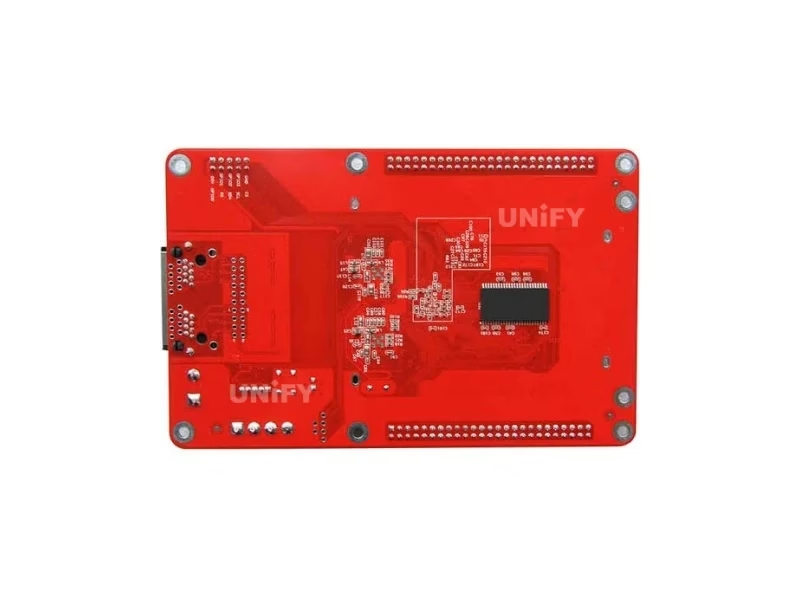
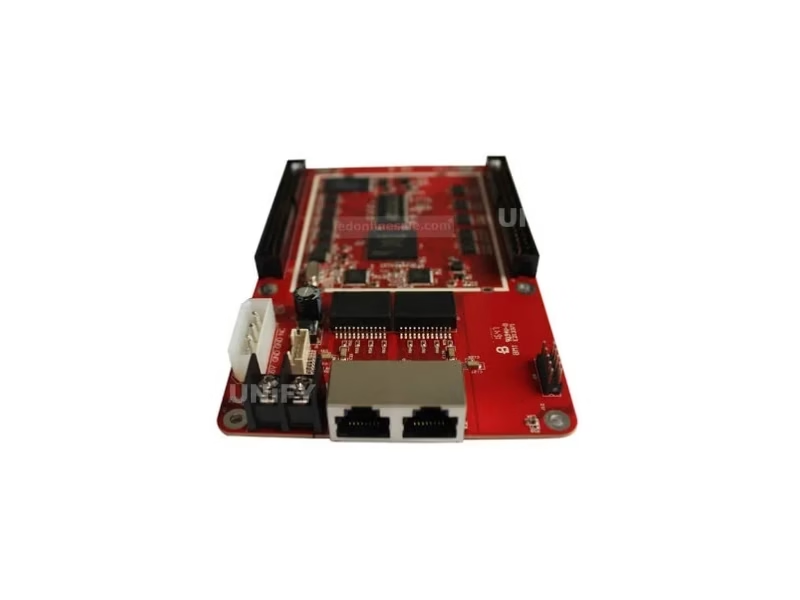
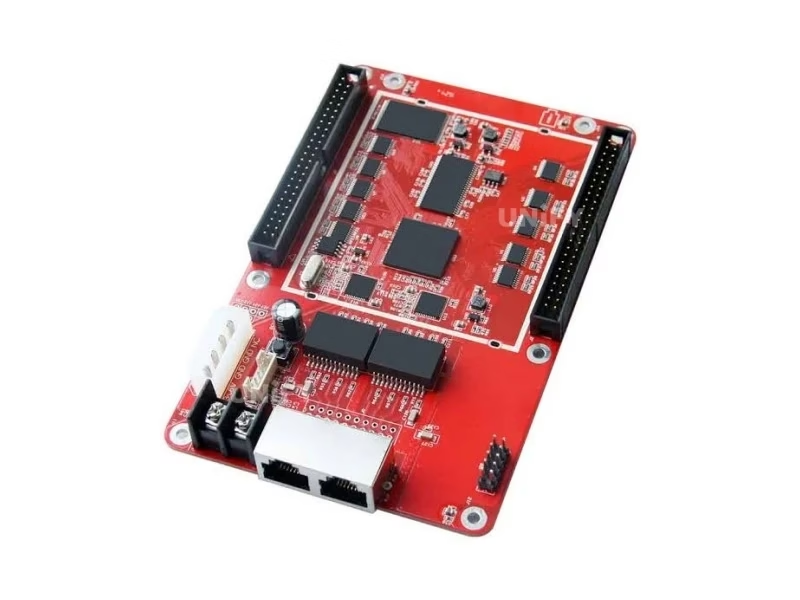
The physical design reflects the card’s field role. The board carries dual 50-pin outputs to the HUB boards, the two network ports, the two power connectors, the monitoring and LCD interfaces, an indicator lamp and a test button — every service point reachable from the front of the cabinet. The 2KV antistatic rating and the −30°C to +85°C operating range extend the same durability story to handling and environment: the card is built for venues, not for benches.
Chapter 2 — The Dual-Mode Fallback, Step by Step
The fallback works in four stages. In normal operation, the card behaves as a standard receiving card, driven frame by frame by the Colorlight sender. Ahead of time, fallback content is loaded onto the 2Gbit onboard memory — how much it holds depends on bitrate, so the fit must be confirmed with the actual files during commissioning. On signal loss, the card switches to asynchronous mode and loops the stored content. On signal return, it switches back — designed to be flicker-free in both directions.
The revenue math that justifies the card belongs in every procurement memo. A stadium perimeter board or an advertising wall earns per minute of uptime; a sending-side failure on a standard card means black screens until a technician arrives. On the i5A-F, the same failure costs nothing visible — the audience sees the fallback loop, and the contract’s uptime clause survives the outage. The card pays for itself the first time it holds the screen during a failure, which is the argument in one sentence.
One commissioning habit separates armed protection from a promise: after loading the fallback content, deliberately disconnect the sender once and verify the switch. A fallback that was never tested is a fallback that does not exist — and the disconnect test takes thirty seconds against the cost of discovering the failure on match day.
The power design supports the same reliability posture. The card carries two power connectors at DC 5V ±10%, so a cabinet can feed it from two points of the power rail — and at 3W rated draw, the card places almost no load on either feed. The dual connectors are not marketing: they are the power-side half of the same never-goes-black philosophy the signal side implements with the dual-mode switch.
Chapter 3 — Loading and Refresh: The Figures With Conditions
The i5A-F’s control area is 512×128 pixels in full-color 1/8-scan mode, or 256×256 conventional with columns extendable to 1024 for special applications — two figures, two modes, and listings that state only the second omit the first. Cascade capacity reaches 65,536 cards and 65,536×65,536 pixels per system, with the calibration area at 256×256 pixels per card and 14-bit brightness and chromaticity correction.
Refresh carries the marketplace’s biggest lie about this card. The cross-verified figure is up to 4,000Hz on static 64×64 modules at 4096 grayscale — scan-dependent, like every receiving card. Listings quoting 16,000Hz and 10,000Hz are copying the i5A-905’s specification sheet onto the i5A-F’s page. The practical consequence: a camera-facing wall specified against the copied figure buys a 4,000Hz card and flickers on broadcast cameras. The verification habit is the same as always — ask which card’s figures the listing is quoting.
Grayscale and output complete the picture: 1–65,536 levels with serial frequency from 1KHz to 41.3MHz and an 8ns minimum OE resolution; 16 groups RGBR’ plus 20 groups RGB, expandable to 32; data exchange, delay and splicing; module support within 8192 pixels in any row or column. Communication runs CAT5 to 140m, CAT6 to 170m, and fiber beyond 20m.
The output-group figure deserves the same conditional reading as the control area: 16 groups RGBR’ is the standard configuration, 20 groups RGB extends it, and the 32-group figure is the expandable ceiling. As with every receiving card, the working configuration follows the module’s parameter file — the driver IC type, scan mode and data routing the module supplier ships with. The card’s job is to offer the modes; the file’s job is to choose them.
Chapter 4 — i5A-F vs i5A-905: The Sister Decision
Two cards, two different jobs, and the choice reduces to three numbered differences:
- Downtime tolerance. If the wall must never go black — stadium, advertising, unattended — the i5A-F’s dual-mode fallback is the requirement. If downtime is acceptable, the i5A-905 saves budget.
- Refresh demand. Camera-facing walls need the i5A-905’s 16,000Hz. Walls viewed by the public at street level run fine on the i5A-F’s 4,000Hz ceiling.
- Monitoring architecture. The i5A-F’s built-in temperature sensor and relay remove the multifunction card from the BOM — a per-cabinet saving that compounds on large walls.
The full sibling comparison lives on the Colorlight i5A-905 LED Receiving Card page — read the two pages together and the receiving-card decision for Colorlight projects reduces to one question: how much is a black screen allowed to cost?
Chapter 5 — Built-In Sensors, Backup and the Unattended Wall
The i5A-F carries a temperature sensor and a relay on the card itself — capabilities that on other Colorlight cards require a separate multifunction card. The temperature sensor flags overheating cabinets before modules fail; the relay switches equipment power remotely, so an unattended wall reboots from the control room; the monitoring expansion interface and LCD interface complete the field-diagnosis toolkit. For an operator running walls without staff on site, the card-level monitoring is the difference between a site visit and a phone call.
The backup stack sits on top: Port A and Port B form a loop so a cut cable still reaches every card from the other direction, with network port exchange for routing flexibility; dual-machine backup lets two senders feed the chain; and the dual-mode layer catches whatever survives both — the i5A-F’s failure story ends with a looped image, never a black screen. Virtual pixel support works in both synchronous and asynchronous modes, and network upgrades land over the same ports.
The field-diagnosis toolkit rounds out the unattended-wall story: an indicator lamp shows power and signal state, a test button cycles monochrome test patterns (red, green, blue, white) and scan modes, and the monitoring expansion plus LCD interfaces expose cabinet status without a laptop. For a technician standing at an unresponsive cabinet, those three physical tools answer the first questions — powered, linked, and test-pattern-clean — before any software opens.
Chapter 6 — Price and Total Cost of Ownership in 2026
The i5A-F’s street price in August 2026 listings spans $37 to $55 — above the i5A-905’s $10–$18 band, reflecting the 2Gbit memory and built-in sensors, with the usual channel-margin spread. The per-cabinet economics work in the card’s favor: removing the multifunction card from the BOM offsets part of the price difference on every cabinet that would otherwise need one, and the fallback protection converts the card’s premium into uptime insurance.
The market context: the LED display control system market reached US$659 million in 2025, projected at a 13.6% CAGR to US$1.59 billion by 2032 (QYResearch, Global LED Display Control System Market Report 2026), with receiving and sending cards the two largest segments. Lifecycle costs favor the card: a 3W solid-state design with 2KV static resistance and a −30°C to +85°C operating range has no wear parts, and LED screen lifespan is set by the modules, not the electronics.
The batch economics deserve one line for procurement teams: the i5A-F is a per-cabinet component, and a stadium wall carries hundreds. The price delta between channels compounds across the wall’s card count, the multifunction-card saving compounds with it, and the fallback protection only works where the card is actually installed — partial deployments protect the wall partially. Quote by card count, verify by specification sheet, deploy to every cabinet that matters.
Chapter 7 — When the i5A-F Beats an Async Player Card
A question that comes up on every dual-mode project: why not run the wall on an asynchronous player card and skip the synchronous side? The answer is the difference between fallback and primary. An async-only card plays stored content well and live video not at all — a stadium or advertising wall that needs live feeds, camera sources or real-time graphics requires the synchronous path, and the i5A-F keeps that path while carrying the async capability as the safety net. The dual-mode card is not an async player with a bonus; it is a synchronous receiving card that refuses to die when the synchronous side fails.
The async side of the i5A-F also inherits the scheduling patterns of the player world — the stored content can follow timed programs the same way Colorlight’s player software schedules asynchronous walls. For the scheduling workflow on the async side:
Colorlight Official — Program Schedule in PlayerMaster tutorial video
For the sending side that feeds the card, the Colorlight controller ladder runs from the X2 through X4, X8m, X16 and Z6 PRO-G2 — and the cross-ecosystem comparison sits on the Novastar MRV412 receiving card page.
The ecosystem rule closes the decision the same way it opens it: the receiving card follows the sending controller, and mixing Colorlight cards with Novastar senders is unsupported by both vendors. The i5A-F’s compatibility list spans T7/iT7, Q7/iQ7, iQ7E, Gigabit NIC, DMB, the S/Z/C series and T8 — the full Colorlight sender history — which is exactly what a card that outlives sender generations should offer.
Conclusion
The Colorlight i5A-F LED Receiving Card is the receiving card for walls that are not allowed to fail visibly: dual-mode operation with a 2Gbit fallback, built-in monitoring without a multifunction card, and a backup stack that ends in a looped image instead of a black screen. Specify it with the corrected numbers in hand — 4,000Hz, not the copied 16,000Hz; 512×128 in 1/8-scan mode; DC 5V — and arm it properly: load the fallback content, test the disconnect, then rely on it. Buy it through a verified LED screen manufacturer that tests cards on live modules and commissions the dual-mode protection against your actual wall. Choose it when a black screen is expensive — and the receiving layer becomes the part of the wall that never lets the audience see a failure, which is exactly what it is for.
Which LED Controllers Should You Pair With the Colorlight i5A-F?
The Colorlight receiving and sending ladder plus Novastar comparisons on UnifyLED.
Colorlight Receiving Cards
Novastar & Guides
Where Can You Find Colorlight i5A-F LED Receiving Card Resources?
The official Colorlight dual-mode backup solution page — the architecture behind the i5A-F — plus the official Colorlight site.