
Colorlight i5A-905 LED Receiving Card
The Colorlight i5A-905 LED Receiving Card is Colorlight’s 137×48mm compact receiving card for LED color screens and casting aluminum cabinets: 256×256 pixels per card, up to 16,000Hz refresh and 65,536 grayscale levels, three working modes up to 28 RGB data groups, dual RJ45 loop backup, and pin-board power at DC 3.3–6V with no external supply.
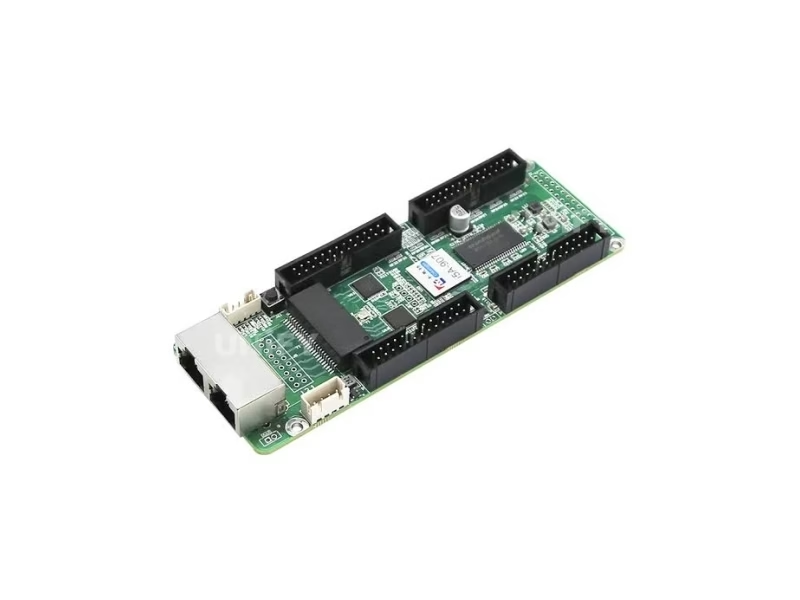
What Is the Colorlight i5A-905 LED Receiving Card?
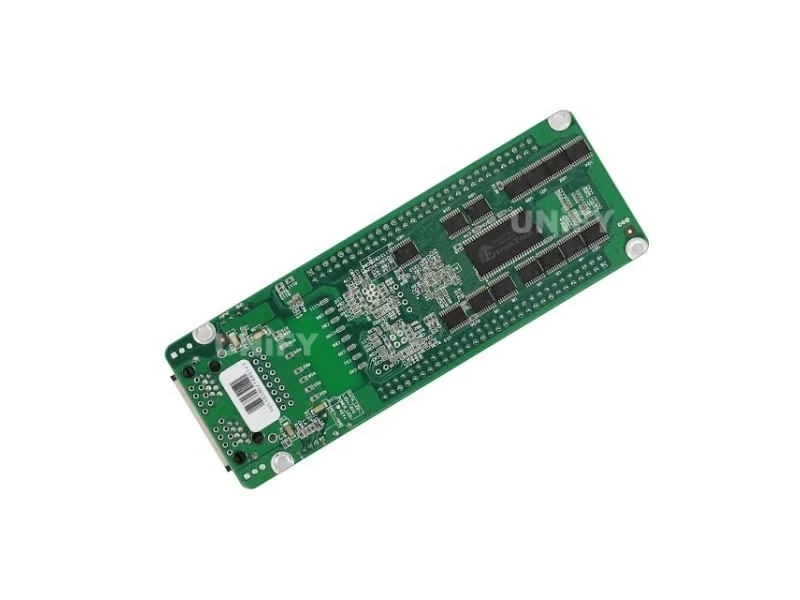
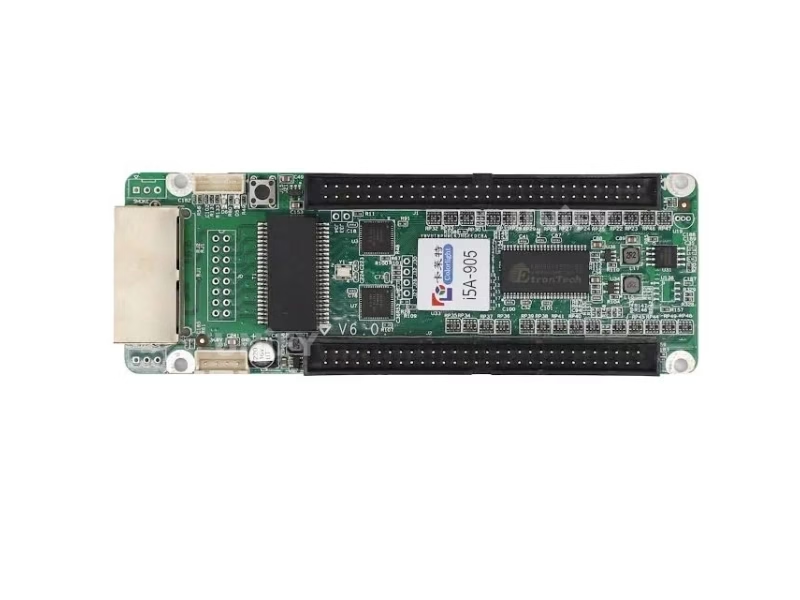
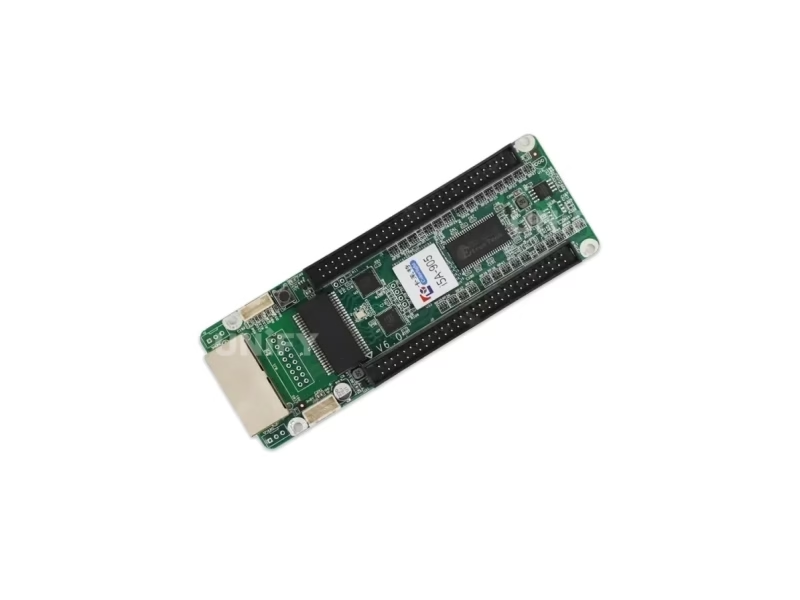
The Colorlight i5A-905 LED Receiving Card is the bridge device between a Colorlight sending controller and the LED modules: it receives the digital signal over Gigabit Ethernet, decodes it, and drives the driver ICs on the modules through two 60-pin outputs. Designed for compact, portable displays — LED color screens and casting aluminum cabinets — it inherits the 5A series’ feature set in a 137×48mm board that draws its power directly from the pin board, with no external power supply in the cabinet. In the control chain, the receiving card is the reason a sending controller works at all: the synchronous vs asynchronous LED control guide explains where it sits.
Short answer: The Colorlight i5A-905 is a 137×48mm, 70g receiving card with a 256×256-pixel control area per card, up to 16,000Hz refresh (static 64×64) and 65,536 grayscale levels, three working modes (16 / 24 / 28 RGB data groups), dual RJ45 ports with loop backup, 14-bit brightness and chromaticity calibration, and DC 3.3–6V pin-board power. It works with Colorlight iT7, iQ7, iQ7E, C1-series and T8 senders plus every current Colorlight sending controller.
Two facts make it the I series workhorse. First, the form factor: at 137×48mm and 70g it fits the shallow cabinets of color screens and the compact casting aluminum boxes of rental panels, where larger cards simply do not go. Second, the reliability stack: dual network ports with intelligent identification, dual-card cabinet backup and dual-machine backup — three layers the touring market depends on. All figures on this page come from the official i5A-905 Specification V1.2; the correction table below documents the listing errors that circulate for this card.
Colorlight’s official receiving card showcase:
Colorlight Official — ISLE 2026 High-End Receiving Cards video
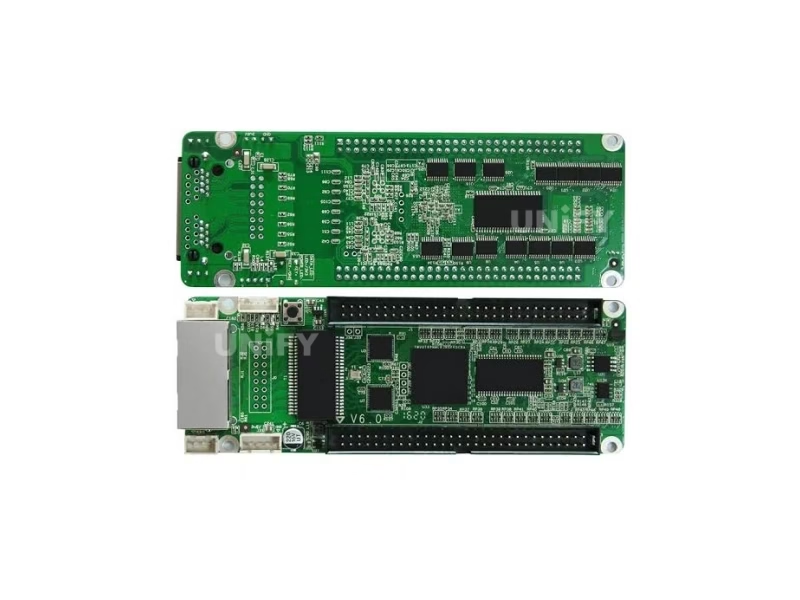
What Are the Colorlight i5A-905 LED Receiving Card Specifications?
All data from the official Colorlight i5A-905 Product Specification V1.2.
Control System & Display Quality (Official V1.2)
Interfaces, Physical & Environment (Official V1.2)
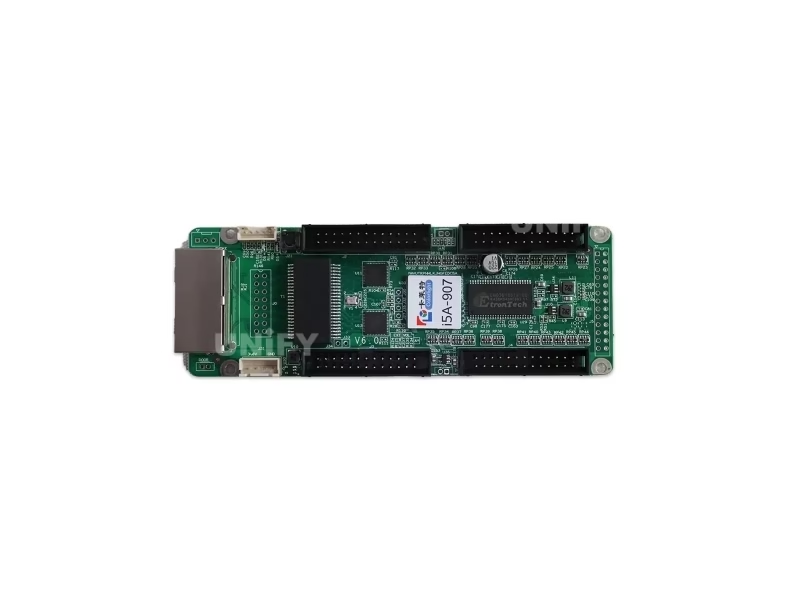
Why Do Colorlight i5A-905 LED Receiver Card Spec Sheets Disagree?
In August 2026 listings we reviewed, the i5A-905 carries three recurring problems — verified against the official Specification V1.2:
Why these errors cost money: freight quotes built on 0.5kg per card over-order the shipping budget seven-fold on multi-card orders; a module design planned around the 28-group mode gets scrapped when the listing never mentions it; and a refresh-rate decision made from “high refresh” instead of 16,000Hz buys the wrong card for the camera-facing wall. Verify against Specification V1.2 — or ask the supplier to state the revision they quote.
How Does the Colorlight i5A-905 LED Receiving Card Compare to the Older A8?
The A8 was Colorlight’s previous-generation compact receiving card. The i5A-905 is its direct successor — and the upgrade gap decides whether an older wall is worth re-carding:
The upgrade decision in three numbered differences:
- Refresh rate. 2,000Hz versus 16,000Hz — an 8× jump. For camera-facing walls, the A8’s ceiling shows flicker on broadcast cameras; the i5A-905’s ceiling does not.
- Grayscale. 256 levels versus 65,536 — banding on dark gradients disappears at the i5A-905’s resolution, with per-level compensation.
- Reliability. The dual-port loop backup and dual-card cabinet backup are i5A-era architecture — the A8 predates them.
For the sending side that feeds this card, the Colorlight controller ladder starts at the X2 and runs through X4, X8m, X16 and Z6 PRO-G2.
Which Working Mode Should You Choose for the Colorlight i5A-905 LED Screen Receiving Card?
The i5A-905 runs three working modes across its two 60P outputs — the mode decides how many data groups the card drives and how the module wiring works:
The rule: the mode follows the module’s parameter file. The module supplier’s configuration defines driver IC type, scan mode and data routing; the card’s mode is selected in the control software to match. Modes are not interchangeable between module designs — the 28-group mode’s serial decoding circuit requirement is why it appears so rarely in listing copy and why the parameter file is the single document that matters at commissioning.
Colorlight’s official data-group walkthrough:
Colorlight Official — Data Group Swap and Split tutorial video
How Does the Dual-Backup Architecture on the i5A-905 LED Receiving Card Work?
Three independent backup layers, per the official specification:
Loop backup — the two RJ45 ports
Ports A and B both carry the signal, and the system identifies the routing intelligently. The cable chain forms a loop: a cut anywhere in the run still reaches every card from the other direction — the single most valuable reliability feature on a touring wall.
Dual-card backup — two cards per cabinet
One cabinet holds two i5A-905 cards that back each other up: if a card fails mid-show, its partner takes over the cabinet’s modules. The touring standard for stages where a black cabinet is not an option.
Dual-machine backup — redundant senders
With two sending controllers feeding the chain, the receiving layer switches between them — the top layer of the Colorlight backup architecture, completing the loop-to-card-to-machine stack.
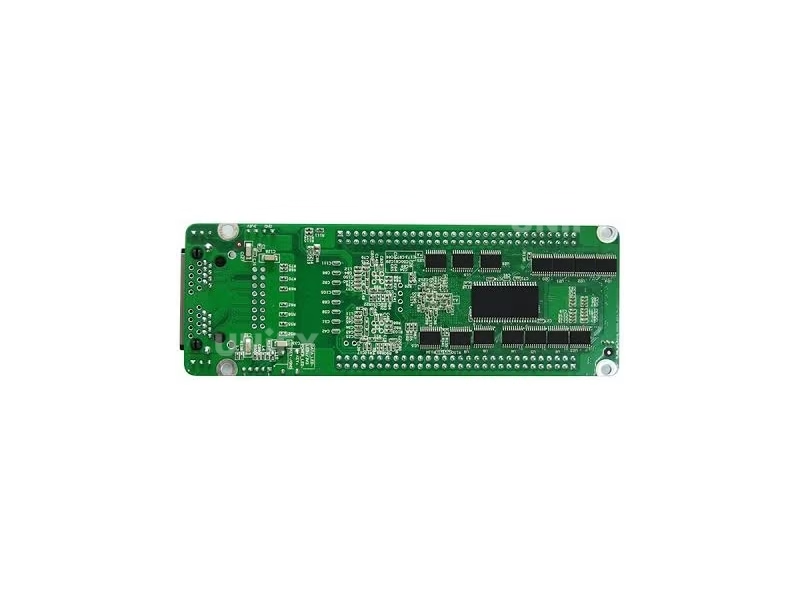
How Does the Colorlight i5A-905 LED Receiver Card Deliver 16,000Hz and 65,536 Levels?
The two headline numbers carry conditions worth understanding before quoting them:
⚡ 16,000Hz — with conditions
Up to 16,000Hz on static 64×64 modules; up to 10,000Hz at 1/8 scan 128×128. The refresh ceiling depends on the module’s scan mode and driver IC — verify against your module’s parameter file.
🎨 65,536-level grayscale
With per-level grayscale compensation and an 8ns OE resolution — dark gradients render without banding, and the first grayscale value displays effectively.
🔧 Low-gray fixes
The specification names the three classic defects it solves: partial dark at row, reddish tint at low gray, and shadow problems — the details that show on dimmed walls.
🧩 Chip coverage
Conventional chips, hundreds of PWM chip specifications (including MBI5042) and lighting chips — the card adapts to the module design, not the reverse.
Colorlight’s official seam-correction walkthrough — the low-gray and seam fixes in practice:
Colorlight Official — Calibration EP03 Seam Correction tutorial video
How Does Calibration Work on the Colorlight i5A-905 LED Receiving Card?
The i5A-905 supports 14-bit high-precision point-by-point calibration for both brightness and chromaticity, with a 256×256-pixel calibration area per card. The workflow: calibration coefficients are measured per pixel (from the module’s calibration data), stored with the module, and loaded onto the receiving card — the wall then renders with per-pixel corrected brightness and color, removing the module-to-module seams that show on solid-color content.
The maintenance habit that protects the calibration: read back and store each card’s coefficients before any replacement, then reload them onto the new card. A card swap without readback loses the calibrated state and forces a fresh calibration pass — on a touring wall, that is the difference between a 10-minute repair and a next-day color session.
Colorlight’s official calibration-coefficient tutorial:
Colorlight Official — Calibration EP01 Send Calibration Coefficients tutorial video
How Do You Configure the Colorlight i5A-905 LED Receiving Card with LEDsetting?
Five steps from wired card to displaying module, in Colorlight’s LEDsetting software:
Wire the card
Pin-board power (DC 3.3–6V), RJ45 from the sending controller to Port A (Port B completes the loop), J1/J2 to the module.
Detect the cards
LEDsetting detects the sender and lists the receiving cards per port — index, type and cable status appear in the device table.
Load the parameter file
The module supplier’s parameter file defines driver IC type, scan mode and data routing — it also determines which working mode the card uses (16 / 24 / 28 groups).
Set data groups and mapping
Configure data group swap/split per the module design, then map the receiving card layout — rows, columns and connection lines per port.
Send and save
Send the parameters, verify the modules display, then save to the card — the configuration survives power cycles and card swaps.
Colorlight’s official intelligent-setting tutorial:
Colorlight Official — Intelligent Setting of LEDsetting tutorial video
Where Is the Colorlight i5A-905 LED Receiving Card Used?
LED Color Screens
The 137×48mm board fits the shallow cabinets of color screens and soft-cover displays — the format the card was designed for.
Casting Aluminum Rental Cabinets
Compact size plus pin-board power plus dual-card backup — the three traits rental panels demand. See LED screen for events.
Freeform & Creative Displays
Any pumping point and arbitrary data offset drive spherical, diamond and freeform screens — 16 data groups offset at random points.
A8 Fleet Upgrades
Re-carding older walls lifts refresh from 2,000Hz to 16,000Hz and grayscale from 256 to 65,536 levels — the same modules, a new card.
Why Buy the Colorlight i5A-905 LED Receiving Card From an LED Display Factory?
A receiving card purchase from a parts-only channel ends at the box — and the i5A-905’s spec chaos documented above is what happens when cards move through unverified listing channels. Buying through a full-line LED screen manufacturer changes the purchase in three ways:
1. Verified hardware against Specification V1.2. Every i5A-905 we ship comes from Colorlight’s authorized channel, is tested on live LED modules before dispatch, and carries serial-number traceability. The official specification’s “zero malfunction of final products” claim rests on the rigorous aging test the factory applies — we verify it, not just repeat it.
2. Commissioning that finishes the card layer. Our engineers configure the i5A-905 with LEDsetting end to end — the working-mode selection, the data-group plan, the mapping and the calibration coefficients — against your actual modules. Our quality control of LED display process applies the same rigor to every batch.
3. Lifecycle economics. A 3W solid-state card with 2KV static resistance has no wear parts — LED screen lifespan is set by the modules, not the card. We back the i5A-905 with a 2-year warranty and keep spares for the project’s operating life.
How Much Does the Colorlight i5A-905 LED Receiving Card Cost?
Price transparency, stated plainly: in August 2026 listings we reviewed, the i5A-905 traded from $10 to $18 per card — a volume product where the spread is channel margin and batch size. Factory-direct tiers for B2B buyers:
Receiving cards are the volume line in the control chain — a 100-cabinet wall carries hundreds of them, and batch pricing moves materially. Ask for a factory-direct quote at your card count.
What Do Buyers Ask About the Colorlight i5A-905 LED Receiving Card?
Why Trust the Colorlight i5A-905 LED Receiving Card From UnifyLED?
Every batch ships with Colorlight original packaging, tested on live modules before dispatch.
Ready to Source the Colorlight i5A-905 LED Receiving Card?
Factory-direct pricing, genuine stock, LEDsetting commissioning support and 2-year warranty.
unifyledscreen@gmail.com | +86-191-18802497
What Should Engineers Know Before Buying the Colorlight i5A-905 LED Receiving Card?
Published: August 2026 | 13 min read | UnifyLED Engineering Team
The Colorlight i5A-905 LED Receiving Card is the smallest and most widely deployed card in Colorlight’s receiving line — and the one whose marketplace listings carry the least real information. Weight figures off by a factor of seven, working modes missing from the copy, and refresh claims with no numbers behind them: this guide resolves all of it against the official i5A-905 Specification V1.2, then walks the decisions that matter when a card choice determines a wall’s quality ceiling.
Short answer: The Colorlight i5A-905 is a 137×48mm, 70g receiving card with a 256×256-pixel control area, up to 16,000Hz refresh (static 64×64) and 65,536 grayscale levels, three working modes (16/24/28 data groups), dual RJ45 loop backup, 14-bit brightness and chromaticity calibration, and DC 3.3–6V pin-board power. It costs $10–$18 per card, upgrades the older A8 by 8× in refresh, and works with every current Colorlight sending controller.
Chapter 1 — Definition: The Bridge Between Sender and Module
The Colorlight i5A-905 LED Receiving Card is the device between a Colorlight sending controller and the LED modules: it receives the digital signal over Gigabit Ethernet, decodes it, and drives the driver ICs through two 60-pin outputs. Every wall has one card per module cluster, which makes the receiving card the most numerous component in the control chain — and the component whose specification ceiling silently caps what the wall can display. A 2,000Hz card renders a camera-visible flicker no matter how good the sending controller above it is; the receiving card is the last link in the quality chain. The synchronous vs asynchronous LED control guide covers where the chain begins.
The i5A-905’s design brief is visible in its dimensions. At 137×48mm and 70g, powered directly from the pin board at DC 3.3–6V with no external supply, it fits the two cabinet types where space is tightest: LED color screens and casting aluminum rental boxes. The official specification says the size and interfaces are “most suitable” for those formats — and that form-factor decision, made a decade ago, is why the card remains the I series workhorse while larger cards rotate through the catalog.
The sender side of the compatibility question deserves one line: the official list covers iT7, iQ7, iQ7E, Gigabit NIC, C1-series and T8 senders, and the card works with every current Colorlight sending controller — from the 2-port X2 to the Z6 PRO-G2 super controller. The practical rule is simple: within the Colorlight ecosystem, the receiving card choice follows the module design, not the sender generation.
Chapter 2 — Loading and Refresh: The Numbers With Conditions
The i5A-905 controls 256×256 pixels per card — columns extendable to 1024 for special applications — with cascade capacity reaching 65,536 cards and 65,536×65,536 pixels per system, synchronized card-to-card at nanosecond level. The loading figure is unconditional; the refresh figure is not.
Refresh is stated as up to 16,000Hz on static 64×64 modules and up to 10,000Hz at 1/8 scan on 128×128 modules, with serial frequencies from 0.2 to 41.7MHz. The condition is the module’s scan mode and driver IC: a 1/32-scan module cannot reach the static ceiling, and the achievable refresh follows the parameter file. The specification discipline: quote the refresh with the scan mode attached, the way the official document does — a bare “16,000Hz” is a marketing number until the module design confirms it.
Grayscale carries a cleaner story: 65,536 levels with per-level grayscale compensation and an 8ns minimum OE resolution. The low-gray behavior is where the card earns its quality reputation — the specification names three defects it solves explicitly: partial dark at row, reddish tint at low gray, and shadow problems. Those are the defects that show on dimmed walls and camera close-ups, and the i5A-905’s generation was built around them.
Module compatibility completes the loading picture. The card supports 4096 pixels per row or column, routes cables in any direction, folds data in the same or reverse direction to lift refresh, and transmits data serially in RGB, R8G8B8 or R16G16B16 form — with the D signal doubling as a clock extension to reach 32 data groups. Chip coverage spans conventional drivers, hundreds of PWM chip specifications including MBI5042, and lighting chips. In practice that means the card adapts to the module design rather than forcing the module design around the card — the compatibility layer that keeps the i5A-905 current across a decade of module generations.
Chapter 3 — Three Working Modes: The Selection Most Listings Omit
The i5A-905 runs three working modes across its two 60-pin outputs, and most listing copy mentions only two. The numbered differences:
- Standard mode — 16 groups RGBR’. 1/32 scan, the default configuration for common modules.
- 24-group mode — 24 groups RGB. 1/32 scan, for higher-density modules needing more data lines.
- 28-group mode — 28 groups RGB. 1/8 scan with a serial decoding circuit required for 1/8–1/32 operation. The maximum group count, and the mode almost no listing mentions.
The mode follows the module’s parameter file, not the buyer’s preference — the file defines driver IC type, scan mode and data routing, and the card’s mode is selected to match in the control software. The practical consequence: a module design that needs 28 groups only works on cards that offer the 28-group mode, which is exactly the capability listing copy hides. Before committing a module design to this card, confirm the parameter file against the mode table — the single most common commissioning surprise on i5A-905 projects.
One further capability rides on the same pin definitions: freeform displays. The specification supports any pumping point and arbitrary data offset across the 16 data groups — the mechanism behind spherical screens, diamond layouts and creative displays, where modules sit at odd angles and the data routing follows the geometry instead of a grid. For creative projects, the i5A-905’s data-offset capability is the feature that makes the shape possible at all; grid-oriented cards top out where the layout stops being rectangular.
Chapter 4 — The Backup Stack: Loop, Card, Machine
The i5A-905’s reliability architecture stacks three layers. First, loop backup: the two RJ45 ports both carry the signal with system-intelligent routing, so the cable chain forms a loop — a cut anywhere still reaches every card from the other direction. Second, dual-card backup: one cabinet holds two cards that take over for each other on failure. Third, dual-machine backup: two sending controllers feed the chain and the receiving layer switches between them. The first layer costs nothing extra (the second port is on the card); the second costs one spare card per critical cabinet; the third is the top of the Colorlight backup architecture — and all three are documented in the official specification, not dealer folklore.
Chapter 5 — i5A-905 vs A8: The Upgrade Math
The A8 was the previous-generation compact card, and the i5A-905 is its direct successor. The upgrade gap, in numbered differences:
- Refresh: 2,000Hz to 16,000Hz. An 8× jump that takes a wall from camera-visible flicker to broadcast-clean.
- Grayscale: 256 to 65,536 levels. Dark gradients go from banded to smooth, with per-level compensation.
- Architecture: dual ports and dual-card backup arrive with the i5A generation — the A8 predates the reliability stack.
The re-carding decision: the modules stay, the cards change, and the wall’s display quality jumps a full generation. For an A8 fleet whose modules are still healthy, the i5A-905 is the cheapest quality upgrade in the Colorlight catalog — the math favors re-carding over replacing walls in every case where the modules have life left.
Chapter 6 — The Spec Errors That Cost Money
In August 2026 listings we reviewed, the i5A-905 carries three recurring problems. The weight: one major listing states 0.5 kg — the official figure is 70 grams, and the inflated number is a store-database shipping weight mislabeled as product weight, which over-orders freight budgets seven-fold on multi-card shipments. The modes: listing copy says “16 and 24 groups maximum” — the official specification’s 28-group mode disappears, hiding the capability that certain module designs depend on. The numbers: pages describe “high refresh” without stating 16,000Hz, “high gray scale” without stating 65,536 — qualitative copy where the specification gives concrete figures. The countermeasure is the same discipline as every Colorlight purchase: verify against Specification V1.2, or ask the supplier to state the revision they quote.
Chapter 7 — Configuration and Calibration: The Field Workflow
The i5A-905 configures in Colorlight’s LEDsetting software: detect the cards, load the module’s parameter file, set data groups and mapping, send and save. The calibration layer on top: 14-bit point-by-point brightness and chromaticity calibration with a 256×256-pixel area per card — coefficients measured per pixel, stored with the module, loaded onto the card. The wall then renders with per-pixel corrected output, removing the module-to-module seams that show on solid color.
The maintenance habit that protects it: read back each card’s coefficients before any replacement and reload them onto the new card. A swap without readback loses the calibrated state and forces a fresh calibration pass. On a touring wall, that is the difference between a ten-minute repair and a next-day color session. Colorlight’s official single-card parameter tutorial:
Beyond calibration, the card’s monitoring features extend the field workflow: in conjunction with a multifunction card, the i5A-905 reports temperature, humidity and smoke — and supports a relay switch to power equipment on and off remotely. For an installed wall in an unstaffed location, that remote relay is the difference between a site visit and a phone call; for a rental wall, the temperature and humidity readouts catch a wet venue before the modules pay for it.
Colorlight Official — How to Accurately Send Parameters to a Single Receiving Card tutorial video
Chapter 8 — Price and Total Cost of Ownership in 2026
The i5A-905’s street price in August 2026 listings spans $10 to $18 per card — a volume product where the spread is channel margin and batch size, and where batch pricing moves materially at 50-card and 500-card tiers. A 100-cabinet wall carries hundreds of cards; the per-card delta between channels compounds into real money, which is why receiving cards are quoted by count, not by unit price alone.
The market context: the LED display control system market reached US$659 million in 2025, projected at a 13.6% CAGR to US$1.59 billion by 2032 (QYResearch, Global LED Display Control System Market Report 2026), with receiving and sending cards the two largest product segments. Lifecycle costs favor the card: a 3W solid-state design with 2KV static resistance and a −25°C to +85°C operating range has no wear parts, and LED screen lifespan is set by the modules, not the electronics. On the wall’s balance sheet, the receiving layer is the smallest durable line item — and the one whose specification decides how good the wall can look.
Chapter 9 — When the i5A-905 Beats a Novastar Receiving Card
The cross-ecosystem comparison matters because the receiving card follows the sending controller — mixing Colorlight cards with Novastar senders is unsupported by both vendors. If the project’s sending side is Colorlight, the i5A-905 is the compact card of that ecosystem, and its specific advantages are the 137×48mm form factor for tight cabinets, the three working modes including 28-group output, and the dual-port loop backup at the card level. If the project runs Novastar senders, the mirror decision lives on the Novastar MRV412 receiving card page, and the Novastar receiving card selection guide covers that side of the ladder.
Conclusion
The Colorlight i5A-905 LED Receiving Card is the workhorse of the Colorlight receiving line for a reason that survives a decade of catalog changes: it is the smallest card that delivers the full modern quality stack — 16,000Hz refresh with the right modules, 65,536 grayscale levels, three working modes and a three-layer backup architecture — at $10–$18 per card. Specify it with the conditions attached (refresh follows the scan mode; the mode follows the parameter file), verify the listing against Specification V1.2, and buy it through a verified LED screen manufacturer that tests cards on live modules and loads the right parameters before dispatch. Choose it for color screens, casting aluminum cabinets, creative displays and A8 upgrades — and the receiving layer becomes the part of the wall nobody thinks about, which is exactly what it is for.
Which LED Controllers Should You Pair With the Colorlight i5A-905?
The Colorlight sending-side ladder plus Novastar receiving card comparisons on UnifyLED.
Novastar Receiving Side
Guides & Resources
Where Can You Download Colorlight i5A-905 LED Receiving Card Resources?
The official Colorlight i5A-905 Product Specification V1.2 — the data source for every figure on this page — plus the official Colorlight site.