
- Home
- »
- LED Screen Buying Guides
- »
- LED Screen Size Guide: Dimensions, Charts & Calculation
LED Screen Size Guide: Dimensions, Charts & Cabinet Calculation
Table of Contents
LED screen size decides the two numbers every project starts with: the width and height of the wall, and the pixel count that fills it. An LED display has no factory-fixed diagonal — it is assembled from modules and cabinets, so the final size follows from pixel pitch, module dimensions, and the space you have. This guide walks through the three calculation methods (module, cabinet, and resolution), gives 16:9 size charts with cabinet counts, and lists standard dimensions by application. If you would rather have the numbers done for you, send us your wall dimensions and our engineers return a free cabinet layout within 1 hour.
1. What Is LED Screen Size?
An LED screen size is the physical width and height of an assembled display, measured in millimeters, meters, or feet. The term covers three linked numbers, and telling them apart is the first step in planning any wall:
- Physical size — width × height in meters or feet; the space the screen occupies.
- Resolution — horizontal × vertical pixel count; it decides sharpness at the viewing distance.
- Module or cabinet count — how many building units tile the wall; it drives cost, power, and structure.
Pixel pitch is the master variable that connects all three: pick a pitch, and resolution and physical size follow from the module grid — Section 3 shows the formulas. Standard aspect ratios such as 16:9 or 4:3 fit most content, while custom builds wrap columns, fill irregular walls, or follow a stage design.
Two quick examples show how the numbers move together. A 3.2 × 1.8 m wall at P1.5 resolves 2,133 × 1,200 — close to Full HD for a conference room. The same wall at P4 resolves only 800 × 450, which is fine for a shop window watched from 8 m and wrong for a boardroom. The wall did not change; the pitch did.
2. Key Factors That Affect LED Screen Size Selection
Choosing the right LED screen size depends on multiple factors, including viewing distance, pixel pitch, installation environment, content type, and budget. Understanding these factors ensures optimal visibility, clarity, and audience experience.
Viewing Distance
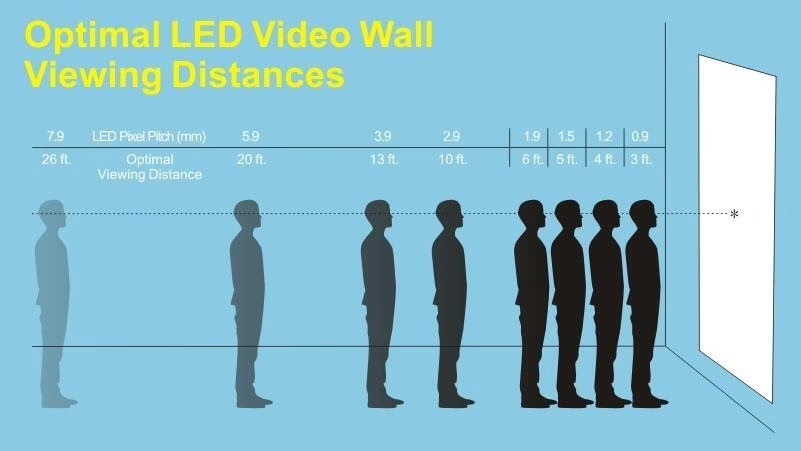
Viewing distance is the primary factor in determining LED wall screen size. Short-range environments, like retail displays, control rooms, or product showcases, require smaller screens with fine pixel pitch for clear detail. Long-range setups, such as outdoor LED billboards or stadiums, need larger screens to maintain visibility.
Regional differences in viewing distance preferences:
|
Region |
Typical Use |
Recommended LED Screen Size |
Pixel Pitch |
|
North America |
Stadiums, large outdoor advertising |
Large-format LED walls |
P4–P6 |
|
Europe |
Outdoor signage, high-traffic areas |
Medium to large walls |
P3–P4 |
|
Asia / Southeast Asia |
Indoor retail, exhibitions |
Small to medium screens |
P1.5–P3 |
Practical formula for reference:
Comfortable viewing distance ≈ Pixel Pitch (mm) × 1,000–1,500
Screen height ≈ viewing distance ÷ 3 — viewers 9 m away need a wall about 3 m tall. Run both rules and the two together bracket the right build.
Pixel Pitch & Resolution
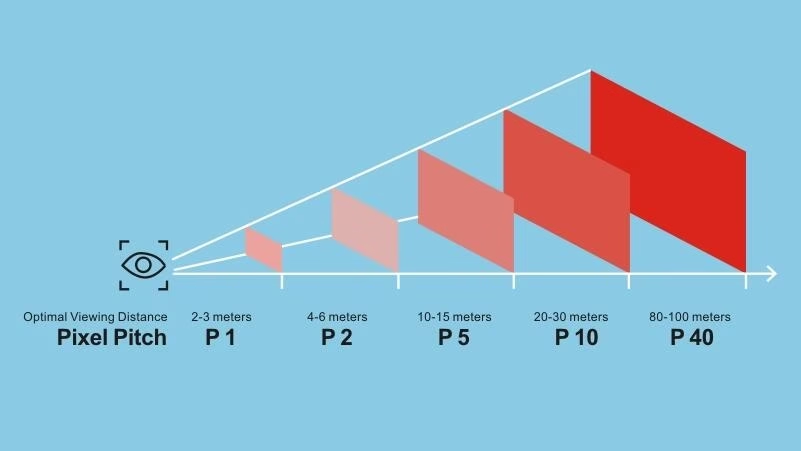
Pixel pitch (P2.5, P3, P4…) is the center-to-center distance between two pixels in millimeters, and it sets how sharp a given LED screen size looks at a given distance. Two staging rules translate distance into a build, and both sit in the section above: viewing distance ≈ pitch (mm) × 1,000–1,500, and screen height ≈ viewing distance ÷ 3. P2.5 therefore works from about 2.5–3.8 m, and viewers 9 m away need a wall about 3 m tall.
Matching pitch to distance prevents the two classic wastes. Finer pitch than the audience can resolve adds cost with no visible gain — P1.5 on a wall watched from 6 m looks the same as P2.5 at three times the price. Coarser pitch than the distance calls for shows visible pixel structure at close range.
Regional preferences reflect seating geometry: North American stadiums often run P4–P6 for long throw distances, European street screens P3–P4, and Asian retail walls P1.5–P3 for close viewing. The full selection table is in our pixel pitch guide.
Installation Environment
The environment affects LED display screen sizes, brightness, and durability. Indoor installations typically require lower LED screenbrightness, smaller pixel pitch, and lighter cabinets, with custom size LED screens often used to maximize space efficiency. Outdoor installations need weatherproof, high-brightness panels, and larger LED wall screen sizes for visibility from long distances. Rental and touring setups benefit from modular LED panels for flexible stage configurations.
Environmental requirements vary by region. In the Middle East, extreme heat and sunlight require displays with high IP ratings and heat-resistant components. In Southeast Asia, high humidity demands corrosion-proof and well-sealed screens. In North America, energy efficiency standards and brightness regulations influence outdoor LED screen design and sizing.
Content Type
The type of content influences LED screen display size and aspect ratio:
Video advertising: 16:9 or portrait formats
IMAG/live events: 16:9 for camera alignment
Control rooms/data visualization: 4:3 or hybrid formats
Experiential marketing/cinema: 21:9 or custom shapes
Matching screen size to content avoids distortion or wasted space. Regions like Europe and Japan increasingly use custom size LED screens for immersive brand experiences.
Budget & Structural Support
Larger LED panel screen sizes increase costs due to more cabinets, higher power needs, and structural support. Consider:
Cabinet quantity → affects cost escalation
Power load → ensures circuit reliability
Structural capacity → supports wall, truss, or floor-mounted screens
Accessibility → space for installation and maintenance
Standard LED screen sizes simplify planning and reduce custom costs, while custom size LED screens are preferred for specialized layouts or unique environmental requirements. Calculating the physical size is only step one. You also need to ensure your total pixel count matches your video source (like 1920×1080). Learn more about how to calculate LED display resolution here.
3. How to Calculate LED Screen Size
Understanding the correct LED screen size is essential before starting any project. Whether you are planning a small indoor display or a big LED screen size for outdoor advertising, accurate calculation ensures the right viewing effect and installation layout. These three proven methods help determine the most suitable LED display screen sizes, including fully custom size LED screen builds and standard configurations.
Method 1 – Module Size × Quantity
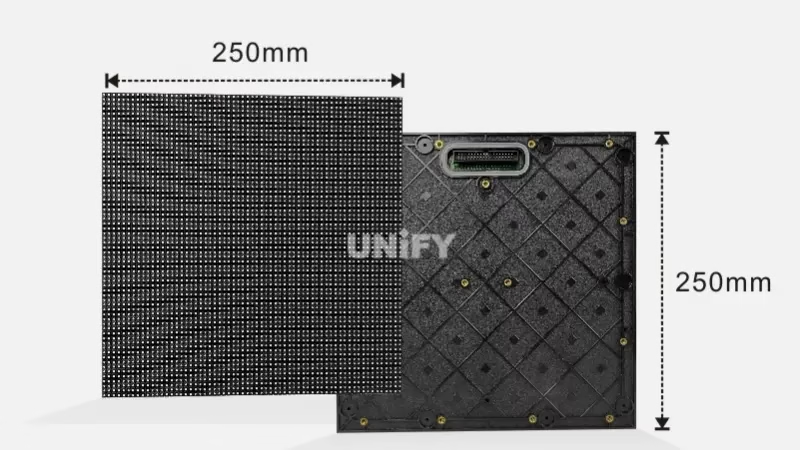
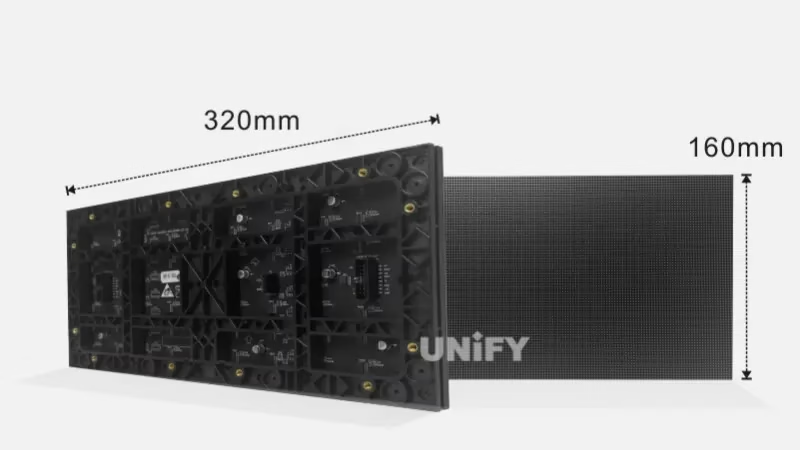
The module method multiplies module dimensions into any wall shape. Common modules: 320 × 160 mm (indoor standard), 250 × 250 mm (square), and 192 × 192 mm (fine pitch).
Formulas: total width = module width × horizontal count; total height = module height × vertical count.
Worked example: a 5 × 3 m wall with P2.5 modules (320 × 160 mm, 128 × 64 px each). Width: 5,000 ÷ 320 = 15.6 → 16 modules. Height: 3,000 ÷ 160 = 18.75 → 19 modules. Actual size: 16 × 320 = 5.12 m by 19 × 160 = 3.04 m = 15.56 sqm, resolving 2,048 × 1,216. The grid rounds the wall — module dimensions, not the wish list, set the final size.
Best for: creative shapes, custom indoor displays, and fine-pitch installations where cabinet seams are unwanted.
Method 2 – Cabinet Size × Quantity (LED Screen Cabinet Method)
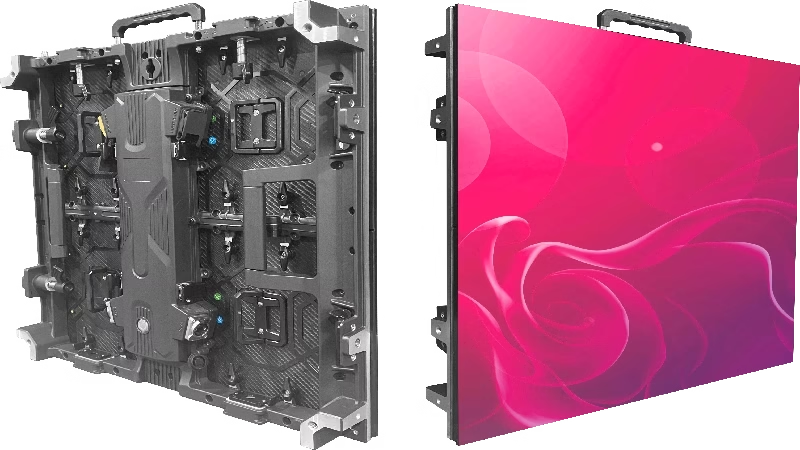
The cabinet method builds the screen from standardized boxes — 500 × 500 mm and 500 × 1000 mm for rental and stage, 960 × 960 mm for outdoor fixed walls, 640 × 480 mm for indoor fine pitch. Cabinets carry the structure, power, and module grid, which is why outdoor projects are quoted in cabinet counts.
Formulas: screen width = cabinet width × horizontal cabinets; screen height = cabinet height × vertical cabinets.
Worked example: an outdoor wall of 5 × 3 cabinets at 960 × 960 mm measures 4.8 × 2.88 m = 13.8 sqm. At P8 that build resolves 600 × 360; at P10, 480 × 288. Rental builds do the same math with 500 mm cabinets — the 500 × 500 mm rental screen and 500 × 1000 mm rental screen pages list the pixel counts per cabinet.
Best for: outdoor advertising walls, rental stages, and any project where structure and install speed matter as much as the dimension.
Method 3 – Resolution × Pixel Pitch
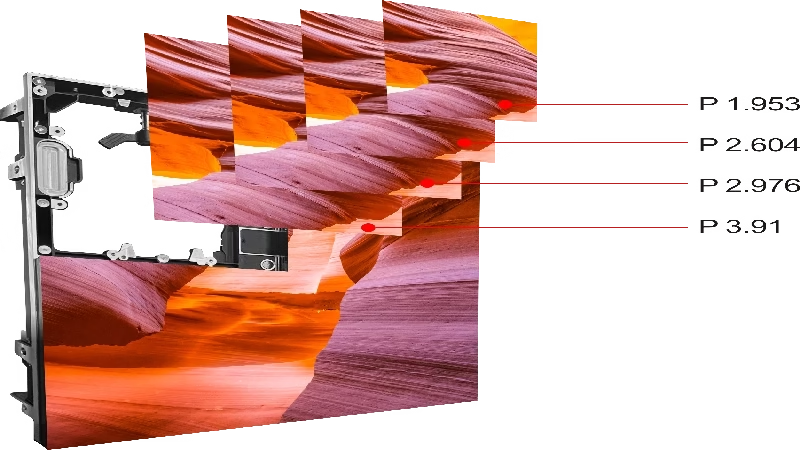
This method calculates the size of LED screen based on the display’s resolution and pixel pitch, making it the most precise approach.
Formula
Width (mm) = Horizontal Pixels × Pixel Pitch (mm)
Height (mm) = Vertical Pixels × Pixel Pitch (mm)
Advantages
Precise LED screen size calculation
Full control over brightness, clarity, and resolution
Ideal for high-end installations where detail matters
Helps define accurate LED screen standard sizes
Example Table
Resolution | Pixel Pitch (mm) | Final Screen Dimensions |
1920 × 1080 | 1.2 mm | 2304 mm × 1296 mm |
1280 × 720 | 2.5 mm | 3200 mm × 1800 mm |
3840 × 2160 | 1.5 mm | 5760 mm × 3240 mm |
Comparison of the 3 Methods
Method | Pros | Cons | Best For |
Module Size × Quantity | Flexible, ideal for custom size LED screen | Size increments depend on module dimensions | Indoor screens, creative shapes |
Cabinet Size × Quantity (LED Screen Cabinet) | Strong structure, fast installation, consistent alignment | Less flexible for custom shapes | Outdoor advertising, rental LED walls |
Resolution × Pixel Pitch | Most accurate control over led screen display size | Requires resolution planning | Control rooms, commercial fine-pitch displays |
Different applications also influence the ideal LED screen size. Indoor retail and meeting rooms usually use smaller fine-pitch displays, while outdoor advertising often requires much larger screens built with standard LED screen cabinet configurations. Event stages prefer flexible rental sizes, and control rooms rely on precise pixel-pitch calculations for wide, high-resolution layouts.
When calculating the physical dimensions, match standard video formats before you finalize dimensions. You can use our guide to calculate the aspect ratio and ensure your screen size fits standard 16:9 content perfectly.
Two reference tables turn the formulas into numbers you can copy. The 16:9 chart converts the common diagonals into exact physical size and the nearest 500 × 500 mm cabinet build — the build rounds up, so the assembled screen lands slightly larger than the exact diagonal. The second table lists the cabinet combinations that cover most projects.
16:9 LED Screen Size Chart with Cabinet Counts
| Diagonal | Exact 16:9 (m) | Build (ft) | Area | 500×500 cabinets | As-built (m) |
| 100″ | 2.21 × 1.25 | 8.2 × 4.9 | 3.8 sqm | 5 × 3 (15) | 2.5 × 1.5 |
| 120″ | 2.66 × 1.49 | 9.8 × 4.9 | 4.5 sqm | 6 × 3 (18) | 3.0 × 1.5 |
| 150″ | 3.32 × 1.87 | 11.5 × 6.6 | 7.0 sqm | 7 × 4 (28) | 3.5 × 2.0 |
| 200″ | 4.43 × 2.49 | 14.8 × 8.2 | 11.3 sqm | 9 × 5 (45) | 4.5 × 2.5 |
| 250″ | 5.54 × 3.12 | 19.7 × 11.5 | 21.0 sqm | 12 × 7 (84) | 6.0 × 3.5 |
| 300″ | 6.65 × 3.74 | 23.0 × 13.1 | 28.0 sqm | 14 × 8 (112) | 7.0 × 4.0 |
| 400″ | 8.86 × 4.98 | 29.5 × 16.4 | 45.0 sqm | 18 × 10 (180) | 9.0 × 5.0 |
| 500″ | 11.08 × 6.23 | 37.7 × 21.3 | 74.8 sqm | 23 × 13 (299) | 11.5 × 6.5 |
Common Cabinet Combinations
| Cabinet | Typical use | Build (W × H) | Screen (m) | Area | Resolution @ pitch |
| 500 × 500 | Rental / stage | 12 × 7 | 6.0 × 3.5 | 21.0 sqm | 2,400 × 1,400 @ P2.5 |
| 500 × 1000 | Rental tall walls | 8 × 4 | 4.0 × 4.0 | 16.0 sqm | 1,600 × 1,600 @ P2.5 |
| 960 × 960 | Outdoor fixed | 5 × 3 | 4.8 × 2.88 | 13.8 sqm | 480 × 288 @ P10 |
| 640 × 480 (4:3) | Indoor fine pitch | 4 × 3 | 2.56 × 1.44 | 3.7 sqm | 2,048 × 1,152 @ P1.25 |
Reading the chart: a 200″ wall built from 45 cabinets comes out 4.5 × 2.5 m — a touch larger than the exact 4.43 × 2.49 m diagonal — and at P2.5 resolves 1,800 × 1,000, just under Full HD. If the application needs exactly Full HD, move to a 1920 × 1080-driven build from Method 3 instead of forcing the diagonal.
4. LED Screen Size for Event
Choosing the right LED screen size for event starts with the question every planner asks first: how many people are watching? Guest count gives the opening estimate — the table below reflects the footprints rental crews reach for most often — and the nearest viewer then refines it through pixel pitch. A church wedding with 200 guests and a product launch with 200 guests may share the same 10 × 6 ft footprint but need different pitches.
| Audience | Screen (ft) | Screen (m) | 500×500 build |
| Up to 200 | 10 × 6 | 3.0 × 1.8 | 6 × 4 (24) |
| 200–500 | 16 × 9 | 4.9 × 2.7 | 10 × 6 (60) |
| 500–1,000 | 20 × 10 | 6.0 × 3.0 | 12 × 6 (72) |
| 1,000+ | 23 × 13 and up | 7.0 × 4.0 and up | 14 × 8 (112) |
Treat guest count as the starting point, not the answer — the seating layout and the farthest seat decide whether that footprint needs P2.9 or P3.91 to read clearly.
LED Screen Size for Wedding
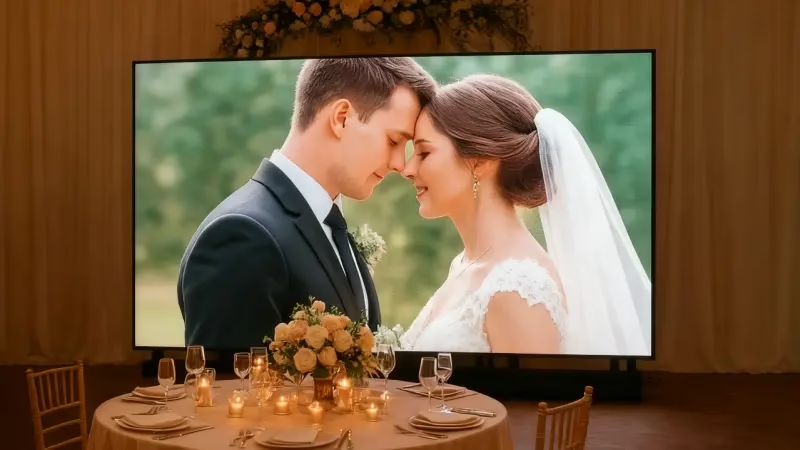
Weddings often use LED screens for live feeds, decorative video walls, or background visuals. The ideal LED screen wall size depends on venue size, audience distance, and screen placement.
Small indoor weddings (Asia): 2 × 1.5 m, 2–3 mm pixel pitch; US/Europe equivalent: 6.5 × 5 ft.
Medium halls (Asia): 4 × 2.5 m, 3–4 mm pixel pitch; US/Europe: 13 × 8 ft.
Large venues: 6 × 3 m, 4–6 mm pixel pitch; US/Europe: 20 × 10 ft.
Using custom size LED screens ensures flexibility for unusual layouts or curved stages. Matching LED screen size and viewing distance is essential so all guests can clearly see images. Modular LED screen cabinets simplify installation and maintenance while helping control costs .
LED Screen Size for Stage
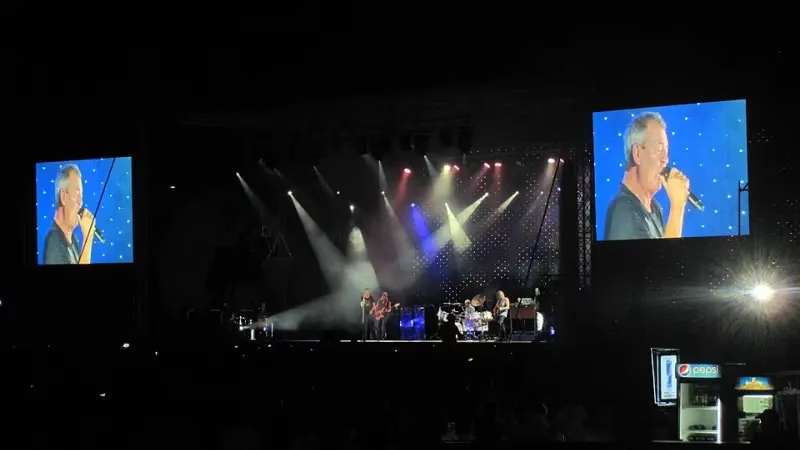
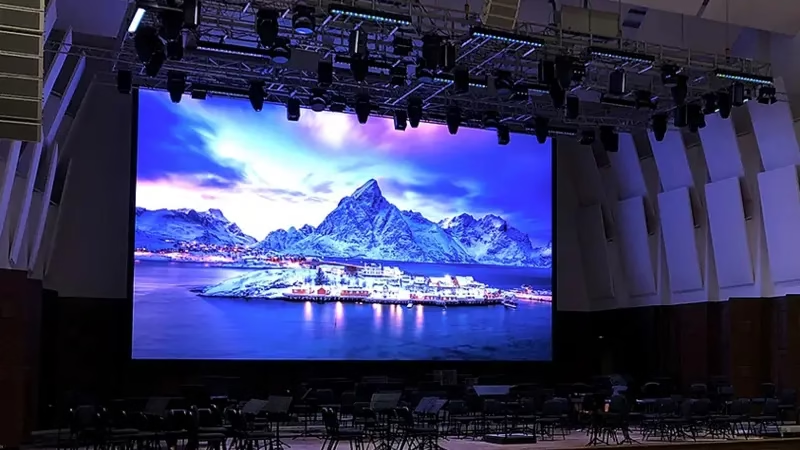
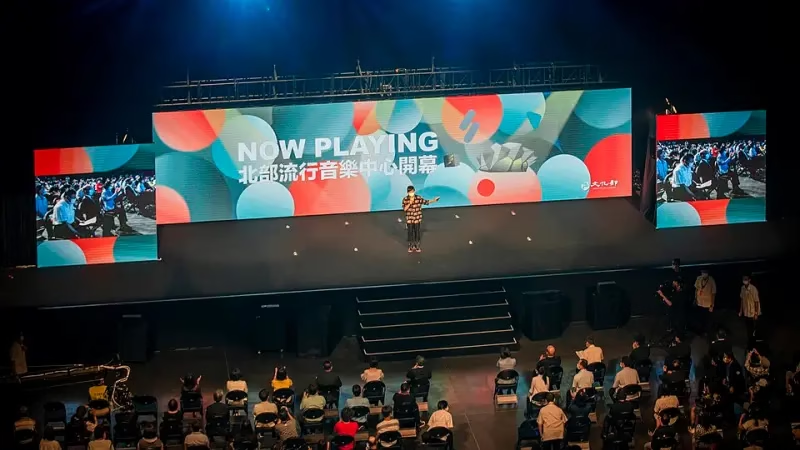
Stage setups, including concerts, corporate events, and theater performances, require high-impact screens visible to large audiences.
Main stage screens: 6 × 4 m, 3–6 mm pixel pitch.
Side or auxiliary screens: 3 × 2 m, 3–5 mm pixel pitch.
IMAG / close-up screens: 2 × 1.5 m, 2–4 mm pixel pitch.
Experience shows that modular LED screen cabinets allow quick assembly and consistent alignment. Custom size LED screens help fit unusual stage layouts and keep sightlines clear. Correct LED screen size and viewing distance ensures clarity across the audience, and using standard cabinets keeps costs predictable.
LED Screen Size for Conference Room
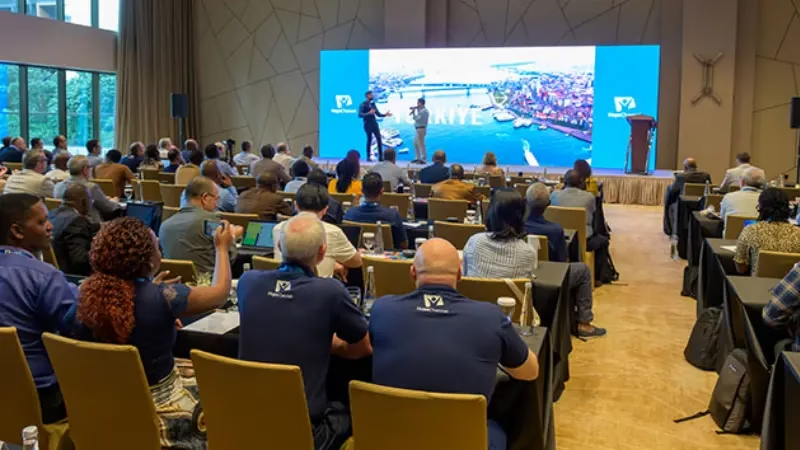
Conference rooms require medium-sized, fine-pitch screens to display presentations, video calls, and dashboards.
Small rooms (Asia): 1.2 × 0.9 m, 1.5–2 mm pixel pitch; US/Europe: 4 × 3 ft.
Medium rooms: 2.5 × 1.5 m, 1.5 mm pitch; 8 × 5 ft.
Large boardrooms / auditoriums: 4.5 × 2.5 m, 2–2.5 mm pitch; 15 × 8 ft.
Modular or custom size LED screens help adapt to unusual room layouts. Proper LED screen size and viewing distance ensures all participants can clearly see content. Always measure the wall and verify dimensions before installation.
LED Screen Size for Outdoor Advertising
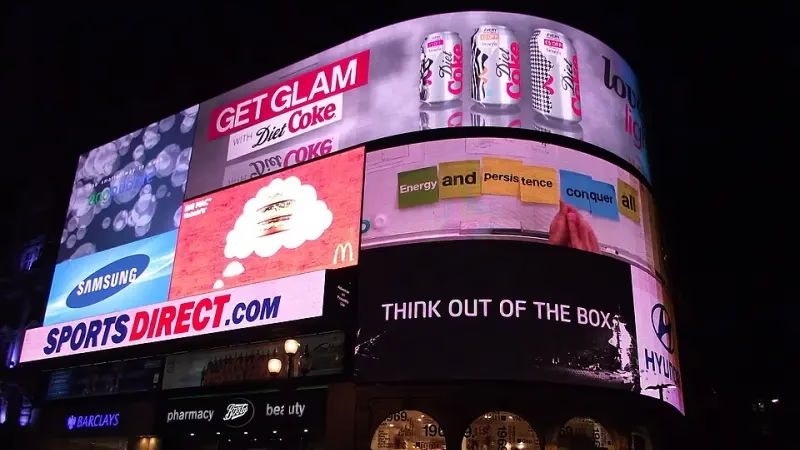
Outdoor LED walls require larger sizes and durable, weather-resistant setups. Viewing distance is the primary factor in determining LED screen wall size.
Small billboards: 3 × 2 m, 6–10 mm pixel pitch; US/Europe: 10 × 6 ft.
Mall signage: 4 × 3 m, 5–8 mm pitch; 13 × 10 ft.
Stadium / sports walls: 10 × 6 m, 8–16 mm pitch; 33 × 20 ft.
Modular LED screen cabinets simplify assembly and maintenance. Custom size LED screens allow adaptation to irregular surfaces. Always consider LED screen size and viewing distance to match expected audience distance, and calculate costs upfront .
LED Screen Size for Home Theater Setup
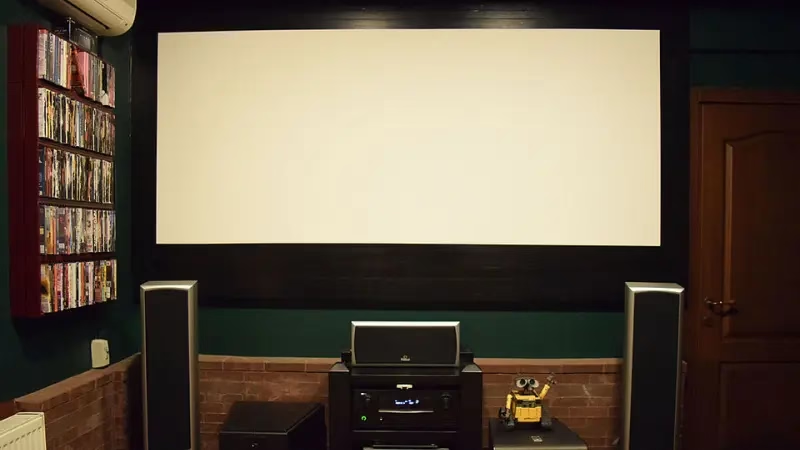
Home theaters prioritize high-resolution, close-viewing clarity.
Small rooms: 1.5 × 0.9 m, 1.2–1.5 mm pitch; 5 × 3 ft.
Medium rooms: 2 × 1.2 m, 1.5 mm pitch; 6.5 × 4 ft.
Large home theaters: 3 × 2 m, 1.5–2 mm pitch; 10 × 6 ft.
Using custom size LED screens ensures proper fit in non-standard rooms. Matching LED screen size and viewing distance avoids eye strain and maintains visual quality. Modular LED screen cabinets allow easier setup and future upgrades.
The through-line across all five scenarios: measure the nearest and farthest viewer first, let the distance set the pixel pitch, and let the pitch plus module grid set the final LED screen size. A wedding wall watched from 3 m and a stadium wall watched from 20 m may end up the same 4 × 2.5 m build with entirely different pixel counts. Quote dimensions and pitch together, and cost follows predictably — the cabinet overview shows how build counts translate into budget.
5. Common Mistakes When Choosing LED Screen Size
Selecting the right LED screen size is essential for visual impact and clarity. Many event organizers make mistakes that can compromise the display’s effectiveness. Understanding these common pitfalls ensures your LED wall screen size meets expectations.
Resolution Mismatch
Choosing a large screen without matching resolution produces visible pixel structure at close range. A 6 × 3 m wall at P10 looks fine from 15 m and poor from 5 m; the same wall at P4 holds up. Match the pitch to the nearest viewer first, then size the wall — the resolution guide shows how pixel count and the content source line up.
Insufficient Installation Space
Oversized screens may not fit walls or stage areas. Custom size LED screens are sometimes required to adapt to unusual layouts. Checking available space carefully helps avoid installation issues and ensures the planned LED screen sizes are achievable.
Content Proportion Mismatch
Using content designed for a standard aspect ratio on a screen with a different proportion can cause stretching or cropping. Planning content according to LED screen standard sizes or LED screen display size ensures visuals remain proportional and professional.
Ignoring Structural and Environmental Factors
Large LED wall screen sizes require sufficient structural support. Outdoor screens must withstand wind, rain, and temperature changes. Reviewing specifications for LED screen sizes in mm and cabinet construction is critical for safety and longevity.
Avoid these four mistakes and the size you calculate holds up on paper and on the wall — the right pitch for the nearest viewer, the right build for the space, and the structure to carry it.
6. LED Screen Size FAQs
7. Conclusion
LED screen size is never picked from a list — it is calculated. The viewing distance sets the pixel pitch, the pitch and module grid set the resolution, and the module or cabinet count sets the final width and height. Run the three methods in Section 3, check the 16:9 chart for the nearest standard build, and confirm the cabinet count before you quote. For a layout drawn from your actual wall dimensions, send us the height and width — our engineers return a free cabinet layout with pixel counts within 1 hour.
8. Recommend
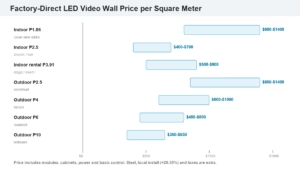
How Much Does a Video Wall Cost in 2026? Real Prices and Budgets
How much does a video wall cost in 2026? Factory-direct LED prices per square meter, LCD comparisons, installation, running costs, and real project budgets.
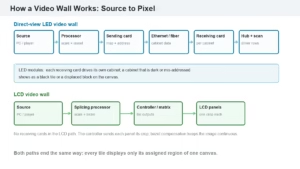
How Does a Video Wall Work? The Signal Chain From Source to Screen (2026)
A stage-by-stage look at how a video wall works: processor, sending card, receiving card, canvas math, sync, calibration, and fault diagnosis.
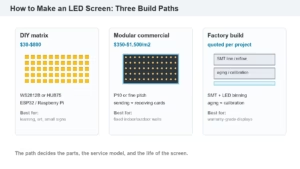
How to Make an LED Screen: DIY, Modular Build, and Factory Manufacturing (2026)
Three paths to build an LED screen, from a $30 ESP32 matrix to a $19k-$39k P10 wall, with module math, power, controllers, and factory testing.