
LED Display Technology Evolution: From 1907 to the Modern Full-Color Era
The LED display you purchase today — whether for a stadium, retail space, control room, or rental fleet — is the result of more than a century of semiconductor innovation. Every pixel pitch, every brightness rating, and every lifespan claim traces back to specific breakthroughs in materials science, packaging technology, and control systems. Understanding this LED display technology evolution is not an academic exercise — it directly informs smarter B2B procurement decisions. Why do some displays cost five times more than others with the same pixel pitch? How long will your chosen technology stay relevant before obsolescence? And what is the real difference between SMD, COB, and Micro LED in practical commercial terms?
This guide traces the complete journey of LED display technology — from the first faint glow of electroluminescence in 1907 to the seamless 8K Micro LED walls of today — with a sharp focus on what matters to professional buyers: reliability, application fit, and total cost of ownership. As a LED screen manufacturer with deep roots in China’s display industry, we draw on decades of engineering practice and the technical foundation laid by authoritative sources including the LED Display Application (Elementary) textbook published by the Electronics Industry Press.
Key Takeaways for B2B Buyers:
- SMD remains the proven workhorse for 80% of commercial LED display projects
- COB delivers superior durability and image quality for close-viewing applications at a 2–3× cost premium
- Micro LED is not yet practical for most commercial projects — it remains an early-adopter technology
- Thermal management, not pixel pitch alone, is the #1 determinant of LED display lifespan
- Understanding technology evolution helps you avoid overpaying for “new” features your application does not need
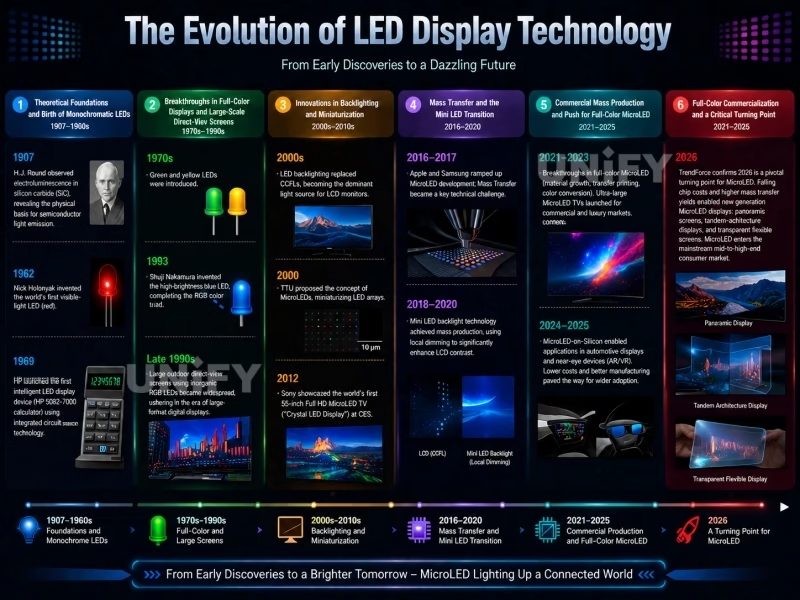
How Did LED Display Technology Evolution Begin? The Semiconductor Foundation (1907–1961)
1907: The First Electroluminescence Discovery
The story of LED display technology evolution begins not with a display, but with a curious observation in a laboratory. In 1907, British engineer H.J. Round at Marconi Labs noticed that a silicon carbide (SiC) crystal emitted a faint yellowish glow when an electric current passed through it. This phenomenon — electroluminescence — was the first recorded observation of what would eventually become LED technology. However, at the time, no one understood its practical potential. The discovery was noted, published, and largely forgotten for two decades.
1927–1955: From Soviet Labs to Infrared Breakthroughs
In 1927, Russian scientist Oleg Losev independently created the first practical light-emitting diode, publishing his research in German and British scientific journals. Losev’s work was remarkably ahead of its time — he described the quantum nature of LED light emission decades before the scientific community fully accepted quantum mechanics. Tragically, Losev died during the Siege of Leningrad in 1942, and his pioneering contributions to LED display technology were only recognized posthumously.
The next major milestone came in 1955 when Rubin Braunstein at RCA demonstrated infrared emission from gallium arsenide (GaAs). While invisible to the human eye, this discovery proved that compound semiconductors could efficiently convert electricity into light — a foundational principle for all modern LED displays.
1961–1962: The Birth of the Visible LED
In 1961, Texas Instruments engineers Robert Biard and Gary Pittman patented the first infrared LED. One year later, in 1962, Nick Holonyak Jr. at General Electric achieved the defining breakthrough: the first visible-spectrum red LED using gallium arsenide phosphide (GaAsP). Holonyak would later be recognized as the “Father of the LED.” These early LEDs were expensive — approximately $10 per unit — and limited to single-color red emission. Their primary applications were indicator lights in calculators, digital watches, and electronic devices.
Yet the foundation was set. As Chapter 1.1.1 of the LED Display Application textbook notes, each incremental advancement in LED materials science — from GaAsP to GaP to GaN — progressively unlocked higher brightness, new colors, and eventually, the possibility of building a display out of individual LED pixels.
What Sparked the Color Revolution in LED Display Technology Evolution? (1970s–1990s)
1970s: DIP Technology and the First LED Billboards
The 1970s saw the emergence of Dual In-line Package (DIP) LEDs as the standard for outdoor signage. DIP LEDs offered high brightness and durability, making them suitable for early billboards and scoreboards. By the late 1970s, red, orange, yellow, and green LEDs were commercially available — but their luminous efficiency was barely 1 lumen per watt, and pixel pitches were enormous (P10–P20+). These early displays could only render simple text and crude graphics, and only organizations with very large budgets could afford them.
1980s: High-Brightness LEDs Enter Commercial Use
The 1980s marked a turning point with the introduction of advanced compound materials such as gallium aluminum arsenide (GaAlAs). LED luminous efficiency jumped to 10 lumens per watt — a tenfold improvement. Monochrome LED dot-matrix displays began appearing for text and symbol presentation in industrial settings, transportation hubs, and public information boards. As referenced in Chapter 1.1.2 of the textbook, these early single-color and dual-color LED displays (see textbook Figure 1-1) represent the prototype of all modern LED signage.
1993–1998: The Blue LED — The Single Most Important Milestone in LED Display History
No single event has been more consequential for LED display technology evolution than Shuji Nakamura’s invention of the high-brightness blue LED in 1993. Working at Nichia Chemical Industries in Japan, Nakamura used gallium nitride (GaN) and indium gallium nitride (InGaN) to produce a blue LED with commercially viable brightness. Without blue, full-color RGB displays are physically impossible — you cannot produce white light or any color beyond red, green, and yellow without it. For this achievement, Nakamura was awarded the 2014 Nobel Prize in Physics.
The cascade of innovations that followed was rapid:
- 1995: Nakamura demonstrated the first high-brightness green LED using InGaN
- 1996: Nichia commercialized the first white LED by coating a blue LED chip with YAG yellow phosphor
- 1998: Red, green, and blue LEDs were combined to produce the first practical white-light LED source
The blue LED unlocked the entire modern LED display industry. Within a few years, the first full-color LED video walls appeared in stadiums and public squares, and China’s LED display industry — now accounting for over 80% of global production — began its rapid ascent. For more on how different LED packaging technologies evolved from these breakthroughs, see our dedicated technical guide.
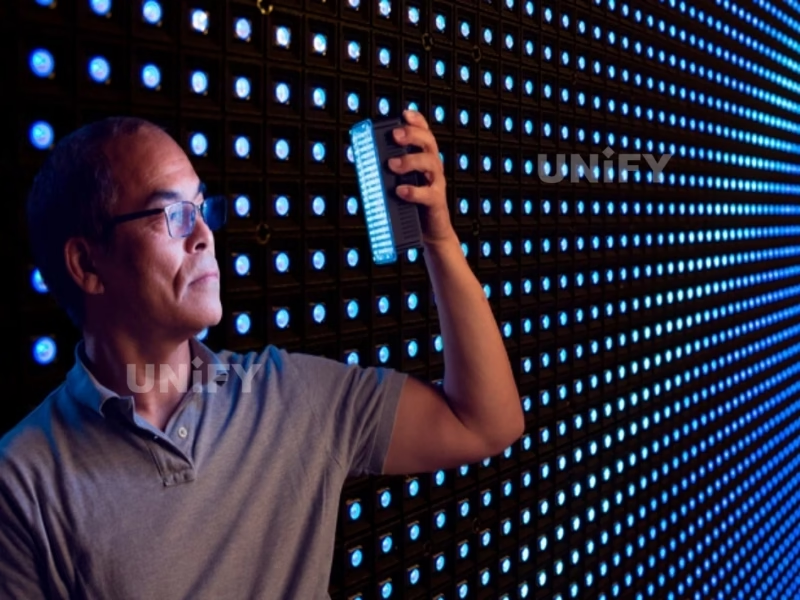 Blue LED invention by Shuji Nakamura 1993 — the breakthrough that enabled full-color LED displays
How Did SMD Transform LED Display Technology Evolution in the 2000s?
Surface Mount Device (SMD) Packaging Matures
As the new millennium arrived, a fundamental shift in packaging technology transformed the LED display industry. Surface Mount Device (SMD) LEDs — where red, green, and blue chips are packaged into a single compact lamp and soldered directly onto a PCB — replaced the bulky DIP format for indoor applications. SMD LEDs were dramatically smaller, enabling much finer pixel pitches. At the same time, SMD improved color mixing by placing all three RGB chips within a single package, creating a more unified light source with wider viewing angles.
Indoor LED Displays Become Viable
By 2005–2009, SMD technology had driven pixel pitches down to P4–P6, making indoor LED displays commercially viable for the first time. Retail stores, corporate lobbies, conference rooms, and houses of worship began adopting LED walls. This was also the period when LED display basics such as thermal management and cabinet design improved dramatically — better aluminum cabinets, optimized PCB layouts, and improved heat sinks extended L70 ratings (the point at which brightness drops to 70% of original) to 50,000 hours.
Industry Standardization and China’s Manufacturing Rise
The LED display industry also matured institutionally during this period. In 1996, China’s former Ministry of Electronics Industry issued the “LED Display General Specification” — the first national industry standard. In 1998, the LED Display Professional Committee was established under the China Optics and Optoelectronics Manufacturers Association. These standardization efforts, combined with China’s manufacturing scale, positioned the country as the dominant global hub for LED display production. Today, a LED screen manufacturer based in China can leverage supply chain efficiencies, skilled engineering talent, and mature quality control processes that have been refined over decades.
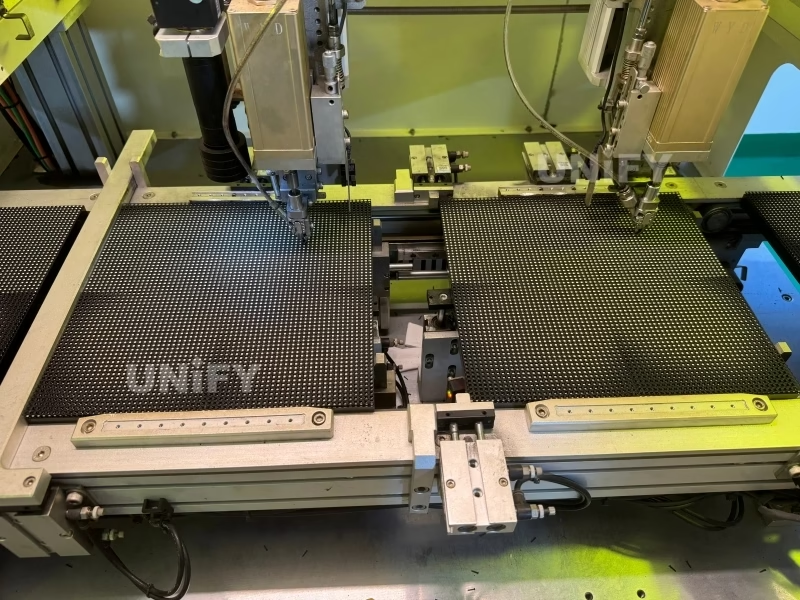 SMD LED display module on a modern surface-mount production line in a Chinese LED factory
Why Was COB the Biggest Leap in LED Display Technology Evolution? (2010s)
Fine-Pitch LED: Breaking the Sub-P3 Barrier
The 2010s were defined by the relentless pursuit of smaller pixel pitches. Around 2010–2012, LED manufacturers broke through the P3 barrier, then P2, and eventually P1.5 and below. A fine-pitch LED wall at P1.5 could now deliver resolution comparable to an LCD video wall — but with the decisive advantage of seamless splicing. Unlike LCD panels, which always have visible bezels where panels join, LED displays scale infinitely without interruption. This made them the preferred choice for control rooms, broadcast studios, and command centers where image continuity is non-negotiable.
If you are evaluating fine pitch LED display options for a control room or broadcast application, you will want to compare COB and SMD variants for your specific viewing distance and ambient light conditions.
COB (Chip-on-Board): A New Packaging Paradigm
While SMD continued to dominate the mainstream market, a fundamentally different approach to LED packaging emerged. Chip-on-Board (COB) technology eliminates the individual LED lamp package entirely. Instead, bare LED chips are mounted directly onto the PCB substrate, wire-bonded, and then encapsulated under a continuous layer of epoxy resin. The result is a flat, seamless, and remarkably durable display surface.
COB offers four decisive advantages over SMD:
- Superior durability: The epoxy layer makes the display waterproof, dustproof, anti-static, and impact-resistant — you can wipe it clean with a damp cloth without fear of damaging delicate LEDs.
- Deeper blacks and higher contrast: The continuous black epoxy surface absorbs ambient light, eliminating reflections between individual LED lamps.
- Wider viewing angles: The flat surface ensures no color shift even at 170° off-axis.
- Lower dead pixel rate: Physical damage during transport and installation — a leading cause of dead pixels on SMD displays — is virtually eliminated.
However, COB comes at a 2–3× cost premium over SMD and is more difficult to repair (a failed pixel typically requires replacing an entire module, not a single lamp). For a detailed technical comparison, read our guide on SMD vs COB vs GOB LED display technology.
GOB (Glue-on-Board): The Practical Middle Ground
GOB is not a separate LED technology but rather a protective enhancement applied to SMD displays. A transparent epoxy glue layer is applied over the finished SMD module surface, providing improved impact resistance, waterproofing, and dust protection. GOB is particularly popular for rental LED displays and high-traffic indoor environments where SMD-level image quality is sufficient but extra physical protection is needed — at roughly half the premium of COB.
What Is the Future of LED Display Technology Evolution? Mini and Micro LED (2020s–Present)
Mini LED Direct-View: Pixels Under 200 Microns
The 2020s brought Mini LED technology into commercial production for direct-view displays. With LED chip sizes under 200 microns, Mini LED enables pixel pitches as fine as P0.4–P1.2 — making 4K and even 8K resolution possible on standard room-sized walls. Mini LED direct-view displays are now used in high-end broadcast studios, virtual production stages (XR), and luxury retail environments where close viewing distances demand the highest pixel density.
It is important to distinguish between two uses of the “Mini LED” label: (a) Mini LED as backlighting for LCD televisions (a different product category entirely), and (b) Mini LED as direct-view display technology — what we discuss here. If you are comparing display technologies for a procurement decision, our article on Mini LED vs QLED clarifies the differences.
Micro LED: The Ultimate Display Technology — Still Emerging
Micro LED represents the theoretical pinnacle of direct-view display technology. With LED chips under 100 microns — smaller than a human hair — each pixel is a self-emissive light source delivering perfect blacks, extreme brightness (potentially 10,000+ nits), near-infinite contrast ratio, and a lifespan exceeding 100,000 hours. No organic materials means no burn-in risk, unlike OLED. The technology is so advanced that it has been described as combining the best attributes of LED and OLED with none of their respective weaknesses.
However — and this is crucial for B2B buyers — Micro LED remains an early-adopter technology in 2026. Manufacturing yields remain low, costs are exorbitant ($10,000+/m²), and the technology is only viable for luxury residential, flagship retail, or specialized broadcast projects with effectively unconstrained budgets. For 99% of commercial applications, SMD or COB offers dramatically better ROI.
AI-Powered LED Controllers and Smart Features
The most practical and immediately accessible innovation of the 2020s is not a new chip technology but rather the integration of AI into LED display controllers. Modern control systems now incorporate:
- AI-enhanced image processing: Real-time upscaling, noise reduction, and dynamic HDR tone mapping that improves perceived image quality without requiring higher-resolution source content.
- Predictive maintenance: AI algorithms that analyze module data — temperature trends, voltage fluctuations, pixel aging patterns — to predict potential failures before they occur, reducing downtime.
- Cloud-based remote management: Asynchronous control systems that allow content scheduling, brightness adjustment, and health monitoring from any device with an internet connection.
LED Display Technology Evolution: SMD vs COB vs GOB vs Mini LED Comparison
The following table provides a practical, data-driven comparison of the five major LED display technologies available to B2B buyers in 2026. Use this as a reference when evaluating supplier proposals.
| Technology | Typical Pixel Pitch | Durability | Color Uniformity | Cost (per m²) | Best Applications |
|---|---|---|---|---|---|
| SMD | P1.5 – P10+ | Moderate | Good (with bin matching) | $600 – $1,800 | Digital signage, outdoor billboards, rental events, houses of worship |
| GOB (SMD + glue) | P1.8 – P8 | High | Good | $900 – $2,200 | Rental stages, interactive floors, high-traffic indoor |
| COB | P0.6 – P1.5 | Very High | Excellent | $2,000 – $4,500+ | Control rooms, broadcast studios, COB LED screen installations, luxury retail |
| Mini LED (direct-view) | P0.4 – P1.2 | High | Excellent | $3,000 – $6,000+ | XR virtual production, high-end broadcast, premium corporate |
| Micro LED | P0.3 – P0.6 | Very High | Exceptional | $10,000+ (early adopter) | Luxury residential, flagship retail, specialized early-adopter projects |
Note: Prices are indicative 2026 market ranges for mid-to-high-quality displays sourced from Chinese manufacturers. Installation, shipping, and control system costs are not included. Always request a formal quotation for your specific project specifications.
For buyers who need to understand how LED display viewing distance interacts with pixel pitch selection, we have a complete calculation guide with practical examples.
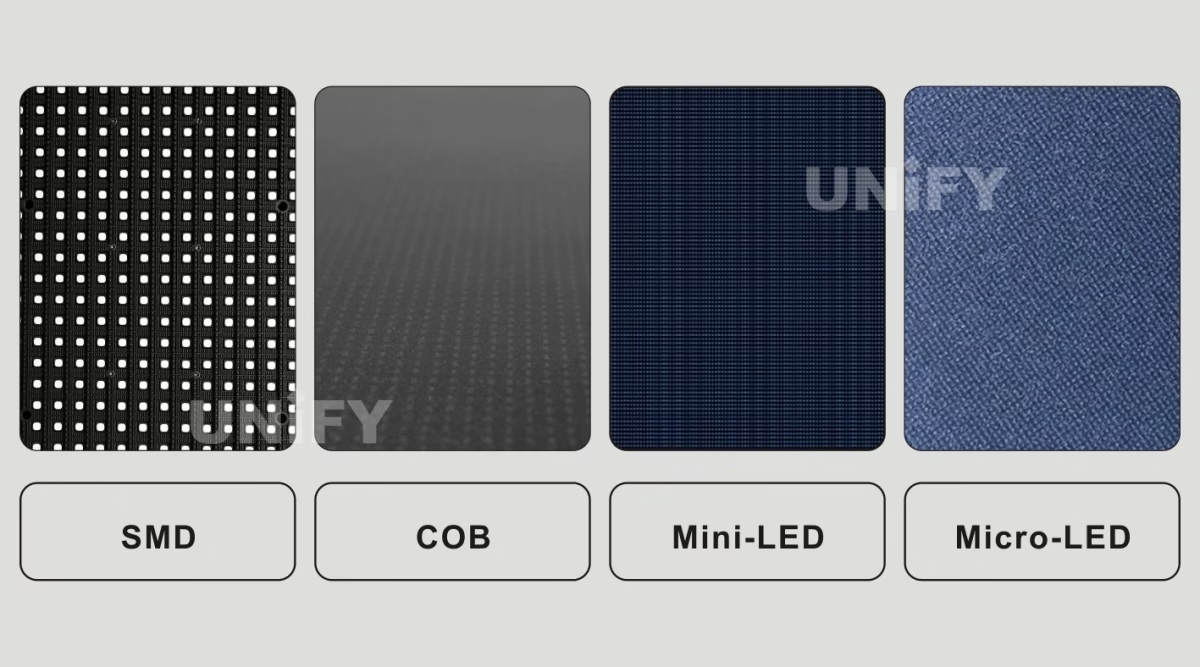
How to Choose: LED Display Technology Evolution Guide for B2B Buyers
After tracing 100+ years of LED display technology evolution, the practical question remains: which technology should you buy for your specific project? Here is a decision framework based on the three variables that matter most.
Match Technology to Viewing Distance
This is the single most important selection criterion — and the one most frequently overlooked by first-time buyers:
- Viewers at 5m+ (16+ ft): SMD at P4–P10 is entirely sufficient. The human eye cannot resolve individual pixels at this distance. Paying for finer pitch is wasted budget.
- Viewers at 2–5m (6–16 ft): SMD at P1.5–P3 provides excellent image quality. COB at P1.2–P1.8 is worth the premium if durability is a concern.
- Viewers under 2m (6 ft): COB at P0.6–P1.2 or Mini LED is justified. At this distance, the improved contrast and uniformity of COB become visible and valuable.
Prioritize Thermal Management Over Peak Brightness
Heat is the #1 killer of LED display lifespan — more than humidity, more than dust, more than usage hours. Every 10°C increase in operating temperature roughly halves LED lifespan. When evaluating suppliers, ask about:
- Cabinet material and heat dissipation design (die-cast aluminum is preferred)
- Operating current — a display driven at 70–80% of maximum rated current will last 2–3× longer than one driven at 100%
- Ventilation and cooling strategy for large installations
A display with slightly lower peak brightness but excellent thermal management will outlast a hotter, brighter display every time. Our guide to LED screen lifespan details the factors that determine how long your investment will last.
Demand Bin Matching and Batch Documentation
SMD displays rely on consistent LED batches for uniform color and brightness. Even LEDs from the same production line vary slightly in wavelength and luminosity. Bin matching is the process of sorting LEDs into narrow-tolerance groups. A supplier who cannot provide bin-matching documentation is a supplier you should not trust with a quality-critical installation.
COB displays face a similar challenge at the manufacturing level — achieving consistent color across every bare chip on a large board is technically demanding and a key differentiator between premium and budget COB manufacturers.
Consider Total Cost of Ownership, Not Just Purchase Price
The cheapest display per square meter is rarely the cheapest over its service life. Factor in:
- Power consumption: A display with common cathode LED technology can reduce energy costs by 15–25% compared to common anode designs
- Maintenance access: Front-service vs rear-service cabinets dramatically affect labor costs over time
- Module replacement cost and availability: Ensure your supplier commits to stocking replacement modules for at least 5 years
- Dead pixel warranty terms: Industry standard allows up to 1/10,000 dead pixels; premium manufacturers guarantee far fewer
FAQ: LED Display Technology Evolution
The 1993 invention of the high-brightness blue LED by Shuji Nakamura at Nichia Chemical Industries. Without blue, full-color RGB LED displays are physically impossible — you cannot create white light or the full color spectrum without it. Every full-color LED display in existence today traces back to this single breakthrough, for which Nakamura received the 2014 Nobel Prize in Physics.
SMD (Surface Mount Device) uses individually packaged RGB LEDs soldered onto a PCB. It is cost-effective, widely available, and delivers excellent image quality for most applications. COB (Chip-on-Board) mounts bare LED chips directly onto the substrate and encapsulates them in epoxy, creating a seamless surface with superior durability, deeper blacks, and wider viewing angles. COB costs 2–3× more than SMD but is recommended for close-viewing and high-reliability environments such as control rooms and broadcast studios.
No. SMD remains the most widely deployed LED display technology globally and offers the best cost-performance balance for approximately 80% of commercial projects. For digital signage, outdoor billboards, rental stages, houses of worship, and corporate lobbies with typical viewing distances, SMD is the standard choice. COB and Mini LED are premium alternatives for specialized use cases — not replacements for SMD across the board.
Only when budget is not a meaningful constraint and the absolute best image quality is essential — typically in luxury residential installations, flagship retail stores, or specialized broadcast applications. For the vast majority of commercial projects in 2026, COB or SMD technology delivers dramatically better return on investment. Micro LED is the future of display technology, but it is not yet the practical present.
Quality LED displays from reputable manufacturers achieve L70 ratings of 80,000–100,000 hours. At 12 hours of daily operation, this translates to approximately 18–22 years before brightness drops to 70% of the original specification. In practice, most commercial displays are replaced for technological obsolescence — not failure — after 8–12 years. Key factors that maximize lifespan include operating at 70–80% of rated current, maintaining proper ventilation, and scheduling regular preventive maintenance.
China manufactures over 80% of the world’s LED displays and is home to the industry’s most advanced production facilities. Leading Chinese LED screen manufacturer brands operate ISO-certified factories with automated SMT lines, rigorous quality control, and compliance with international standards including CE, FCC, UL, and EMC. The key is vetting your supplier — look for factory audit reports, third-party certifications, verifiable case studies, and a willingness to provide bin-matching and batch-consistency documentation. A factory-direct relationship with a qualified Chinese manufacturer typically yields 20–40% cost savings versus buying through intermediaries.
Why LED Display Technology Evolution Matters: 100+ Years of Lessons
From a faint electroluminescent glow in 1907 to today’s seamless 8K Micro LED walls, the LED display technology evolution is a story of relentless innovation across materials science, packaging engineering, and control systems. But for the B2B buyer evaluating technology options in 2026, the most important lesson from this history is surprisingly straightforward:
The most mature technology — not the newest — almost always delivers the best ROI for commercial applications.
SMD LED displays are not “outdated” because COB exists. DIP LEDs are not “obsolete” just because SMD dominates indoors. Each technology generation finds its optimal application niche based on viewing distance, environmental conditions, and budget. The skill is in matching the technology to your specific requirements — not chasing the newest acronym on a spec sheet.
As you plan your next LED display procurement, remember these three principles:
- SMD is the proven workhorse for the vast majority of commercial projects. It offers the best balance of performance, cost, and reliability.
- COB is worth the premium for close viewing, high-durability, or premium image quality applications — and its cost continues to decline as manufacturing scales.
- Micro LED is not yet practical for most B2B projects. Monitor its progress, but do not budget for it unless your application truly demands it.
At UnifyLED, we manufacture LED displays using SMD, GOB, COB, and Mini LED technologies — and we help buyers select the right one based on their application, viewing distance, and budget, not based on which technology carries the highest margin. If you are evaluating LED display options for an upcoming project, contact our engineering team for a no-obligation consultation.
📧 Email: legidatechled@gmail.com | 📱 WhatsApp: +86-191-18802497