
LED Display vs LCD vs Projection: Which Display Technology Wins for Commercial Applications?
Every commercial AV project starts with the same fundamental question: LED display, LCD video wall, or projection? The answer has enormous financial implications — a poor choice can mean paying 3× more than necessary or living with inadequate performance for years. Yet the decision is often made on outdated assumptions. LCD bezels have shrunk. LED pixel pitches have dropped below P1.0. Laser projectors now deliver 20,000+ lumens in ambient light. The competitive landscape has shifted dramatically, and what was true even three years ago may no longer apply.
This guide provides a data-driven, application-specific comparison of the three dominant large-format display technologies. We examine them across the dimensions that matter most to B2B buyers: total cost of ownership, image quality at scale, environmental durability, maintenance burden, and application fit. As a LED screen manufacturer with experience across all three technologies, we bring practical, engineering-grounded analysis — not marketing rhetoric.
Decision Shortcut (Jump To):
- Need seamless scaling beyond 120 inches? → LED Display
- Budget-constrained indoor presentation under 100 inches? → LCD Video Wall
- Temporary installation, flexible screen size, lowest upfront cost? → Projection
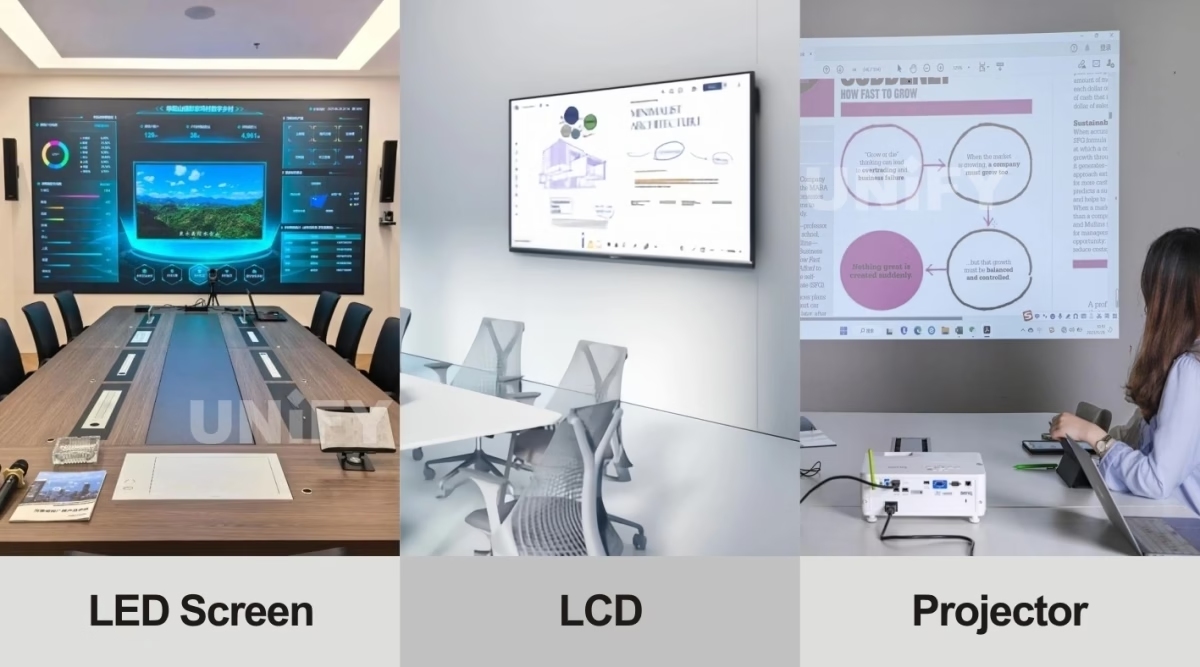 Side-by-side comparison of LED display video wall, LCD video wall with bezels, and laser projector in a commercial conference room setting
How Do LED Display vs LCD vs Projection Technologies Work? A Technical Breakdown
LED Display: Self-Emissive, Modular, Infinitely Scalable
An LED display is a direct-view system where each pixel is a self-emissive light source — a cluster of red, green, and blue LEDs that generate their own light without a backlight. Individual LED modules (typically 250×250mm or 500×500mm) are assembled into cabinets, and cabinets are tiled together to form displays of virtually any size and aspect ratio. Because there are no bezels between modules, the final image is completely seamless regardless of display size.
Key architectural advantage: LED displays scale without compounding bezels. A 200-inch LED wall is just as seamless as a 100-inch one. This is the fundamental reason LED has displaced LCD and projection for large-format commercial installations. For more on the underlying technology, see our guide to LED display technology basics.
LCD Video Wall: Backlit, Bounded, Budget-Friendly at Small Scale
An LCD (Liquid Crystal Display) video wall consists of multiple LCD panels — typically 46″, 49″, or 55″ — tiled together in a matrix. Each panel contains a liquid crystal layer that modulates light from a backlight (LED-backlit in modern panels). The critical limitation: every LCD panel has a physical bezel around its edges. Even ultra-narrow bezel (UNB) panels have 0.44–0.88mm seams between panels, which create visible grid lines across the final image.
LCD video walls are most competitive at smaller sizes (under 110 inches diagonal) where a single panel or 2×2 matrix suffices. Beyond this, the cumulative bezel effect and the cost of mounting, aligning, and calibrating multiple panels begin to erode the price advantage over LED.
Projection: Flexible, Affordable, Ambient-Light Sensitive
Projection systems use a projector — lamp-based or laser — to cast an image onto a screen or surface. Modern laser projectors deliver 5,000–30,000+ lumens with 20,000+ hour light-source lifespans, dramatically improving on the lamp-replacement headaches of earlier generations. Edge-blending multiple projectors can create very large images at relatively low hardware cost.
The critical limitation: projection requires controlled ambient light. In brightly lit environments — retail stores, sunlit lobbies, outdoor venues — even high-lumen projectors struggle to produce acceptable contrast. Projection also requires precise geometric alignment, regular recalibration, and sufficient throw distance behind or in front of the screen, which can be a significant installation constraint.
LED Display vs LCD vs Projection: What Are the 8 Key Comparison Dimensions?
Image Quality and Resolution
LED Display: Pixel pitch determines resolution. A P1.5 LED wall provides approximately 168 pixels per foot — comparable to 4K at typical viewing distances. LED also delivers superior contrast (3,000:1 to 10,000:1+ for COB), true HDR capability, and no motion blur. The seamless surface means no image interruption regardless of display size.
LCD Video Wall: Individual panels are typically Full HD or 4K, but the bezel grid disrupts image continuity. For content that crosses panel boundaries — maps, data visualizations, live video — bezels create visible breaks. LCD contrast ratios (1,000:1 to 5,000:1 for premium panels) are lower than LED, and off-axis color shift is more pronounced.
Projection: Resolution is fixed by the projector (WUXGA, 4K). Image quality is highly dependent on ambient light control, screen material, and projector calibration. Even premium laser projectors cannot match the contrast and color saturation of a direct-view LED or LCD panel in environments with any ambient light. For a deeper dive into resolution metrics, see our guide on LED screen resolution.
Brightness and Ambient Light Performance
| Technology | Typical Brightness (nits) | Ambient Light Tolerance | Outdoor Capable? |
|---|---|---|---|
| LED Display | 800–8,000+ (indoor); 5,000–10,000+ (outdoor) | Excellent | Yes (IP65 rated) |
| LCD Video Wall | 350–700 (consumer); 500–1,500 (high-brightness) | Moderate | No (indoor only) |
| Laser Projection | Not measured in nits; 5,000–30,000 lumens | Poor to Moderate | Limited (dusk/night only) |
For environments with uncontrolled or high ambient light — retail stores, airport terminals, glass-walled lobbies, outdoor venues — LED is the objectively superior choice. The brightness gap is not marginal; it is 5–10×. For more on this topic, read our article on LED screen brightness requirements by environment.
Size and Scalability
LED Display: Infinitely scalable. From a 55″ conference room display to a 100-meter stadium screen, LED uses the same modular architecture. No bezels, no seams, no practical upper size limit.
LCD Video Wall: Effective range is approximately 80–180 inches diagonal. Below 80″, a single large-format LCD is simpler and cheaper. Above 180″, bezel accumulation and mounting complexity become prohibitive.
Projection: Flexible screen size — from 80″ to 300″+ — limited primarily by projector brightness and throw distance. However, image brightness decreases with screen size (inverse square law), so larger projected images require exponentially more lumens.
What Is the True Cost? LED Display vs LCD vs Projection TCO Analysis
The most common procurement mistake is comparing the purchase price per square meter without accounting for installation, maintenance, energy, and replacement costs over a 5–7 year service life. Here is how the three technologies compare on total cost of ownership (TCO).
Upfront Hardware Cost (per m², 2026 indicative)
| Technology | Indoor (low end) | Indoor (mid-range) | Indoor (premium) |
|---|---|---|---|
| LED Display | $600–$1,200 (P3–P4) | $1,200–$2,500 (P1.5–P2.5) | $2,500–$6,000+ (COB P0.6–P1.2) |
| LCD Video Wall | $300–$600 (46–55″ panels) | $600–$1,200 (UNB panels) | $1,200–$2,500 (high-brightness UNB) |
| Laser Projection | $100–$300 (screen + projector) | $300–$800 (ALR screen + proj.) | $800–$2,000+ (edge-blend multi-proj.) |
Five-Year TCO Comparison (100″–120″ Indoor Installation)
For a representative 110-inch indoor display used 12 hours/day in a corporate or retail environment:
- LED Display (P1.8 SMD): Hardware $8,000–$12,000 + Installation $1,500–$3,000 + 5yr energy $1,500–$2,500 + Maintenance $500–$1,000 = $11,500–$18,500 TCO
- LCD Video Wall (2×2 55″ UNB): Hardware $4,000–$8,000 + Mount/alignment $1,000–$2,000 + 5yr energy $800–$1,200 + Maintenance $300–$800 = $6,100–$12,000 TCO
- Laser Projection (8,000 lumen + ALR screen): Hardware $3,000–$6,000 + Install $500–$1,000 + 5yr energy $300–$600 + Lamp/calibration $500–$1,500 = $4,300–$9,100 TCO
When to Choose What: LED Display vs LCD vs Projection Application Matrix
| Application | Best Choice | Why |
|---|---|---|
| Corporate Boardroom (86–110″) | LCD or LED | LCD at 86–98″ is cost-effective; LED above 110″ for seamless image |
| Large Conference Hall (120–200″) | LED Display | Seamless scaling, high brightness for lit stages |
| Control Room / CCTV (24/7) | LED Display (COB) | No burn-in, 100,000hr lifespan, seamless across operators |
| Retail Storefront / Digital Signage | LED Display | High brightness defeats window glare, 24/7 rated |
| House of Worship (Stage Backdrop) | LED Display | Stage-light tolerant, seamless IMAG for congregation |
| Classroom / Training Room (65–86″) | LCD or Projection | Lowest cost at small sizes, sufficient quality for slides |
| Temporary Event / Exhibition | LED (Rental) or Projection | Rental LED for premium events; projection for budget events |
| Home Theater (100–150″) | Projection or LED | Projection for dark-room viewing; LED for mixed-use rooms |
| Outdoor Billboard / Building Façade | LED Display (only option) | Only LED delivers outdoor brightness, IP65 durability |
| Sports Stadium / Arena | LED Display | Only technology that scales to stadium dimensions with daylight visibility |
For buyers evaluating specific applications, our indoor LED display buying guide and outdoor LED display buying guide provide detailed, scenario-specific selection frameworks.
Why Choose LED Display Over LCD and Projection? 7 Key Advantages
LED displays have displaced LCD and projection in the majority of large-format commercial installations for seven specific, engineering-based reasons:
- Seamless scalability without bezels: The single most important differentiator. A 200-inch LED wall has zero image-interrupting bezels. A 200-inch LCD wall has visible grid lines every 47–55 inches.
- 5–10× higher brightness: Indoor LED displays deliver 800–2,000 nits; outdoor versions exceed 8,000 nits. The brightest LCD panels reach 1,500 nits. Even premium laser projectors cannot overcome direct sunlight or bright retail lighting. This is why LED screens for outdoor advertising have no viable LCD or projection alternative.
- Superior lifespan and 24/7 operation: LED displays achieve L70 80,000–100,000 hours (10+ years at 24/7). LCD backlights degrade after 30,000–50,000 hours. Projector lamps require replacement every 2,000–5,000 hours (though laser sources last 20,000+).
- No burn-in risk: Unlike OLED and some LCD panels, LED displays do not suffer permanent image retention — critical for control rooms, digital signage, and any application with static content elements.
- Flexible form factors: LED modules can be assembled into curved, cylindrical, spherical, and irregular shapes. LCD panels are rigid rectangles. Projection requires flat or carefully mapped surfaces.
- Front-serviceable modular design: Individual LED modules can be replaced from the front in minutes. LCD video walls often require rear access or complete panel removal.
- Lower long-term maintenance cost: No lamps to replace, no filters to clean, no alignment to recalibrate. LED maintenance is primarily module-level replacement, which is fast and low-skill compared to projector alignment or LCD panel replacement.
For a more detailed exploration, see our dedicated article on the video wall vs projector comparison.
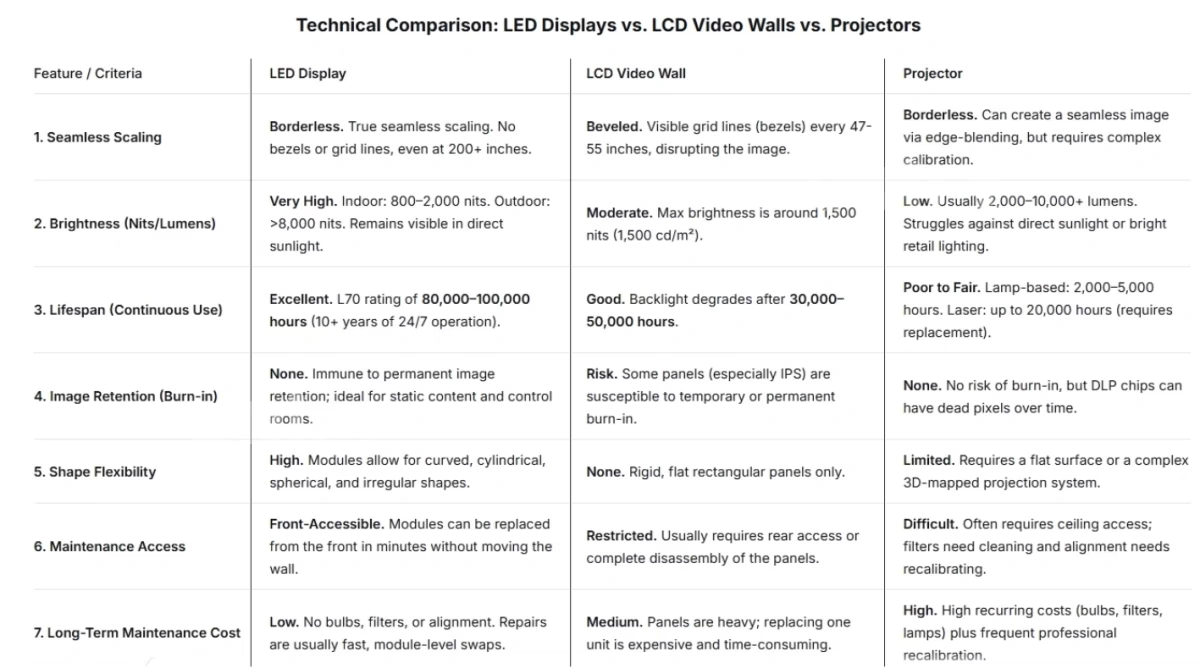
Infographic comparing seven key advantages of LED displays over LCD video walls and projection systems for commercial B2B applications
FAQ: LED Display vs LCD vs Projection – Common Questions Answered
For indoor commercial installations, the crossover point is approximately 120–140 inches diagonal. Below this, a single large-format LCD or 2×2 video wall is usually more cost-effective. Above this, LED’s seamless scaling and declining per-pixel cost make it increasingly competitive. By 200 inches, LED is typically the lower-TCO option when factoring in installation complexity and long-term maintenance.
Not effectively. Even a 30,000-lumen laser projector on a high-gain screen struggles to produce acceptable contrast in environments with significant ambient light. LED displays deliver 5–10× the effective brightness (measured in nits at the screen surface) and do not suffer from the washed-out appearance that affects projection under lighting. For retail, lobbies, and any space with windows or overhead lighting, LED is the objectively superior technology.
OLED (Organic LED) is a consumer and professional monitor technology, not a large-format commercial display technology. The largest commercially available OLED panels are 97 inches and cost $25,000+. OLED also suffers from burn-in risk with static content, making it unsuitable for digital signage and control room applications. For commercial installations above 100 inches, direct-view LED is the practical self-emissive technology. See our LCD vs LED comparison for more context.
LED display is the overwhelming recommendation for houses of worship. It handles stage lighting without washout, scales to any size, provides IMAG (Image Magnification) without delay, and is front-serviceable. Rental LED options are available for portable churches. LCD video walls are a budget alternative for smaller fixed installations under 110 inches. Projection is the lowest-cost option but struggles with stage lighting and requires regular recalibration.
A good rule of thumb: pixel pitch (in mm) should be roughly equal to or less than the minimum viewing distance (in meters). For example, if the closest viewer is 3 meters away, P3 or finer is recommended. For more precise calculations, including visual acuity factors, see our LED display viewing distance calculator guide.
LED installation is modular but requires more upfront structural work — mounting frames, precise cabinet alignment, and cable management. A professional installation team can typically complete a standard indoor LED wall in 1–3 days. LCD video walls are faster to mount but require more precise alignment and calibration. Projection is the quickest to deploy but requires careful geometric setup and environmental light control. For any technology, professional installation is strongly recommended for commercial applications.
Why LED Display vs LCD vs Projection Is About Application, Not Just Specs
The question “which is better — LED, LCD, or projection?” has no universal answer. The correct question is: “which is better for my specific application, viewing distance, ambient light conditions, and budget?”
For the majority of commercial installations above 120 inches, LED display technology has become the default choice — not because it is newer, but because it solves the fundamental problems that limit LCD (bezels, brightness ceiling) and projection (ambient light sensitivity, maintenance burden). Below 100 inches in controlled indoor environments, LCD remains a cost-effective and perfectly adequate solution. Projection retains two strongholds: temporary installations where portability matters, and dedicated dark-room environments (home theaters, screening rooms) where its cost advantage is decisive.
At UnifyLED, we help buyers navigate this decision with engineering-based analysis, not sales pressure. Contact us with your application parameters, and we will provide an honest assessment of which technology — or combination of technologies — delivers the best outcome for your project.
Email: legidatechled@gmail.com | WhatsApp: +86-191-18802497