
RGBlink · M Series · Modular NDI Production Switcher
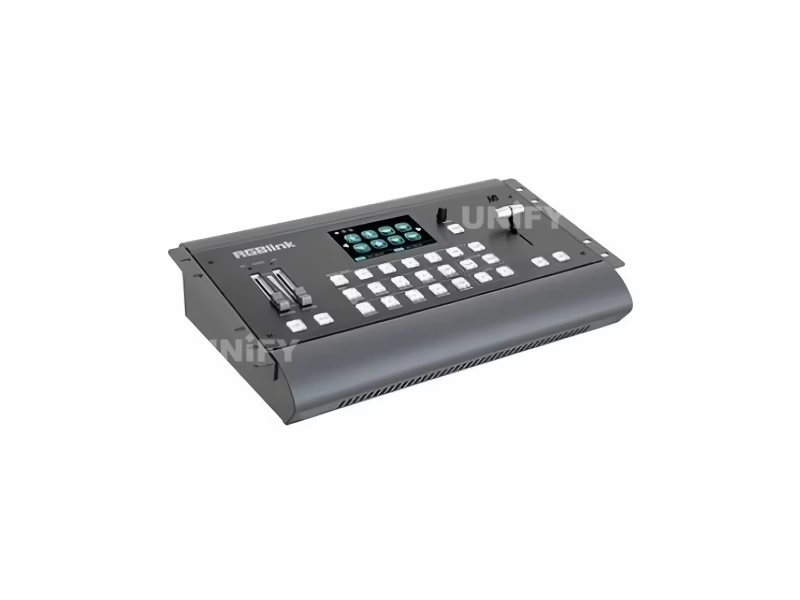
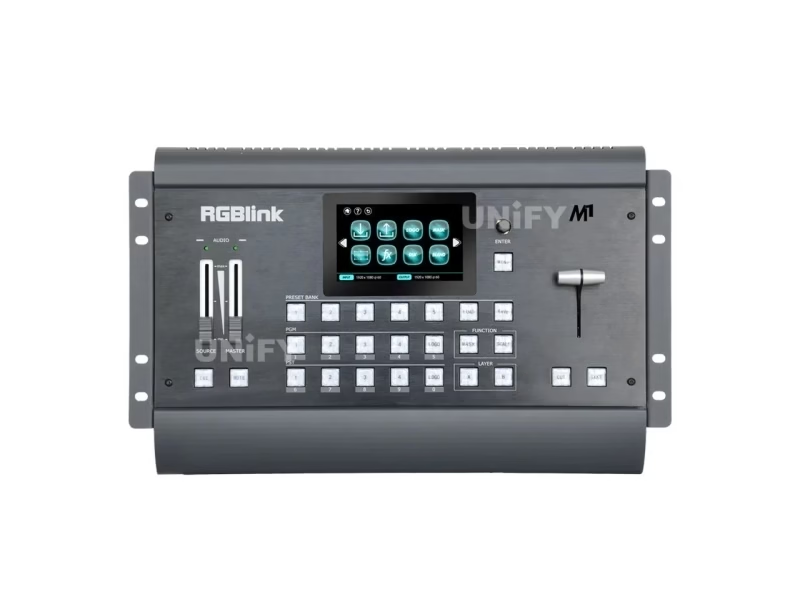
RGBlink M1 NDI Modular Production Switcher
The RGBlink M1 NDI Modular Production Switcher (M1-NDI, order code 220-0001-04-0) is a rack-mount production switcher with two hot-swappable NDI input modules (expandable to four), a built-in pixel scaling engine that converts any input to any output, and PGM HDMI plus USB 3.0 streaming outputs — the NDI edition of RGBlink’s modular M1 family.
Product Overview
What Is the RGBlink M1 NDI Modular Production Switcher?
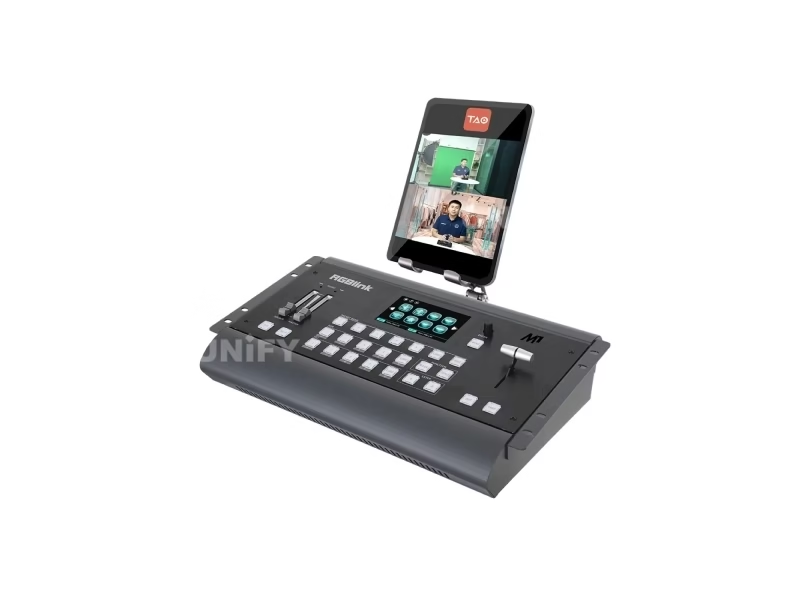
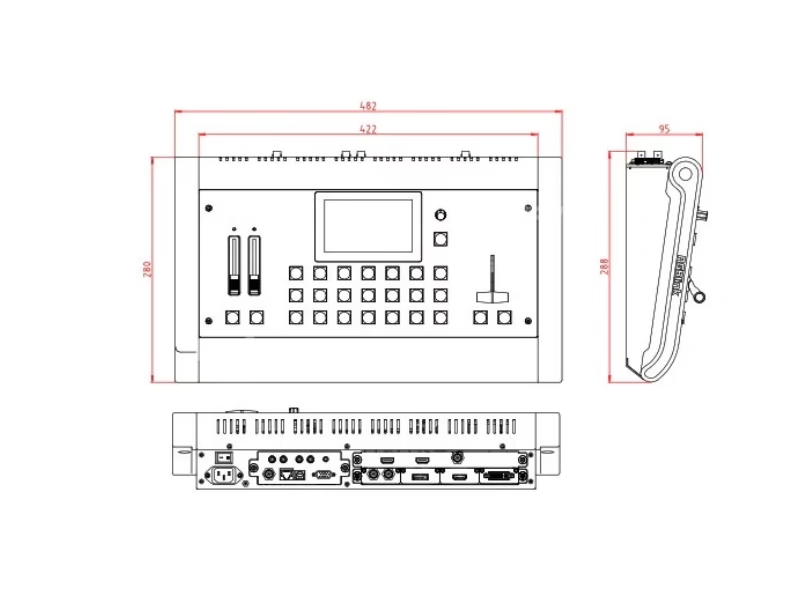
The RGBlink M1 NDI Modular Production Switcher is the NDI edition of RGBlink’s M1 modular production switcher family: a rack-mount unit (462 × 280 × 95 mm, 5.5 kg) whose hot-swappable modules turn it into a scaled video mixer — the standard M1-NDI configuration ships with two single NDI input modules (two Gigabit RJ45 ports decoding NDI|HX2 sources, expandable to four), an output module delivering PGM over HDMI plus USB 3.0 with a separate PVW HDMI output, an EXT module that hosts the NDI boards, rack ears and side wings. A built-in pixel scaling engine up-, down- and cross-converts any input signal to any output — RGBlink’s own brochure says the operator does not need a video scaler behind the unit for modern displays including LED — with two video layers plus OSD, logo and still layers, clean preset-to-program switching through 14 transition effects on a T-bar and TAKE key, and audio mixing with RCA and headphone outputs. Official data sources on this page are the M1-NDI Specification V1.8 (December 2023), the newest User Manual V1.4 and Brochure V2.11 downloaded from RGBlink’s product page, cross-checked against the classic M1 documents.
Short answer: The RGBlink M1 NDI (M1-NDI, order code 220-0001-04-0) is a rack-mount modular production switcher that ships with two NDI|HX2 input modules (expandable to four), an output module with PGM HDMI + USB 3.0 and PVW HDMI, an EXT module, rack ears and wings: it decodes NDI sources over Gigabit Ethernet, scales every input independently to a 1080p-family output through its built-in pixel engine, cuts two video layers plus OSD/logo/still between preset and program with 14 transitions on a T-bar, mixes RCA and embedded audio with PPM monitoring, carries Genlock Y input, DB15 tally and EDID management, and streams program through the USB 3.0 output module or a TAO App on a tablet or phone — at a $1,920 street price. The M1 family spans four host variants (M1 classic with four DVI-I, M1 HDMI, M1 DVI, M1 HDMI+SDI and this NDI model), with the M2 and M3 mixed-signal mixers above it in RGBlink’s M series.
The M1-NDI occupies a different position from the portable RGBlink switchers this site reviews — the mini-ISO, mini-edge SDI and mini-pro v3 are desk-sized, battery-friendly HDMI consoles; the M1-NDI is a 5.5 kg AC-powered rack instrument for installed and trucked production. Where the mini line outputs a single 1080p program for a laptop-free stream desk, the M1-NDI targets the NDI workflow: cameras and computers on the network decode inside the switcher, the built-in scaler matches any source to the program format, and the rack ears, genlock and tally put it in a control-room or broadcast frame — for the same reason it lists at $1,920 rather than the mini family’s $295–$729 band.
For an LED-fronted venue the M1-NDI is the production stage: NDI cameras and laptops enter over Ethernet, the switcher cuts and keys, and the PGM HDMI output feeds a display chain — a monitor, a projector, or an LED video processor driving a wall. RGBlink’s own 2022 tutorial demonstrates the exact pattern — M1 working with an LED display for events while streaming the same program to the cloud — which is why this page’s LED section opens with that official workflow.
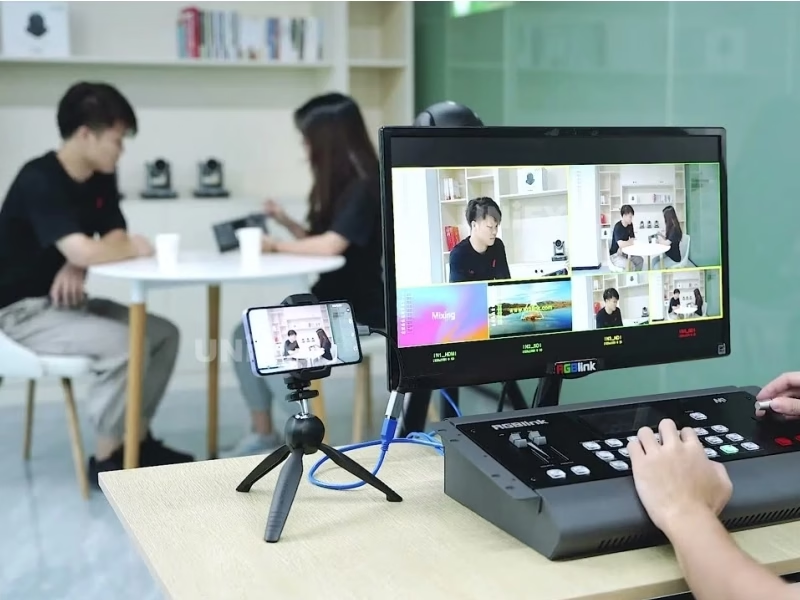
Official RGBlink video — introducing the M1.
Specifications
What Are the RGBlink M1 NDI Modular Production Switcher Specifications?
Data from the official RGBlink M1-NDI Specification V1.8 (December 2023).
Switcher, Scaling & Control
Official Data Check
What Do Official M1 Documents Say That Distributor Pages Get Wrong?
Five points deserve the official-document treatment on the M1-NDI. First, the shipped configuration: the official Specification V1.8 lists the standard contents — 2× single NDI input modules, the PGM HDMI + USB 3.0 | PVW HDMI output module, an EXT module, rack ears and wings — and notes in the same table that the pad shown in marketing imagery is not included; distributor copy that shows a tablet on the unit should be read with that footnote, and quotes should name the module list, since the same host appears in reseller catalogs as a “bare machine.”
Second, weight: the official specification prints “5.5g” for net weight — a unit typo for 5.5 kg, which is the figure consistent with the 8 kg packaged weight and the 5.3 kg a distributor scale lists; rack loading should use 5.5 kg. Third, temperature: RGBlink rates the unit 0–55 °C, while one dealer spec table prints −25 to 55 °C — the difference matters for unconditioned truck storage, and the official 0–55 °C envelope is the one to plan. Fourth, the document generations: the user-facing M1 specification and manual (V1.7/V1.2, December 2023) describe the classic M1 host and list the NDI module as an option, while the M1-NDI-specific V1.8 sheet (one day newer) makes two NDI modules the standard configuration — buyers comparing the two documents will see the NDI model’s standard kit in V1.8 only. Fifth, USB streaming semantics: the USB 3.0 output module delivers the program as a USB video stream, and streaming without a computer runs through the TAO App on a tablet or phone — the tablet is an accessory, not part of the unit.
Modular System
How Does the Modular Design of the M1-NDI Adapt to Different Inputs?
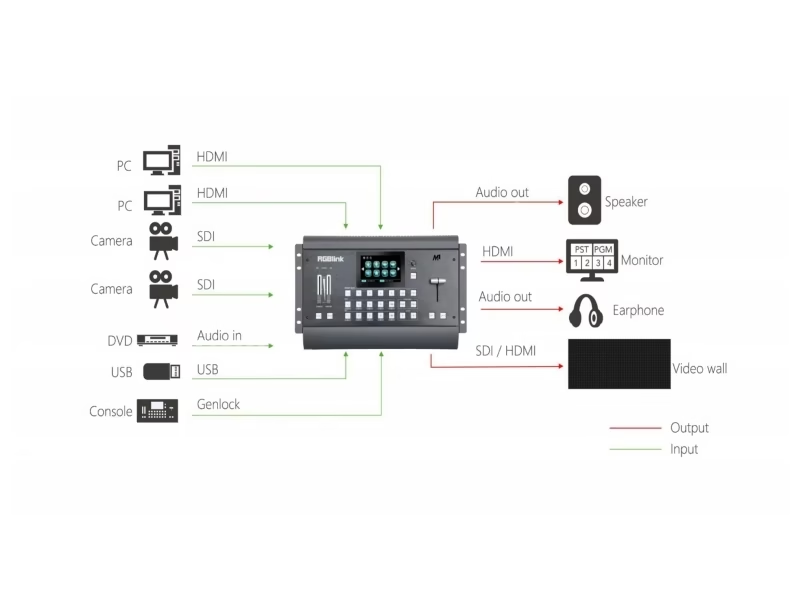
The M1-NDI is modular throughout, and the modules are hot-swappable — a configuration change is a slot change, not a new purchase. The standard NDI model fills its EXT module with two single NDI input modules, each one Gigabit RJ45 port decoding NDI|HX2 sources from the network; adding two more NDI modules brings the unit to four NDI inputs for larger camera counts. The same EXT slots accept the classic M1 single modules when a show needs wired sources: a DVI-I module that accepts DVI, VGA, YPbPr and CVBS on one connector — the format-flexibility workhorse of the family — an HDMI module, a 3G-SDI module with input and loop-through, or a USB 2.0 input/backup module. Each single module rides on the EXT carrier, which hosts up to four of them, and one output slot takes the output module of choice: PGM HDMI with PVW HDMI, adding SDI or USB 3.0 on the PGM side as the model variant requires.
The modular logic changes procurement math for a rental house or integrator: one M1-NDI host plus a spares kit of input modules covers shows whose sources change every week — NDI cameras this week, SDI cameras next, a legacy CVBS source the week after — and a failed module swaps in seconds without taking the switcher off air. RGBlink’s order codes keep the system straight: the M1-NDI host is 220-0001-04-0, NDI modules are 290-0001-08-0 and 290-0001-10-0, DVI/HDMI/SDI/USB modules carry the 190-0001 family, and the EXT carrier is 980-0001-02-2.
Scaling & LED
How Does the Built-In Scaler Connect the M1 NDI to an LED Display?
The M1 is, in RGBlink’s own words, an all-in-one scaling and vision mixing processor: its integrated pixel scaling engine up-converts, down-converts and cross-converts any input signal to the output format, so a 480i legacy camera, a 1080p laptop and an NDI source all resolve to the program’s output resolution without an external scaler in the chain. RGBlink’s brochure is explicit about the display consequence — the M1 is compatible with all kinds of digital displays including LED, and the user does not need a video scaler behind it.
The LED reading deserves engineering precision. The M1-NDI outputs standard 1080p-family HDMI (plus SDI or USB 3.0 on the output-module variant): for displays that accept a standard HDMI program signal — a presentation display, an LED all-in-one with an HDMI input, a small wall with an integrated controller — the M1 drives them directly, scaler-free. For a pixel-addressable large LED wall the receiving cards still need their sending and processing stage, and the M1 hands program to that LED video processor as a clean 1080p signal — the switcher replaces the scaling and mixing layer upstream of the processor, not the processor itself. RGBlink’s own tutorial demonstrates the event pattern end to end: M1 working with an LED display while streaming the same program to the cloud.
Official RGBlink video — M1 with an LED display for events, streaming to the cloud.
Switching & Picture
What Switching, Layer and Picture Power Does the M1-NDI Offer?
The M1-NDI cuts like a broadcast desk, not a tablet app. Preset and program run in parallel with clean switching between them; the PVW output shows a four-input multi-view — program, preset, the NDI sources and audio PPM levels on one screen — and the PGM output carries the live show. Transition control spans 14 effects on the T-bar with a TAKE button for timed cuts, joined by AUTO and wipe modes. Compositing runs two full video layers plus additional layers for OSD, logo and stills, and the foreground layer takes a mask — including user-defined masks — for shaped and branded pictures. Picture-in-picture windows accept masks, DSK and chroma key treatment with variable edge blending and softening, and each input carries fine picture controls for brightness, contrast, saturation, sharpness and color temperature — the per-source grading that keeps a multi-camera program uniform.
Audio follows the broadcast pattern: two RCA inputs and two RCA outputs plus a 3.5 mm stereo jack, with embedded audio mixed in and independent left/right level controls on the front panel. Audio can be selected independently from the video source — the M1 is not audio-follow-video only — and PPM metering displays on the PVW output as visual confirmation of source and output levels. Genlock Y input, DB15 tally and EDID management round out the professional I/O set that portable switchers omit, which is what puts the M1-NDI in a rack rather than on a desk.
NDI Workflow
How Do NDI Sources Enter the M1 NDI Switcher?
NDI is the M1-NDI’s reason to exist, and the workflow is a network story. Each NDI input module is a Gigabit RJ45 port that decodes NDI|HX2 sources — the compressed, low-latency profile that carries high-quality video over long network distances — so cameras, computers running NDI Tools and other network sources appear in the switcher like local inputs. The standard model decodes two NDI sources and expands to four with two additional modules; the EXT carrier hosts them, and RGBlink’s 2022 material pairs the M1 with its vue PTZ cameras and NDI camera ecosystem for the full network-production layout — cameras anywhere on the LAN, the switcher in the rack, program to the display and the stream.
Network planning follows the module count: each active NDI input consumes Gigabit Ethernet bandwidth, so the switch feeding the M1-NDI should be sized for the camera count and the program path should stay on the production VLAN rather than the office LAN — the same discipline as any NDI infrastructure, and the reason the unit keeps its own LAN port alongside the input modules. For wired sources the EXT slots take the classic DVI-I, HDMI, SDI or USB modules described in the modular section, which is how one host mixes NDI and traditional inputs in a single show.
Control & Streaming
How Do You Control and Stream From the M1 NDI?
Control on the M1-NDI runs three ways. The LCD touchscreen and menu rotation knob operate the unit from the front panel, with large illuminated buttons and the T-bar for the actions an operator fires repeatedly. XPOSE, RGBlink’s software platform, configures and controls the unit from a computer. And the TAO App puts streaming on a tablet or phone mounted to the unit — RGBlink markets the M1 as streaming via the USB 3.0 output module and mobile phone, so a show can go live through the TAO ecosystem without a laptop in the signal path; the official footnote that the pad is not included keeps the accessory conversation honest.
Streaming itself runs through the USB 3.0 output module that carries the PGM: the module’s USB-A port presents program video to the connected device, and RGBlink’s own tutorial walks the complete stream setup. The output-module variants matter for the plan: the standard M1-NDI ships the PGM HDMI + USB 3.0 | PVW HDMI module, and modules adding SDI on the PGM side are available in the 290-0001 family — a broadcast output plan should name the module variant in the quote alongside the host.
Official RGBlink video — how to stream with the M1.
Setup & Operation
How Do You Install and Operate the RGBlink M1 NDI Switcher?
Installation is rack work. The M1-NDI mounts in a 19-inch rack with the included rack ears, the side wings stabilize the unit in transit, and the IEC power inlet takes AC from 85 to 264 V at 50/60 Hz — one PSU design that runs on any mains standard, drawing up to 120 W. The rear panel brings the module slots forward into service: NDI modules connect to the production switch, the output module’s PGM and PVW HDMI feeds the display chain and the operator monitor, the USB 3.0 port carries the program stream, and the RCA pairs plus 3.5 mm jack handle analog audio. Genlock Y on BNC references the unit to a house sync signal, DB15 tally reports program state to a tally system, and EDID management resolves display-negotiation surprises before the show.
Operation follows the classic desk pattern: preview sources on the PVW multi-view, build the next shot on preset, cut or transition with the T-bar or TAKE, and let the PGM output carry the show to the display and the stream. Presets save complete panel states on board and to an external USB disk for recall across shows — a rental house carries its console setups on a stick. The official quick-start video walks the full sequence from power-on through first switching, and the manual’s chapters cover PST/PGM modes, output parameters, blackout, panel lock, PTZ control and factory reset. The M1 family has shipped since 2019 and the NDI edition since 2022 — a mature platform whose manuals and firmware settled years ago, which is the stability argument an installed system values over a stream of updates.
Official RGBlink video — M1 quick start.
Where It Works
Where Does the RGBlink M1 NDI Switcher Fit in Production and LED-Fronted Events?
The official M1 workflow — cameras into the switcher, program to the LED screen for events while the cloud stream runs — is the event shape: NDI cameras across a venue, the M1-NDI in the rack, and a 1080p program that scales to any display without a separate scaler.
NDI PTZ cameras on the LAN, the M1-NDI in a control room feeding a church LED display, program streamed through TAO — the multi-campus pattern behind our UK church project scaled to a rack install.
A fixed room with genlock and tally: laptop and camera sources, conference LED display solution downstream, USB 3.0 or TAO carrying the remote audience — no laptop at the switcher.
One host, a kit of modules, presets on a USB stick: the M1-NDI reconfigures between rental jobs ahead of stage LED walls and rental LED screens — the hot-swap module story is a rental inventory story.
The display half of the same chain is the site’s core business: an M1-NDI in front of an LED video processor and wall is a complete event production and display package, and the related links below build that package.
Comparison
M1, M1-NDI or the mini Family: Which RGBlink Switcher Fits Your Room?
RGBlink’s M series spans the modular mixing family — the classic M1 (four DVI-I inputs, PGM/PVW HDMI), the M1 HDMI and M1 DVI variants, the M1 (HDMI+SDI) mix, and the M1-NDI reviewed here — with the M2 (9-channel mixed-signal mixer) and M3 (14-channel) above it for larger productions. The naming differences that matter at purchase:
The category decision against the portable mini family is a rack-versus-desk decision. The RGBlink mini-ISO ($599), mini-edge SDI ($729) and mini-pro v3 ($295) are HDMI-first, battery-capable, laptop-free stream consoles for single-operator desks. The M1-NDI ($1,920) is a 5.5 kg AC rack instrument: NDI on the network, independent per-input scaling, genlock and tally for broadcast integration, hot-swap modules for changing source types, and TAO streaming without a computer. A church or venue that owns NDI cameras and a rack room buys the M1-NDI; a rental crew that carries flypacks buys the mini line; a 4K program requirement sits above both with the mini-max class at $1,940.
Against the $1,940 mini-max at a similar price, the M1-NDI’s answer is architectural rather than resolution-based: the mini-max is a portable 4K all-in-one, the M1-NDI is a 1080p modular NDI switcher with scaling, genlock and rack I/O — productions whose signal grammar is network-based and whose frame is a rack choose the M1, and productions whose requirement is 4K program output choose the mini-max. The official documents, not distributor copy, should make that call.
Pricing
How Much Does a RGBlink M1 NDI Modular Production Switcher Cost?
Price transparency, stated plainly: the RGBlink M1 NDI lists at $1,920.00 at B&H Photo Video (authorized dealer, special order with 2–4 week availability, September 2026; order code 220-0001-04-0, EAN 6970447704356), with the same price at a second US reseller. The comparable frame from RGBlink’s own catalog is the 4K all-in-one mini-max at $1,940; from outside the family, the price band is professional NDI hardware rather than the $295–$729 mini line. Factory-direct tiers for B2B buyers:
Budget the system, not just the host: the standard M1-NDI kit covers two NDI inputs, and a four-NDI camera room adds two NDI modules; a show mixing wired sources adds DVI, HDMI or SDI modules; rack, cabling and the production switch belong in the quote. Genuine unit, 2-year warranty and CE-LVD, CE-EMC, FCC and RoHS certification ship with every order; ask for a factory-direct quote at your configuration — we are the LED screen manufacturer behind unifyled.com.
FAQ
What Do Buyers Ask About the RGBlink M1 NDI Modular Production Switcher?
What Assurance Comes With the RGBlink M1 NDI Switcher?
Every M1-NDI ships with RGBlink original packaging, the standard module kit and compliance documentation.
Ready to Spec the RGBlink M1 NDI for Your Production Room?
Factory-direct pricing, genuine RGBlink stock, standard module kits pre-configured and 2-year warranty.
unifyledscreen@gmail.com | +86-191-18802497
Technical Deep-Dive
What Should Engineers Know Before Buying the RGBlink M1 NDI Modular Production Switcher?
Published: September 2026 | 12 min read | UnifyLED Engineering Team
The RGBlink M1 NDI Modular Production Switcher is the rack-mount, NDI-native member of RGBlink’s M1 family — a 5.5 kg instrument whose hot-swap modules and built-in scaling engine put it in a different category from the portable mini switchers this site has reviewed. This guide is written for engineers, integrators and procurement teams in 2026, using the official M1-NDI Specification V1.8, User Manual V1.4 and Brochure V2.11 as data sources, with the configuration facts, the scaling architecture and the category comparison that distributor pages skip.
Chapter 1 — Definition and the M1 Family
The RGBlink M1 NDI (order code 220-0001-04-0) is a rack-mount modular production switcher that ships with two NDI|HX2 input modules, an output module delivering PGM over HDMI plus USB 3.0 with a separate PVW HDMI output, an EXT module hosting the NDI boards, rack ears and side wings. Its engine is an all-in-one scaling and vision mixer: a pixel scaler converts any input signal up, down or cross to the program format; two video layers plus OSD, logo and still layers sit between preset and program with 14 transitions on a T-bar; audio mixes RCA and embedded sources with PPM monitoring; genlock, tally and EDID management close the broadcast loop. It is the NDI configuration of an M1 family whose classic hosts ship four DVI-I, HDMI or mixed inputs, above which RGBlink’s M series runs to the 9-channel M2 and 14-channel M3.
Position in the production chain separates it from the portable family this site covers. The RGBlink mini-ISO, mini-edge SDI and mini-pro v3 are desk consoles for laptop-free single-operator streams; the M1-NDI is rack hardware for installed rooms, NDI camera networks and broadcast-framed productions — the same display chain ends both stories, with the switcher handing a clean program to a monitor, a projector, or an LED video processor driving a wall.
Chapter 2 — The Configuration Sheet: What Ships and What Does Not
The configuration question is the first thing procurement should settle, because the same host appears in catalogs as a product and as a “bare machine.” Official Specification V1.8 lists the M1-NDI standard contents precisely: two single NDI input modules, one output module (PGM HDMI + USB 3.0 | PVW HDMI), one EXT module, rack ears and side wings — and the same sheet footnotes that the pad shown in marketing imagery is not included. A four-NDI camera room adds two NDI modules (290-0001 family); a show with wired cameras adds DVI-I, HDMI, SDI or USB modules from the 190-0001 family onto the EXT carrier; an SDI program output swaps the output module to the 290-0001 variants that carry SDI on the PGM side. Every module is hot-swappable, which is the maintenance story: a failed input swaps in seconds without taking the switcher off air, and one host plus a module kit covers shows whose source types change weekly.
Document discipline follows the same pattern as the rest of the family: RGBlink publishes separate sheets for the classic M1 (V1.7, where the NDI module appears as an option) and the M1-NDI (V1.8, where two NDI modules are standard), dated one day apart in December 2023. Buyers comparing spec sheets should read the V1.8 standard-configuration line, not the classic sheet’s option list, and quotes should name the module kit — the official weight figure prints “5.5g” (a unit typo for 5.5 kg, consistent with the 8 kg packaged weight), and rack loading should use 5.5 kg against the official 0–55 °C envelope rather than a distributor’s −25 °C figure.
Chapter 3 — NDI: The Network Grammar
NDI on the M1-NDI is a decode story: each input module is a Gigabit RJ45 port decoding NDI|HX2 — the compressed low-latency profile RGBlink markets for high-quality video over long network distances — so cameras, NDI Tools computers and other network sources land in the switcher like local inputs. The standard two modules grow to four, and RGBlink’s 2022 material pairs the M1 with vue PTZ cameras for a complete network production: cameras anywhere on the LAN, the switcher in the rack, program to display and stream.
Network engineering follows the module count. Each active NDI input consumes Gigabit bandwidth, so the production switch feeding the unit needs ports and capacity for the camera count; the program path belongs on a production VLAN rather than the office LAN; and the unit’s own LAN port plus the per-module ports should be planned in the rack patch list. Mixed shows keep the EXT slots for DVI-I, HDMI, SDI and USB modules, which is how one host carries NDI and traditional inputs in a single program — the DVI-I module’s acceptance of DVI, VGA, YPbPr and CVBS on one connector makes it the family’s format-flexibility workhorse for legacy sources.
Deployment sequencing matters as much as bandwidth: NDI discovery must complete before show time, so cameras and NDI Tools machines should join the production VLAN and appear in the switcher’s input list during rehearsal, not at call time. The manual’s setup chapters walk the network path alongside the video path, and RGBlink’s vue PTZ and NDI camera material gives the camera-selection guidance — a camera that speaks native NDI avoids a separate encoder in the chain, while an HDMI camera joins the network only with an NDI encoder device. For integrators standardizing one signal grammar, the M1-NDI plus native-NDI cameras collapses the traditional camera-to-switcher cabling into a single switched network — the cost and labor argument that puts the $1,920 host in front of a multi-camera room rather than a per-camera cable run.
Chapter 4 — The Scaling Architecture and LED Displays
The scaling engine is the M1’s architectural difference from every mini-series switcher: RGBlink calls the M1 an all-in-one scaling and vision mixing processor, and its brochure states the display consequence — compatible with all kinds of digital displays including LED, with no video scaler needed behind the unit. Inputs from 480i/576i through 1080p60 plus VESA computer rates resolve to the output format through independent per-input conversion; outputs are the 1080p family — HDMI, SDI or USB 3.0 depending on the output module — with selectable or custom resolutions.
The LED reading belongs in the spec conversation with precision. Displays that accept a standard HDMI program signal — presentation displays, LED all-in-ones with HDMI inputs, walls with integrated controllers — connect to the PGM output directly, which is the scaler-free case RGBlink advertises. A pixel-addressable large LED wall still needs its sending and processing stage: the M1-NDI hands program to the LED video processor as a clean 1080p signal, replacing the scaling and mixing layer upstream of the processor rather than the processor itself. RGBlink’s official tutorial shows the event pattern end to end — M1 with an LED display while the same program streams to the cloud — which is the workflow an integrator should mirror on the drawing board.
Chapter 5 — Switching, Pictures and the Broadcast Frame
The M1-NDI operates as a broadcast desk: preset and program run in parallel with clean switching, the PVW output shows a four-input multi-view with program, preset, NDI sources and audio PPM levels, and the PGM output carries the show. Fourteen transition effects run on the T-bar with a TAKE button; compositing spans two video layers plus OSD, logo and still layers with user-defined masks on the foreground; PiP windows take masks, DSK and chroma key with variable edge blending; and per-input picture controls — brightness, contrast, saturation, sharpness, color temperature — keep a multi-camera program uniform without external grading. Genlock Y input, DB15 tally and EDID management are the rack-frame requirements portable switchers omit, and audio runs RCA L/R in and out plus a 3.5 mm jack with independent channel levels and PPM metering on the PVW output.
Streaming stays computer-free in the M1 story: the USB 3.0 output module carries the program stream, the TAO App streams from a tablet or phone mounted at the unit, and XPOSE handles computer control — with the official footnote that the tablet is not included keeping the accessory conversation honest. Presets save complete panel states on board and to an external USB disk, which is how a rental or multi-room operator carries console setups between shows.
Chapter 6 — The Buying Decision and Price
The M1-NDI lists at $1,920 at B&H Photo Video (special order, 2–4 weeks) and a second US reseller — order code 220-0001-04-0, EAN 6970447704356 — and the budget belongs on the system, not the host: two NDI modules come standard, a four-NDI room adds two, wired sources add DVI/HDMI/SDI modules, and rack, cabling and the production switch are separate line items. The category question against the portable family is a rack-versus-desk question: the mini line at $295–$729 serves laptop-free stream desks with HDMI cameras; the M1-NDI serves NDI networks and installed rooms where scaling, genlock, tally and hot-swap modules earn the $1,920; the mini-max class at $1,940 answers a 4K program requirement the 1080p M1 does not.
Ownership cost closes the engineering case. A rack room that installs the M1-NDI once and runs it for years spends its money on the host and modules up front — against a per-show rental model, the break-even lands inside a season of events, and the hot-swap module kit turns a source-type change into a spare-part swap rather than a new switcher purchase. Presets stored on a USB disk carry show layouts between venues and operators, which compresses setup on multi-room installs; the AC 85–264 V supply removes power-supply variants from the spares list; and the mature firmware base means an installed unit is not chasing release notes during an event season. Those are the figures integrators should carry into the tender alongside the $1,920 list price, because they are where the M1-NDI’s economics separate from the portable line’s.
A final word on the product’s lifecycle, because the age of the documents reads like a warning to buyers who mistake silence for abandonment: the M1 family shipped in 2019, the NDI edition followed in 2022, and its manuals and firmware settled by late 2023 — a mature platform whose stability is the installed-system argument, not a 2026-launch story. RGBlink still lists it as a current product with current certification, and a venue buying for a decade of Sunday services or event seasons reads that maturity as the feature. The official documents are the reference for every number on this page, and where a distributor page differs — the weight, the temperature, the standard kit — the RGBlink documents win.
Conclusion
The RGBlink M1 NDI Modular Production Switcher is the NDI-native, rack-mount member of RGBlink’s M1 family: two NDI|HX2 input modules expandable to four, an output module with PGM HDMI + USB 3.0 and PVW HDMI, a built-in pixel scaling engine that converts any input to any output, two layers plus OSD/logo/still, 14 transitions on a T-bar, genlock, tally and EDID — in a 5.5 kg rack body at $1,920. It is the M1 family’s network-grammar configuration, mature and field-verified, and the rack instrument to specify where NDI cameras and installed production frames meet an LED wall.
Planning an NDI production build around an LED wall? Talk to us — we are the LED screen manufacturer behind unifyled.com, and switchers, processors and screens ship together with 2-year warranty and engineering support.
Related Pages
Build the Rest of the Production Chain
RGBlink mini-edge SDI 10-Channel All-in-One Switcher
RGBlink mini-pro 3rd Generation mini Streaming Switcher
LED video processor
LED screen for events
LED display for church
Conference LED display solution
SDI vs HDMI
English · December 2023 · standard NDI configuration, connectors, scaling and physical sheet · order code 220-0001-04-0
English · December 2023 · 64 pages · setup, PST/PGM modes, output, streaming, PTZ, presets