
B960 Series · Common-Anode Value Line · Outdoor Fixed Display
960x960mm Outdoor LED Display – B960 Series
The B960 series is a 960x960mm outdoor LED display built as the value line of our fixed-install family: a 25kg die-cast aluminum cabinet, IP66 sealing, 3840Hz refresh with row-blanking drive, and two field-proven pitches — P4.44 and P6.67 — at the sharpest factory pricing we publish. Same 960×960 platform as our premium A960, tuned for buyers whose budget line is the deciding vote.
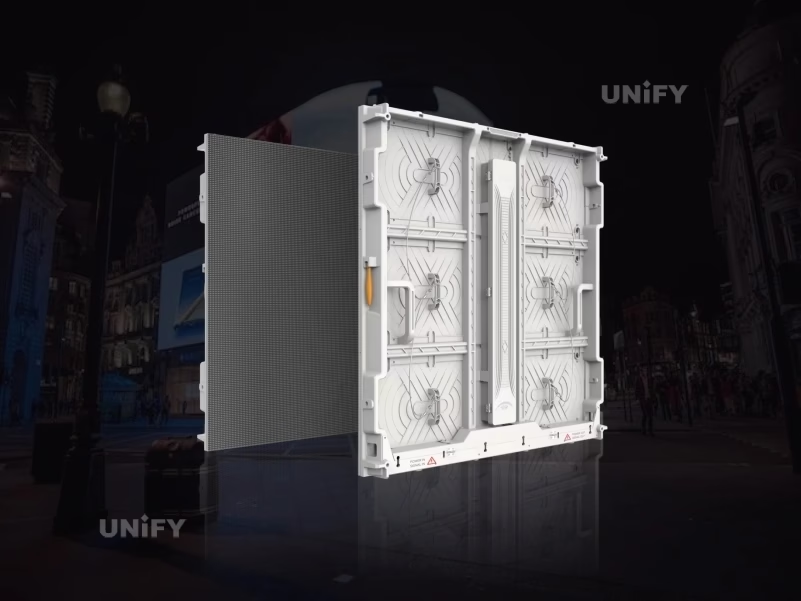
What Is the 960x960mm Outdoor LED Display (B960 Series)?
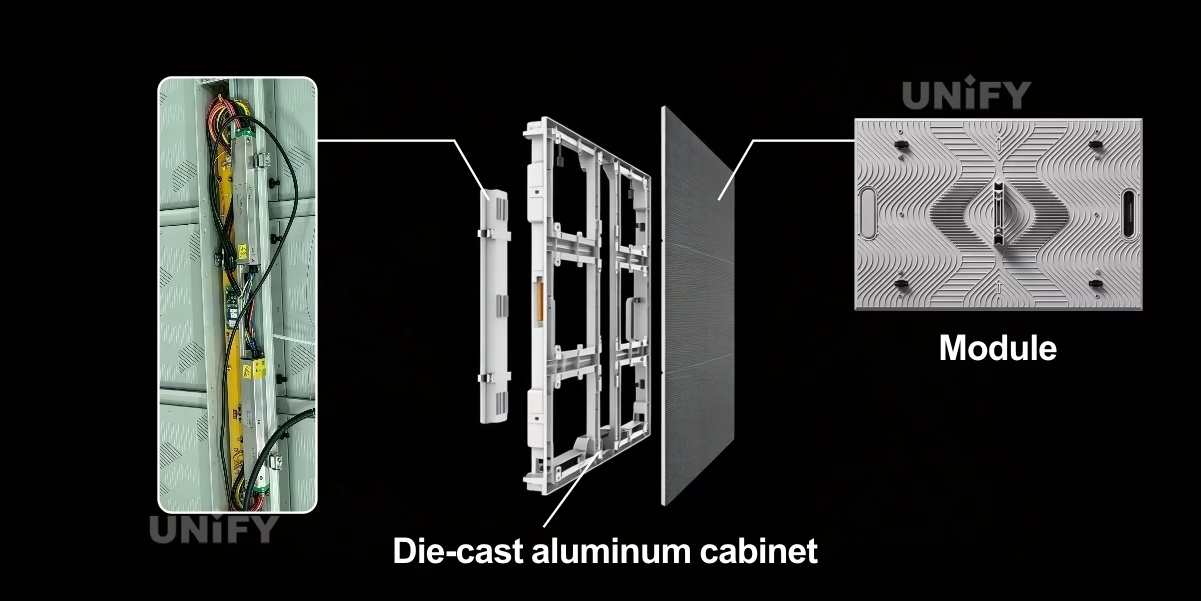
A 960x960mm outdoor LED display is a permanent outdoor video wall built from standardized die-cast aluminum cabinets, each 960 × 960mm and assembled from six 480 × 320mm modules in a 2×3 layout — the cabinet size that outdoor advertising, building facades and highway screens converged on because structure steel, cabling and spare parts are all designed around it. The B960 series is our value line on that standard: two pitches (P4.44 and P6.67), 3840Hz refresh with row-blanking drive, ≥5000 nits, IP66, and front/rear maintenance — priced for projects where the premium A960’s extra hertz is not in the budget.
Market listings for 960x960mm cabinets quote 1920Hz, 3840Hz or 7680Hz without stating the drive scheme behind the number. The B960 publishes one value — 3840Hz on common-anode drive with row blanking — on both pitches. What you read here is what the QC bench signs off.
For the premium build of the same 960×960 platform — 7680Hz common-cathode, 160° viewing angle, ≤186W/m² — see the 960*960mm outdoor LED display (A960 series).
960x960mm Outdoor LED Display Technical Specifications (B960 Series)
Two pitches share one cabinet. Pick by viewing distance and budget: P4.44 for close roadside and facade work, P6.67 for large-format highway and wall screens.
Maximum power may vary ±10% with LED chip batch. Specifications subject to change with product iteration. Drive scheme: common-anode with upper/lower row blanking, first-row darkening correction and low-gray mottling improvement.
Pain Points: 8 Problems the 960x960mm Outdoor LED Display Solves
Each card pairs a failure mode we hear about from outdoor installations with the B960 feature that answers it.
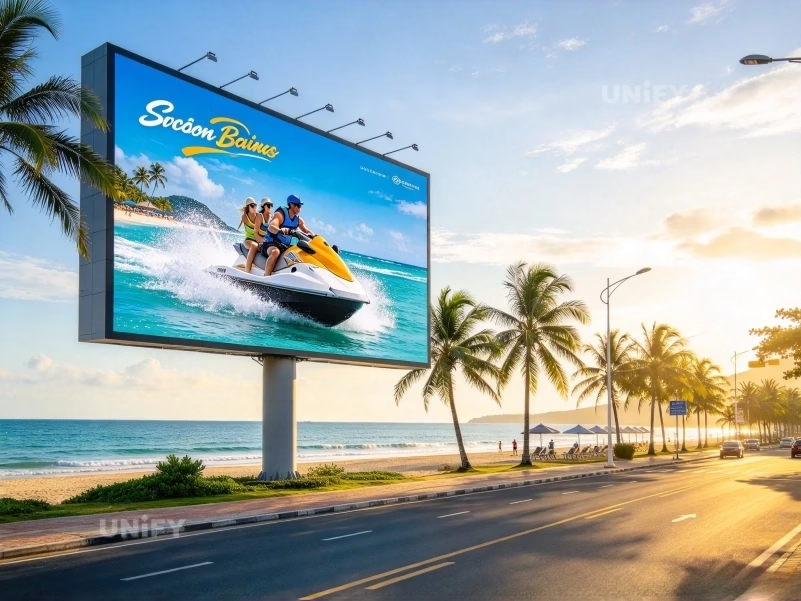
Die-cast aluminum with high melt point, flame retardance and salt-fog resistance; the B960 is rated for long-term seaside operation at IP66.
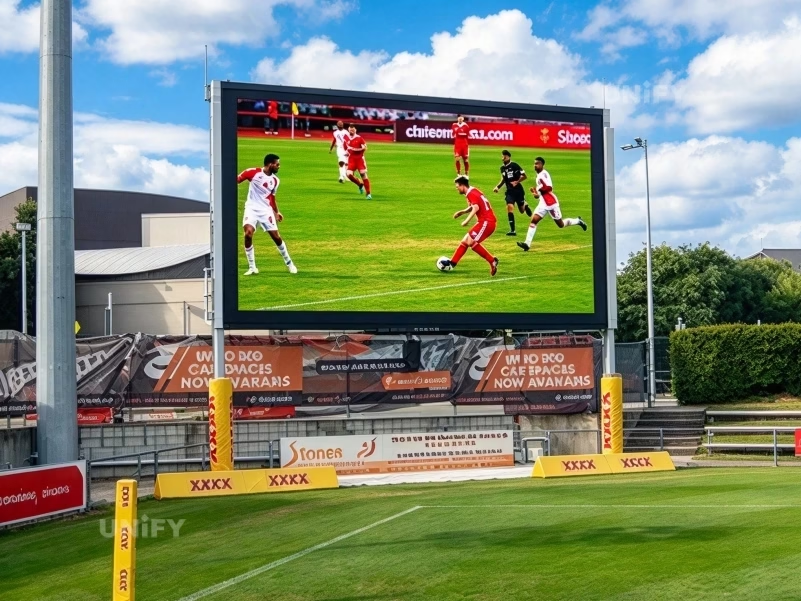
Die-cast aluminum resists deformation where thin sheet metal cabinets bow after a season of thermal cycling, keeping the face flat and the seams tight.
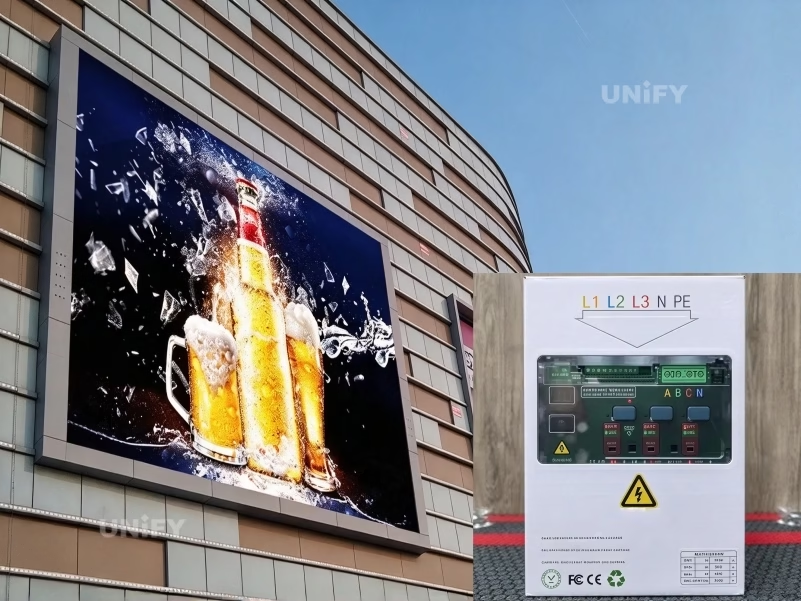
≤200W/m² average draw: a 100m² wall averages about 20kW, and the 2×400W per-cabinet supply plan keeps the distribution design simple.
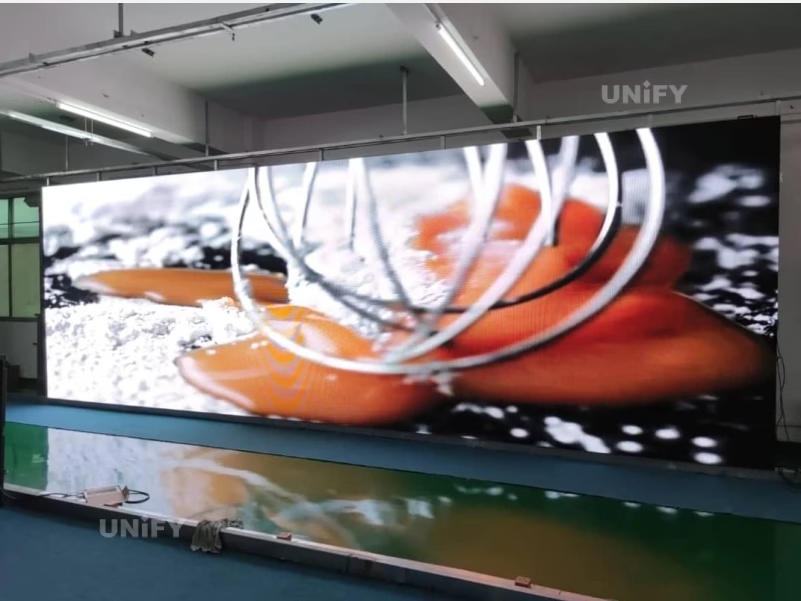
3840Hz refresh with row blanking holds news shots and event filming stable — the acceptance threshold broadcast crews actually test at.
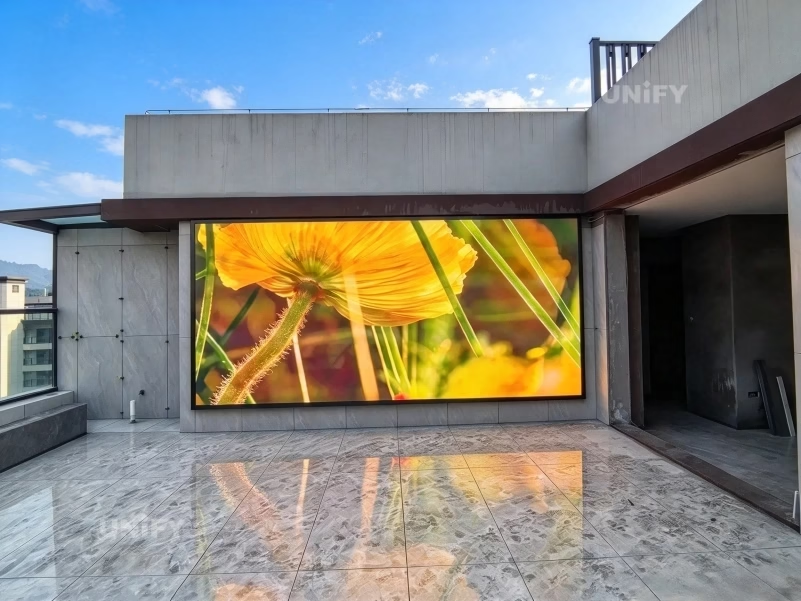
The drive scheme carries first-row darkening correction and low-gray color-shift and mottling improvement — the two defects most visible on night broadcasts.
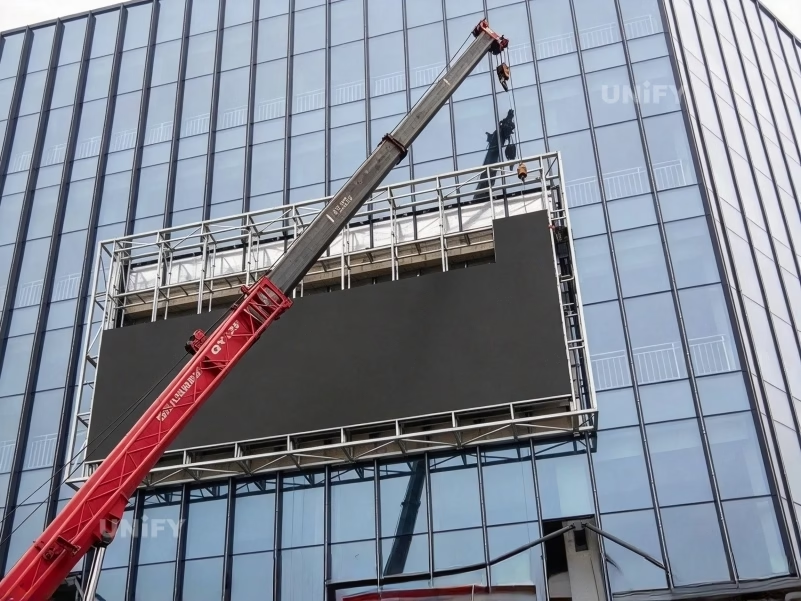
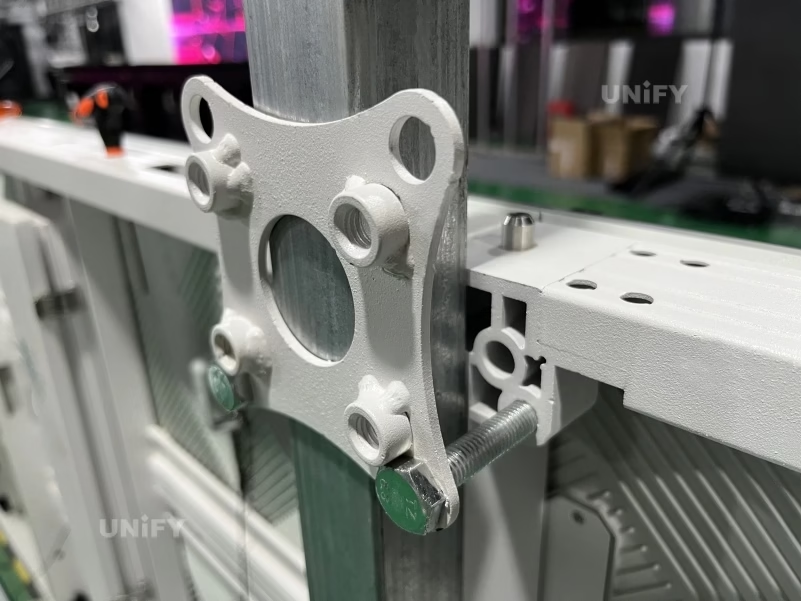
Hard-connection cabinets mount directly to the frame with no secondary structure installation — the spec sheet line that trims the fabrication quote.
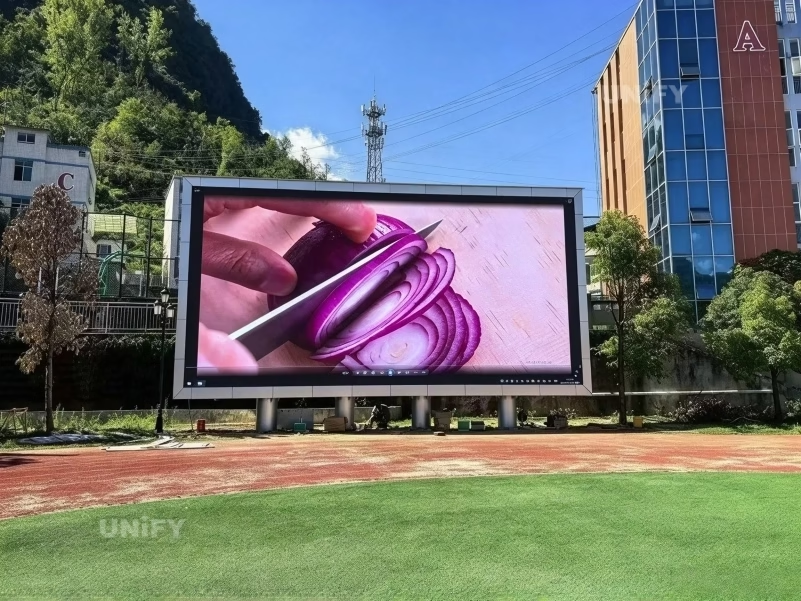
Ultra-low temperature rise plus the aluminum module’s own thermal conductivity move heat out — no air conditioner on the structure, rated to 60°C ambient.
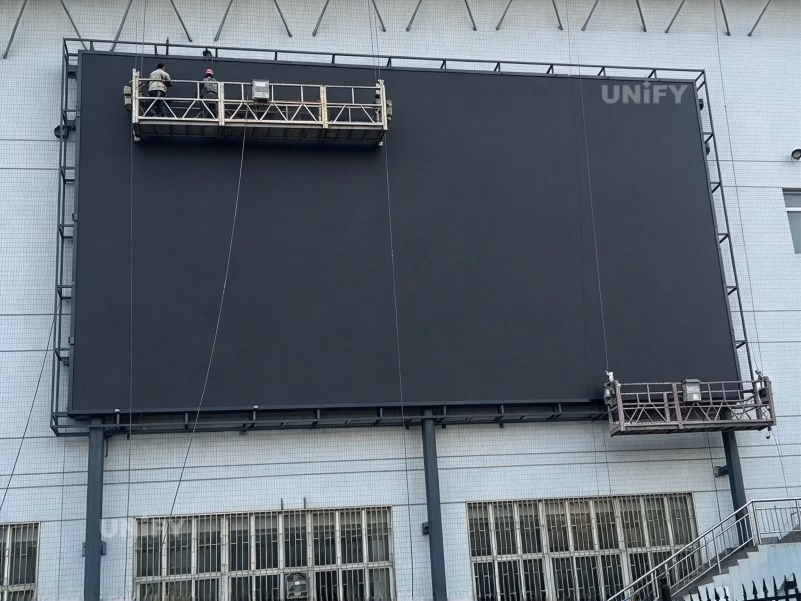
Front and rear maintenance on every cabinet — facade and wall-mounted screens service from the front when the building wall leaves no catwalk.
Common Anode vs Common Cathode: Which 960x960mm Outdoor LED Display Do You Need?
A common-anode display feeds one positive supply rail to all LED rows and switches the cathodes — the classic drive scheme behind most value-line outdoor screens. A common-cathode display powers each color’s cathode separately and drops the residual voltage on the board, which cuts heat and power at high brightness. Both drive the same LEDs; they differ in where the voltage is dropped and who pays for it.
| Factor | B960 (common anode) | A960 (common cathode) |
|---|---|---|
| Position in the family | Value line — sharpest factory price | Premium line — spec ceiling |
| Refresh rate | 3840Hz + row blanking | up to 7680Hz |
| Viewing angle | 140° × 120° | 160° × 160° |
| Average power | ≤200W/m² | ≤186W/m² |
| Pitch range | P4.44, P6.67 | P4.44 to P10 (5 pitches) |
| Choose it when | Budget decides → B960 · Broadcast-grade camera work and lowest long-run power → A960 series | |
Both lines share the same 960×960mm die-cast cabinet platform, IP66 sealing and front/rear maintenance — so the choice is a drive-scheme and budget decision, not a structural one. Mixed fleets are rare; most buyers standardize on one line.
How Do You Install a 960x960mm Outdoor LED Display?
Six mounting methods cover the standard outdoor briefs: hanging, supported, floor-standing, embedded, pillar and wall-mounted. The wall-mount front-service method is documented step by step: I-shaped and half-I connector plates anchor to the wall on M10×80 expansion bolts (full plates mid-field, half plates on the perimeter), and each cabinet locks onto the plates with M8 hex screws — built from the bottom-left corner, left to right, bottom to top.
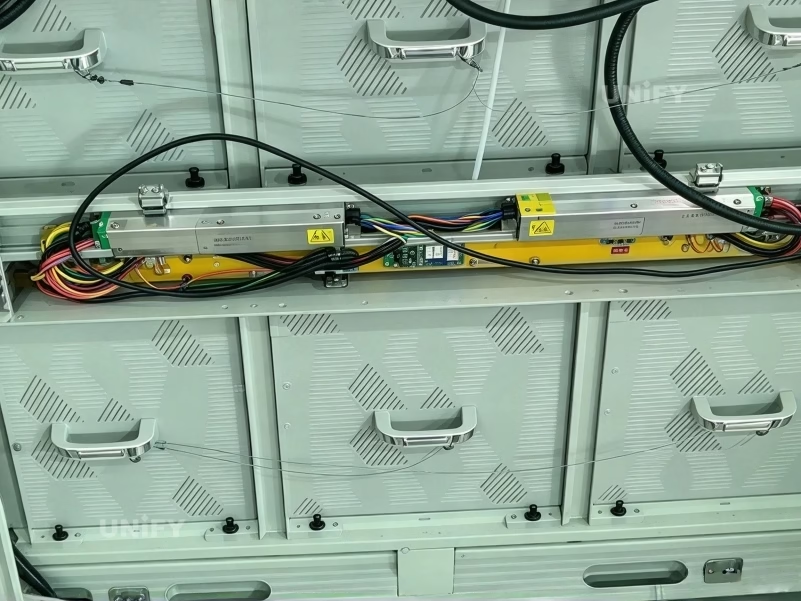
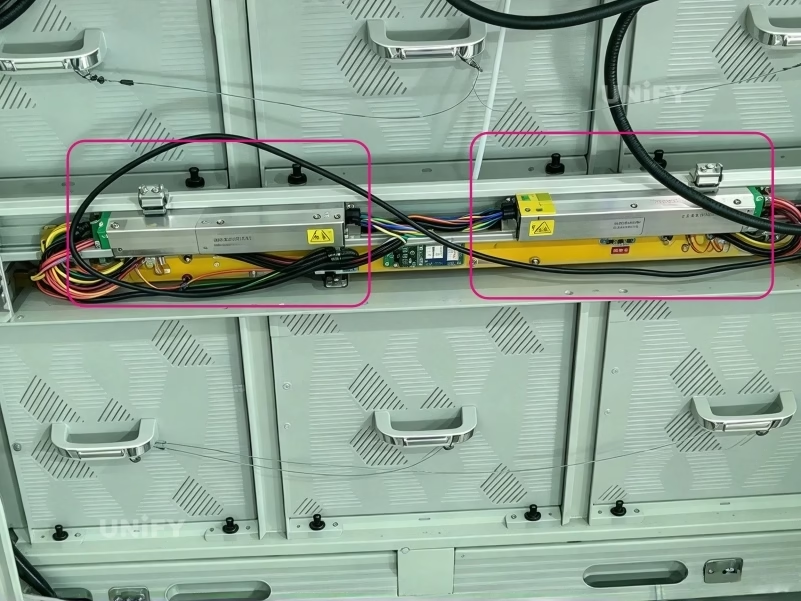
Every cabinet carries its services on board: the power box latches shut over the receiving card, power supplies and HUB board, power and signal aviation connectors route through a concealed cable box, and each module hangs on a safety rope with a waterproof ring at its connector. Module locks turn 90° from the front-service holes with the included tool, so a service call needs no hex work; the power box itself is a 4-screw pull once the modules are out. The network side plans like any receiving-card chain — see our LED screen control system guide.
How Weatherproof Is the B960 960x960mm Outdoor LED Display?
- IP66 sealed — dust-tight and protected against heavy seas of rain; built for outdoor 24/7 duty
- -30°C to 60°C operating window (10%-98% RH, non-condensing); storage to -40~80°C
- Corrosion stack — die-cast aluminum body, high melt point, flame-retardant, moisture and salt-fog resistant: rated for long-term seaside sites
- No air conditioner needed — ultra-low temperature rise and the aluminum module’s conductivity handle heat rejection
- 100,000-hour LED life with low decay lamp spec
For fixed-install pitch benchmarks at the same class, compare the P4 outdoor LED display and P6 outdoor LED display collections.
What Does the 960x960mm Outdoor LED Display Cost to Run?
Each cabinet carries two 400W power units on an AC200-240V input. Budget on ≤600W/m² peak and ≤200W/m² average — the numbers that size your breakers, cables and energy bill:
| Screen size | Average draw | Peak draw |
|---|---|---|
| 50m² facade | ≤10kW | ≤30kW |
| 100m² wall | ≤20kW | ≤60kW |
| 200m² landmark | ≤40kW | ≤120kW |
Average = ≤200W/m²; peak = ≤600W/m² (±10% by LED chip batch). Size the feed on peak draw; the average is what the energy bill sees.
Two practical notes:
- AC200-240V input — spec the site feed accordingly; where the grid sags outside that band, add a stabilizer stage ahead of the cabinets.
- PSU selection matters — the DC side runs on industrial LED display power supplies; see our CZCL LED display power supply range for the units behind this cabinet family.
Where the B960 960x960mm Outdoor LED Display Works
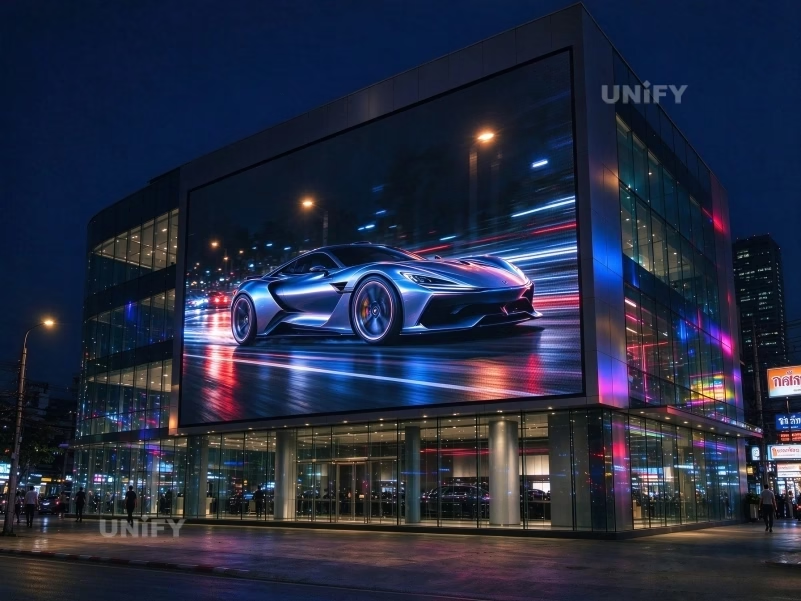
P4.44 close-range facade walls with front service; embedded or wall-mounted, no rear catwalk required.
Transport-hub information and advertising screens where 24/7 duty and 100,000hr lamp life carry the business case.
City-landmark and cultural-screen projects that buy on documented acceptance methods and long service life.
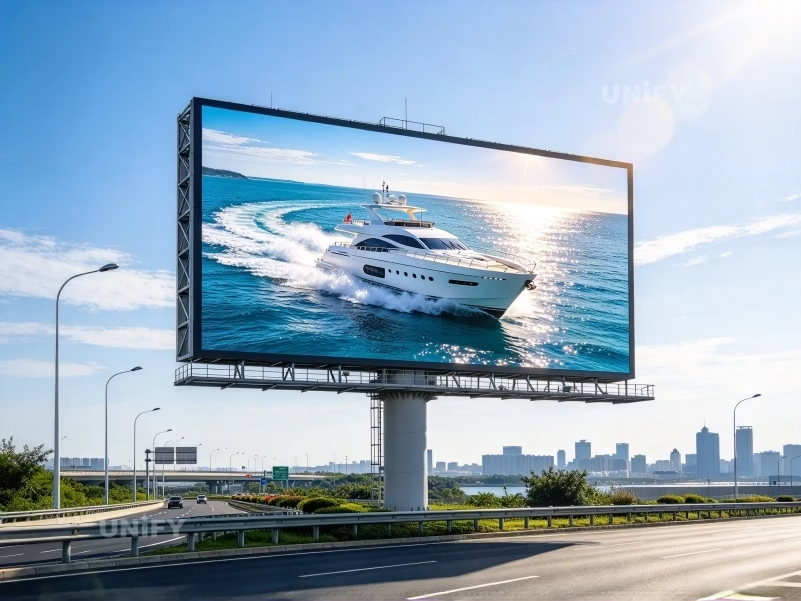
P6.67 double- and single-sided pillar screens viewed from 60m+; 5500 nits holds against direct sun.
Reference projects from this cabinet family
Zhengzhou University double-sided screen (220m²) · Jiangyin Stadium screen (280m²) · Dongguan Baoli Plaza screen (130m²) · Houston double-sided screen, USA (180m²) · Sokcho coast screens, Gangwon-do, South Korea (90m² / 150m²)
How Do You Accept and Verify a 960x960mm Outdoor LED Display Shipment?
We publish the acceptance method because buyers who measure accept faster and argue less. Three procedures, straight from our QC bench:
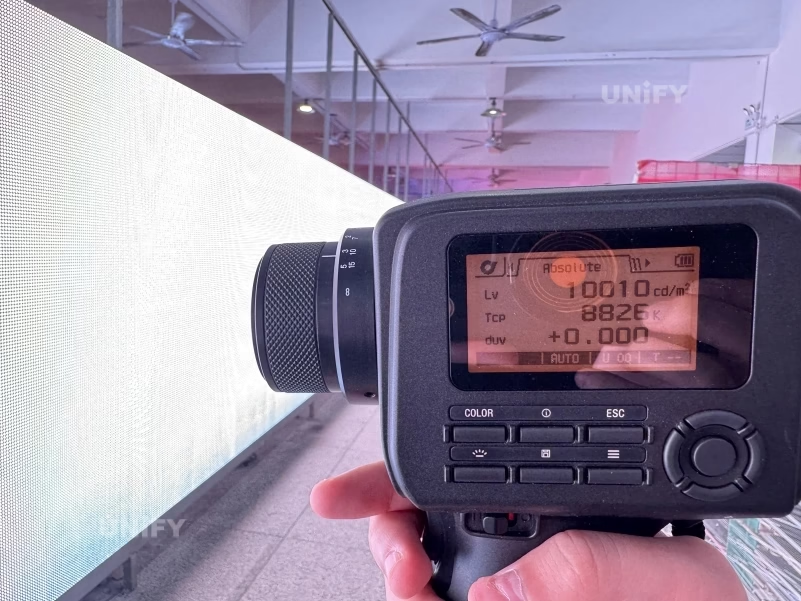
Full-white the wall, then measure with a lux meter held perpendicular to the screen within 10 minutes. Adjust distance until the meter’s window covers 16+ pixels, focus until individual lamps are sharp, read.
Stand at ±140° horizontal and 65° below center: the wall must show no obvious dark patches or blocks at either position.
After long storage, dehumidify before full load: light the wall 2 hours each at 20%, 40%, 60%, 80% and 100% brightness, stepping up in order. Above 65% RH ambient, run 8+ hours daily with the enclosure closed.
Every shipment leaves with manual, certificate, warranty card and installation notes; grounding requires <10Ω earth resistance to protect against static damage.
How Much Does the 960x960mm Outdoor LED Display (B960) Cost?
Market listings for 960x960mm outdoor cabinets span roughly $352-665 per cabinet and $420-450/m² depending on pitch and drive scheme. The B960 is our price-optimized line: common-anode drive, two pitches, one cabinet platform — quoted factory-direct against your screen size, pitch and structure scope, usually sharper than marketplace pricing at like-for-like spec.
Send the wall size, site type (facade, pillar, highway) and pitch preference; the quote returns itemized — cabinets, modules, power supplies, receiving cards and spare ratio. As the LED screen manufacturer, we control the BOM end to end.
Email unifyledscreen@gmail.com or WhatsApp +86-191-18802497 with your screen size and pitch — or open the quote form below.
960x960mm Outdoor LED Display FAQ
960 × 960mm, 85mm deep (P4.44) or 87mm (P6.67), 25kg per cabinet in die-cast aluminum, covering 0.92m² with six 480×320mm modules in a 2×3 layout.
Two pitches: P4.44 (SMD1921, ≥5000 nits, 50,625 dots/m²) and P6.67 (SMD2727, ≥5500 nits, 22,500 dots/m²), both on the same 960x960mm cabinet.
Common anode (B960) if budget leads and 3840Hz refresh covers your camera plan; common cathode (A960) if you want up to 7680Hz, 160° viewing angle and ≤186W/m² average draw. Same cabinet platform either way.
Yes for standard broadcast and event cameras — 3840Hz with row blanking is the acceptance threshold most crews test at, and the B960 adds first-row darkening correction and low-gray mottling improvement for night footage. For high-frame-rate and virtual production work, step up to the A960’s 7680Hz.
IP66 — dust-tight and protected against heavy rain, with -30~60°C operation and salt-fog resistance for seaside installations.
AC200-240V input, two 400W supply units per cabinet, ≤600W/m² peak and ≤200W/m² average. If your site grid sags below 200V, add a stabilizer stage ahead of the wall.
Front and rear maintenance on every cabinet: modules release with a 90° quarter-turn from front-service holes where the building leaves no rear access, and the integrated power box (receiving card, supplies, HUB board) pulls with 4 screws from the rear where it does.
Display set, manual, certificate, warranty card and installation notes, plus a published acceptance method (lux-meter brightness check, 140°/65° viewing check, stepped dehumidification protocol) so your team can verify the wall on site.
960x960mm Outdoor LED Display: The Value Buyer’s Guide
The 960x960mm cabinet is the size the outdoor LED industry standardized on, and it is also the size where the widest price spread lives: the same cabinet outline is sold as a premium common-cathode product and as a value common-anode product, sometimes with a two-fold difference on the quotation. This guide explains what you actually get at the value end of that spread — how the B960 series builds a 960x960mm outdoor LED display, where it saves money honestly, and where the premium line earns its premium back.
1. Why 960x960mm became the outdoor standard
Six 480×320mm modules tile a 960×960mm cabinet in a 2×3 grid, and that arithmetic is why the size won: 480×320 modules are the workhorse of outdoor SMD manufacturing, a 960×960 cabinet covers 0.92m² — close enough to one square meter that structure, pricing and power math all run on round numbers — and the cabinet footprint matches the spacing of standard steel frames and highway pillar heads. When you buy any 960x960mm outdoor LED display, you are buying into that ecosystem: spares, rigging and installers all exist for it everywhere.
The second reason is maintenance economics. A standardized cabinet means a standardized service routine: modules come out front or rear, power boxes swap as units, and a technician who has serviced one 960×960 wall has serviced them all. On a screen that runs 24/7 for a decade, that routine is worth more than any single line-item spec.
2. What “value line” means on the B960
Value does not mean stripped. The B960 keeps the platform intact: die-cast aluminum cabinet (not thin sheet metal), IP66 sealing, front and rear maintenance, ≥5000 nits brightness, 15000:1 contrast and 14-16bit gray scale. The savings come from three deliberate choices. First, drive scheme: common-anode electronics are cheaper to build than common-cathode, at the cost of slightly higher residual heat. Second, refresh: 3840Hz with row blanking instead of 7680Hz — enough for standard broadcast cameras, below the ceiling the premium line hits. Third, focus: two pitches (P4.44, P6.67) instead of five, which concentrates manufacturing volume and drops unit cost on exactly the two pitches most outdoor projects buy.
What you give up is written on the spec sheet, not hidden: 140°×120° viewing angle instead of 160°, ≤200W/m² average instead of ≤186W/m², and an AC200-240V input instead of a wider band. For a facade or pillar screen viewed head-on at 40m+, none of those show in the picture. For a 3D landmark or a virtual-production stage, they do.
3. P4.44 or P6.67: picking the pitch
Rule of thumb for outdoor fixed install: minimum comfortable viewing distance in meters roughly equals the pitch number times one, and comfortable detail viewing starts near pitch × 2-3. A P4.44 wall reads cleanly from about 5m and holds up close on a facade lobby or an urban plaza; a P6.67 wall wants 20m+ and shines on highway pillars and large building tops where viewers never get close. Between those distances, price decides: at the same cabinet count, P6.67 costs meaningfully less per square meter, so every meter of viewing distance you can honestly trade away is money back.
The two pitches share the same cabinet, module size and power plan, so a mixed decision is also workable: P4.44 at eye level on a two-sided pillar, P6.67 above — the wall below 20m gets the detail, the wall above gets the economy.
4. Power planning that survives the audit
Two 400W supply units per cabinet, AC200-240V input, ≤600W/m² peak, ≤200W/m² average. The number to size the feeder is the peak — a 100m² wall peaks near 60kW, so a three-phase feed and breaker plan must absorb that — while the number that fills the energy bill is the average: about 20kW for the same wall, roughly 175kWh per day at 24/7 duty. Check the site voltage before ordering: the B960’s input band is 200-240V, and where the grid sags below that, a stabilizer stage is cheaper than a wall of unexplained night reboots.
5. Installation: where the structure budget hides
The cabinet’s hard-connection design mounts directly onto the steel frame with no secondary structure installation — on facade projects, the fabrication quote for that secondary structure can rival the LED hardware itself, so deleting it is the single largest honest saving in the build. Six mounting methods cover the standard briefs (hanging, supported, floor-standing, embedded, pillar, wall-mounted), and at 25kg per cabinet, placement stays a two-technician job with standard tools. Grounding below 10Ω is not optional: it is the difference between a static nuisance and fried driver ICs in a dry winter.
6. Common anode vs common cathode, in one page
Both schemes light the same LEDs. Common anode ties the anodes to one supply rail and switches the cathodes; the residual voltage drops inside the driver, which is simple and inexpensive but leaves a little more heat in the board. Common cathode drops the residual voltage before the board, cutting heat and power at high brightness — the physics behind the premium line’s ≤186W/m² figure and its higher refresh ceiling. If your wall is a decade-long 24/7 asset, run the energy math at both ≤200W and ≤186W per square meter over ten years; on a 200m² landmark, that difference is real money and may buy the premium line by itself. If your wall is a budget-bounded tender with a fixed scope, the B960’s price does the deciding.
7. Accepting the shipment like a QC engineer
The fastest way to protect a value-line purchase is a written acceptance routine, and the B960 ships with one. Full-white the wall and measure brightness with a lux meter perpendicular to the screen; stand at ±140° horizontal and 65° below and look for dark patches; after any long storage, step the wall up through 20/40/60/80/100% brightness, two hours each, to drive out moisture before full load. Buyers who run those three checks accept in an afternoon — and the discipline of measuring is what separates a screen that runs a decade from one that collects complaints in its first rainy season.
8. Where the B960 fits in the family
The honest summary: the A960 series is the 960x960mm platform with every ceiling raised — 7680Hz, 160°, five pitches, common-cathode efficiency; the B960 is the same platform with every cost lever pulled — two pitches, common-anode drive, one cabinet, value pricing. Studios and 3D landmarks buy the first; facade, pillar and tender buyers buy the second. Both are documented on this site with the same spec-sheet discipline, so the decision can be made on numbers, not adjectives.
The bottom line: a 960x960mm outdoor LED display is a decade-long asset, and the value line is where careful buyers win — the B960 keeps the cabinet platform, the sealing, the serviceability and the published acceptance method, and prices the drive scheme and pitch focus honestly. Send your wall size and site type for an itemized factory quote.
B960: 25kg die-cast cabinet, IP66, 3840Hz row-blanking drive, P4.44 & P6.67 — quoted factory-direct with acceptance methods your team can run on day one.
P4 Outdoor LED Display Collection →
P6 Outdoor LED Display Collection →
LED Screen Display Control System →
CZCL LED Display Power Supply →
LED Screen Manufacturer – UnifyLED →
As a LED screen manufacturer in Shenzhen, UnifyLED builds rental, fixed-install and fine-pitch displays for buyers in 100+ countries.