
F960 Series · Outdoor Mobile Folding LED Poster
960*1920mm Folding LED Poster Screen — F960 Series
The F960 Series — a 960×1920mm folding LED poster screen that folds on its own base to 960×1140×227mm for transport, rolls into position on casters, and runs true outdoor duty: IP66 front and rear, 6,500–10,000 nits, common cathode power as low as 200W per unit. Five pixel pitches from P4.44 to P10 for street advertising, roadshows and event screens that live outdoors.
Product Overview
What Is the 960*1920mm Folding LED Poster Screen?
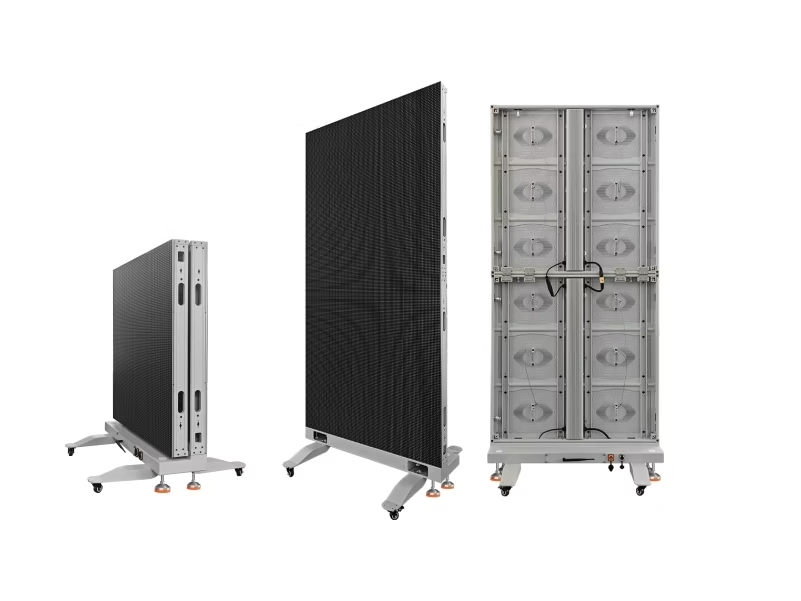
The 960*1920mm folding LED poster screen is a self-standing outdoor advertising display built around one idea: the screen folds in half on its own integrated base, so one person can move, place and power it without a crane, a forklift or a steel structure. Unfolded it stands 2.1m tall with a 1.84m² active display; folded it becomes a 227mm-thick unit that rides on casters and ships in a wheeled flight case. The category is also sold as a foldable LED poster display — the F960 Series is the heavy-outdoor version of it, rated IP66 on both faces where most folding posters stop at IP65 on the front only. For the flat poster format it complements, see LED poster display.
Five models, two LED configurations: F960-4.44 (P4.44), F960-5.7 (P5.7), F960-6.67 (P6.67), F960-8 (P8) and F960-10 (P10). Every model shares the same 960×1920mm display area built from twelve 480×320mm die-cast aluminum modules in a 2×6 layout, the same folding base, the same 3840Hz refresh and IP66 sealing. Two LED paths are available: the standard configuration (SMD1921 on F960-4.44, SMD2727 on the rest) and the 2745 independent triple-lens configuration on F960-5.7–F960-10, which raises brightness to 10,000 nits while lowering average power to ≤200W per unit. Only pitch, LED package and brightness change between models — the folding mechanism, base and control system stay identical, which keeps spare parts and operator training uniform across a fleet.
Folding Design
How Does the 960*1920mm Folding LED Poster Screen Fold for Transport?
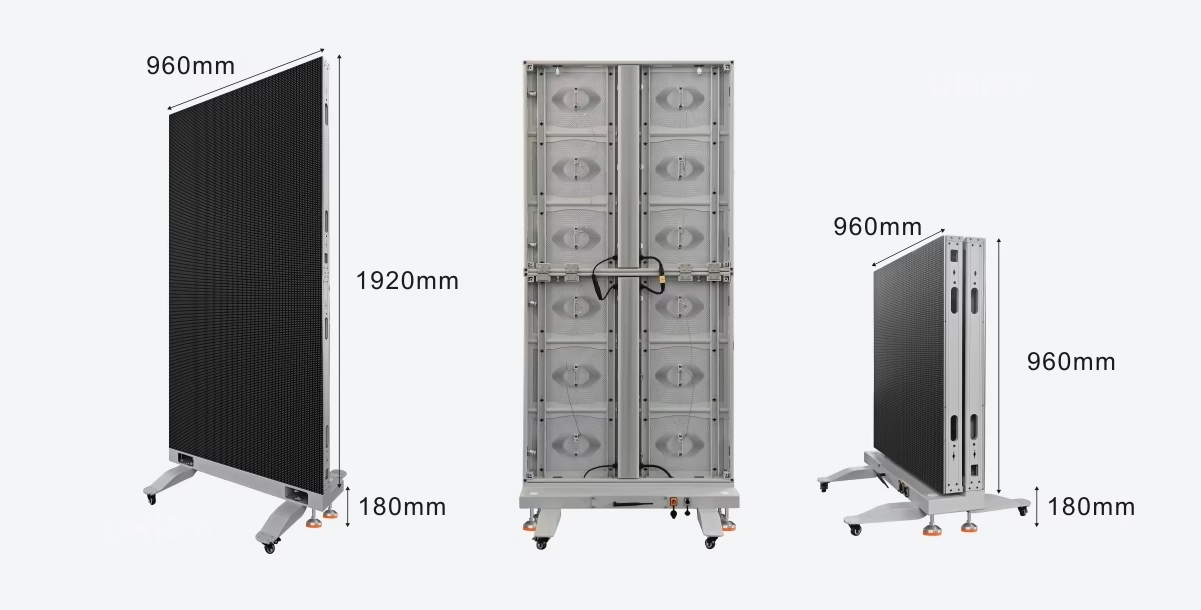
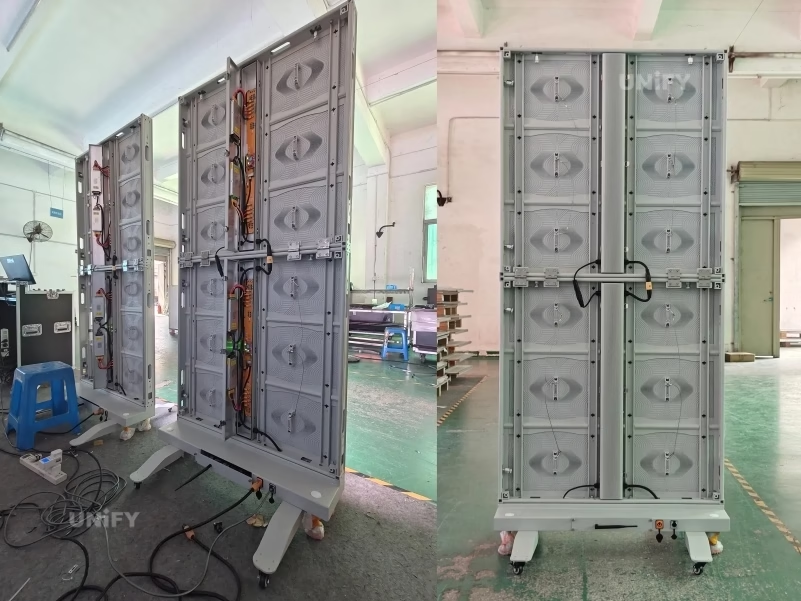
The screen is a dual-panel unit: two 960×960mm panel sections joined at a reinforced center hinge, mounted on an integrated base frame with lockable casters and four screw-jack leveling feet. Fold the upper panel down onto the lower one, latch it, and the whole unit compresses from a 2.1m standing screen into a 960×1140×227mm block — base, casters and all. No parts come off, nothing needs repacking, and the folded unit rolls on its own casters into a wheeled flight case.
The volume math is the selling point: open footprint volume is about 1.55m³, folded volume about 0.25m³ — the folded unit takes roughly one-sixth of the space, and the depth drops from 767mm to 227mm. A standard cargo van takes several folded units with flight cases for a multi-site roadshow, and 74kg per unit keeps the whole fleet within one loader’s capacity. Note the honest figure here: 960×1140×227mm includes the base and casters, because that is the object you actually ship — folding-poster listings that quote a 960×960mm folded size are measuring the panel without its stand.
Fold-down demo: the top panel meets the bottom in one motion
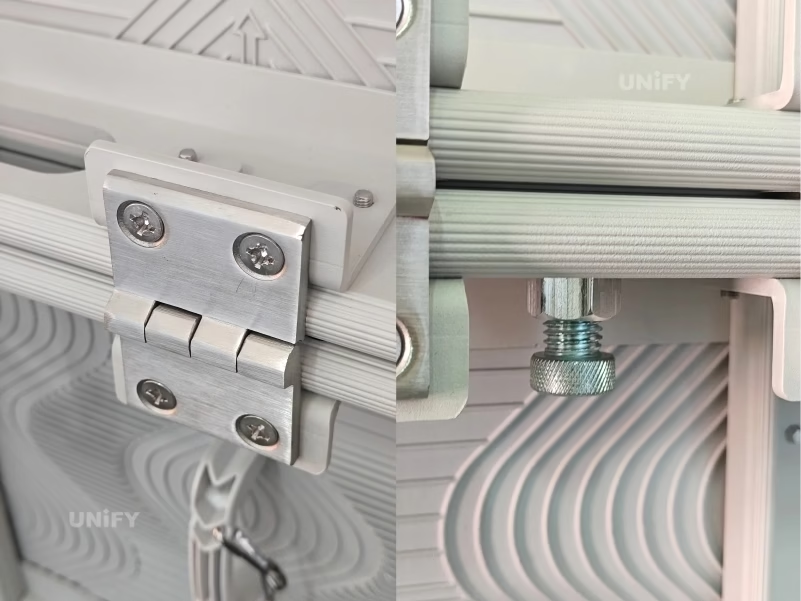
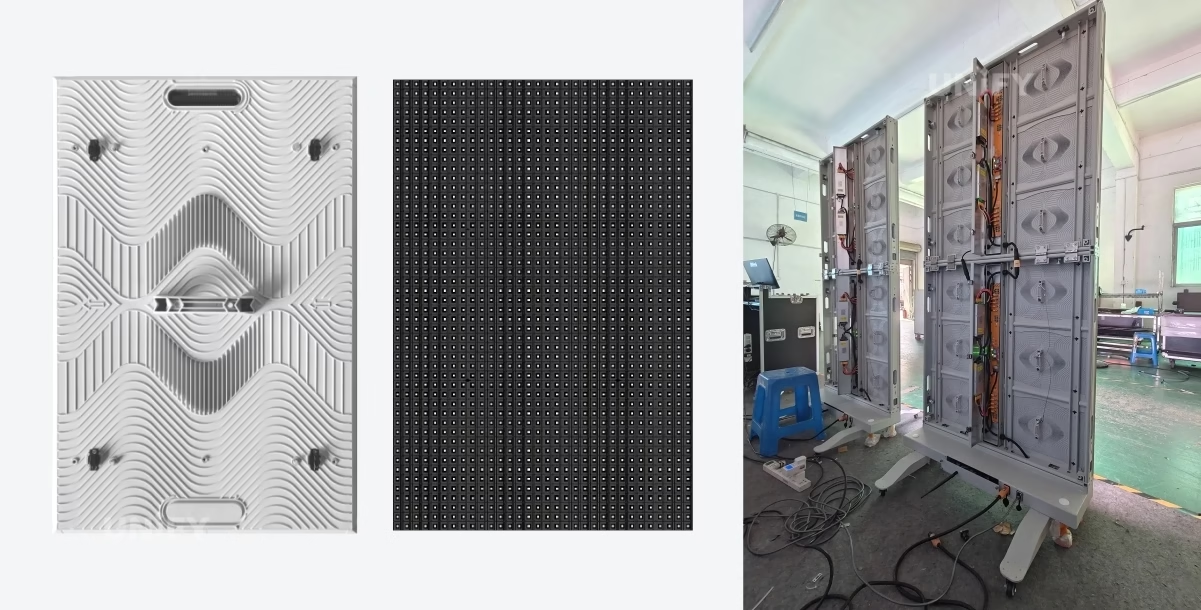
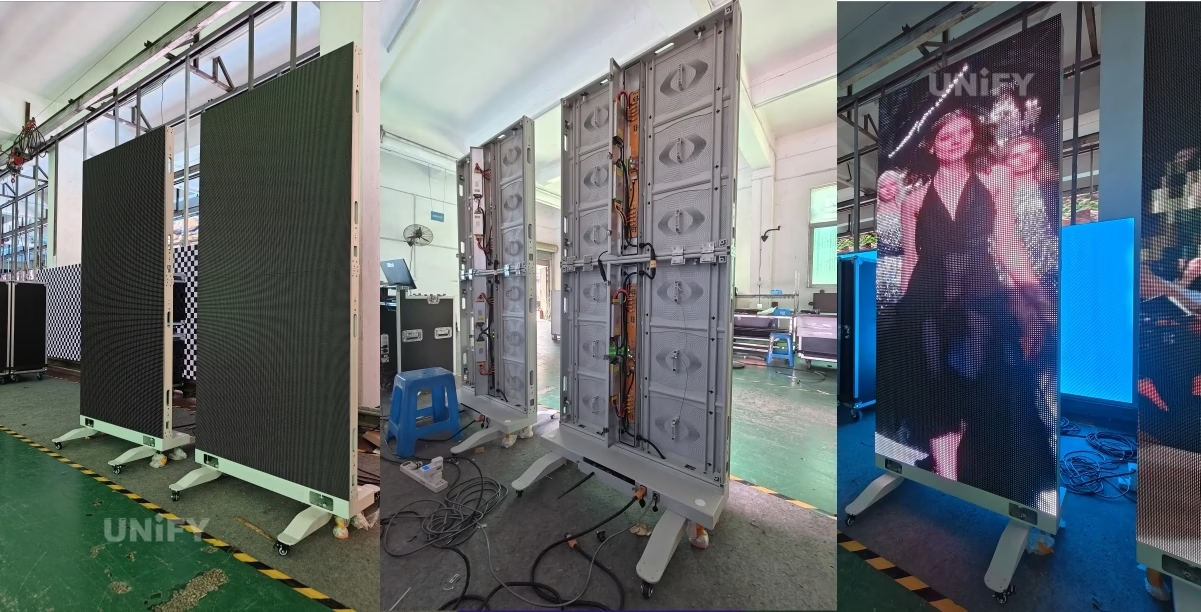
Rear tour: center hinge column, module latches and sealed quick connectors at the fold line
Specifications
960*1920mm Folding LED Poster Screen Technical Specifications (F960 Series)
Two configuration tables, both from the F960 factory datasheet: the standard SMD configuration across all five pitches, and the 2745 triple-lens configuration available on F960-5.7–F960-10. Every figure is per complete unit (960×1920mm display, twelve modules, folding base included).
Table 1 — Standard Configuration (All Models)
Table 2 — 2745 Independent Triple-Lens Configuration (F960-5.7–F960-10)
The 2745 option carries two honest boundaries: it is available on F960-5.7 and above — F960-4.44 has no 2745 version — and the 10,000-nit figure belongs only to this configuration; the standard tables’ brightness values are the standard SMD figures. Maximum power figures vary up to 10% with LED chip batch, which is why average power is the number we verify and publish.
Unit & System Specifications (All Models)
Outdoor Visibility
How Bright Is the 960*1920mm Folding LED Poster Screen in Direct Sunlight?
Bright enough to hold contrast against a sunlit street — and that is a spec question, not a mood question. A sunlit advertising surface demands roughly 5,000+ nits to keep legibility; the F960 Series standard configuration delivers ≥5500 nits on F960-4.44 and ≥6500 nits on the larger pitches, while the 2745 triple-lens configuration reaches 10,000 nits — headroom that keeps content readable at noon and lets the screen run at partial brightness the rest of the day, which is easier on the LEDs and the power bill. The 140° horizontal viewing angle keeps the message intact for crowds spread across a street or plaza rather than standing in a narrow cone in front of the screen.
The 2745 configuration earns its number structurally. Each LED is an independent triple-lens package: three separate optical paths, one per color channel, isolated from each other inside the lamp. The isolation does two things a conventional SMD does not — it blocks cross-talk between color channels (the cause of color drift when the screen is viewed at an angle), and it directs more of the generated light forward instead of losing it inside the package, which is how the same drive electronics reach 10,000 nits at ≤600W maximum. Off-axis viewers see the same color as the viewer standing dead-center, which matters for a street screen that crowds approach from every direction.
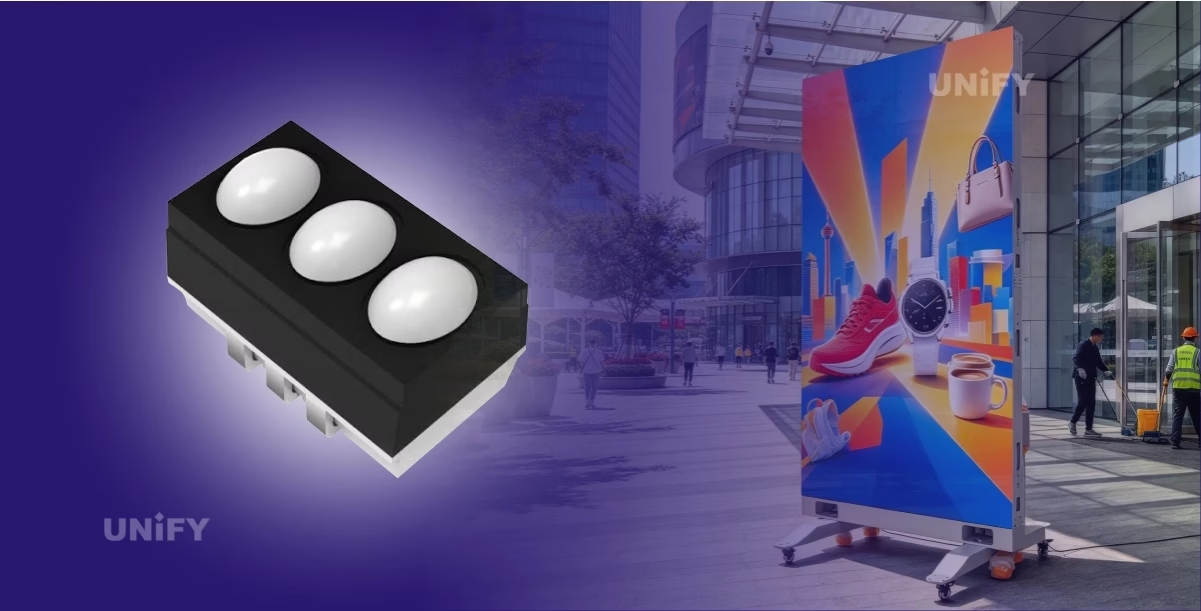
Camera performance comes from the drive side: 3840Hz refresh with 14–16bit grayscale clears scan lines from phone and broadcast footage, and ≥15000:1 contrast keeps dark content from washing out under street lighting at night. For advertisers whose acceptance test is “how does it look on camera”, that combination is the answer. Background reading: LED screen brightness.
Picture quality up close: shot at an angle, the way street audiences actually watch
Mobility & Deployment
How Fast Can You Deploy a 960*1920mm Folding LED Poster Screen?
Minutes, by one person, with no installation tools. The base frame, casters and leveling jacks ship attached — there is no assembly step and no separate stand to mount. The working sequence:
Roll out of the case
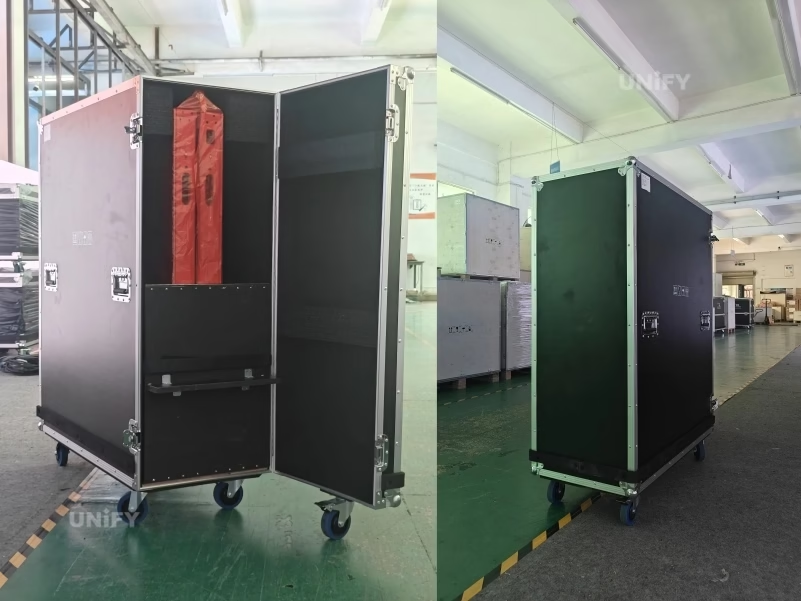
Open the flight case, tip the folded unit onto its casters, push it to position. The case stays for the return trip.
Raise and latch
Lift the upper panel until the hinge seats, close the latches. The panel locks at a little past vertical — the base geometry does the holding.
Level the feet
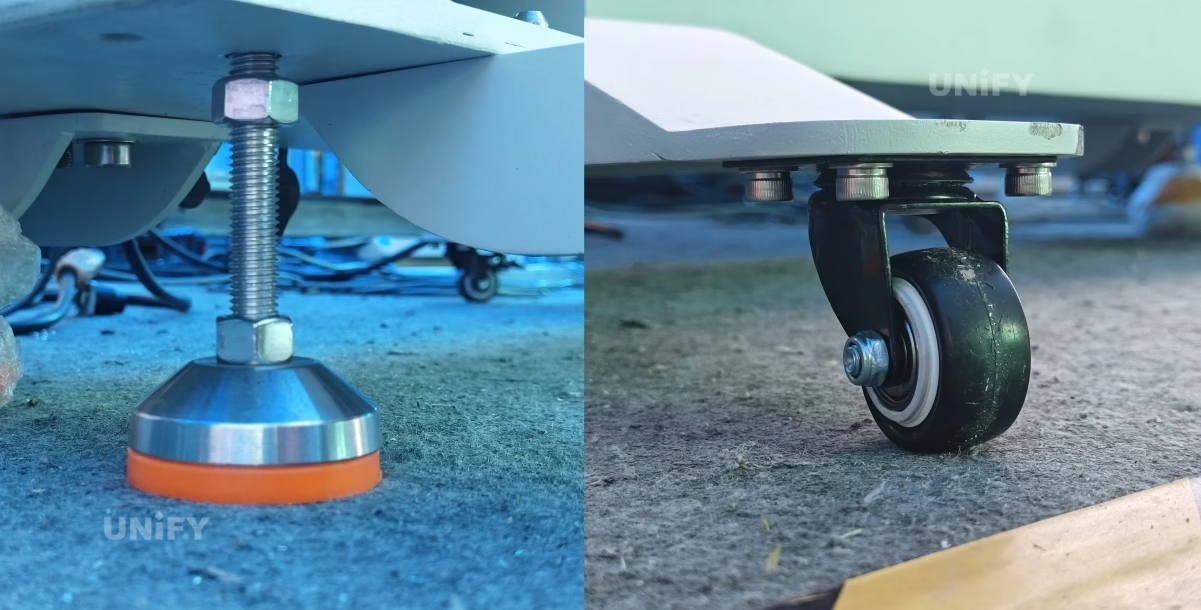
Screw down the four stainless jack feet until they carry the load, so the screen stands off its casters — stable on uneven pavement and immune to bumps.
Power and publish
One AC cable, then push content from a phone over WiFi or from a USB stick. The screen is selling from the first hour on site.
The four jack feet matter more than they look. Pavement is rarely flat; a screen that rests only on casters rocks, and a rocking 2.1m screen is a safety call, not an aesthetic one. Leveling jacks convert the unit from “wheeled cart” to “standing structure” in a few turns, and the orange-ringed feet make it obvious from a distance whether they are down. On the move between sites, the same feet screw back up and the unit rolls again.
Packing: film off, panel upright, into the wheeled flight case
Control & Cascade
How Do You Control the 960*1920mm Folding LED Poster Screen?
Three input paths, chosen per situation: publish remotely from a phone over WiFi — video, images and scrolling text — hand the screen a USB stick with the playlist, or manage a fleet from a control PC. There is no fixed on-site computer to babysit; content updates happen where the operator already is, which for a rental fleet means the driver’s phone. The asynchronous system keeps playing the loaded playlist through power cycles, so a unit placed at a site runs its schedule without anyone attending it.
Scale comes from cascading. Units connect in a chain with synchronized signal and synchronized power, so two F960 screens run one campaign in step and a row of them becomes a wider wall — a 2×1 pair is a 4m-wide street banner, and multiples build event backdrops with no dimension ceiling. Each unit remains independently deployable the next day; cascading is a connection, not a configuration change that has to be undone. For multi-screen campaign planning, see poster LED display.
Outdoor Durability & Energy
Is the 960*1920mm Folding LED Poster Screen Really Outdoor-Ready?
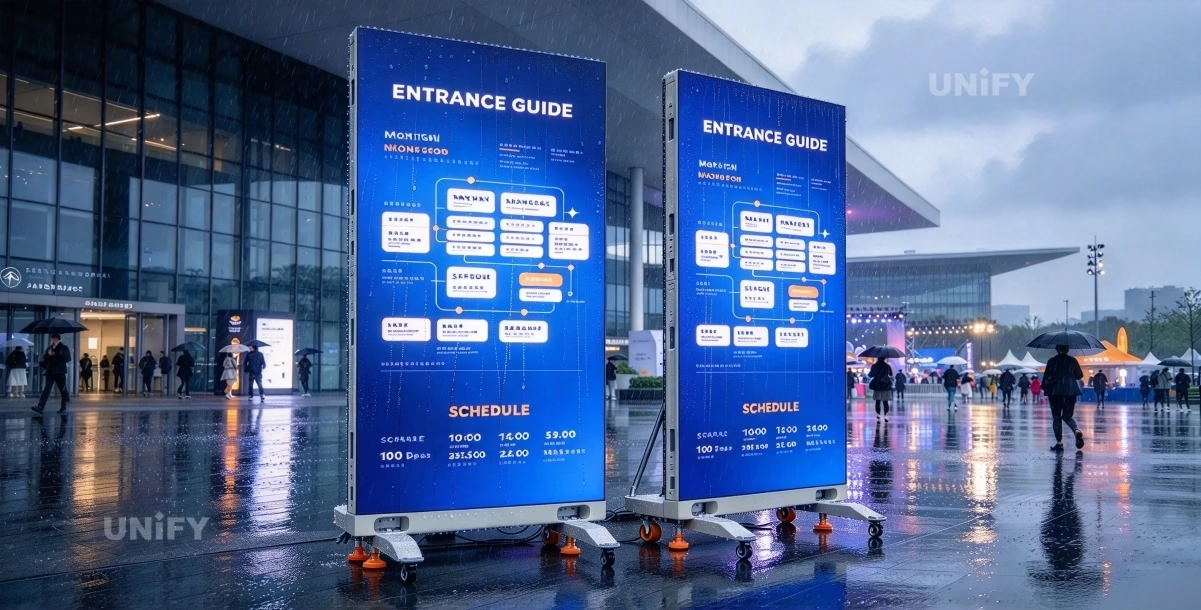
Yes — and the rating that proves it is on both faces. The F960 Series is sealed to IP66: dust-tight, and protected against powerful water jets from any direction. Most folding posters on the market stop at IP65 on the front panel and less behind; the gap shows up in exactly the situations a mobile screen meets — horizontal rain with wind behind it, monsoon-season curb placement, and the wash-down a food-adjacent site gets every night. IP66 front and rear means the hinge line, the base joint and the cable glands are part of the same sealing plan, not afterthoughts. The rating system decoded: IP rating explained.
Temperature is the other half of outdoor-ready. The unit is specified for –30°C to +60°C operation and –40°C to +80°C storage, and the die-cast aluminum module shells do double duty: they conduct heat out of the LED plane in summer and hold their mechanical properties in winter cold. The aluminum choice is also why the screen survives transport — a folding unit’s hinge and panel edges take knocks that a fixed billboard never sees.
Energy comes from common cathode electronics: each RGB channel is driven at its own voltage instead of one shared rail, cutting screen-body temperature by about 14.6°C against conventional common-anode circuits and consumption by more than 20%. Per unit the operating numbers are ≤285W average (≤850W max) in the standard configuration and ≤200W average (≤600W max) in the 2745 configuration. Run eight hours a day at average load and a standard unit draws about 2.3kWh — a few cents of electricity, which is what makes unsupervised placement seven days a week an economic non-issue. Full methodology: outdoor LED display power consumption.
On the meter: the F960 running a full-color loop while the meter keeps count
Service & Maintenance
How Do You Maintain a 960*1920mm Folding LED Poster Screen?
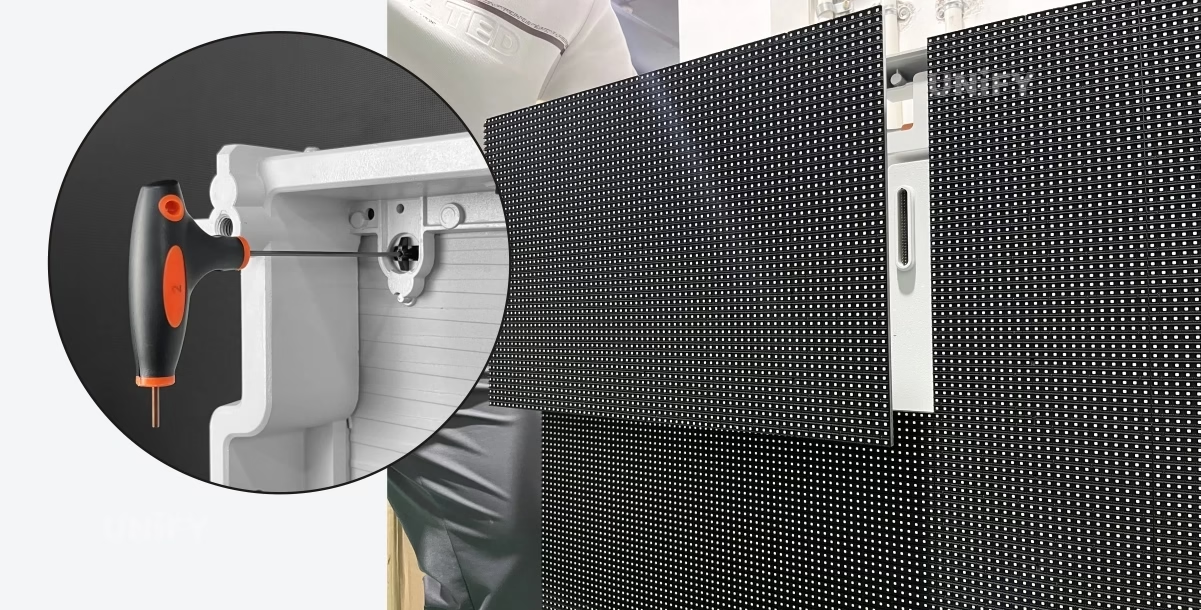
Modules carry quick-release locks and service from both front and rear: a failed module comes out in about ten seconds with no tools beyond the supplied handling tool, and the replacement seats into the exact same position. On a mobile unit this matters more than on a fixed wall — the technician is often the same person who drives the screen to the site, and the repair happens in the van or behind the unit, not on a scaffold next week.
The routine that keeps a fleet healthy is short. After any wet-weather transport or long storage, dry the unit out with the staged power-up: run the screen at 20% brightness for two hours, then 40%, 60%, 80% and 100%, two hours each — the stepped warm-up drives residual moisture out of the module before full brightness stresses it. Between events, check the hinge latches and jack feet, keep the module gaskets clean, and store the unit in its flight case where the spec allows –40°C to +80°C. Modules are rated 100,000 hours to half-brightness; a fleet that follows the routine retires them on schedule, not on failure. See LED screen maintenance for the full discipline.
Applications
Where Does a 960*1920mm Folding LED Poster Screen Work Best?
Anywhere a message must stand outside, move often and run without supervision — the applications below are the recurring four:

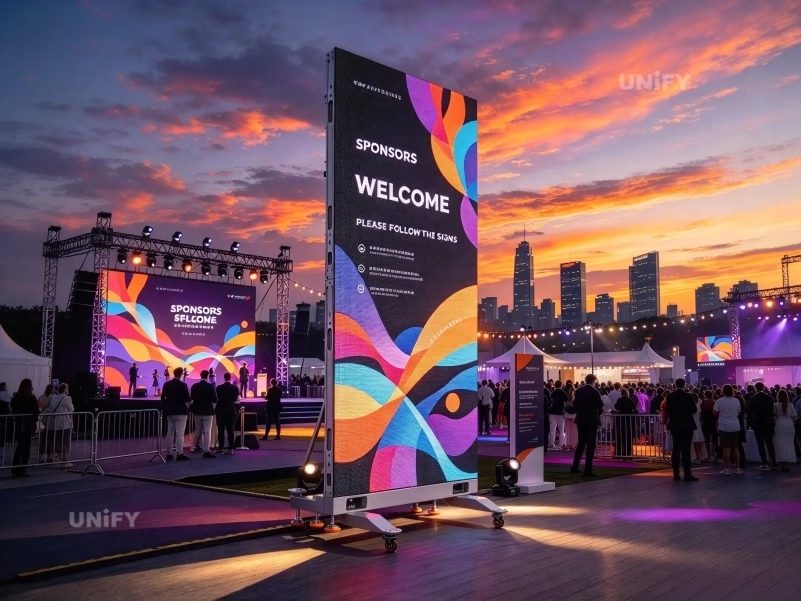
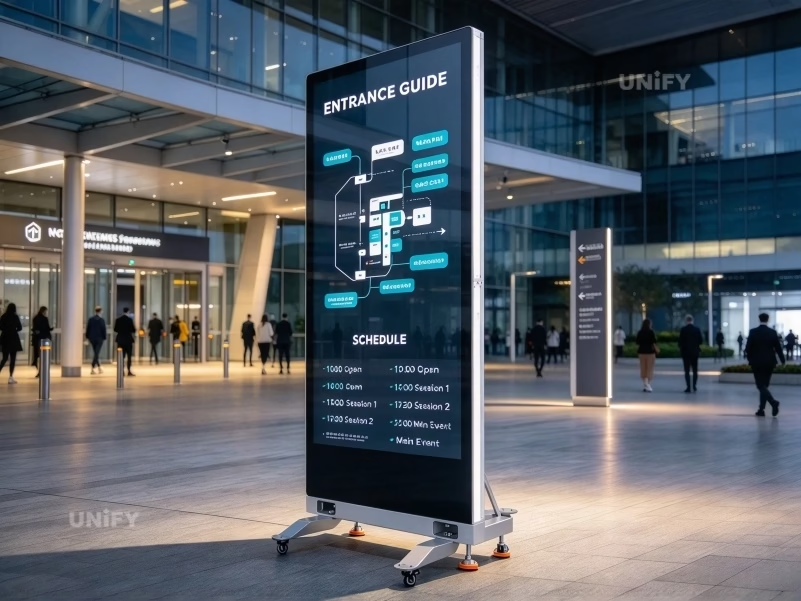
960*1920mm Folding LED Poster Screen Case Studies: United States, Germany, United Kingdom, Netherlands
Four deployments that show the format earning its keep on two continents — each with the F960-specific reason it worked:
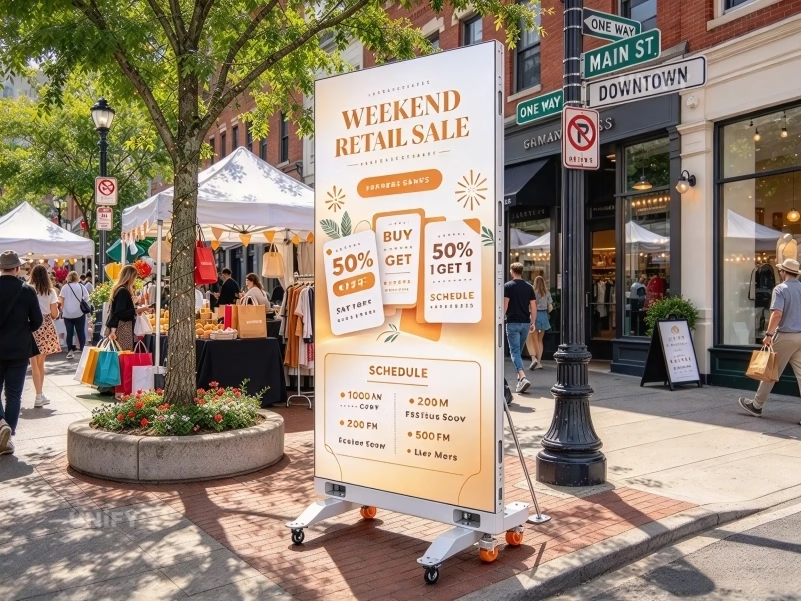
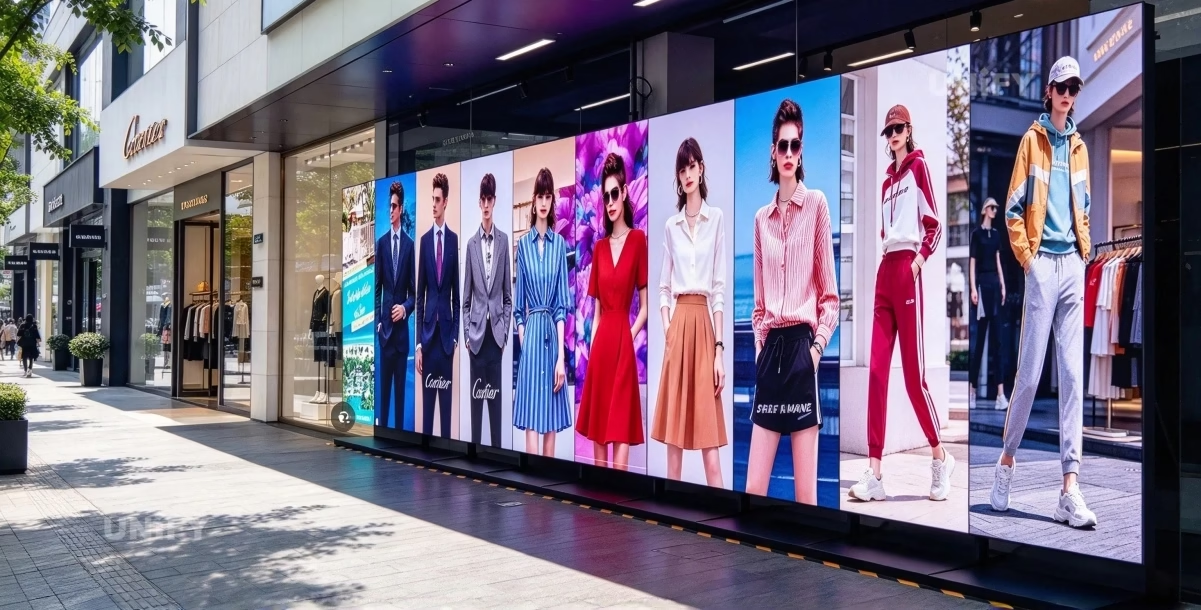
A retailer runs Friday-to-Sunday promotions on the sidewalk outside stores that have no facade permits. The screen deploys Saturday morning on casters, levels on its jack feet, plays the weekend playlist from a phone, and folds back into the case Sunday night. ≥6500 nits keeps the offer readable against a west-facing afternoon sun.
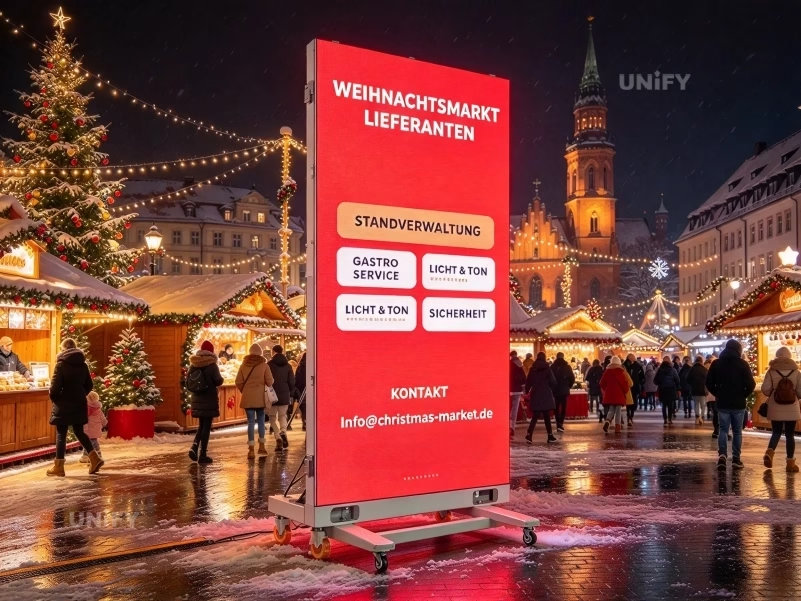
Seasonal markets and Messe forecourts need screens for a few weeks, not a few years. One F960 unit covers a market stall row by day and an exhibitor directory by evening; IP66 front and rear carries the December rain, and the flight case stores it between weekends without a storage room dedicated to a screen.
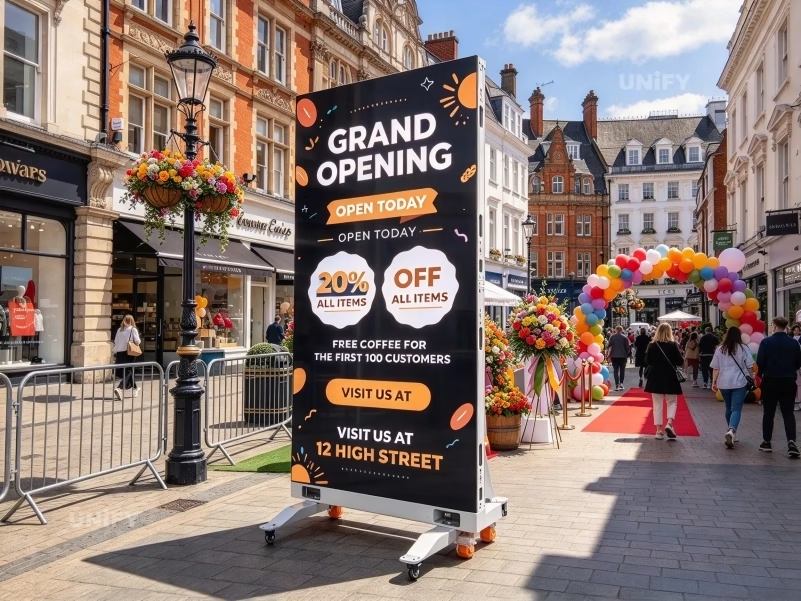
A store launch needs a big screen for one week on pavement the brand does not own. The 2.1m unit stands where the footfall is, plays launch content and social feeds over WiFi, and leaves no fixing holes behind when the council visit ends the booking — the whole installation is reversible by design.
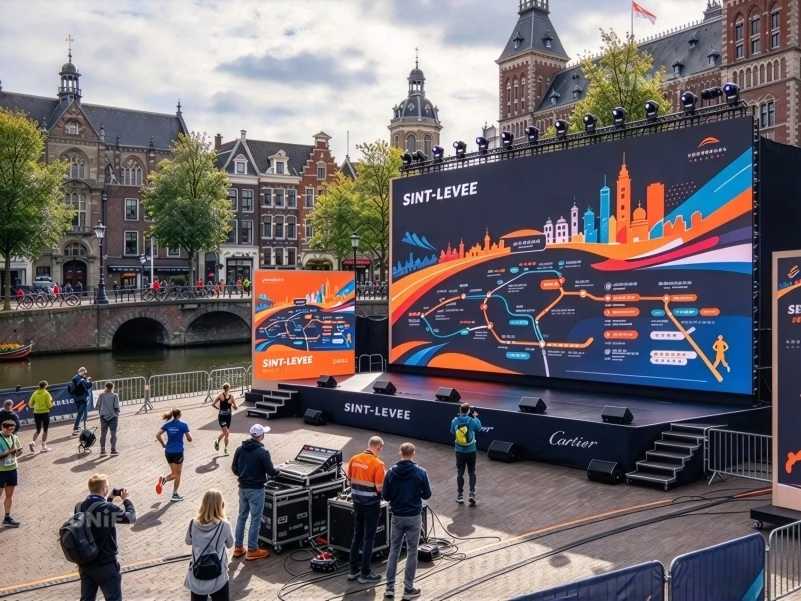
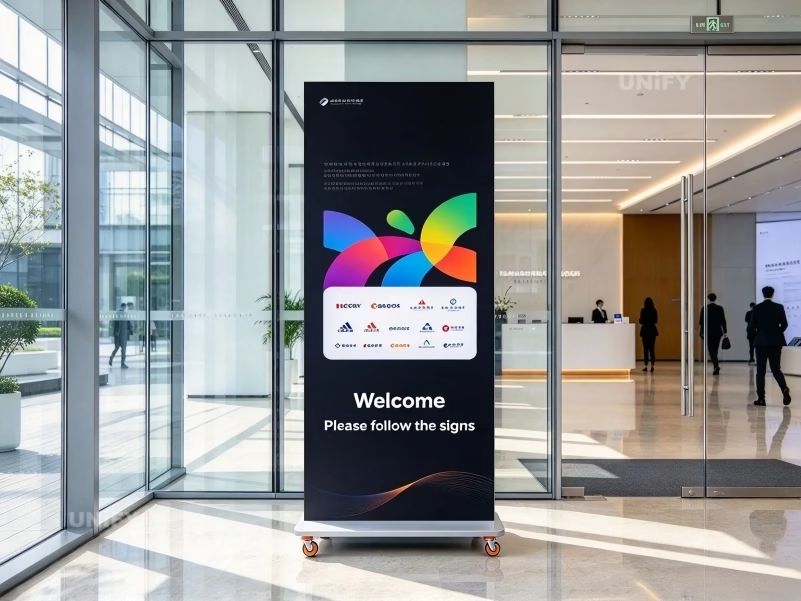
An event organizer cascades three units into a wide backdrop for a canal-side festival stage, synchronized signal and power, then splits them back into single wayfinding screens for the next weekend’s market. One fleet, three formats — the cascade is a cable, not a rebuild.
Factory & Quality Control
Why Source Your Folding LED Poster Screen From the F960 Series Factory
Every F960 unit passes the same acceptance checks the datasheet implies. Brightness is measured with a calibrated light gun perpendicular to the panel at full white; viewing angle is confirmed by an observer at 140° left-right and 65° below center checking for dark patches; uniformity targets (≥97% brightness, ±0.003 Cx,Cy chromaticity) are verified per unit, not per batch sample. Before packing, each screen runs the staged aging sequence — the same 20%→100% stepped brightening used for moisture control doubles as the burn-in that surfaces early LED failures in-house instead of on your first event.
The shipping package is part of QC: one wheeled flight case per unit with the screen, manual, warranty card, power and signal cables, the maintenance tool and the installation drawings. Spare modules ship from the same production batch as the screen, so a year-three replacement matches the color population of a year-one unit — ask for batch-matched spares when you order. As the LED screen manufacturer, we ship the fleet documentation — topology diagrams, power distribution plan, commissioning notes — with every order.
Pricing & Sourcing
What Does a 960*1920mm Folding LED Poster Screen Cost?
The folding-poster market quotes roughly $400–$900 per unit for light-duty P2–P3 screens built for malls and lobbies — 3500–5500 nits, IP65 front, 35–48kg. The F960 Series sits above that band deliberately: it is the version specified for real outdoor duty, with IP66 sealing on both faces, 6500–10000 nits, a 74kg profile-frame base and the flight case in the box. The premium buys the deployments the light screens refuse: rain, sun, pavement, and the third year of a rental fleet.
Final pricing depends on pitch, LED configuration (standard SMD or 2745 triple-lens), order quantity and destination. Single-unit buyers typically start at F960-6.67 or F960-8; fleets mix pitches to the viewing distances of their usual sites. Every quote ships with the two numbers that matter most in writing — average power per unit and the warranty repair path — because a folding screen’s cost of ownership is decided by those, not by the invoice. For banner-format alternatives, see 1890×560mm LED poster display and the tri-fold LED poster display.
FAQ
960*1920mm Folding LED Poster Screen FAQ
The questions buyers ask before ordering a folding poster screen — answered with the F960 Series specifications:
Related Products & Guides
Related Folding LED Poster Screen Products & Guides
More poster and folding formats from our catalog, and the articles that support a 960*1920mm folding LED poster screen project:
Ready to Source Your 960*1920mm Folding LED Poster Screen?
F960 Series factory-direct pricing, batch-matched spares, flight-case packing and commissioning support for your 960*1920mm folding LED poster screen fleet.
unifyledscreen@gmail.com | +86-191-18802497
Technical Deep-Dive
960*1920mm Folding LED Poster Screen: The Complete F960 Series Buyer’s Guide
Published: October 2026 | 11 min read | UnifyLED Engineering Team
A 960×1920mm folding LED poster screen is bought for the places a fixed screen cannot go — the sidewalk that is only busy on weekends, the market that runs six weeks a year, the event that needs a screen on Friday and returns it on Sunday. Buying one is a logistics decision as much as a display decision: the folding mechanism, the folded dimensions and the base decide whether one person can run the screen, and the brightness and IP rating decide whether it survives the places it travels to. This guide walks both halves of that decision with the F960 Series as the worked example — folding and transport, brightness and LED configuration, weatherproofing, pitch selection, power economics, and the deployment routine that keeps a fleet alive.
Chapter 1 — Why 960×1920mm Became the Folding Poster Format
The 960mm width is not an accident; it is the outdoor LED industry’s unit cell. Cabinet architectures, module grids and content templates are all built around 960mm increments, and a 960×1920mm poster — two modules wide, six tall in the F960 layout — inherits that ecosystem. Content authored for vertical advertising fits its 1:2 aspect ratio without letterboxing; portrait video, price grids and wayfinding layouts map onto it directly. A buyer who specifies 960×1920mm is specifying compatibility with the widest possible pool of content and spare parts, which is why the format dominates the folding-poster category across every major manufacturer.
Terminology matters when comparing quotes, because the category carries several names — folding LED poster screen, foldable LED poster display, portable folding LED screen — and not all of them describe the same build. The load-bearing question is what folds and what ships. Light-duty units fold the panel and quote you the panel’s folded size; the stand, casters and base are accessories you assemble on site. The F960 Series folds the complete assembly — panel, base, casters and jack feet in one latched unit — and quotes 960×1140×227mm for that whole object. When a folded dimension in a competitor’s listing looks suspiciously square, ask what it excludes.
Chapter 2 — Transport Economics: What the Fold Actually Saves
Run the numbers on the F960 fold. Open, the unit stands 960×2100×767mm and occupies about 1.55m³; folded, it is 960×1140×227mm at about 0.25m³ — one-sixth of the volume, with depth cut from 767mm to 227mm. The 74kg folded unit rides its own casters, which means the “transport plan” for most buyers is one adult and a smooth floor. That is the difference between a screen an events team deploys on impulse and one that needs a van, a tail-lift and two pairs of hands booked a week ahead.
The flight case converts those savings into fleet logistics. One wheeled case per unit stacks in a warehouse corner, protects the panel edges that take the knocks, and rolls out for the next booking. A standard cargo van carries several cased units, so a four-screen roadshow is one vehicle and one driver. For international buyers the same math lands on the freight invoice: folded units palletize into a volume a fraction of their standing footprint, and the case survives the last-mile handling that loose cabinets do not. Budget the cases with the screens; they are the difference between a fleet and a set of fragile projects.
Storage is the quiet half of transport economics. A folded F960 unit stands 1.14m tall and 227mm deep — it parks against a wall, under a mezzanine, or in the same van bay as the event furniture. Fleets that retire screens each winter gain a real number back here: ten units folded occupy roughly 2.5m³ instead of the 15.5m³ their open footprints would claim, which is the difference between a storage room and a storage building.
Chapter 3 — Brightness and the 2745 Triple-Lens Configuration
Outdoor legibility has a threshold, and it sits near 5,000 nits: below it, a sunlit screen turns into a mirror with hints of content. The F960 standard configuration clears the bar with ≥5500 nits on F960-4.44 and ≥6500 nits on the larger pitches — enough for streets, plazas and event grounds in full sun. The 2745 configuration, available on F960-5.7 and above, reaches 10,000 nits, and the extra headroom is not for bragging: it lets the screen hold contrast at noon and then run at partial brightness for the rest of the day, which reduces LED stress and power draw simultaneously. A screen specified at 10,000 nits that averages 60% output lives longer than a 6,500-nit screen pinned at 100% to survive the same noon.
The 2745 package earns its number in the lamp, not the power supply. Each LED carries three independent optical channels — one per color — isolated from each other inside the package. Color-channel isolation stops the cross-talk that makes a conventional SMD shift color off-axis, so a viewer at 60° sees the same grade as the viewer at 0°; and the lens structure pushes more generated light forward out of the package, which is how brightness rises to 10,000 nits while maximum power falls to ≤600W per unit. The configuration also drops average power to ≤200W. Brighter and cheaper to run is not a contradiction — it is what the optics were worth.
One boundary to hold onto when comparing quotes: the 2745 build is an F960-5.7–F960-10 option. F960-4.44 — the finest pitch, intended for the closest viewing — exists only in the standard SMD configuration, and its ≥5500-nit figure is already above the sunlight threshold. Buyers comparing a P4.44 folding poster against the F960-4.44 should compare the whole datasheet, not the headline nit count.
Chapter 4 — Weatherproofing: IP66 on Both Faces, and Why Rear Sealing Decides Field Life
IP ratings are read backwards by most buyers. The second digit — the 6 in IP66 — is the water rating, and it is the one that decides outdoor survival: IP65 resists low-pressure jets, IP66 resists powerful jets from any direction. The situations that separate them are precisely a mobile screen’s life: horizontal rain with wind behind it, a unit parked on an open plaza through a storm, and the hose-down a food-adjacent site receives nightly. A front-only IP65 screen with an exposed rear is a summer device.
Sealing both faces is harder than it sounds on a folding unit, because the fold line, the hinge column and the base joint are all potential ingress paths. The F960 design treats them as part of the sealing plan — the hinge carries its cable loop with drip loops positioned so water runs off the connectors, not into them, and the base glands seal the same way. This is also why the unit tolerates the storage spec it carries: –40°C to +80°C in the case, –30°C to +60°C in operation. The aluminum module shells conduct heat away in summer and hold their mechanical tolerances in winter cold; plastic housings do neither, and a folding mechanism amplifies every millimeter of thermal warp.
The routine that protects the rating costs fifteen minutes: after wet transport or long storage, dry the unit with the staged power-up — 20% brightness for two hours, then 40%, 60%, 80% and 100%. The sequence walks residual moisture out of the module before full brightness and full current stress it. Fleets that follow it report module lifetimes that match the 100,000-hour rating; fleets that skip it meet their first moisture failures in year one.
Chapter 5 — Pitch Selection: P4.44 to P10 on a 960×1920mm Canvas
Pixel pitch sets the distance at which the image fuses, and the working rule is blunt: pitch in millimeters equals minimum comfortable viewing distance in meters. On a 960×1920mm canvas that rule maps the five F960 models onto five deployment bands. F960-4.44 (216×432 pixels, 50,625px/m²) serves sidewalk-adjacent viewing at 4–5m — storefront promos, queue-side information. F960-5.7 (168×336) and F960-6.67 (144×288) own the 6–12m band where most street and plaza advertising happens. F960-8 (120×240) and F960-10 (96×192) serve squares, campuses and roadside placement from 12m out, where pixel density is wasted money and brightness is not.
Fleets should mix pitches to their site mix, not default to one. A rental operator running sidewalk promos and city-square events gets more working life from a 2+2 fleet (two F960-5.7, two F960-8) than from four identical units pitched for the average of nothing. Content type refines the choice: text-heavy price grids and schedules read better one pitch step finer than video-led content at the same distance, because letterforms expose pixelation before motion does. And since every F960 model shares the folding base, control system and module format, mixing pitches inside one fleet costs nothing in spares or training — the only thing that changes between an F960-5.7 and an F960-8 is the LED population.
Resolution math, for the planners: one F960 unit carries 93,312 pixels at P4.44 and 18,432 at P10. Two cascaded F960-4.44 units form a 432×432 canvas — sufficient for 4m-wide portrait content at 5m viewing; the same two units at P8 carry 60,000 pixels for a 12m square. Decide the closest realistic viewer distance first, then buy the pitch; the reverse order is how over-specced fleets happen.
Chapter 6 — Power: Common Cathode and the Per-Unit Bill
A folding poster’s power story is told per unit, not per square meter, and the numbers are small by design. The F960 standard configuration averages ≤285W per unit (≤850W maximum); the 2745 configuration averages ≤200W (≤600W maximum). At an eight-hour day, that is 1.6–2.3kWh per unit — single-digit cents at commercial tariffs. The economics of unsupervised placement follow directly: a screen that costs a coffee’s worth of electricity per day can run seven days a week at sites where someone would otherwise be switching off a projector.
Common cathode is the reason the numbers sit this low. Conventional common-anode LED circuits feed all three color channels from one shared voltage rail and burn the difference as heat; common cathode drives each channel at its own voltage, which cuts screen-body temperature by about 14.6°C and consumption by more than 20%. On a fixed billboard the saving shows on the power bill; on a folding poster it also shows in the hinge zone, where cooler modules mean cooler electronics inside the fold line — the hottest, hardest-to-ventilate part of the unit. Cascade planning inherits the discipline: eight cased units on one site draw less than a single conventional 2m² screen, so a standard 16A feed runs a multi-unit cascade without a distribution upgrade. The 4×400W power-supply allocation per unit is in the datasheet for exactly this planning step.
Chapter 7 — Deployment and Content: From Case to Campaign
The deployment routine is four steps and ten minutes: roll the cased unit to position; tip it onto its casters and push to the spot; raise and latch the upper panel; screw down the four jack feet until they carry the load. Power is one AC cable; content goes over from a phone on WiFi or a USB stick. The leveling step deserves its emphasis — pavement is not flat, and a 2.1m screen that rocks on casters is a hazard and a candidate for theft-by-toppling. Feet down, screen becomes furniture; feet up, it rolls again. Teams that drill the sequence deploy in single-digit minutes and stop thinking of the screen as equipment.
Content planning for a 960×1920mm canvas has three working rules. Design portrait-first: the 1:2 ratio rewards tall layouts and punishes letterboxed horizontal video. Keep text above roughly 60mm character height for 10m viewing (scale down proportionally for closer sites), and build playlists for the site’s dwell pattern — a sidewalk screen needs 15–30 second loops, a wayfinding unit needs a schedule page held for minutes. The asynchronous player handles the rest: load once, schedule, and the unit runs unattended through power cycles.
Acceptance closes the loop. The factory checks each unit with a calibrated light gun at full white and a 140°/65° angle walk before it ships; a buyer can repeat both checks in ten minutes on delivery, and should — any LED screen manufacturer that resists those two on-delivery checks is telling you something, and a screen that passes on the pavement it will actually occupy is a screen with no arguments left. From there the fleet’s economics are arithmetic: minutes to deploy, cents to power, and a format that folds to a sixth of its size when the event ends. That is the case for the 960*1920mm folding LED poster screen, and the F960 Series is the version of it built for the outdoors.