
Mean Well NEL Series · 5V 80A · 400W · 30 mm Low Profile · UL 62368-1
Mean Well NEL-400 Switching Power Supply
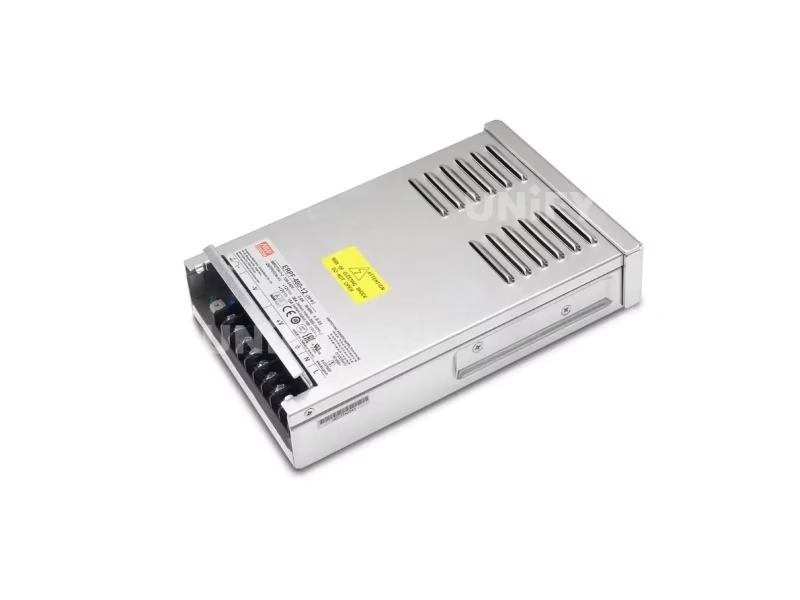
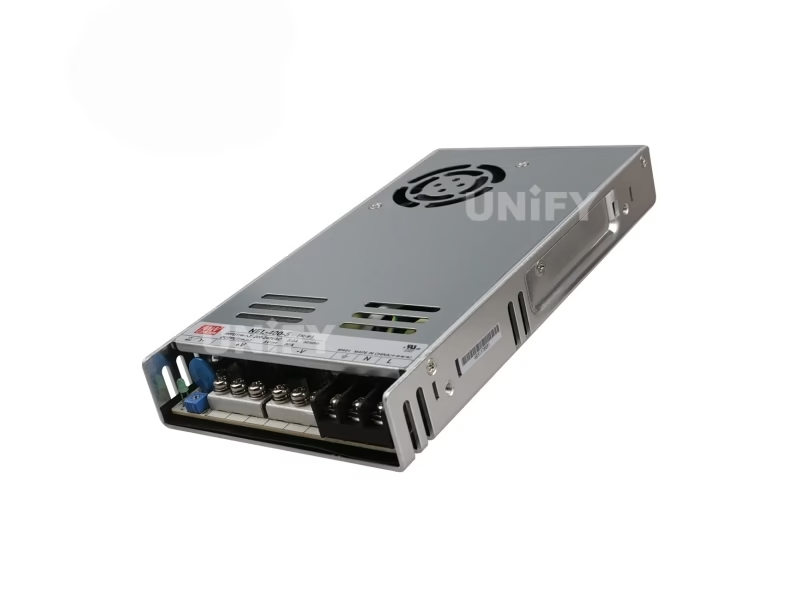
The Mean Well NEL-400 switching power supply delivers 5 V DC at 80 A — a full 400 W — from a 180–264 VAC input in a fan-cooled 215 × 115 × 30 mm chassis, with conformal coating fitted as standard and a 1.7-million-hour Telcordia MTBF rating behind it.
📱 / WhatsApp: +86-191-18802497 · Shenzhen, China · GMT+8
400 W
Rated output (5 V rail)
5 V / 80 A
DC output rail
180–264 VAC
Input range
30 mm
Low-profile height
1.7 M hrs
MTBF, Telcordia SR-332
Short answer
The NEL-400 is Mean Well’s 400 W single-output switching power supply for LED screens, offered in three rails: 2.8 V / 80 A (224 W), 4.2 V / 80 A (336 W) and 5 V / 80 A (400 W). Input is 180–264 VAC, cooling is a built-in DC fan, the case is a 215 × 115 × 30 mm low-profile aluminum chassis weighing 0.85 kg, and the platform carries UL 62368-1 and EAC approval with conformal coating fitted as standard. Load it to 80% — 320 W or 64 A on the 5 V rail — and it carries a dense indoor cabinet or a bright outdoor module group.
What Is the Mean Well NEL-400 Switching Power Supply?
The NEL-400 is a 400 W-class switching-mode power supply (SMPS) built for LED display work: it converts a 180–264 VAC mains feed into a single regulated DC rail at up to 80 A, feeding LED modules, receiving cards and hub boards inside a screen. It is the low-profile member of Mean Well’s LED-focused NEL line — the series that trades the LRS family’s multi-rail flexibility for exactly the three rails LED screens actually order: 2.8 V, 4.2 V and 5 V, all at the same 80 A rating.
Mean Well, founded in 1993 and one of the few standard-power-supply makers whose catalogue runs from 0.5 W to 25,600 W, builds the NEL-400 as a cost-focused, high-reliability platform: 100% full-load burn-in testing before shipment, a 2-year warranty, and an MTBF floor of 1,708,900 hours by the Telcordia SR-332 (Bellcore) method — plus 220,900 hours minimum under MIL-HDBK-217F at 25°C. Publishing both numbers is unusual in this price class and makes the NEL-400 one of the most thoroughly documented 400 W LED supplies you can spec.
Screen-native rail set
2.8 V for common-cathode energy-saving modules, 4.2 V for power-saving walls, 5 V for standard modules and receiving cards — no 12/24/48 V rails you will never use in a cabinet.
Harsh-site protection built in
Conformal-coated PCB as standard, 300 VAC surge tolerance for 5 seconds, and hiccup-mode recovery on overload and overvoltage — the supply rides through transients instead of latching off.
Certified for both markets
UL 62368-1 (cULus mark on the nameplate) plus EAC TP TC 004 for Eurasian Customs Union projects — one SKU covers North American and CIS tender lists.
Sizing a whole screen’s electrical side? Pair this page with our LED display power consumption guide, and for the control end of the same cabinet see the LED screen display control system catalog.
What Are the Mean Well NEL-400 Switching Power Supply Specifications?
Every figure below is taken from the official Mean Well NEL-400 specification sheet (2 pages, revision dated 2024-10-16) and cross-checked against the unit nameplate. Where the two documents disagree, both are shown — and one of those disagreements deserves its own warning box.
| Parameter | NEL-400-2.8 | NEL-400-4.2 | NEL-400-5 |
|---|---|---|---|
| DC output voltage | 2.8 V | 4.2 V | 5 V |
| Rated current / range | 80 A (0–80 A) | 80 A (0–80 A) | 80 A (0–80 A) |
| Rated power | 224 W | 336 W | 400 W |
| Ripple & noise (max.) | 150 mVp-p | 150 mVp-p | 150 mVp-p |
| Voltage adj. range | 2.5–3 V | 3.6–4.4 V | 4.5–5.5 V |
| Voltage tolerance | +3%, −4.5% | +3%, −4.5% | ±3.0% |
| Line / load regulation | ±0.5% / ±2.5% | ±0.5% / ±2.5% | ±0.5% / ±2.0% |
| Efficiency (typ.) | 79% | 83% | 84% |
| AC current (typ.) | 3 A / 230 VAC | 4 A / 230 VAC | 5 A / 230 VAC |
| Over-voltage protection | 3.22–3.78 V | 4.6–5.4 V | 5.6–7 V |
| Common to all three rails | Value |
|---|---|
| Input voltage range | 180–264 VAC / 254–370 VDC, 47–63 Hz (nameplate: 200–240 V, 5.0 A) |
| Inrush / leakage current | 100 A cold start at 230 VAC / <1 mA at 240 VAC |
| Setup, rise / hold-up time | 2500 ms, 50 ms / 20 ms at 230 VAC |
| Protections | Overload 105–140%: hiccup, auto-recovery; OVP: hiccup, auto-recovery; OTP: shut down, auto-recovery; short circuit |
| Cooling | Forced air cooling by built-in DC fan |
| Working temperature | −20°C to +60°C (output derating curve applies); 20–90% RH |
| Temp. coefficient / vibration | ±0.03%/°C (0–50°C) / 10–500 Hz, 3G |
| Withstand voltage / isolation | I/P-O/P 3 kVAC, I/P-FG 2 kVAC, O/P-FG 0.5 kVAC / 100 MΩ at 500 VDC |
| MTBF | 1,708.9K hrs min. (Telcordia SR-332); 220.9K hrs min. (MIL-HDBK-217F, 25°C) |
| Dimensions / packing | 215 × 115 × 30 mm (Case 207D) / 0.85 kg, 15 pcs per carton |
| Safety / EMC | UL 62368-1, EAC TP TC 004; EMC emission and immunity to EAC TP TC 020 |
| Warranty | 2 years |
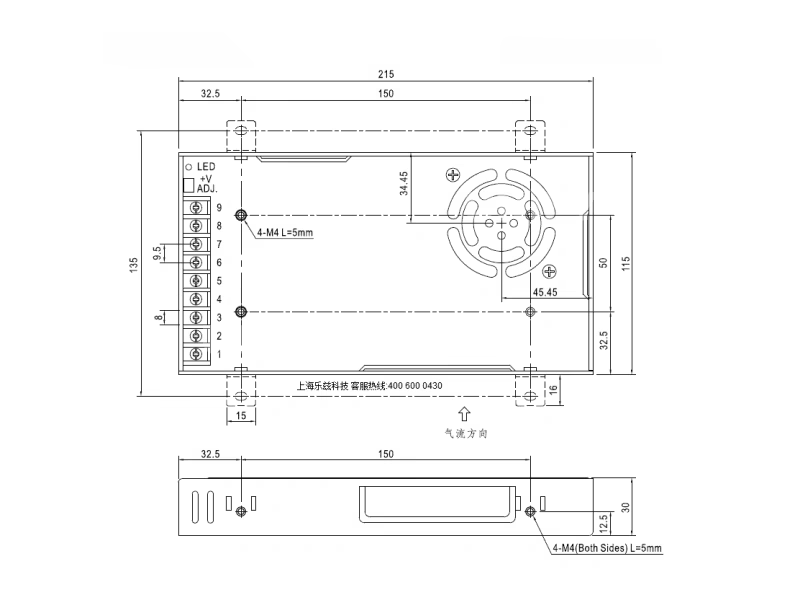
Factory mechanical drawing: 215 × 115 × 30 mm, 9-pin terminal block, 4-M4 taps both sides, airflow direction marked
Three spec claims to buy against
First, input range: the datasheet specifies 180–264 VAC, while the production nameplate reads 200–240 V, 5.0 A (the photo below shows both marks) — design around 200–240 V nominal and you sit inside either document, and neither covers 100–120 V grids. Second, cooling: some reseller listings describe natural convection and a built-in PFC circuit; the official sheet specifies a built-in DC fan and lists no PFC stage. Third, warranty: listings advertising 3 years exceed Mean Well’s official 2-year term — hold your supplier to the factory document.
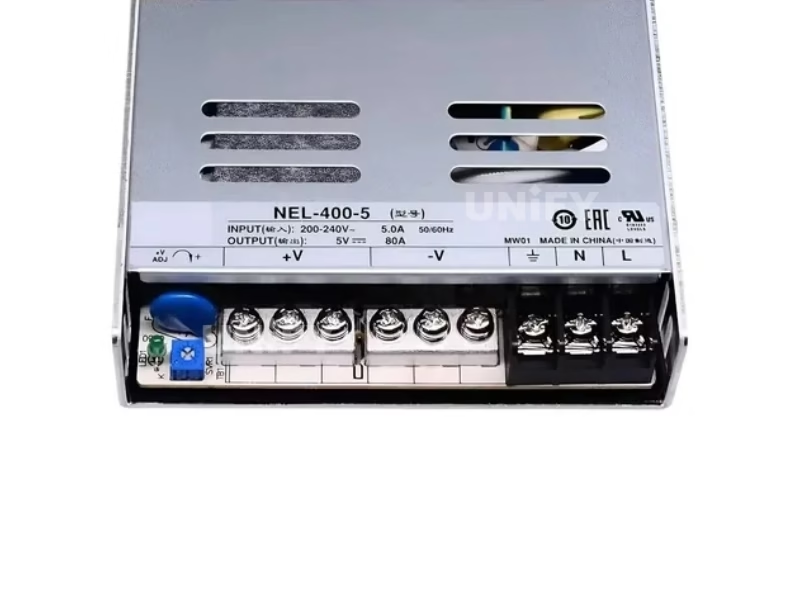
Production NEL-400-5 nameplate: INPUT 200–240 V, 5.0 A · OUTPUT +5 V, 80 A · EAC and cULus marks
The 150 mVp-p ripple figure is measured the way Mean Well measures everything — here is the factory’s own method video, which is also the habit our bench uses when we verify a batch before shipment:
How Many LED Modules Can the Mean Well NEL-400 Power Supply Carry?
Apply the industry-standard 80% loading rule and the NEL-400-5 gives you two budgets:
Power budget
400 W × 80% = 320 W usable per unit
Current budget
80 A × 80% = 64 A usable per unit
Mapped onto typical modules (average draws under normal program material — full-white patterns run higher, so verify against your module datasheet):
| Typical load | Average draw | Max per NEL-400-5 at 320 W |
|---|---|---|
| Indoor P2.5 module (320 × 160 mm) | ~10–15 W | ~21–32 modules |
| Rental P3.91 module (250 × 250 mm) | ~15–20 W | ~16–21 modules |
| Outdoor P4.81 module (250 × 250 mm) | ~20–30 W | ~10–16 modules |
| Receiving card (Novastar / Colorlight class) | ~3–5 W | Shares the same 5 V rail |
One NEL-400-5 therefore carries a 500 × 1000 mm indoor cabinet outright, or an outdoor module group that would push a 300 W-class supply past its budget. For screens that need more still, the next step up in the Mean Well range is the Mean Well LRS-600 switching power supply at 5 V / 100 A / 500 W — and the full derating math lives in our power consumption walkthrough.
Why Does the Mean Well NEL-400 Switching Power Supply Use a Built-in DC Fan?
At 400 W in a 30 mm-tall shell, Mean Well spends its thermal budget on forced air: the factory drawing marks the airflow path across the fin field, and the datasheet’s cooling line reads “forced air cooling by built-in DC fan.” The fan is what lets this platform hold a full 80 A rail at just 30 mm — the same height class that CZCL needed a heatsink plate to reach fanless.
The rest of the standard-equipment list matters as much as the fan, because Mean Well fits protection items that competitors sell as options:
Conformal coating, standard
The three-proofing moisture barrier that CZCL and others list as a build option is standard on the NEL-400 — meaningful for coastal, dusty or high-humidity installs.
300 VAC surge, 5 seconds
The input tolerates a 300 VAC surge for five seconds — headroom for unstable grids that run past the 264 V ceiling during swells.
Self-recovering protection
Overload (105–140%) and overvoltage trip into hiccup mode and recover on their own; over-temperature shuts down and restarts once the case cools — same behavior family as the CZCL A-300AB-5.
The working window is −20°C to +60°C with an output derating curve at the top of the range, so a fully loaded unit needs cabinet airflow and should not sit in a sun-struck sealed bay at 100% white. Keep the fan grille clear during scheduled screen service — the same maintenance habit the fan-cooled CZCL units ask for.
Which Rail of the Mean Well NEL-400 Power Supply Fits Your Screen: 2.8 V, 4.2 V or 5 V?
All three NEL-400 rails ship at the same 80 A rating — power scales with voltage (224 W / 336 W / 400 W). The set maps onto how your modules manage power:
| Model | Rail | Rated power | Typical use |
|---|---|---|---|
| NEL-400-2.8 | 2.8 V | 224 W | Common-cathode energy-saving modules — the lowest rail on any supply page in this series |
| NEL-400-4.2 | 4.2 V | 336 W | Power-saving fixed installations |
| NEL-400-5 | 5.0 V | 400 W | Standard modules + receiving cards |
The 2.8 V rail is the headline: the LRS family starts at 3.3 V and the CZCL A-200AC at 3.8 V, so screens spec’d around a 2.8 V common-cathode bus previously mixed brands — the NEL-400-2.8 covers it inside Mean Well’s own catalogue. Read our common cathode LED technology explainer before locking the rail, and never feed a 2.8 V bus from a 5 V supply.
Mean Well NEL-400-5 vs CZCL A-400JQ-5P: Which 400 W, 80 A Switching Power Supply Wins?
These two are the same electrical product from opposite engineering philosophies — both deliver 5 V at 80 A / 400 W, and screens regularly mix them across cabinet rows:
- Cooling: the NEL-400-5 uses a built-in DC fan at 30 mm; the A-400JQ-5P is fanless at 26 mm and dumps heat through a forced-convection heatsink plate — silence and no-dust-intake versus one fewer moving part to service.
- Efficiency and PFC: the A-400JQ-5P publishes 90% efficiency with the family’s only active PFC stage; the NEL-400-5 publishes 84% and lists no PFC — over a long season, the CZCL unit draws measurably less mains for the same screen.
- Corrosion protection: conformal coating is standard on the NEL-400; the CZCL platform treats it as a build option.
- Certification scope: the NEL-400 carries UL 62368-1 plus EAC TP TC 004/020 for Eurasian tenders; the CZCL platform leans on its UL/CB/CE/CCC/KC/BIS set.
- Documentation: Mean Well publishes dual-method MTBF (1.7M Telcordia / 220.9K MIL-HDBK-217F) — the deepest reliability paper trail in this comparison.
| Parameter | Mean Well NEL-400-5 | CZCL A-400JQ-5P |
|---|---|---|
| Output | 5 V / 80 A / 400 W | 5 V / 80 A / 400 W |
| Cooling / height | Built-in DC fan / 30 mm | Fanless + heatsink plate / 26 mm |
| Efficiency (typ.) | 84% | 90% |
| PFC | Not specified | Active PFC (family-only) |
| Conformal coating | Standard | Build option |
| Rail options | 2.8 / 4.2 / 5 V | 5 V (JQ platform) |
Full detail on the CZCL unit lives on the CZCL A-400JQ-5P LED switching power page; trial one of each in the same cabinet row and the thermal and acoustic differences make the choice for you.
How Does the Mean Well NEL-400 Power Supply Fit the LRS Family?
Within Mean Well’s own catalogue, the NEL and LRS lines split the LED-screen work cleanly:
NEL line — screen-native
Three rails (2.8 / 4.2 / 5 V), 30 mm low profile, conformal coating standard, UL 62368-1 + EAC. Built for LED display bill-of-materials.
LRS line — general purpose
Wide rail ladders from 3.3/5 V up to 48 V, from 150 W (LRS-150) through 450 W (LRS-450, 5 V / 75 A) to the 500 W LRS-600 (5 V / 100 A, seven rails including 27 V).
Choosing between them
Standard 5 V screens: NEL-400-5 at 80 A or step up to the LRS-600 at 100 A. Mixed 12/24/48 V signage: LRS. Common-cathode 2.8 V buses: NEL-400-2.8 is the only Mean Well answer.
On our own bench, this is the platform that power supply serviceability is designed around — our stage-screen build runs a detachable PSU box so a failed unit swaps in minutes:
How Do You Install and Wire the Mean Well NEL-400 Power Supply Safely?
The 9-pin terminal block and dual-side M4 mounts define the wiring workflow:
| Pin | Assignment |
|---|---|
| 1 / 2 | AC/L · AC/N |
| 3 | FG (frame ground) |
| 4–6 | DC output −V |
| 7–9 | DC output +V |
1 · Mount on both side flanges
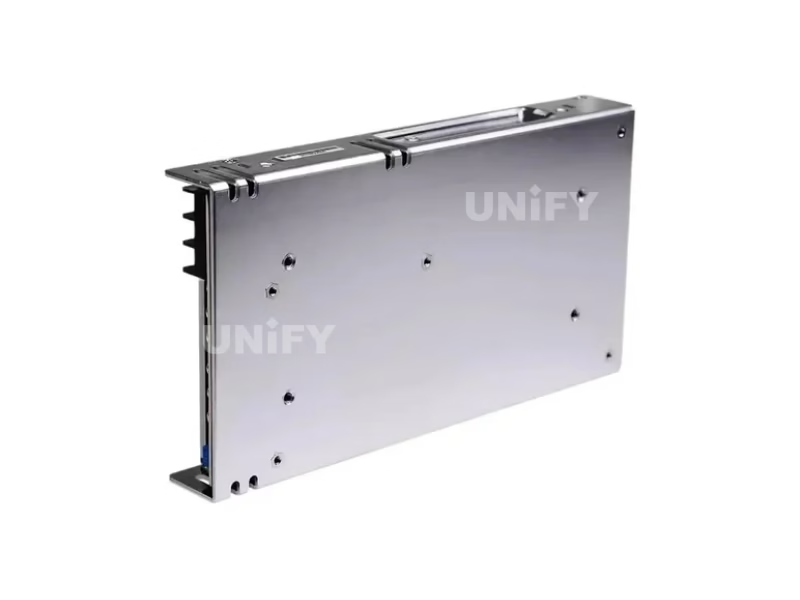
Four M4 screws per side (L = 5 mm per the factory drawing), into the cabinet power-bay rails. Orient the case so the marked airflow path faces the open bay.
2 · Verify grid and ground
Design around 200–240 V nominal per the nameplate. Bond FG to the cabinet earth — a floating cabinet is the classic cause of dead pixels and damaged driver ICs.
3 · Wire AC and DC, meter before power
AC into pins 1–2, module and receiving-card bus across pins 7–9 (+V) and 4–6 (−V). Check polarity with a meter — reversed DC is the fastest way to destroy a receiving card.
4 · Set the rail with V-ADJ
Trim to 5.0 V (adjustable 4.5–5.5 V) at the far end of the DC bus under load, then confirm each cabinet measures the same within a few tenths. Stay inside the factory window — the tolerance spec applies at the trimmed point.
5 · Load-test and listen
Run a full-white pattern for ten minutes, feel for hot spots, confirm the fan spins clean and the front LED indicator stays lit, and re-torque the terminals before closing the cabinet.
Do not parallel the outputs
The NEL-400 datasheet does not list a current-sharing feature, so two paralleled units will not divide load evenly. If a bay needs more than 400 W, move up to the LRS-600 at 100 A or split the bus across supplies by cabinet.
When a unit does fail in the field, our LED display power supply diagnostics and replacement guide walks the test-and-swap workflow end to end.
What Problems Does a Failing Mean Well NEL-400 Power Supply Cause?
Power trouble wears disguises — check these three signatures before blaming a module or a control card:
Dim or uneven brightness, one cabinet
Aging output capacitors sag the rail under load; the cabinet’s corner looks tired while its neighbors shine. Full-white patterns make it obvious.
Flicker on camera or under load spikes
An overloaded or failing rail dips for a frame at a time. Flicker that tracks bright content points at the supply first.
Cabinet reboots or dead sections
Protection cycling reads as “random” dead cabinets — on the NEL-400 the hiccup behavior means the cause is usually upstream of the shutdown. Measure the rail during the dropout.
How Much Does the Mean Well NEL-400-5 Switching Power Supply Cost?
Single units list at $90.00 on the US market with quantity steps to $81.90 at 15+ pieces (superlightingled.com, observed September 2026, UL-listed option). Volume pricing for whole-screen quantities steps down well below street level — this is a part that screen factories buy by the carton of 15.
Sample · 1–10 pcs
For repairs, prototypes and trial cabinets — shipped from stock with the cULus + EAC nameplate you see above.
Project · 10–500 pcs
Whole-screen and fleet quantities with per-cabinet load math and rail matching to your module datasheets.
Volume · 500+ pcs
Production-line pricing with container freight planning and batch date-code consistency.
Send the module types, modules-per-cabinet and total cabinet count, and the quote comes back with the load math attached — from an LED screen manufacturer that stocks the full chain from power to control.
Mean Well NEL-400 Switching Power Supply: Frequently Asked Questions
Can I run the NEL-400-5 on a 110 V outlet in the US?
No. The datasheet input window is 180–264 VAC and the production nameplate reads 200–240 V, 5.0 A — both exclude 100–120 V grids. For US, Canadian or Japanese sites you need a wide-input model or a step-up transformer.
How many LED modules can one NEL-400-5 drive?
At the 80% loading rule: 320 W or 64 A usable. A typical indoor P2.5 module draws about 10–15 W of average program material, so one unit covers roughly 21–32 such modules plus the receiving card — verify against your module’s datasheet and brightness profile.
Does the NEL-400 have a fan?
Yes — the official datasheet specifies forced air cooling by a built-in DC fan, and the factory drawing marks the airflow path. That fan is what holds the 80 A rail in a 30 mm shell. Some reseller pages claim natural convection; the factory document wins.
What is the difference between the NEL-400-5 and the LRS-600-5?
Capacity and rail set: the NEL-400-5 is 400 W / 80 A in three LED-native rails with conformal coating standard; the LRS-600-5 is 500 W / 100 A across seven rails including 27 V in a 41 mm chassis. Standard 5 V cabinets: NEL-400-5 or LRS-450; the biggest single-supply bays: LRS-600.
What is the 2.8 V rail for?
Common-cathode energy-saving screens run the LED string from a reduced bus so the driver IC burns less headroom as heat. At 2.8 V / 80 A / 224 W, the NEL-400-2.8 is the lowest rail in the Mean Well catalogue — below the LRS family’s 3.3 V floor and CZCL’s 3.8 V.
What does the standard conformal coating change?
The PCB arrives with a moisture and contaminant barrier fitted at the factory — the three-proofing treatment other brands charge extra for. For coastal, dusty or high-humidity installs it removes one build option from your order and one failure driver from your fleet.
What warranty and service life does Mean Well publish?
A 2-year warranty with 100% full-load burn-in before shipment, and a dual-method MTBF: 1,708,900 hours minimum by Telcordia SR-332 plus 220,900 hours minimum by MIL-HDBK-217F at 25°C.
Can I parallel two NEL-400 units for more current?
No. The datasheet lists no current-sharing feature, so paralleled units will not divide load evenly — one runs hot while the other idles. Split the bus by cabinet or move up to a 100 A single unit.
Quote Your Mean Well NEL-400 Switching Power Supply With the Load Math Done
Send your module types and cabinet count; we return per-cabinet power sizing and a matched quote from a LED screen manufacturer that ships worldwide.
📱 / WhatsApp: +86-191-18802497 · Shenzhen, China · GMT+8
More Mean Well Switching Power Supply and LED Display Power Resources
LED Display Power Supply (Mother Catalog)
The three-brand mother catalog: 27 model pages, 2026 price bands, architecture map and the 80% load math — start here.
Mean Well LRS-600 (500 W)
The step-up sibling: 5 V / 100 A / 500 W across seven rails including 27 V.
CZCL A-400JQ-5P (400 W)
The fanless rival: same 400 W / 80 A rating, active PFC, 90% efficiency, 26 mm.
LED Display Power Consumption
Screen-level power math: module draw, brightness settings, breaker sizing and cable gauges.
Power Supply Diagnostics & Replacement
Test a suspect supply, swap it inside a live screen, and root-cause repeat failures.