
LED Driver IC Shortage 2026: How AI Chip Demand Is Reshaping LED Display Manufacturing
Published: July 2026 | By Unifyled Editorial Team | Data Sources: TrendForce, SiliconAnalysts
The LED driver IC shortage of 2026 has emerged as the most consequential supply-side bottleneck in the global LED display industry—a bottleneck that few industry observers predicted at scale. LED driver ICs—the small, mature-node chips that control every pixel on an LED module—are in critically short supply, not because of a demand spike from the LED industry itself, but because AI chip demand is structurally cannibalizing the mature-node wafer capacity on which these components depend. The cause is not a demand spike from the LED industry itself. It is a structural displacement of mature-node wafer capacity by artificial intelligence and automotive semiconductor demand, compounded by strategic fab output cuts at two of the world’s largest foundries.
By mid-2026, LED driver IC lead times had stretched from the standard four weeks to six to eight weeks, spot-market premiums reached 50%–100% above contracted pricing, and certain driver SKUs entered quota-based allocation for the first time since the 2021 global chip shortage. For LED display manufacturers and their B2B buyers, the driver IC bottleneck has become the single most consequential supply-side variable of 2026—more than copper, more than PCB substrates, and in many cases more than LED package costs.
This report examines the three mechanisms through which AI chip demand is cannibalizing LED driver IC wafer capacity, the foundry pricing dynamics that have made mature-node chips structurally more expensive, and the procurement strategies that LED display supply chain buyers can deploy to secure stable component supply through 2027.

What Is Causing the LED Driver IC Shortage in 2026?
LED driver ICs are fabricated on mature semiconductor process nodes—primarily 8-inch (200mm) wafers at 0.11μm to 0.18μm geometries, with some 12-inch migration for high-volume SKUs. These nodes are shared with power management ICs (PMICs), analog chips, MCUs, and a growing volume of AI edge-computing components. The foundries that manufacture them do not distinguish between an LED driver wafer order and an AI power IC wafer order—they allocate capacity by margin.
An AI chip order generates approximately three to five times the gross margin of an LED driver wafer on the same mature node. The portion of total foundry capacity allocated to LED driver production dropped from roughly 30% in 2024 to approximately 15% in 2026, according to component procurement data and industry analysis. For LED display module manufacturers, this margin gap translates directly into a capacity deficit: when a fab manager must decide between 15,000 wafers of AI power management ICs and 15,000 wafers of LED drivers at the same geometry, the economics dictate the outcome every time.
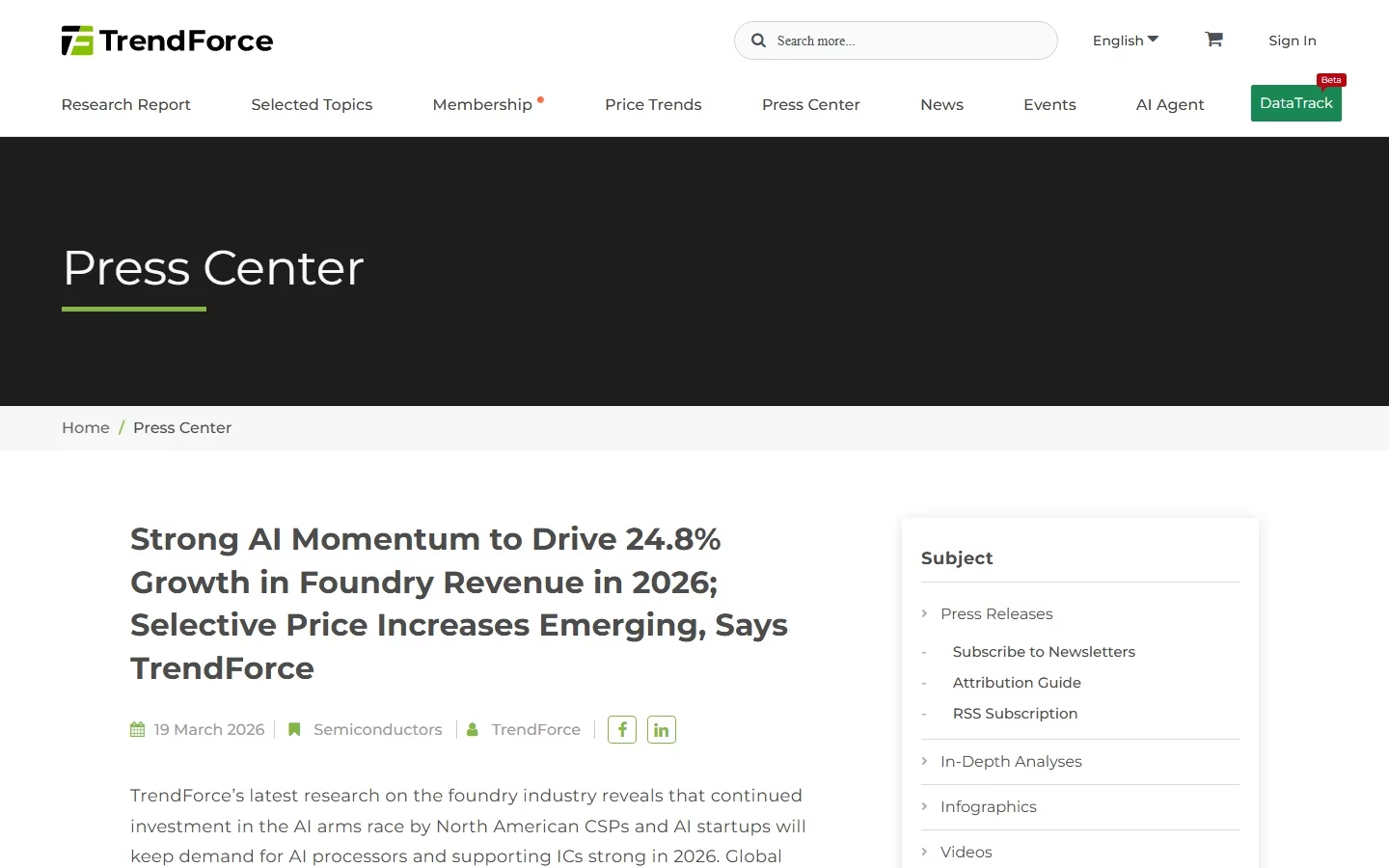
The supply-side story is reinforced by strategic capacity decisions at the world’s largest foundries. TSMC and Samsung have both accelerated reductions in 8-inch wafer output—not because demand is weak, but because the capital expenditure required to maintain aging 8-inch lines produces lower returns than directing investment toward advanced nodes and CoWoS packaging capacity. The net effect: 8-inch wafer fab utilization reached 88% across top-ten foundries in 2026, with TrendForce projecting 90% by the second half of the year—levels at which spot pricing premiums become structural.
How Much Is the LED Driver IC Shortage Driving Prices Up in 2026?
The price escalation data from the first half of 2026 is unambiguous. Across the LED driver IC segment—encompassing constant-current drivers for indoor/outdoor modules, row-scan drivers, and integrated smart LED driver solutions—pricing has moved sharply upward in two distinct waves.
Wave One (January–March 2026): Fullhan Microelectronics, Chipone (Jichuang Beifang), Lipshen Micro, Mingwei Microelectronics, and BPS (Jingfeng Mingyuan) implemented an initial 10%–20% increase across their LED driver IC portfolios. These adjustments were attributed to rising foundry wafer costs and packaging material inflation.
Wave Two (May–July 2026): The same suppliers implemented a second round, this time averaging 30%+ across-the-board increases. Certain edge-computing and advanced display controller products saw increases of 30%–50%. Cumulatively, LED driver IC unit costs rose 50%–80% year-over-year, with spot-market premiums at 50%–100% above contracted pricing for buyers without allocated supply.
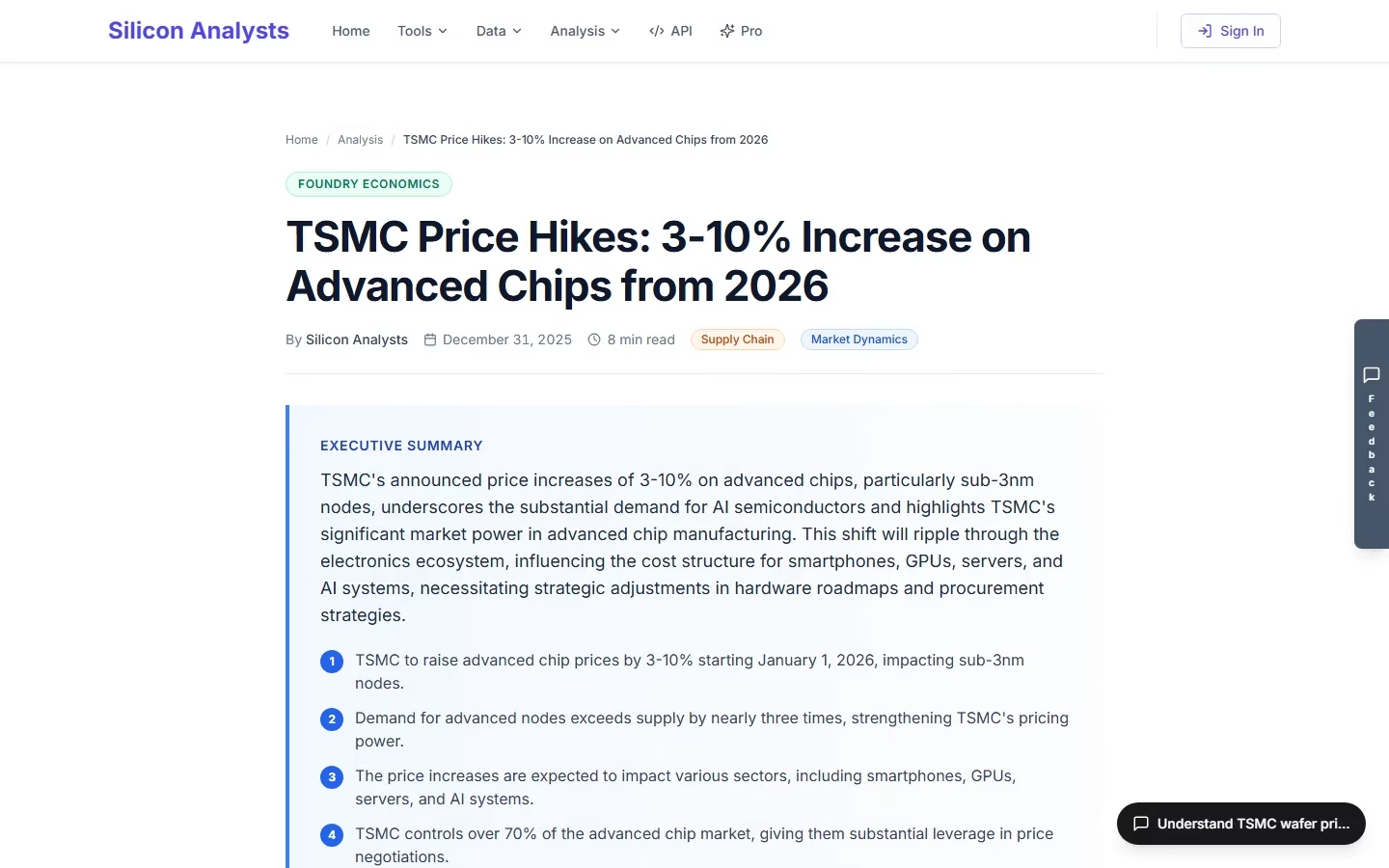
The underlying foundry pricing data mirrors these increases. Mature-node foundry prices rose 5%–15% between Q1 and Q2 2026, with UMC, VIS, Powerchip, and China’s Nexchip each implementing or signaling 10%+ wafer price adjustments. TSMC executed a 3%–10% increase on advanced nodes and applied targeted price adjustments to mature-node capacity. Samsung Foundry raised selected 4nm and 5nm node pricing by approximately 15%, with the pricing pressure cascading downstream to all process nodes.
Why Is the LED Driver IC Shortage Rooted in AI Chip Demand for Mature Fab Capacity?
The displacement mechanism operates through three overlapping channels: direct fab capacity competition, advanced packaging resource diversion, and capital expenditure reallocation.
Channel 1: Direct Fab Capacity Competition. Morgan Stanley estimates global AI-related CoWoS wafer demand at approximately 1 million wafers in 2026, a 170% increase from 2024 levels. Each CoWoS wafer consumes roughly three times the silicon area of an equivalent non-packaged wafer for the same gigabyte of logic capacity, according to semiconductor industry data. The surge in AI accelerator production—led by one manufacturer that has secured approximately 800,000 wafers annually for its main chip alone—does not merely compete with LED driver IC capacity: it absorbs the fab allocation that would otherwise be available for mature-node production.
Channel 2: Advanced Packaging Resource Diversion. TSMC’s CoWoS (Chip-on-Wafer-on-Substrate) packaging capacity is the critical constraint in the AI chip supply chain. With advanced packaging demand exceeding supply, foundries have diverted engineering resources, cleanroom space, and capital equipment from mature-node maintenance and expansion toward CoWoS capacity build-out. The capital intensity of advanced packaging—CoWoS expansion costs approximately $10 billion per 100,000 wafers of incremental capacity—absorbs the investment that might otherwise fund mature-node fab expansion.
Channel 3: Capital Expenditure Reallocation. TSMC raised its 2026 capex guidance to $64 billion, with the overwhelming majority directed toward advanced nodes (3nm, 2nm) and advanced packaging. Samsung Foundry and Intel Foundry Services have similarly prioritized leading-edge investment. Mature-node capacity—the 8-inch and 12-inch lines on which LED driver ICs are fabricated—receives minimal incremental capital. The global 8-inch wafer fabrication capacity actually contracted by 2.4% in 2026, even as demand for the chips produced on those lines has risen.
When Will the LED Driver IC Shortage Ease? The 2027 Outlook
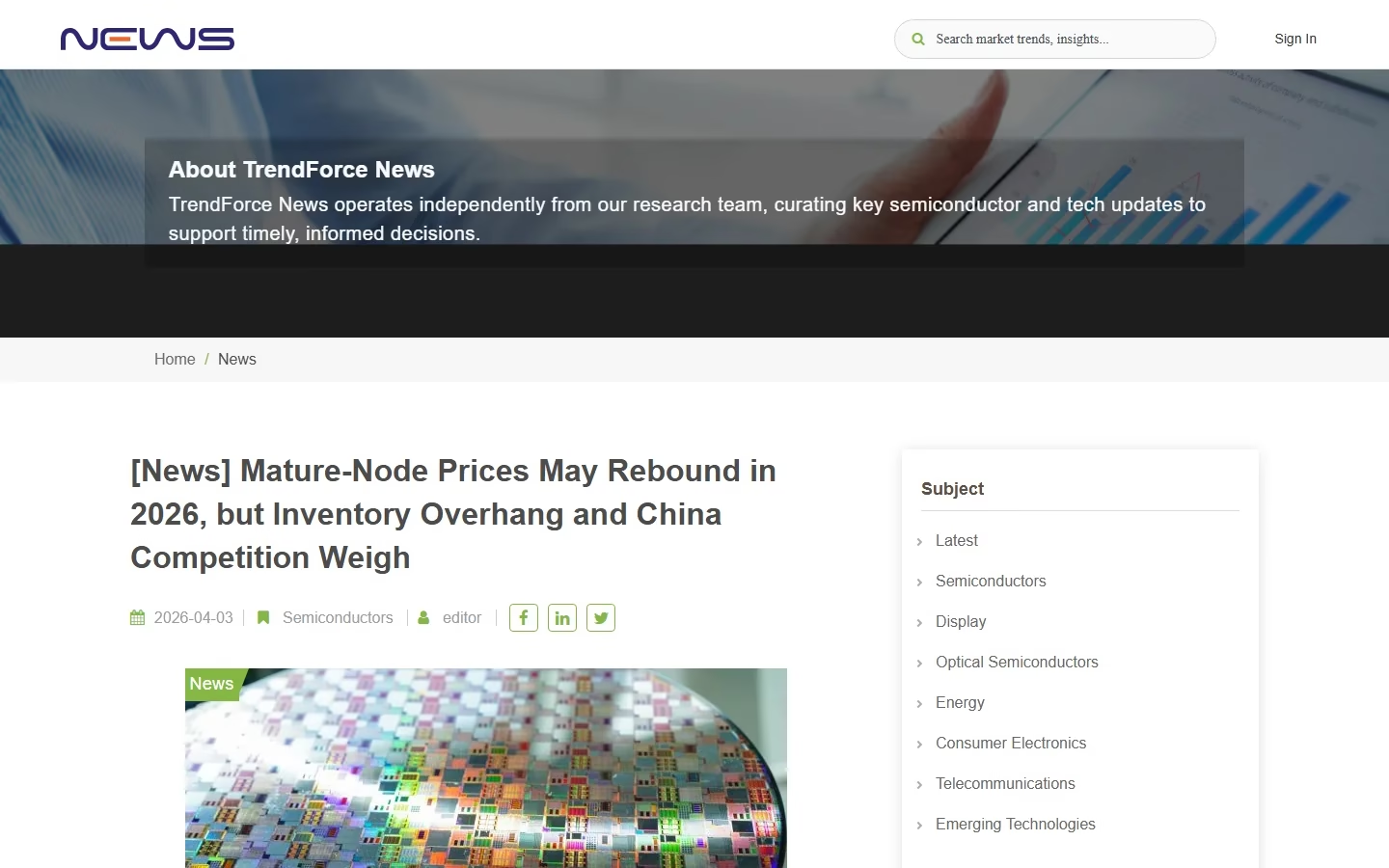
The near-term outlook for LED driver IC supply does not suggest relief. TrendForce projects that upward pricing pressure on mature nodes will extend through 2027. SK hynix has warned of wafer constraints lasting to 2030, with a projected 20% supply gap. The 2026 LED display price increase cycle is driven by structural semiconductor economics, not cyclical inventory fluctuations—meaning the driver IC bottleneck is unlikely to resolve through normal market corrections alone.
Three factors shape the timeline. First, new mature-node fab capacity—primarily from Chinese foundries including Nexchip and SMIC—is entering production, but at volumes insufficient to offset the simultaneous 8-inch capacity reductions at TSMC and Samsung. Second, AI chip demand shows no sign of moderating, with hyperscaler capital expenditure forecast to exceed $300 billion in 2026. Third, the lead time for new 8-inch fab construction is 18–24 months, meaning capacity additions ordered today would not begin contributing supply until 2028 at the earliest.
For LED module buyers planning projects through 2027, the operational implication is clear: driver IC supply and pricing stability will require either long-term allocation agreements with component suppliers or relationships with vertically integrated manufacturers that have pre-stocked inventory positions.
How to Navigate the LED Driver IC Shortage: Unifyled Supply Chain Strategy
As a source-level LED display factory with direct component procurement control, Unifyled has implemented a three-tier supply chain stabilization program designed to insulate international buyers from the worst of the 2026–2027 driver IC shortage cycle.
First: Multi-Quarter Driver IC Pre-Stocking. Beginning in Q4 2025—as early signals of wafer capacity displacement emerged from TrendForce and foundry industry contacts—Unifyled secured multi-quarter allocations of core LED driver IC SKUs at pre-escalation pricing. These inventory positions cover the primary constant-current driver ICs used in the company’s indoor and outdoor LED module production, providing a buffer that enables 30-day price-stable quotations—significantly longer than the current market standard of 7–14 days.
Second: Long-Term Framework Agreements with Foundry-Allocated IC Suppliers. Unifyled maintains fixed-price supply contracts with its primary driver IC partners, locking in wafer allocation through Q3 2026. These agreements, reinforced by a quality-first procurement policy, ensure that cost stability does not come at the expense of component-grade consistency.
Third: Multi-Source IC Qualification. Unifyled has qualified driver ICs from multiple pin-compatible suppliers across its product portfolio, eliminating single-source dependency. When one supplier’s fab allocation tightens, production shifts to pre-qualified alternative SKUs without redesign cycles, lead time extensions, or power consumption compromises.
For B2B buyers evaluating LED screen procurement options in the current market, the driver IC shortage has introduced a new criterion for supplier selection: component-level supply chain visibility. Factory-direct manufacturers with pre-stocked IC inventory and multi-source qualification are positioned to deliver predictable lead times and stable pricing, while contract manufacturers and trading companies without direct component procurement control face the full force of spot-market IC pricing and quota-based allocation.
Beat the LED Driver IC Shortage 2026: Lock In Your Project Pricing Before Q4 Capacity Tightens
The semiconductor industry data points in one direction: mature-node foundry capacity constraints driven by AI demand are structural, not cyclical. TrendForce expects foundry price increases to persist through 2027. SK hynix projects wafer supply gaps extending to 2030. For LED display buyers, the window for securing projects at pre-escalation component pricing narrows with each quarterly foundry allocation cycle.
The LED driver IC shortage has rewritten procurement timelines across the LED display industry—but buyers who act now can still access pre-escalation component pricing. Send your project specifications today for a driver-IC-backed, fixed-validity quotation. Unifyled’s engineering team will provide a line-item quotation—panels, driver ICs, control system, steel structure, installation hardware, spare modules, and shipping—within 24 hours, with component pricing secured by pre-stocked inventory positions and supplier framework agreements.
→ Request a Price-Stable Quotation Now
Related Reading: LED Display Supply Chain & Technology
References & Data Sources
• TrendForce, “AI Component Capacity Squeeze and Foundry Output Cuts to Extend Mature-Node Price Increases in 2027,” June 30, 2026.
• TrendForce, “Mature-Node Prices May Rebound in 2026, but Inventory Overhang and China Competition Weigh,” April 3, 2026.
• TrendForce, “2026 Foundry Outlook: AI Fuels Price Hikes and Growth,” March 2026.
• SiliconAnalysts, “TSMC Price Hikes: 3-10% Increase on Advanced Chips Starting January 2026,” 2026.
• Deloitte, “2026 Global Semiconductor Industry Outlook: Capitalizing on the AI Data Center Boom,” 2026.
• New Electronics, “AI Demand and Capacity Cuts to Drive Up Mature-Node Foundry Prices,” 2026.
• Morgan Stanley, “Global AI CoWoS Wafer Demand Estimate,” 2026.
• J2Sourcing, “Semiconductor Price Hikes and Lead Time Crunches: 14 Suppliers Raise Costs in April 2026,” April 2026.