
Why LED Display Prices Are Surging in 2026: A Full Supply Chain Analysis
July 8, 2026 — By Unifyled Editorial Team
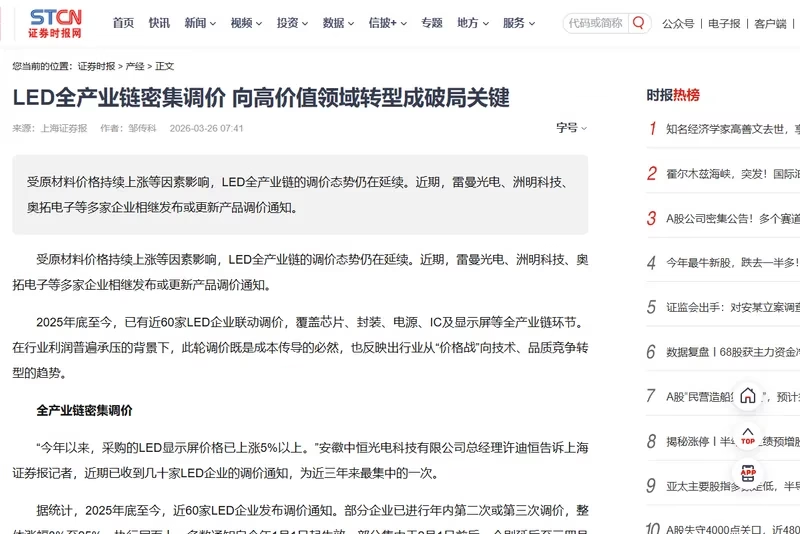
The global LED display industry entered 2026 confronting a cost escalation wave unmatched in scale since the sector’s post-pandemic recovery. By July 2026, approximately 100 companies across the LED supply chain—from IC designers and LED package houses to PCB fabricators and finished display manufacturers—had issued formal price adjustment notices to their customers. Some have cycled through three to four rounds of increases in the span of seven months. For international buyers, system integrators, and project contractors, the numbers carry immediate operational consequences: quotation validity windows have compressed from the standard 30–90 days to as little as 7–14 days, and total project budgets for LED display deployments now require an 8%–15% uplift over 2025 planning figures.
This report maps the full architecture of the 2026 LED display price increase—who raised prices, by how much, and why—drawing on announcements from over 30 named manufacturers, component-level cost data, and analysis from industry research desks including TrendForce, Hangjianet Display, OFweek, and LEDinside.
What Is the LED Display Price Increase 2026? Who Raised Prices and by How Much
The price adjustment wave has swept across every tier of the LED display supply chain. Unlike the demand-driven shortages of 2020–2021, this cycle is a cost-input transmission chain: precious metal spikes hit packaging first in Q3 2025, fab capacity reallocation squeezed driver ICs by Q1 2026, and copper-clad laminate (CCL) price escalation pushed PCB costs upward through mid-2026. The cumulative effect is that no link in the chain has been spared.
At the component and packaging level, Mullinsen (MLS), Guoxing Optoelectronics (NationStar), DSBJ, and Hongli Zhihui led the first wave in late 2025 with 5%–10% hikes on LED packages. Jucai Optoelectronics followed with a 25% increase on select specialty packages. By May 2026, 1515 SMD LED package pricing had moved from approximately 3.8 RMB/K to above 5.0 RMB/K for mid-tier customers—a roughly 30% increase in unit cost for the most common surface-mount device in indoor LED modules.
In the driver IC segment, the escalation has been the most severe. Fullhan Microelectronics, Chipone (Jichuang Beifang), Lipshen Micro, Mingwei Microelectronics, and BPS (Jingfeng Mingyuan) collectively implemented two waves of price increases: an initial 10%–20% round in January–March 2026, followed by a 30%+ across-the-board increase in May. Certain edge-computing display controller products from Colorlight saw increases of 30%–50%. Cumulatively, LED driver IC unit costs have risen 50%–80% year-over-year, with spot-market premiums at 50%–100% above contracted pricing for buyers without allocated supply.
On the PCB and substrate front, Mitsubishi Gas Chemical raised CCL prices by 30% across all thickness grades. Mitsui Metals added 12% to its MicroThin copper foil line. Kingboard Laminates, the dominant CCL supplier to China’s LED module industry, implemented a 15% increase on FR-4 and 10% on CEM-1 grades in July 2026, with copper foil processing fees rising an additional 5–8 RMB/kg. Glass fabric suppliers declared 20% increases, and epoxy resin costs climbed €150–200 per tonne from European suppliers. LED PCB fabrication costs rose by an estimated 20%–37% year-over-year, with lead times stretching from 4–6 weeks to 12–16 weeks.
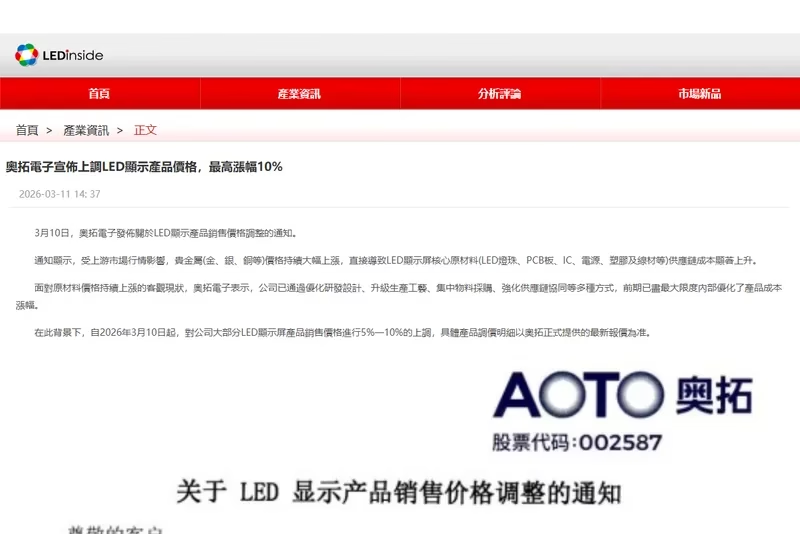
At the finished display level, Leyard adjusted most LED display products by 3%–15% in February 2026. Unilumin executed price increases across all product lines from January 30, subsequently issuing four additional rounds through July—making it five adjustments in a single half-year period. AOTO Electronics raised LED display products by 5%–10% in March. Qiangli Jucai, the dominant volume-module manufacturer, raised prices on over 30 indoor module SKUs by 1–2 RMB per unit in May, then followed with a 3%–15% adjustment across its broader range in July. Hi-Tech Huaxing raised its specialty color-series products by 15%. Power supply manufacturers Songsheng and Inventronics implemented 5%–15% increases, while LED lead-frame supplier Changke (6548.TW) pushed through 15%–25% price hikes across its entire portfolio.
Why Are LED Display Prices Increasing in 2026? Three Compounding Forces Explained
1. Precious and Base Metals at Historic Price Levels
Gold, silver, and copper together account for over 70% of LED package material costs—in bonding wires, die-attach silver paste, solder, lead frames, and PCB substrates. Each of these metals has traded at or near all-time highs through 2026. Gold reached $5,595 per troy ounce on January 29, 2026, and has held above $4,300 through mid-year—a gain exceeding $1,300 year-over-year. Silver surged to $93 per ounce, a 170% increase from its 2024 trough, driven by photovoltaic demand compounding its industrial consumption. Copper on the LME hit $13,500 per metric ton in January and has sustained above $13,000 through Q2 2026. Goldman Sachs projects gold reaching $5,200/oz by year-end; J.P. Morgan models a copper annual average of $12,075/t with a global refined copper deficit of approximately 330,000 tonnes.
These are not futures-market abstractions. They flow directly into the bill of materials for every LED display module manufactured. A standard double-sided PCB with ENIG surface finish now carries an additional $40–$50 per square meter in gold cost alone. Hard-gold edge-connector boards—common in fine-pitch rental panels—bear roughly ten times that incremental burden.
2. Wafer Capacity Displacement by AI and Automotive Silicon
The structural dimension of the 2026 LED display price increase lies in semiconductor fab economics. Global 8-inch wafer fabrication capacity contracted by 2.4% in 2026 as TSMC, Samsung, and second-tier foundries reallocated mature-node capacity to higher-margin AI server and automotive-grade IC production. For LED driver ICs—which run on mature 8-inch and 12-inch nodes at relatively low margins—the arithmetic is unforgiving. AI chip orders generate three to five times the gross margin of an LED driver wafer. The portion of foundry capacity allocated to LED driver production dropped from approximately 30% in 2024 to roughly 15% in 2026.
Morgan Stanley estimates global AI-related CoWoS wafer demand at 1 million wafers in 2026, a 170% increase from 2024. This demand does not merely compete with LED driver capacity—it cannibalizes it. Twelve-inch driver IC wafer quotes rose 30% in early 2026; 8-inch quotes increased 15%–25%. LED driver delivery lead times have stretched from the standard four weeks to six to eight weeks, with spot-market premiums at 50%–100% for non-allocated buyers. IC distributors report that certain driver SKUs are on quota-based allocation, a condition the industry last experienced during the 2021 global chip shortage.
3. CCL and PCB Cost Transmission from Copper and Glass Fabric Shortages
Copper-clad laminate represents over 30% of PCB production cost, and CCL pricing is the primary transmission mechanism from raw copper to the LED display supply chain. The Mitsubishi Gas Chemical 30% CCL increase, the Mitsui Metals 12% copper foil increase, and the Kingboard Laminates 15% FR-4 / 10% CEM-1 increase are not independent events—they are linked signals in a global substrate cost escalation. Glass fabric, constrained by production capacity that has not expanded since 2021, rose 12% in 2025 and another 20% in 2026. The net result: high-end PCB fabrication costs have risen an estimated 37.8% year-over-year, and standard LED module PCB costs have increased 20% or more according to manufacturer price adjustment notices issued by Zhongqi Optoelectronics and Qiangli Jucai.
How Does the LED Display Price Increase 2026 Impact the Industry?
For global buyers and project contractors, the 2026 LED display price increase has rewritten procurement timelines. Quotation validity—traditionally 30 to 90 days for LED display projects—has contracted to 7 to 14 days across much of the market. Several manufacturers now explicitly state that pricing is subject to the latest quotation at the time of order confirmation, a departure from the fixed-bid norms that governed the industry through 2025.
The operational consequences are material. A 30-square-meter indoor P2.5 LED video wall quoted at $1,500 per square meter yields a $45,000 panel invoice. After accounting for steel structure (10%–20%), installation, control system (5%–10%), spare modules (5%–10%), and shipping with applicable tariffs (5%–15%), the first-year total cost of ownership reaches $65,000–$72,000—a 44%–60% premium over the headline screen price. When the 2026 component-level price increases are layered into this calculation, project budgets require an estimated 8%–15% uplift above 2025 baselines.
The market data paints a complex picture. Omdia reports that Q1 2026 LED video display revenue declined 2.3% year-over-year despite rising component costs, with shipments up only 0.6%. The 1.00–1.99mm pixel pitch segment—the largest revenue category—saw a 6.8% decline. Buyers are deferring projects or reducing scope. Mid-sized display manufacturers without deep component inventories are declining long-cycle, fixed-price orders in favor of short-turnaround, price-flexible contracts. The tiered pricing structure in the LED module supply chain—where large contract customers receive preferential allocation and smaller buyers absorb the full spot-market premium—has widened.
Industry analysts at TrendForce note that this cycle is distinct from previous disruptions: it is fundamentally cost-push, not demand-pull. Several publicly traded LED display manufacturers posted Q1 2026 revenue declines despite implementing price increases—Leyard revenue fell 21.6% year-over-year, Unilumin declined 11.17%—indicating that the price adjustments have not yet offset volume compression. The exception is Absen, which reported Q1 2026 revenue of 888 million RMB (up 7.52% year-over-year) and net profit of 39.3 million RMB (up 7.87%), with overseas revenue accounting for 76.5% of the total—a figure that underscores where demand resilience currently resides.
How Unifyled Navigates the LED Display Price Increase 2026: Supply Chain Strategy
As a source-level LED display factory with direct control over its component procurement pipeline, Unifyled has implemented a multi-pronged supply chain stabilization program designed to insulate international buyers from the worst of the 2026 price escalation cycle.
The strategy rests on three pillars. First, strategic pre-stocking of core driver ICs and LED packages. Beginning in Q4 2025, as early signals of wafer capacity displacement emerged, Unifyled secured multi-quarter allocations of key driver IC SKUs and 1515, 2121, and 1921 SMD LED packages at pre-escalation pricing. These inventory positions provide a buffer that allows the company to offer price-stable quotations with 30-day validity—significantly longer than the current market standard of 7–14 days.
Second, long-term framework agreements with upstream materials suppliers. Unifyled has signed fixed-price contracts with its primary PCB and CCL supply partners, locking in substrate costs through Q3 2026. These agreements, combined with a rigorous quality control system that enforces incoming material inspection at every stage, ensure that cost stability does not come at the expense of component quality—a concern as some manufacturers turn to alternative, untested supply sources in the current environment.
Third, module-level vertical integration. Unifyled manufactures its own indoor LED modules and outdoor LED modules in-house, eliminating the margin stacking that occurs when a display brand purchases modules from a third-party module assembler that has itself already absorbed component-level price increases. This integration—from LED packaging technology selection through final assembly—compresses the cost structure by removing one to two intermediate margin layers.
For project buyers evaluating their procurement options in the current market, the operational calculus has shifted. Factory-direct manufacturers with demonstrated supply chain control and component-level cost visibility are now positioned to offer more stable pricing than branded competitors whose contract manufacturing model passes raw material volatility through to the customer without a buffer. Unifyled’s products are engineered for long service life, and the company’s common-cathode LED technology delivers 30%–40% energy savings that compound into meaningful operational cost reductions over a display’s 5–10 year deployment horizon—a factor that becomes more relevant as upfront hardware costs rise.
When to Lock In Pricing Amid the LED Display Price Increase 2026?
The 2026 LED display price increase represents a genuine, supply-chain-wide cost restructuring—not temporary market noise. Buyers who secure quotations with deposit-backed price locks today can still access pricing that reflects pre-escalation component costs. Those who wait until Q4 2026 or Q1 2027 will likely face the fully flowed-through cost structure as pre-stocked inventories deplete and new-production pricing becomes the universal baseline.
Send your project specifications today for a fixed-validity quotation backed by Unifyled’s pre-stocked component inventory and upstream supplier agreements. Whether your deployment involves stage LED walls for live events, outdoor advertising LED screens, rental LED displays, or fixed outdoor LED installations, our engineering team will provide a line-item quotation—panels, steel structure, control system, video processor, spare modules, and shipping—within 24 hours, with pricing secured upon deposit.
LED Display Price Increase 2026: References & Data Sources
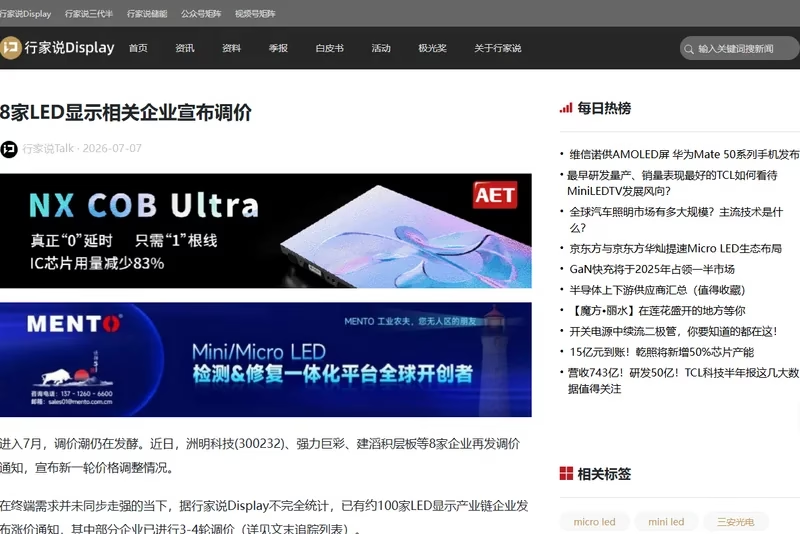
- Hangjianet Display (行家说Display) — “Nearly 100 LED Display Companies Announce Price Adjustments,” July 7, 2026. hangjianet.com
- TrendForce (集邦咨询) — “Leyard: LED Display Price Adjustment of 3%–15%,” February 12, 2026; “Absen: Not Following Price Hikes,” June 1, 2026. trendforce.cn
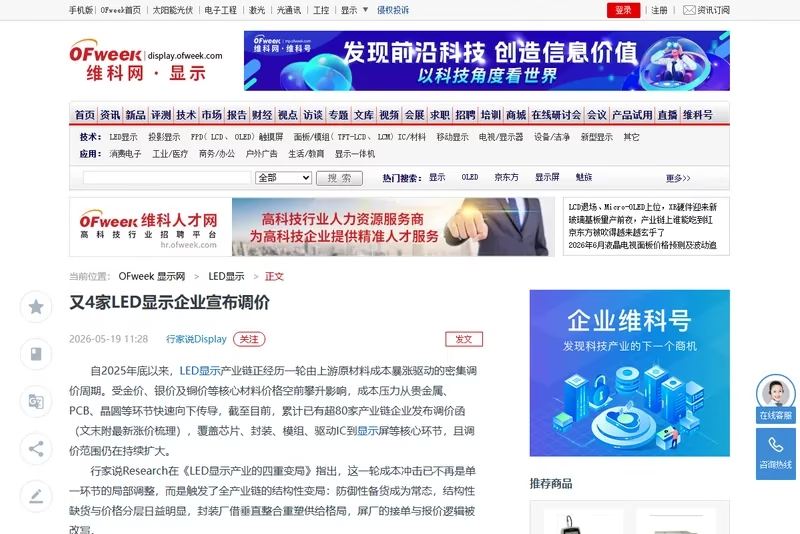
- OFweek Display — “Four More LED Display Companies Announce Price Adjustments,” May 2026; “Three Years of LED Display Industry Price Hikes Deconstructed,” January 2026. display.ofweek.com
- LEDinside — “AOTO Electronics Announces LED Display Product Price Increase, Up to 10%,” 2026. ledinside.com.tw
- EET China (电子工程专辑) — “Over 80 Companies in Rotation Price Hikes: Why Is the LED Display Market Still Cooling?”; “12 LED Display Companies Announce Price Adjustments”; “Driver IC / Display Control / PCB Concentrated Price Hikes Up to 80%.” eet-china.com
- Securities Times (证券时报) — “LED Full Supply Chain Intensive Price Adjustments: Transformation Toward High-Value Segments as the Breakthrough,” 2026. stcn.com
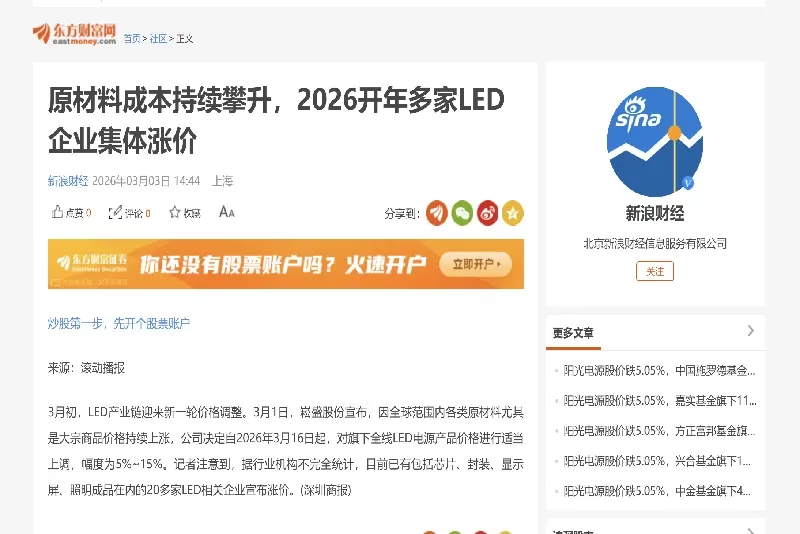
- Eastmoney (东方财富) — “Raw Material Costs Continue to Rise: Multiple LED Companies Announce Collective Price Increases at the Start of 2026,” March 3, 2026. eastmoney.com
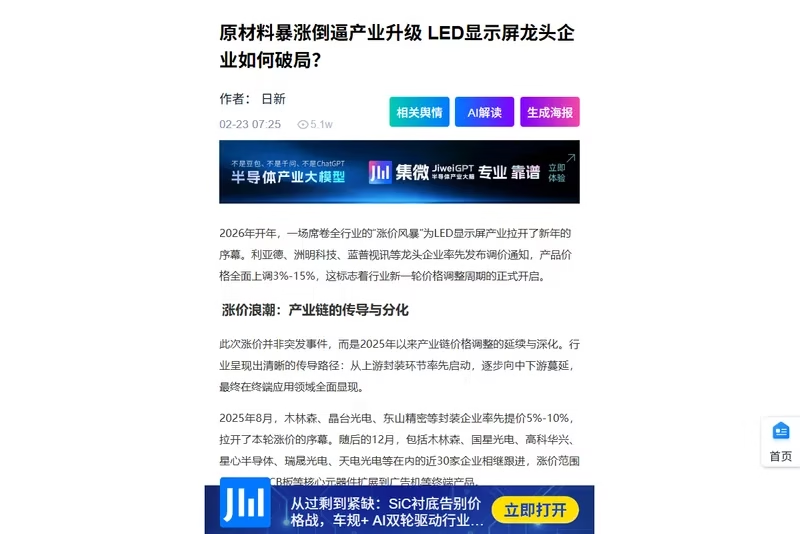
- Laoyaoba (老杳吧) — “Raw Material Surge Forces LED Display Industry Upgrade: How Leading Manufacturers Respond,” 2026. laoyaoba.com
- Omdia — “LED Video Display Shipments Edge Up As Revenue Slips,” June 2026. invidis.com
- Hile Electronic — “The PCB Cost Storm of 2026.” hilelectronic.com
- SZ Growling — “LED Driver Price Hikes 2026: Smart Strategies to Protect Your Project Budget.” szgrowling.com
- Electronics Sourcing — “Arrow Electronics Director Explains How 2026’s Chip Supply Chain Is Being Redrawn,” April 2026. electronics-sourcing.com
Disclosure: This article was researched and written by the Unifyled Editorial Team using publicly available industry data, manufacturer announcements, and third-party research reports. All price figures and company statements cited are sourced from the publications listed above. Unifyled is a manufacturer of LED display products and this article contains promotional content regarding its supply chain services.