
6,000+ nits brightness, IP67 weatherproof. Engineered to dominate direct sunlight.
Selecting the right outdoor LED display depends entirely on your installation goals. For permanent 24/7 fixed billboards, we recommend the OK Series, featuring standard 960x960mm cabinets designed for durability. If your focus is high-impact outdoor advertising requiring vivid visibility, the B-Series is the ideal choice with brightness options ranging from 5,000 to 6,000 nits. However, for concerts and touring applications, look to the Metastar Series, which offers a lightweight, fast-lock design specifically tailored for rental events.
Specification
| VALUE | OK5 | OK6 | OK8 | OK10 |
| PIXEL PITCH | P5.7MM | P6.667MM | P8MM | P10MM |
| BRIGHTNESS | 6500CD | 6500CD | 6500CD | 6500CD |
| GRAY SCALE | 65536 | 65536 | 65536 | 65536 |
| REFRESH RATE | 3840HZ | 3840HZ | 3840HZ | 3840HZ |
| PIXEL PER PANEL | 168×168 | 144X144 | 120X120 | 96X96 |
| PIXEL PER SQM | 30625 | 22498 | 15625 | 10000 |
| VIEWING ANGLE | 140/140 degree | 140/140 degree | 140/140 degree | 140/140 degree |
| POWER COMSUNPTION | 250W/650W | 250W/650W | 250W/650W | 250W/650W |
| IP RATE | IP65 | IP65 | IP65 | IP65 |
| VOLTAGE | 100/240V | 100/240V | 100/240V | 100/240V |
| CABINET SIZE | 960X960X77MM | 960X960X77MM | 960X960X77MM | 960X960X77MM |
| CABINET MATERIAL | ALUMINUM | ALUMINUM | ALUMINUM | ALUMINUM |
| CABINET WEIGHT | 28kgs | 28kgs | 28kgs | 28kgs |
| Value | P4 | P5 | P6 | P8 | P10 |
| Pixel Pitch | 4mm | 5mm | 6mm | 8mm | 10mm |
| Brightness | 6000nits | 6000nits | 6000nits | 6000nits | 6000nits |
| Pixel Configuration | SMD | SMD | SMD | SMD | SMD |
| Gray Scale | 65536 | 65536 | 65536 | 65536 | 65536 |
| Refresh Rate | ≥1920hz | ≥1920hz | ≥1920hz | ≥1920hz | ≥1920hz |
| Pixel Matrix Per Panel | 240*240 | 192*192 | 144*144 | 120*120 | 96*96 |
| Pixel Matrix Per Sq.m | 62500 | 40000 | 22498 | 15625 | 10000 |
| View Angle (H/V) | 140/140 deg | 140/140 deg | 140/140 deg | 140/140 deg | 140/140 deg |
| Power Comsuption | 800/300 | 800/300 | 800/300 | 800/300 | 800/300 |
| IP Rate | IP65 | IP65 | IP65 | IP65 | IP65 |
| Input Volyage(AC) | 100/240 | 100/240 | 100/240 | 100/240 | 100/240 |
| Panel Size | 960*960*120 | 960*960*120 | 960*960*120 | 960*960*120 | 960*960*120 |
| Panel Material | Magnesium | Magnesium | Magnesium | Magnesium | Magnesium |
| Panel Weight | 28kgs | 28kgs | 28kgs | 28kgs | 28kgs |
| Operating Temperature | -20-60ºC | -20-60ºC | -20-60ºC | -20-60ºC | -20-60ºC |
| Value | P4 | P5 | P6 | P8 | P10 |
| Pixel Pitch | 4mm | 5mm | 6mm | 8mm | 10mm |
| Brightness | 6000nits | 6000nits | 6000nits | 6000nits | 6000nits |
| Pixel Configuration | SMD | SMD | SMD | SMD | SMD |
| Gray Scale | 65536 | 65536 | 65536 | 65536 | 65536 |
| Refresh Rate | ≥1920hz | ≥1920hz | ≥1920hz | ≥1920hz | ≥1920hz |
| Pixel Matrix Per Panel | 240*240 | 192*192 | 144*144 | 120*120 | 96*96 |
| Pixel Matrix Per Sq.m | 62500 | 40000 | 22498 | 15625 | 10000 |
| View Angle (H/V) | 140/140 deg | 140/140 deg | 140/140 deg | 140/140 deg | 140/140 deg |
| Power Comsuption | 800/300 | 800/300 | 800/300 | 800/300 | 800/300 |
| IP Rate | IP65 | IP65 | IP65 | IP65 | IP65 |
| Input Volyage(AC) | 100/240 | 100/240 | 100/240 | 100/240 | 100/240 |
| Panel Size | 960*960*120 | 960*960*120 | 960*960*120 | 960*960*120 | 960*960*120 |
| Panel Material | Magnesium | Magnesium | Magnesium | Magnesium | Magnesium |
| Panel Weight | 28kgs | 28kgs | 28kgs | 28kgs | 28kgs |
| Operating Temperature | -20-60ºC | -20-60ºC | -20-60ºC | -20-60ºC | -20-60ºC |
Item | LA2.97 | LA3.91 | LA4.81 | LA6.25 | LA7.81 | LA10.42 |
Pixel Composition(SMD) | 1415 | 1921 | 1921 | 2727 | 2727 | 2727 |
Pixel Pitch(mm) | 2.97 | 3.91 | 4.81 | 6.25 | 7.81 | 10.42 |
Module Resolution(W×H) | 84×168 | 64×128 | 52×104 | 40×80 | 32×64 | 24×48 |
Module Size(mm) | 250×500×16 | |||||
Module Weight(kg) | 1.93 | |||||
Module Qty/Cabinet(W×H) | 4×2 | |||||
Cabinet Resolution(W×H) | 336×336 | 256×256 | 208×208 | 160×160 | 128×128 | 96×96 |
Cabinet Size(mm) | 1000×1000×78 | |||||
Cabinet Area(㎡) | 1 | |||||
Cabinet Weight(kg/cabinet) | 25 | |||||
Cabinet Material | Profile Cabinet | |||||
Cabinet Density(dot/m²) | 112,896 | 65,536 | 43,264 | 25,600 | 16,384 | 9,216 |
IP Rating | IP66 | |||||
White Balance Brightness(nits) | ≥5000 | ≥5500 | ≥5500 | ≥5500 | ≥5500 | ≥5500 |
Color Processor(bit) | 6 | |||||
Color Temperature(K) | 6500-9000 | |||||
Visual Angle(H/V) | 140°/ 120° | |||||
Luminous point centre deviation | <3% | |||||
Luminance uniformity | ≥97% | |||||
Chromaticity uniformity | Within ±0.003Cx, Cy | |||||
Contrast Ratio | 8000:1 | |||||
The Max Power Consumption(W/㎡) | 550 | 550 | 550 | 550 | 550 | 550 |
Average Power Consumption(W/㎡) | 186 | 186 | 186 | 186 | 186 | 186 |
Input Voltage | AC100~240V | |||||
Frequency(Hz) | 50&60 | |||||
IC Driving(s) | 1/14 | 1/8 | 1/7 | 1/5 | 1/4 | 1/2 |
Refreshing Ratio(Hz) | 3840/7680 | |||||
Maintenance Method | Front and Rear | |||||
Lifespan(hrs) | 100,000 | |||||
Work Temperature/Humidity | -40℃-80℃/10%RH-98%RH (Non Condensing) | |||||
Storage Temperature/Humidity | -20℃-60℃/10%RH-98%RH (Non Condensing) | |||||
| Indoor | Outdoor | ||||||
| Item | 1.95 | 2.604 | 2.97 | 2.604 | 2.97 | 3.91(16S) | 3.91(8S) |
| Pixel Composition(SMD) | 1515 | 1515 | 2121 | 1415 | 1415 | 1921 | 1921 |
| Pixel Pitch(mm) | 1.95 | 2.604 | 2.97 | 2.604 | 2.97 | 3.91 | 3.91 |
| Module Resolution(W×H) | 128×128 | 96×96 | 84×84 | 96×96 | 84×84 | 64×64 | 64×64 |
| Module Size(mm) | 250×250×15 | ||||||
| Module Weight(kg) | 0.58 | ||||||
| Module Qty/Cabinet(W×H) | 2×2 | ||||||
| Cabinet Resolution(W×H) | 256×256 | 192×192 | 168×168 | 192×192 | 168×168 | 128×128 | 128×128 |
| Cabinet Size(mm) | 500×500×87 | ||||||
| Cabinet Area(㎡) | 0.25 | ||||||
| Cabinet Weight(kg/cabinet) | 7.5 | ||||||
| Cabinet Material | Die-cast Aluminium | ||||||
| Cabinet Density(dot/m²) | 262144 | 147456 | 112896 | 147456 | 112896 | 65536 | 65536 |
| IP Rating | IP20 | IP65 | |||||
| White Balance Brightness(nits) | ≥700 | ≥700 | ≥800 | ≥700 | ≥700 | ≥700 | ≥800 |
| Color Processor(bit) | 14 | 16 | 16 | .16 | |||
| Color Temperature(K) | 6500-9000 | 6500-9000 | |||||
| Visual Angle(H/V) | 140°/ 120° | 140°/ 120° | |||||
| Luminous point centre deviation | <3% | <3% | |||||
| Luminance uniformity | ≥97% | ≥97% | |||||
| Chromaticity uniformity | Within ±0.003Cx, Cy | Within ±0.003Cx, Cy | |||||
| Contrast Ratio | ≥5000:1 | ≥5000:1 | |||||
| The Max Power Consumption(W/㎡) | 500 | 500 | 500 | 700 | 700 | 700 | 800 |
| Average Power Consumption(W/㎡) | 168 | 168 | 168 | 235 | 235 | 235 | 268 |
| Input Voltage | AC100~240V | AC100~240V | |||||
| Frequency(Hz) | 50&60 | 50&60 | |||||
| IC Driving(s) | 1/32 | 1/32 | 1/28 | 1/24 | 1/28 | 1/16 | 1/8 |
| Refreshing Ratio(Hz) | 3840 | 3840 | |||||
| Maintenance Method | Front and Rear | Front and Rear | |||||
| Lifespan(hrs) | 100,000 | 100,000 | |||||
| Work Temperature/Humidity | -40℃-80℃/10%RH-98%RH (Non Condensing) | -40℃-80℃/10%RH-98%RH (Non Condensing) | |||||
| Storage Temperature/Humidity | -20℃-60℃/10%RH-98%RH (Non Condensing) | -20℃-60℃/10%RH-98%RH (Non Condensing) | |||||
| Value | Indoor | Outdoor | |||
| Pixel Pitch | 2.604 | 2.976 | 3.91 | 3.91 | 4.81 |
| Brightness | 1000 | 1000 | 1000 | 4500 | 4500 |
| Pixel Configuration | SMD | SMD | SMD | SMD | SMD |
| Colors | 281trillion | 281trillion | 281trillion | 281trillion | 281trillion |
| Panel Pixel | 192*192 | 168*168 | 128*128 | 128*128 | 104*104 |
| Refresh Rate (HZ) | ≥3840 | ≥3840 | ≥3840 | ≥3840 | ≥3840 |
| Pixel Matrix Per Sq.m | 147456 | 112896 | 65536 | 65536 | 43264 |
| View Angle (H/V) | 140/140 | 140/140 | 140/140 | 140/140 | 140/140 |
| Power Comsuption(max/avg) | 550/200 | 480/170 | 400/150 | 600/200 | 580/180 |
| IP Rate | IP40/20 | IP40/20 | IP40/20 | IP65/43 | IP65/43 |
| Input Voltage (AC) | 110/240 | 110/240 | 110/240 | 110/240 | 110/240 |
| Panel Size(mm) | 500*500*88 | 500*500*88 | 500*500*88 | 500*500*88 | 500*500*88 |
| Module Size(mm) | 250*250 | 250*250 | 250*250 | 250*250 | 250*250 |
| Panel Weight(kgs) | 7.2 | 7.2 | 7.2 | 7.5 | 7.5 |
| Value | Indoor | Outdoor | |||
| Pixel Pitch | 2.604 | 2.976 | 3.91 | 3.91 | 4.81 |
| Brightness | 1000 | 1000 | 1000 | 4500 | 4500 |
| Pixel Configuration | SMD | SMD | SMD | SMD | SMD |
| Colors | 281trillion | 281trillion | 281trillion | 281trillion | 281trillion |
| Panel Pixel | 192*192 | 168*168 | 128*128 | 128*128 | 104*104 |
| Refresh Rate (HZ) | ≥3840 | ≥3840 | ≥3840 | ≥3840 | ≥3840 |
| Pixel Matrix Per Sq.m | 147456 | 112896 | 65536 | 65536 | 43264 |
| View Angle (H/V) | 140/140 | 140/140 | 140/140 | 140/140 | 140/140 |
| Power Comsuption(max/avg) | 550/200 | 480/170 | 400/150 | 600/200 | 580/180 |
| IP Rate | IP40/20 | IP40/20 | IP40/20 | IP65/43 | IP65/43 |
| Input Voltage (AC) | 110/240 | 110/240 | 110/240 | 110/240 | 110/240 |
| Panel Size(mm) | 500*1000*88 | 500*1000*88 | 500*1000*88 | 500*1000*88 | 500*1000*88 |
| Module Size(mm) | 250*250 | 250*250 | 250*250 | 250*250 | 250*250 |
| Panel Weight(kgs) | 7.2 | 7.2 | 7.2 | 7.5 | 7.5 |
| Value | Indoor | Outdoor | |||
| Pixel Pitch | 2.604 | 2.976 | 3.91 | 3.91 | 4.81 |
| Brightness | 1000 | 1000 | 1000 | 4500 | 4500 |
| Pixel Configuration | SMD | SMD | SMD | SMD | SMD |
| Colors | 281trillion | 281trillion | 281trillion | 281trillion | 281trillion |
| Panel Pixel | 192*192 | 168*168 | 128*128 | 128*128 | 104*104 |
| Refresh Rate (HZ) | ≥3840 | ≥3840 | ≥3840 | ≥3840 | ≥3840 |
| Pixel Matrix Per Sq.m | 147456 | 112896 | 65536 | 65536 | 43264 |
| View Angle (H/V) | 140/140 | 140/140 | 140/140 | 140/140 | 140/140 |
| Power Comsuption(max/avg) | 550/200 | 480/170 | 400/150 | 600/200 | 580/180 |
| IP Rate | IP40/20 | IP40/20 | IP40/20 | IP65/43 | IP65/43 |
| Input Voltage (AC) | 110/240 | 110/240 | 110/240 | 110/240 | 110/240 |
| Panel Size(mm) | 500*1000*88 | 500*1000*88 | 500*1000*88 | 500*1000*88 | 500*1000*88 |
| Module Size(mm) | 250*250 | 250*250 | 250*250 | 250*250 | 250*250 |
| Panel Weight(kgs) | 7.2 | 7.2 | 7.2 | 7.5 | 7.5 |
| Value | Indoor | Outdoor | |||
| Pixel Pitch | 2.604 | 2.976 | 3.91 | 3.91 | 4.81 |
| Brightness | 1000 | 1000 | 1000 | 4500 | 4500 |
| Pixel Configuration | SMD | SMD | SMD | SMD | SMD |
| Colors | 281trillion | 281trillion | 281trillion | 281trillion | 281trillion |
| Panel Pixel | 192*192 | 168*168 | 128*128 | 128*128 | 104*104 |
| Refresh Rate (HZ) | ≥3840 | ≥3840 | ≥3840 | ≥3840 | ≥3840 |
| Pixel Matrix Per Sq.m | 147456 | 112896 | 65536 | 65536 | 43264 |
| View Angle (H/V) | 140/140 | 140/140 | 140/140 | 140/140 | 140/140 |
| Power Comsuption(max/avg) | 550/200 | 480/170 | 400/150 | 600/200 | 580/180 |
| IP Rate | IP40/20 | IP40/20 | IP40/20 | IP65/43 | IP65/43 |
| Input Voltage (AC) | 110/240 | 110/240 | 110/240 | 110/240 | 110/240 |
| Panel Size(mm) | 500*1000*88 | 500*1000*88 | 500*1000*88 | 500*1000*88 | 500*1000*88 |
| Module Size(mm) | 250*250 | 250*250 | 250*250 | 250*250 | 250*250 |
| Panel Weight(kgs) | 7.2 | 7.2 | 7.2 | 7.5 | 7.5 |
LED PANEL PRICE CALCULATOR
Just fill the sizes, and get your LED screen budget right now !
Use Scenarios of Outdoor LED Screens
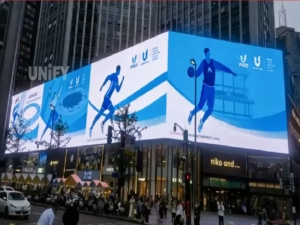
Outdoor Digital Billboards (DOOH)
Maximize advertising revenue with high-brightness outdoor LED displays that deliver vibrant, unmissable visuals on highways and city streets, day or night.
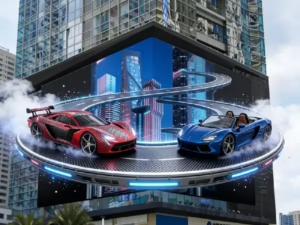
Outdoor Building Facades
Transform static exterior walls into dynamic outdoor media landmarks that modernize your building’s architecture and capture city-wide attention.
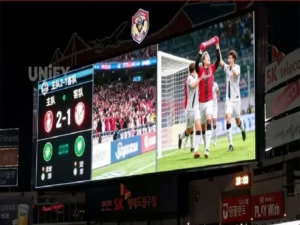
Outdoor Stadiums & Sports Venues
Elevate the fan experience with weather-resistant outdoor screens designed for giant scoreboards, live replays, and perimeter advertising in open-air arenas.
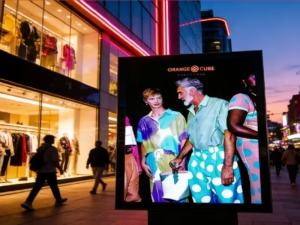
Outdoor Retail & Shopping Malls
Drive foot traffic and boost brand visibility with eye-catching outdoor commercial displays strategically positioned at mall entrances and busy plazas.
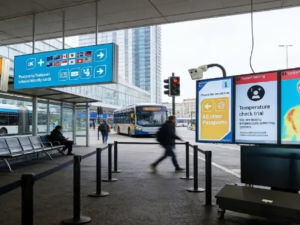
Outdoor Transportation Hubs
Deliver critical travel information and advertisements in real-time with durable outdoor LED signage built to withstand elements at airports, train stations, and bus terminals.
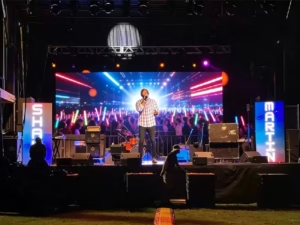
Outdoor Events & Festivals
Create unforgettable visual atmospheres for live concerts with rugged outdoor rental screens engineered to perform perfectly in sunlight, rain, or wind.
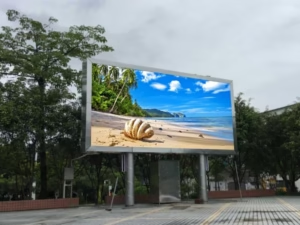
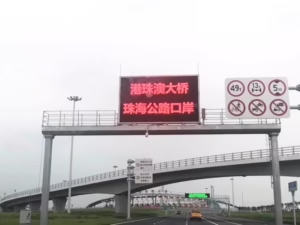
Outdoor LED Display Case Show
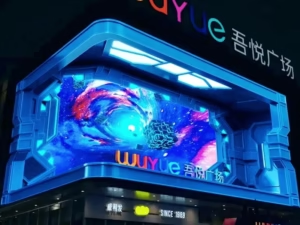
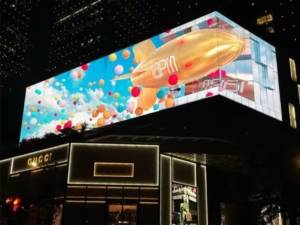
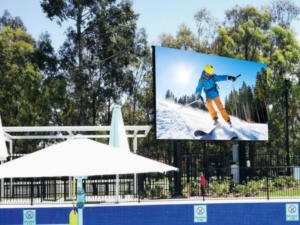
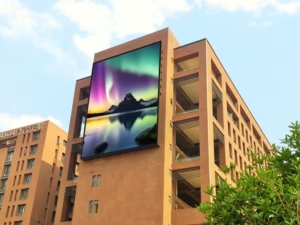
Playlist
Types of Outdoor LED Displays
Outdoor Rental LED Display
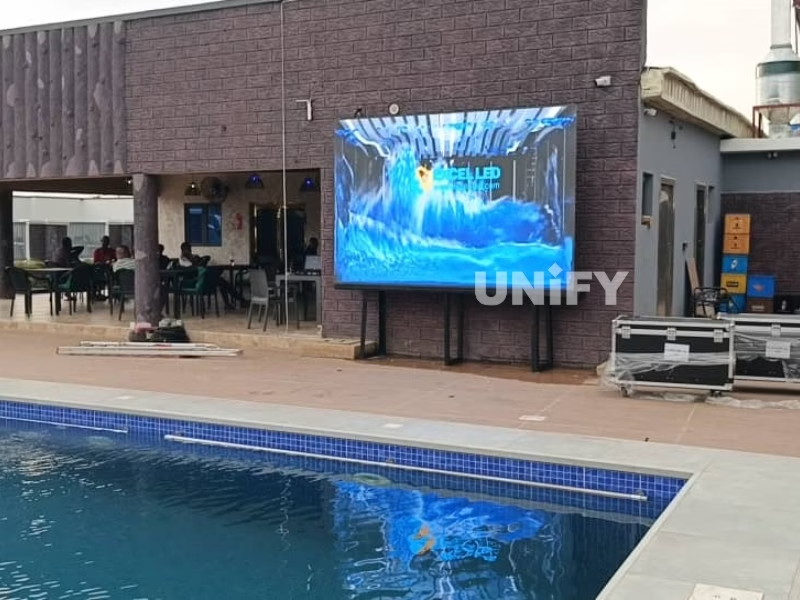
Designed for the fast-paced event industry, our outdoor rental LED display features lightweight die-cast aluminum cabinets and a quick-lock mechanism. This design allows for rapid installation and dismantling, making it the perfect visual solution for touring concerts, music festivals, and temporary outdoor stages where speed and durability are paramount.
Outdoor Fixed LED Display
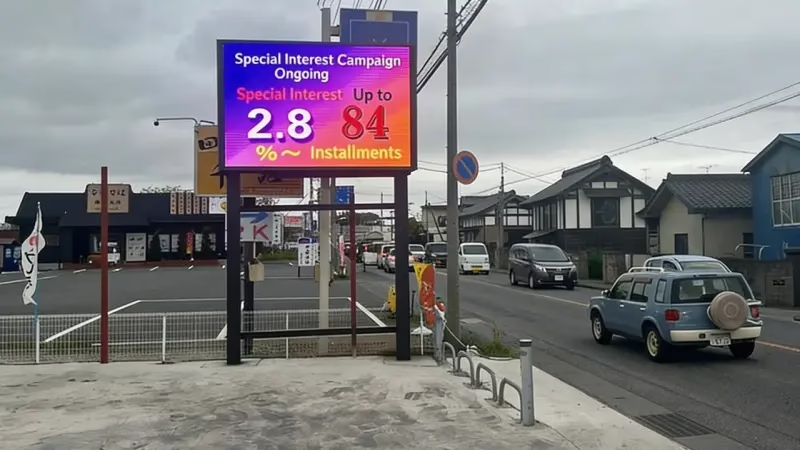
The front maintenance outdoor LED display is the ultimate space-saving solution. Unlike traditional screens that require a rear service channel, this system allows modules and power supplies to be serviced directly from the front. It is ideal for wall-mounted installations on retail stores or buildings where rear access is impossible or too costly to build.
Outdoor Front Maintenance LED Screen
The front maintenance outdoor LED display is the ultimate space-saving solution. Unlike traditional screens that require a rear service channel, this system allows modules and power supplies to be serviced directly from the front. It is ideal for wall-mounted installations on retail stores or buildings where rear access is impossible or too costly to build.
Outdoor Rear Maintenance LED Screen
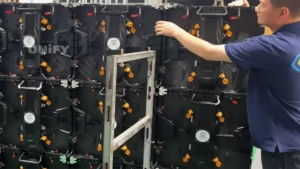
As the industry standard for large-scale digital billboards, the outdoor rear maintenance LED screen is known for its rugged reliability and superior heat dissipation. Featuring secure rear-opening doors, this design offers ample internal space for maintenance and cooling. It is the most cost-effective and durable solution for open environments, such as highway monopoles (single pole) or roof-mounted displays where a rear service walkway is available.
Outdoor Naked-3D Billboards
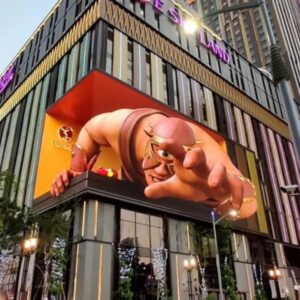
Transform your building into a viral landmark with our Naked-Eye 3D LED screen. Utilizing seamless curved corners and high-precision modules, these displays create stunning, immersive visual effects that pop out of the screen without requiring 3D glasses. It is the most effective way to grab attention in premium commercial districts.

Outdoor LED Pole Screen
Perfect for smart city applications, the outdoor LED pole screen is a compact, high-definition display mounted on street light poles. These screens are managed via cloud control (4G/5G) to display synchronized street ads, traffic information, and weather updates across an entire city network.
Components of Outdoor LED Screens
High Refresh Driver IC
High-Contrast UV Mask
Premium LED Lamp Beads
Industrial-Grade Power Supply
Outdoor LED Display Module
Smart Control System
Common Cathode Energy-Saving PCB
Lamp Type of Outdoor LED Display
SMD Outdoor LED Display
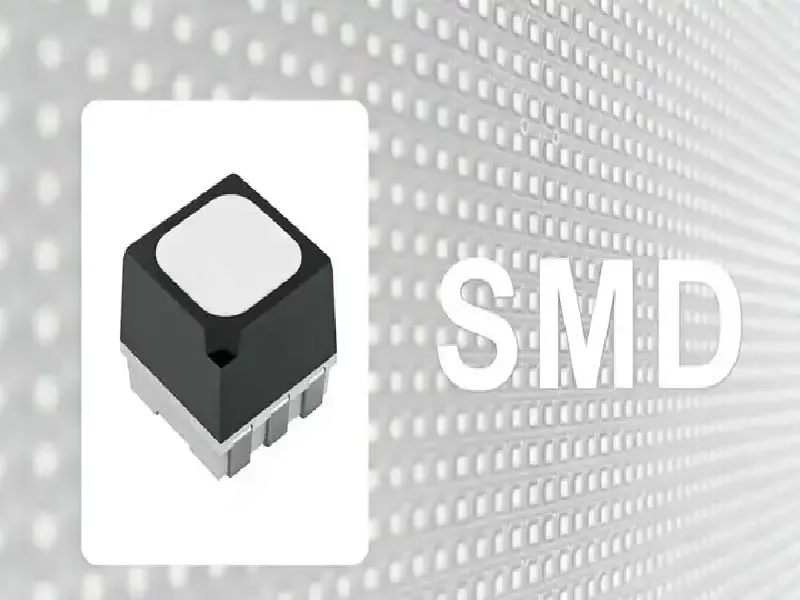
SMD technology encapsulates the RGB chips into a single compact unit mounted directly on the PCB. It is currently the most popular choice for 90% of outdoor projects (P2.5 to P10) because it offers superior color consistency, sharper details, and a wide 140° viewing angle. It is perfect for commercial displays where the audience is relatively close, such as shopping malls and street signage.
DIP Outdoor LED Display
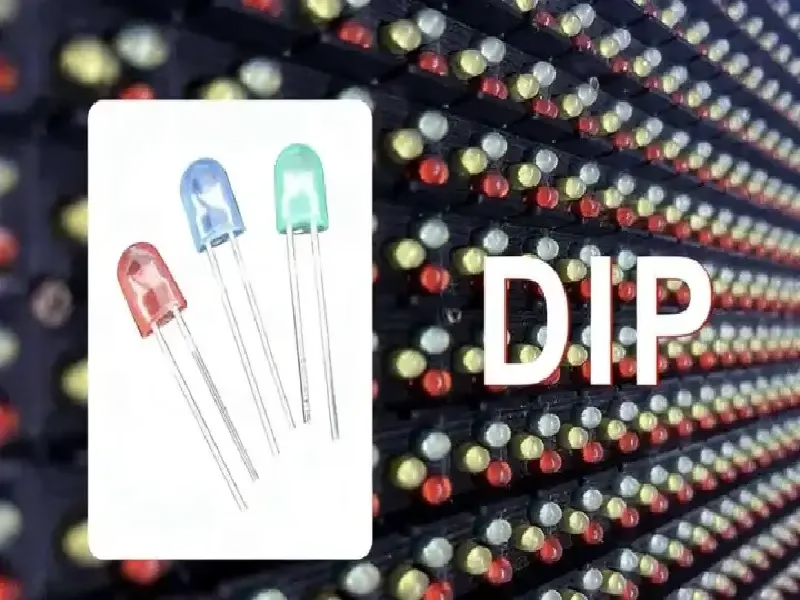
DIP technology features three separate LED bulbs (Red, Green, Blue) and is known for its rugged durability. Its primary advantage is ultra-high brightness (reaching 10,000+ nits), making it the only solution that remains fully visible under direct, intense tropical sunlight. It is ideal for large-scale highway billboards or coastal installations requiring maximum weather resistance and long viewing distances.
Outdoor LED Screen Cabinet Types
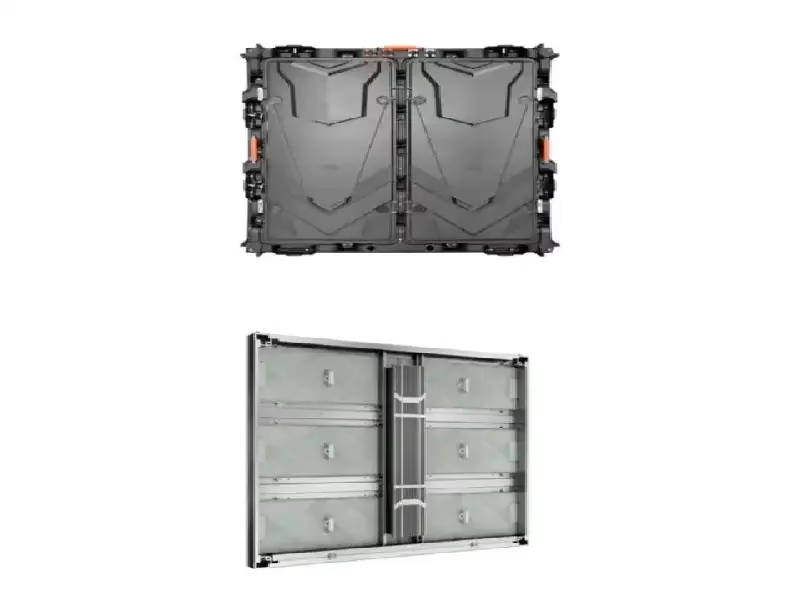
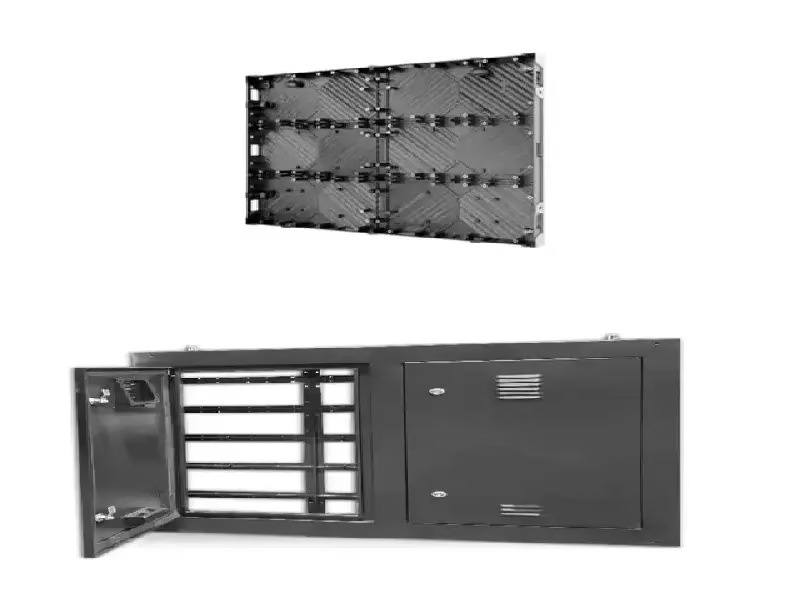
A one-size-fits-all screen doesn’t work for every project. Whether you are installing a massive billboard on a highway or a seamless screen on a glass facade, UnifyLED provides the perfect structural material to match your budget and climate:
For Cost-Efficiency: Our Galvanized Iron cabinets are durable and customizable to any shape (curves/corners), ideal for giant billboards.
For Precision & Rental: Choose Die-Cast Aluminum for a seamless, gap-free surface and lightweight portability.
For Extreme Climates: We offer Aluminum Profile (rust-proof for coastal areas) and Magnesium Alloy (ultra-lightweight) options to withstand salt spray and reduce structural load.
The Ultimate Guide to High-Performance Outdoor LED Displays
Stop settling for displays that fade under the sun or fail in the rain. At UnifyLED, we manufacture outdoor LED screens designed to withstand the harshest environments while delivering crystal-clear visuals. Whether you are a system integrator looking for a custom digital billboard or an event organizer needing a robust rental screen, our solutions guarantee visibility and durability.
1. What is an Outdoor LED Display?
An Outdoor LED Display (often referred to as an outdoor digital billboard, LED video wall, or electronic sign) is a large-format digital communication tool designed specifically for exterior environments. Unlike indoor screens, these displays are engineered to withstand harsh weather conditions while delivering brilliant, dynamic visuals that remain visible even under direct sunlight.
At its core, an outdoor LED display is composed of three main layers:
LED Modules: The basic unit containing thousands of individual Light Emitting Diodes (LEDs) arranged in specific pixel pitches (resolution).
Cabinets: The structural housing that connects modules together, providing power, data signal, and weather protection.
The Seamless Screen: Multiple cabinets are spliced together to form a single, massive screen of unlimited size and shape.
However, what truly defines an outdoor LED display is not just its size, but its ability to overcome environmental challenges. To be classified as a true outdoor solution, the screen must possess three critical characteristics:
Ultra-High Brightness: Standard TVs or indoor screens typically offer 300–800 nits of brightness, which look black or washed out outside. A professional outdoor LED screen utilizes high-intensity SMD or DIP LEDs to achieve 5,000 to 10,000 nits of brightness, ensuring content is readable and vibrant even when facing the sun directly.
Rugged Weather Resistance (IP Rating): These displays are built with robust waterproof and dustproof enclosures (typically IP65 or IP68 rated). This ensures they can operate stable 24/7, regardless of heavy rain, snow, sandstorms, or extreme heat.
Optimized Viewing Distances: Outdoor displays use specific Pixel Pitches (such as P2.5, P3.9, P5, P6, P8, or P10) tailored for longer viewing distances. This ensures that the image looks smooth and sharp whether the audience is standing 5 meters away or driving by on a highway 100 meters away.
In summary, an outdoor LED display is the modern replacement for static print billboards—a durable, high-visibility digital canvas that allows brands and businesses to broadcast video, text, and images to a mass audience, day or night.
2. What Can Outdoor LED Screen Do for You?
Investing in an Outdoor LED Display is not just about buying a screen; it is about acquiring a powerful asset that transforms how your business communicates with the world. Compared to traditional static billboards, digital solutions offer distinct advantages:
Grab Attention Instantly:
Human eyes are naturally drawn to moving images and bright lights. An outdoor LED screen supports dynamic video, animation, and high-resolution graphics, making your message significantly more eye-catching than a static poster.Unmatched Visibility, Day & Night:
With high brightness capabilities (over 5,000 nits), your content remains crystal clear even under direct sunlight. At night, the screen automatically adjusts to a comfortable brightness, ensuring your brand is visible 24/7 without interruption.Instant Content Updates (Cost-Saving):
Say goodbye to printing costs and installation fees for every new campaign. With an outdoor LED display, you can update advertisements, promotions, or public announcements in seconds via a computer or smartphone—anytime, anywhere.Higher ROI & Revenue Generation:
For media companies, a single digital LED billboard can rotate ads for multiple clients, multiplying revenue streams from one location. For retail owners, it drives foot traffic directly into your store by displaying real-time sales and offers.
3. What Using Scenarios Can You Apply to Outdoor LED Display?
Thanks to modular design and high adaptability, an outdoor LED display serves diverse industries. From functional information boards to high-end visual landmarks, here are the most common application scenarios:
Commercial Landmarks & Retail Centers (Naked-Eye 3D):
This is the modern standard for shopping malls and flagship stores. Beyond standard flat screens, businesses are increasingly adopting L-shaped corner screens or curved outdoor LED displays on building facades. These creative shapes support Naked-Eye 3D content, transforming a building into a viral social media landmark and driving massive foot traffic to commercial districts.DOOH (Digital Out-of-Home) Advertising:
Seen on highways, rooftops, and busy intersections, these digital billboards are the backbone of the advertising industry. They allow media owners to replace static prints with dynamic video ads, managing content remotely and maximizing revenue by rotating multiple advertisers on a single screen.Sports Stadiums & Arenas:
Essential for the fan experience, outdoor LED screens are used as giant scoreboards, perimeter banners, and center-hung displays. They provide live game feeds, instant replays, and sponsor visibility, ensuring every seat in the house has a perfect view.Transportation & Public Information:
Reliability is key here. Outdoor LED displays are deployed at airport entrances, train stations, and highway gantries to display real-time traffic updates, weather warnings, and wayfinding information, operating 24/7 in all weather conditions.
4. Key Technical Technologies of Outdoor LED Displays
Understanding the core technologies behind an outdoor LED display is crucial for making a smart investment. It’s not just about the screen size; the underlying tech determines the display’s visual performance, lifespan, and operational costs.
SMD vs. DIP Technology: Which One to Choose?
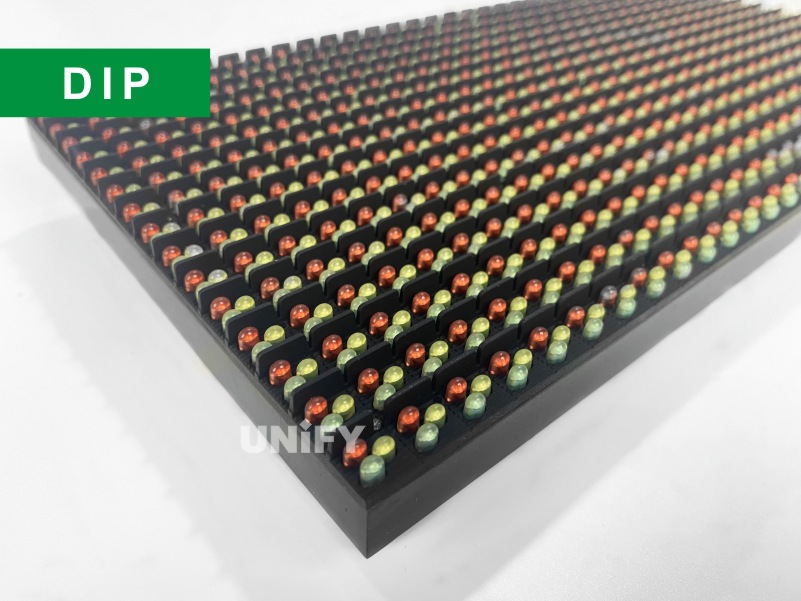
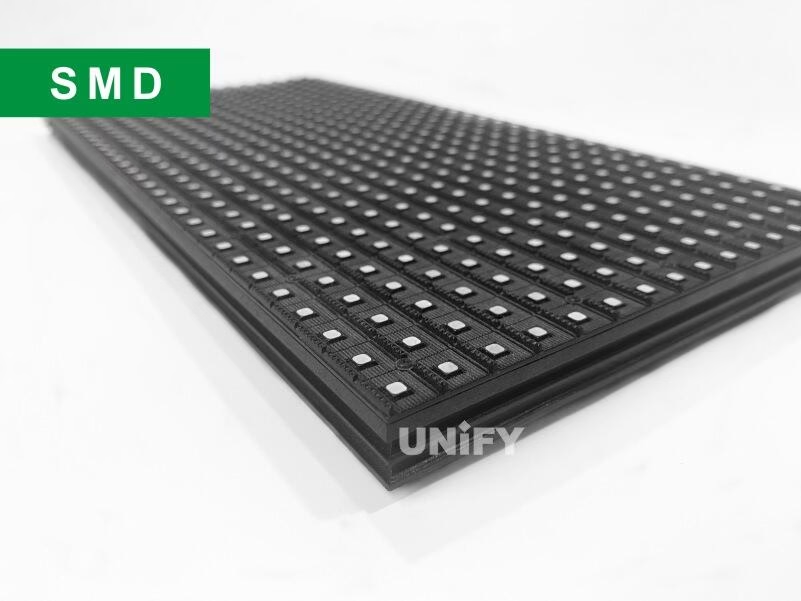
In the world of outdoor screens, two encapsulation technologies dominate: DIP (Dual In-line Package) and SMD (Surface Mounted Device).
DIP LED: The traditional “old-school” technology. The red, green, and blue bulbs are separate.
Best for: Extremely harsh environments and huge viewing distances (P10 or larger). It is known for ultra-high brightness and ruggedness.
SMD LED: The modern standard. The RGB chips are encapsulated in a single tiny square on the PCB.
Best for: Most modern outdoor LED displays (P2.5 to P10).
Advantage: SMD offers wider viewing angles (140°+) and better color consistency compared to DIP. It allows for higher resolution (smaller pixel pitch), making the image look sharp even from close distances.
Common Cathode Energy Saving Technology
Power consumption is often the biggest concern for outdoor screen owners. To solve this, premium outdoor LED displays now utilize Common Cathode technology.
How it works: Unlike traditional “Common Anode” displays that supply constant voltage to all chips, Common Cathode supplies precise, separate voltages to the Red, Green, and Blue chips (since the Red chip needs less voltage).
The Benefit: This precision reduces wasted power, cutting energy consumption by 30% to 50%. Less wasted energy means less heat generation, which creates a “Cold Screen” effect, significantly extending the lifespan of the LEDs and reducing the need for noisy cooling fans.
High Brightness & Smart Auto-Dimming
Visibility is the lifeline of outdoor advertising.
Sunlight Readability: A standard outdoor screen must deliver at least 5,000 to 6,000 nits of brightness to compete with daylight. For locations facing direct sunlight, high-brightness models reaching 8,000 to 10,000 nits are recommended to ensure the image never looks washed out.
Light Sensors (Auto-Dimming): While high brightness is essential during the day, it can be blindingly bright at night. A reliable outdoor LED display system includes a light sensor. It automatically detects ambient light levels and adjusts the screen brightness in real-time. This not only prevents light pollution complaints but also saves energy and protects the LED chips from overwork.
5. How Can You Install & Maintain the LED Displays?
A successful outdoor LED display project isn’t just about the screen itself; it requires a robust installation structure and a clear maintenance plan. The installation method you choose will directly dictate which type of cabinet design (Front or Rear Access) you need to purchase.
Common Installation Methods
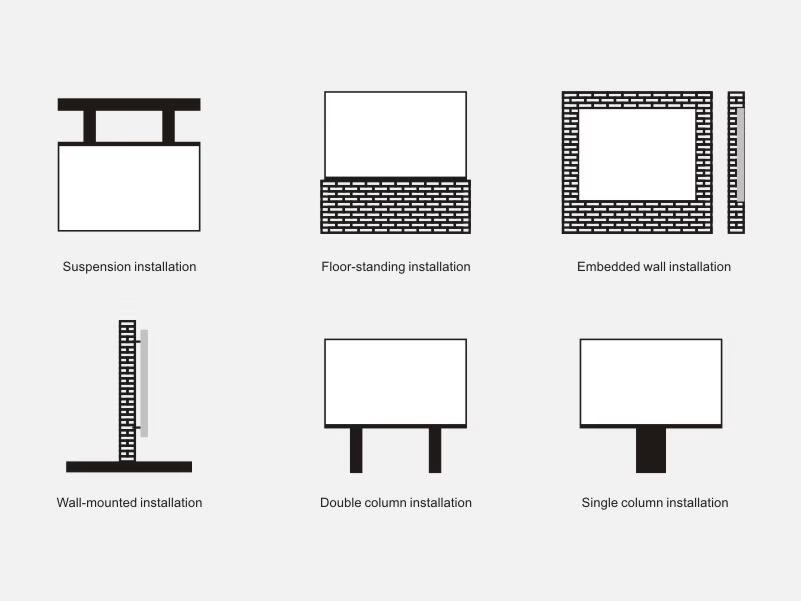
Since outdoor screens are heavy and exposed to wind loads, they typically require a custom-engineered steel structure. Common mounting styles include:
Wall-Mounted: The screen is attached directly to the facade of a building. This is the most popular choice for shopping malls and corporate branding.
Pole / Column Mounted: A freestanding structure, often seen alongside highways or in plazas. It can be a Single Pole (for smaller screens) or Double Pole (for massive digital billboards).
Roof-Mounted: Installed on the top of buildings to maximize visibility from long distances. This requires a strong wind-resistant steel frame.
Hanging / Truss System: Primarily for rental or temporary events, where the outdoor LED display is suspended from a truss beam.
The Critical Choice: Front Access vs. Rear Access Maintenance
Before ordering your screen, you must determine how you will access the internal components (power supplies, receiving cards, and modules) if a repair is needed.
1. Rear Maintenance (The Traditional Choice)
Rear maintenance cabinets feature doors or removable panels on the back.
Scenario: Ideal for Pole-mounted displays or Roof-mounted screens where there is plenty of open space behind the screen.
Requirement: You must leave a “catwalk” or a service channel (usually 60-80cm wide) behind the screen structure for a technician to walk in and open the cabinet doors.
Pros: typically more cost-effective; excellent heat dissipation.
2. Front Maintenance (The Space-Saving Choice)
Front maintenance allows you to remove LED modules and components from the front side using simple tools (like a magnetic tool or hex key).
Scenario: Essential for Wall-mounted displays or double-sided screens where there is no space behind the cabinet.
Mechanism: The screen can be mounted flat against the wall, saving valuable installation depth and structural steel costs.
Pros: Sleeker, thinner profile; no need for a rear service channel; easier for technicians to service in tight spaces.
Pro Tip: If your outdoor LED display is going to be mounted directly on a building wall, you must specify “Front Maintenance” to your supplier to avoid costly installation errors later.
6. How to Control Outdoor Advertising LED Display?
The hardware is only half the story; the control system is the brain of your outdoor LED display. Choosing the right control method depends entirely on what kind of content you plan to show and where your screen is located.
Generally, there are two main control architectures:
Synchronous Control System (Real-Time)
This system works exactly like a giant computer monitor.
How it works: The outdoor LED display connects directly to a controlling computer (PC) via an HDMI/DVI cable. Whatever you see on the computer monitor is displayed on the LED screen instantly, pixel for pixel.
Best For: Live events, concerts, sports stadiums, or massive screens (like Times Square) that require ultra-high resolution (4K/8K) and live video feeds.
Note: The controlling computer must remain turned on and connected at all times for the screen to work.
Asynchronous Control System (Store & Play)
This is the most popular choice for advertising.
How it works: The content is uploaded to the screen’s built-in media player or memory card. Once the upload is complete, you can disconnect the computer. The screen will loop the content automatically according to a schedule.
Best For: Standalone outdoor advertising LED displays, street-side digital signage, and shopping mall screens where the content (ads/videos) doesn’t change every second.
Note: It works offline, making it more reliable for remote locations.
The Modern Standard: Cloud & Remote Control (4G/5G/WiFi)
In the past, updating an asynchronous screen meant climbing a pole to plug in a USB drive. Today, smart Cluster Management is the industry standard.
By equipping your outdoor LED display with a 4G/5G module or connecting it to WiFi/LAN, you can manage everything remotely:
Cloud Platform Management: Log in to a web portal or use an App on your phone to publish ads to one screen—or one hundred screens—simultaneously from your office in New York to a display in London.
Real-Time Monitoring: Check the screen’s health status (temperature, power supply) and receive error alerts remotely.
Emergency Interventions: Instantly stop a playlist or insert an emergency public announcement with a single click.
Pro Tip: For most commercial advertising projects (DOOH), we strongly recommend an Asynchronous Dual-Mode System with 4G/5G control. This gives you the flexibility to play stored ads 24/7 but also switch to a live feed (Synchronous mode) for special events if needed.
While the Asynchronous Dual-Mode is popular, the right choice ultimately depends on your specific application scenarios. To help you make the best decision between real-time feeds and standalone players, check out our in-depth analysis of Synchronous vs. Asynchronous LED Control.
7. How to Choose Reliable Outdoor LED Display Suppliers
The market is flooded with LED manufacturers, but the quality gap between a premium supplier and a low-end assembly workshop is massive. An outdoor LED display is a significant financial investment; choosing the wrong partner can lead to frequent failures, safety hazards, and zero after-sales support.
To ensure you are partnering with a reliable manufacturer, evaluate them based on these four critical criteria:
Rigorous Quality Control & Aging Tests
For outdoor screens, durability is non-negotiable. A reputable supplier should not just assemble components but rigorously test them.
The 72-Hour Aging Test: Ask the supplier if they perform a continuous 72-hour white-balance aging test before shipment. This process forces early failures to happen in the factory, not at your installation site.
Waterproof Testing: Ensure they conduct high-pressure water spray tests (IP65/IP68 verification) on every cabinet to guarantee leak-proof seals.
Comprehensive Certifications (CE, EMC, UL, FCC)
Certifications are the passport for international trade and a badge of safety.
If you are in Europe, the supplier must offer CE-EMC and CE-LVD certificates to meet interference and safety standards.
If you are in the USA, ask for UL/ETL or FCC compliance.
A supplier who cannot provide valid, verifiable certificates is a major red flag.
Project References & Case Studies
“Don’t just tell me; show me.”
Ask the supplier for case studies of outdoor LED displays installed in climates similar to yours.
If you are in a coastal area (high salt/humidity) or a desert (extreme heat), check if they have successful projects in those environments. A supplier with a proven track record understands the specific cooling and coating requirements for your region.
Clear Warranty & Spare Parts Policy
Electronics will eventually require maintenance. A reliable supplier focuses on the long-term relationship.
Spare Parts: Do they include free spare modules, power supplies, and cables (usually 1-3% of the total order) for immediate replacements?
Warranty Terms: Look for a standard 2-3 year warranty. Be wary of suppliers offering “5-year warranties” at suspiciously low prices without a local service office to back it up.
Do not decide based on price alone. An outdoor LED display that is 10% cheaper but fails after six months will cost you double in repairs and lost advertising revenue.
8. Key Considerations When Choosing an Outdoor LED Display
Selecting the right outdoor LED display is a balancing act between visual performance and budget. To avoid overspending on unnecessary specs or underspending on a screen that looks pixelated, you need to understand two critical aspects: Price Factors and Viewing Distance.
Factors Influencing the Price
You might find quotes for an outdoor LED display ranging widely, even for the same size. Why? The price is driven by the quality of the raw materials inside:
Pixel Pitch (Resolution): This is the biggest cost driver. A P2.5 screen has 160,000 pixels per square meter, while a P10 has only 10,000. Naturally, the P2.5 screen costs significantly more due to the sheer number of LED lamps and driver ICs required.
Advice: Don’t chase the smallest pitch blindly. If your screen is on a roof, P8 or P10 is often sufficient and much cheaper.
LED Lamp Quality: The brand of the LED chip (e.g., Nationstar vs. Kinglight vs. No-brand) and the encapsulation material (Gold wire vs. Copper wire) determine the screen’s lifespan and stability. Premium lamps cost more but guarantee less dead pixels over time.
Cabinet Material:
Iron (Steel): Cheaper and heavy. Prone to rust over long periods in coastal areas.
Die-Cast Aluminum: More expensive, but lightweight, rust-proof, and offers better heat dissipation. Highly recommended for premium outdoor LED displays.
Refresh Rate: A standard 1920Hz IC is cheaper, but a high-end 3840Hz or 7680Hz IC (needed for flicker-free camera recording) will increase the cost.
Viewing Distance Calculation: Picking the Right Pixel Pitch
The “Pixel Pitch” (e.g., P3, P5, P8) refers to the distance in millimeters between two LED clusters. The rule of thumb is simple: The larger the pitch, the farther the viewing distance should be.
How do you calculate the perfect pitch for your project? Use these standard formulas:
1. Minimum Viewing Distance (The “Pixelation” Line)
Formula: Pixel Pitch (mm) × 1 = Minimum Distance (meters)
Example: For a P6 outdoor LED display, the minimum viewing distance is 6 meters. If viewers stand closer than 6 meters, they will see individual dots (pixels).
2. Best/Optimal Viewing Distance (The “HD” Experience)
Formula: Pixel Pitch (mm) × 3 = Optimal Distance (meters)
Example: For a P6 screen, the image looks smoothest and truly high-definition from 18 meters away.
Conclusion:
If your audience is walking right past the screen (e.g., a bus stop or street-level store), choose P2.5, P3, or P4.
If your audience is driving by or the screen is mounted high on a building (e.g., a digital billboard), P6, P8, or P10 provides the best balance of cost and performance.
9. Conclusion: The Future of Your Visual Communication
Investing in an outdoor LED display is a significant decision that blends engineering, marketing, and architectural aesthetics. Whether you are aiming to create a landmark with a Naked-Eye 3D screen, generate revenue through a digital billboard, or enhance fan engagement in a stadium, the success of your project relies on three pillars: Visibility, Durability, and Reliability.
As we have explored, the cheapest option is rarely the most cost-effective in the long run. Factors like Common Cathode technology for energy saving, high-quality SMD lamps for longevity, and robust IP65/68 weatherproofing are what separate a professional display from one that fails within a year. By understanding the technical nuances—from pixel pitch calculations to maintenance access—you are now equipped to make an informed choice that ensures high ROI and minimal downtime.
10. FAQS
It depends on viewing distance. A simple rule: use P2.5 to P4 for close viewing (3-10m) like street shops, and P6 to P10 for long-distance viewing (15m+) like highway billboards.
Yes. Unlike standard TVs, our outdoor displays use high-intensity LEDs (6,000+ nits) to ensure the image remains crystal clear and vibrant, even at noon.
Absolutely. Our screens are IP65/IP68 rated, designed to withstand heavy rain, dust storms, and temperatures from -40°C to +60°C without needing extra protection.
No. You can update content wirelessly via WiFi, 4G, or Cloud. Manage your screen from a smartphone or laptop anywhere in the world—no technical skills required.
Not with UnifyLED. We use Common Cathode technology and auto-dimming sensors, which reduce power consumption by up to 30-50%, saving you significant energy costs annually.
11. Partner with UnifyLED for Your Outdoor Display Solution
At UnifyLED, we don’t just sell screens; we engineer visual experiences. We understand that every installation environment is unique, from the freezing winds of Northern Europe to the scorching heat of the Middle East.
Why Choose UnifyLED?
Factory-Direct Manufacturing: We control the entire production process, ensuring strict quality control and competitive pricing without middleman markups.
Custom Engineering: Whether you need a curved screen, a 90-degree corner display, or a specific pixel pitch, our R&D team designs solutions tailored to your structure.
Global Support: From the initial consultation and structural drawing assistance to remote configuration and after-sales spare parts, we support you at every step.
Ready to bring your project to life?
Stop searching and start projecting. Contact our team today for a free consultation and a detailed quote based on your specific project requirements.