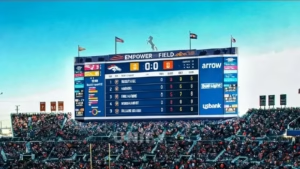
The Ultimate Giant LED Display Analysis: Price, Rental & Engineering
- Home
- »
- LED Screen Buying Guides
- »
- The Ultimate Giant LED Display Analysis: Price, Rental & Engineering
Table of Contents
In the realm of modern urban architecture and high-stakes commercial branding, the giant led display has emerged as the ultimate medium for visual dominance. No longer confined to the iconic glitz of Times Square, a high-quality giant screen led is now a fundamental asset for stadiums, shopping malls, and corporate landmarks worldwide.
This evolution toward the led giant screen reflects a growing demand for immersive, large-format digital experiences that command attention from miles away. Whether it is a soaring 3D billboard on a city skyscraper or a massive video wall in a sports arena, these installations do more than just show images; they transform local landscapes into high-revenue digital hubs.
While many professionals use these terms interchangeably with a jumbotron screen, a modern giant led display project requires a deeper understanding of technical execution, ROI analysis, and engineering safety. In this guide, we will move beyond the basic definitions to explore the real-world costs, rental vs. purchase strategies, and the structural secrets behind the world’s most successful giant screen installations.
1. What is the Real Giant LED Display Cost and Price in 2026?
For B2B buyers and project managers, understanding the giant led screen price is the most critical step in the procurement process. However, a common mistake is looking only at the bottom-line figure without analyzing the “Bill of Materials” (BOM). In 2026, the giant led screen cost is no longer just about the size; it is a complex calculation of three core components that determine the long-term ROI of your giant led display.
The "Price Pyramid": Why Do Quotes Vary So Much?
To understand why one quote might be 30% higher than another for the same pixel pitch, we must look at the internal components:
The LED Lamps (The Heart): High-end giant led display projects typically use Nationstar gold-wire LEDs for superior color stability and a lifespan exceeding 100,000 hours. Cheaper alternatives using copper-wire LEDs can reduce the initial giant led screen cost but lead to faster brightness decay and higher failure rates in harsh outdoor environments.
The Driver IC (The Brain): To achieve a professional 3840Hz high refresh rate—essential for flicker-free performance on cameras—premium driver ICs are required. This is a major factor in the giant led screen price for stadium or broadcasting applications.
The Cabinet Engineering: Standard iron cabinets are cost-effective for fixed billboards, but die-cast aluminum cabinets, while increasing the price, offer better heat dissipation and structural precision for seamless large-scale installations.
2026 Reference Price Guide by Model
While the jumbotron screen pillar page provides a general overview of project budgeting, the following table breaks down the current factory-direct price estimates for the most popular outdoor giant led display models per square meter:
Model (Pixel Pitch) Estimated Price Range (USD/sqm) Best Use Case P6 Outdoor $1,000 – $1,800 High-end retail & close-viewing city billboards P8 Outdoor $900 – $1,500 Medium-sized stadium screens & shopping malls P10 Outdoor $800 – $1,200 Large-format highway billboards & giant event screens Note: These prices are estimates for 2025-2026 and can vary based on the specific customization of brightness (Nits) and protection ratings (IP65/IP66).
By focusing on these technical “why” factors, investors can avoid the trap of low-quality, high-maintenance products. If your goal is a permanent installation that maintains its value, focusing on the quality of the internal components is just as important as the initial giant led screen price.
2. Why Choose Buying Over Giant LED Display Rental for Your Events?
For many event organizers and venue owners, the initial thought when planning a festival, crusade, or product launch is to look for a giant led screen rental. While renting provides a short-term solution without the need for storage, the long-term financial reality often tells a different story. If you are a recurring event organizer, transitioning from a giant led screen rental model to a purchase model is the single most effective way to increase your project’s ROI.
The "Rental Trap": Calculating the Long-Term Cost
Daily rates for a high-quality giant led display can be staggering. In major event hubs, for example, if you are searching for a giant led screen rental Houston or Los Angeles, you might find that a single 3-day event can cost anywhere from $5,000 to $15,000 including setup and labor.
Here is the ROI math that most rental companies won’t tell you:
The 3-Event Rule: For the price of three or four professional rentals, you can often purchase a brand-new, factory-direct giant led display from UnifyLED.
Asset vs. Expense: A rental is a “sunk cost” that leaves you with nothing after the event. Purchasing creates a digital asset that you can lease out to other organizations when you aren’t using it, turning a cost center into a profit center.
Ownership Means Control
While our jumbotron screen guide explains the logistics of renting for one-off stadium events, owning your hardware offers technical advantages that rental houses cannot match:
Zero Configuration Time: Your team becomes experts on your specific giant led display setup, reducing onsite troubleshooting.
2026 Customization: When you buy, you can specify the exact pixel pitch (e.g., P3.91 vs P4.81) and brightness levels that fit your specific venue, rather than settling for whatever the rental company has in stock.
Revenue Generation: Beyond your own events, owning a giant led screen rental quality kit allows you to generate advertising revenue 365 days a year.
If you are currently budgeting for a giant led screen rental in Houston, Dallas, or Chicago, we invite you to compare that quote with our factory-direct manufacturing prices. You will likely find that ownership is not only more affordable but a smarter strategic move for your 2026 event calendar.
3. What Makes High-Quality Giant LED Display Panels Weatherproof?
When you see a giant led display standing tall during a heavy rainstorm or under the scorching desert sun, you are witnessing the engineering excellence of the individual giant led screen panels. For any large-scale outdoor project, the “weatherproof” label isn’t just a marketing buzzword—it is a result of rigorous material selection and precise manufacturing processes. Understanding the anatomy of these giant led screen panels is essential for ensuring your investment survives the elements for a decade or more.
The Secret of IP65 Protection
The industry standard for a reliable giant led display is the IP65 rating. But what does that actually mean for the hardware?
The First Digit (6): This represents total protection against dust and solid particles. In high-wind areas, dust can act like sandpaper, eroding the components. High-quality giant led screen panels are vacuum-sealed to prevent any microscopic ingress.
The Second Digit (5): This indicates protection against low-pressure water jets from any angle. Whether it’s a tropical storm or a routine cleaning, the panel’s internal circuitry remains bone-dry.
Advanced Encapsulation and Potting Processes
While our jumbotron screen guide touches on the broad concept of outdoor durability, the real magic happens at the module level. High-performance giant led screen panels utilize a specialized “potting” process. This involves a dual-layer silicone or epoxy resin coating that covers the PCB (Printed Circuit Board). This layer acts as a thermal conductor and a moisture barrier, preventing the “popcorn effect” where humidity causes LEDs to fail under heat.
Furthermore, the “Mask” (the plastic front cover) is treated with UV-resistant chemicals. Without this, a giant led display would become brittle and lose its deep black contrast under constant sun exposure, leading to a “washed-out” look in just a few years.
Cabinet Integrity: Aluminum vs. Iron
The structural housing of the giant led screen panels also plays a role in weatherproofing. While iron cabinets are a cost-effective choice for fixed billboards, aluminum die-cast cabinets offer superior corrosion resistance, especially in coastal “salt-mist” environments. By choosing panels with high-quality thermal management, you reduce the need for external cooling fans, which are often the first point of failure in a waterproof system.
By diving deep into the technical build of these giant led screen panels, it becomes clear why some displays look brand new after five years while others begin to fail. For the ultimate outdoor reliability, every technical layer—from the LED lamp encapsulation to the cabinet seal—must be engineered for the extremes.
4. How to Maximize Revenue via Giant LED Screen Advertising?
Investing in a giant led display is more than just a hardware purchase; it is the acquisition of a high-value digital asset capable of generating consistent cash flow. To truly maximize the return on investment (ROI), media owners must look beyond the screen and understand the operational mechanics of giant led screen advertising. In a world dominated by Digital Out-of-Home (DOOH) media, the profitability of your screen depends on how effectively you can sell “pixels and time.”
The Business Model: Selling Impressions in Slots
Successful giant led screen advertising typically operates on a “loop” or “slot” model. Instead of selling a screen to a single advertiser, owners divide an hour into multiple 15-second or 30-second slots.
Programmatic Integration: Modern displays allow for programmatic ad buying, where brands can bid for screen time in real-time based on traffic or time of day.
High-Traffic Positioning: While our jumbotron screen guide focuses on event-based engagement, permanent advertising displays rely on “dwell time”—placing the giant led display at busy intersections or shopping districts where commuters are forced to see the content.
Why Brightness (Nits) is a Commercial Currency
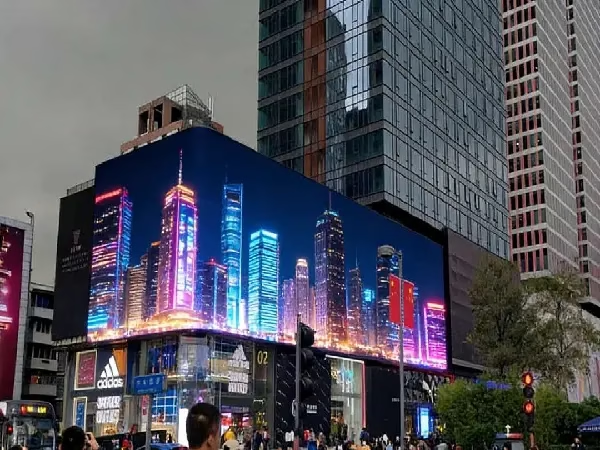
In the advertising world, visibility equals value. This is where technical specs meet financial gain.
The Premium of Sunlight Readability: A standard outdoor screen might offer 5,000 nits, but a premium giant led display reaching 8,000 to 10,000 nits can maintain vivid colors even in direct midday sun.
Higher Ad Rates: Advertisers are willing to pay a premium for “Prime Time” (daylight hours). If your giant led screen advertising remains sharp and bright when others look washed out, you can charge 20-30% more for those high-visibility slots.
Dynamic Content and 3D Anamorphic Ads
To command the highest rates in 2026, the content must be as impressive as the hardware. We are seeing a massive surge in “Naked-eye 3D” advertisements. By utilizing a curved or corner giant led display, you can host 3D anamorphic content that goes viral on social media. This “viral effect” increases the brand’s exposure exponentially, allowing the screen owner to justify premium sponsorship packages that far exceed the revenue of traditional flat billboards.
By treating your giant led display as a high-performance advertising platform rather than just a monitor, the path to recouping your initial investment becomes much shorter. While the technical build as detailed in our stadium jumbotron technical resource, the true “soul” of the product is its ability to turn every bright pixel into a profitable advertising moment.
5. How to Make a Giant LED Screen Installation Safe and Permanent?
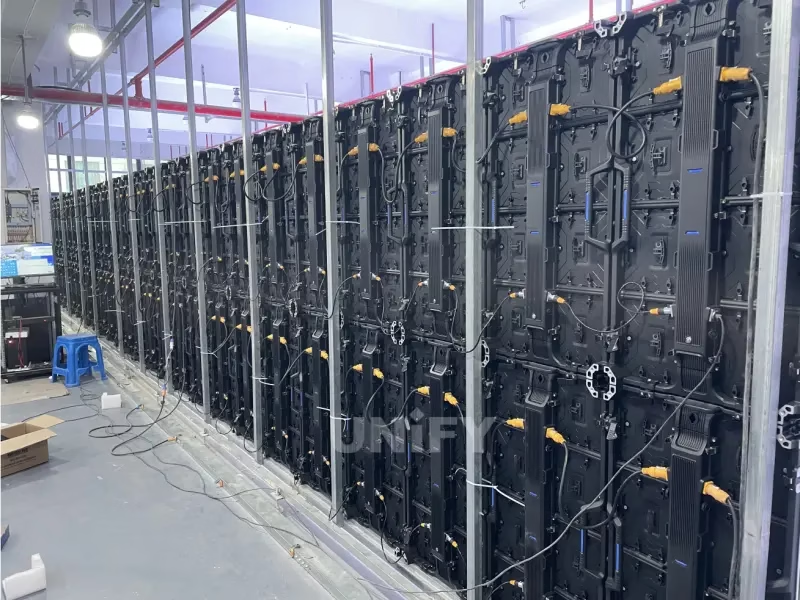
When industry professionals search for how to make a giant led screen, they are rarely looking for a DIY guide to soldering LEDs. Instead, they are seeking the complex engineering protocols required to transform thousands of individual panels into a safe, permanent, and functional landmark. A successful giant led display project is 50% hardware and 50% on-site engineering. To ensure your installation survives decades of environmental stress, you must focus on three pillars of implementation: the steel structure, power distribution, and thermal management.
Structural Engineering: The Skeleton of the Giant
The first step in how to make a giant led screen permanent is the design of the steel support structure. Unlike a standard TV, a giant led display can weigh several tons and acts as a massive “sail” against the wind.
Wind Load Calculations: Professional installers must calculate the maximum wind pressure based on local climate data. A structure designed for a giant led display in a hurricane-prone coastal area requires significantly different reinforcement than one in an indoor arena.
Precision Alignment: Even a 1mm deviation in the steel frame can cause visible gaps in the LED modules. Using high-precision mounting brackets is essential for achieving that “seamless” look.
Power Distribution: Managing High Wattage
A common hurdle in how to make a giant led screen operational is managing the massive electrical load. A 100-square-meter screen can pull hundreds of kilowatts at peak brightness.
PLC Power Systems: We utilize intelligent power distribution cabinets (PLC-controlled) that power up the screen in stages rather than all at once, preventing a surge that could trip the venue’s main circuit breakers.
Redundancy: For mission-critical displays, we implement dual-power supply backups, ensuring that if one power unit fails, the giant led display remains lit.
Thermal Management: Preventing Heat Fatigue
If you want to know how to make a giant led screen last for over 100,000 hours, the answer is cooling.
Active vs. Passive Cooling: For massive outdoor billboards, we design the rear enclosure with high-volume ventilation fans or even industrial air conditioning units.
Heat Dissipation Design: The spacing between the screen and the wall must be sufficient to allow for a “chimney effect,” where hot air naturally rises and exits the structure, protecting the delicate driver ICs from heat-induced failure.
While our jumbotron screen guide provides a high-level overview of display categories and uses, the actual “how-to” of permanent engineering is what separates a professional installation from a temporary fix. By mastering the steel structure, power, and cooling, you ensure that your giant led display remains a safe and vibrant landmark for years to come.
6. Why is the Giant LED Display the Best Asset for Large Venues?
In conclusion, a giant led display is more than just hardware; it is a high-yield digital asset. By balancing the giant led screen cost with professional engineering, you create a vibrant landmark that drives both audience engagement and advertising revenue for decades.
Whether you are currently researching a jumbotron screen for an event or planning a permanent giant led display installation, the key to success is choosing a partner that understands the intersection of hardware quality and structural safety.
At UnifyLED, we specialize in turning massive visions into a giant screen led reality. Ready to transform your venue with the best led giant screen technology? Contact our engineering team today for a custom quote and a structural feasibility study.
7. FAQs
The total giant led screen cost depends on the pixel pitch and total area. For 2026, factory-direct prices typically range from $800 to $1,800 per square meter. However, you must also budget for the steel structure, video processor, and shipping to get a final giant led screen price.
While UnifyLED is a manufacturer, we support many local partners. If you are looking for a giant led screen rental in Houston, Dallas, or Las Vegas, our modular giant led screen panels are the preferred choice for local AV rental houses due to their high refresh rate and easy setup.
Building a permanent display requires professional engineering. When researching how to make a giant led screen, focus on the three pillars: structural safety, power load management, and signal transmission. We provide full CAD drawings and remote technical support to ensure your giant led display installation is successful.
High-quality giant led screen panels using gold-wire LEDs (like Nationstar) have a lifespan of up to 100,000 hours. Proper thermal management and regular maintenance are key to ensuring your led giant screen maintains its brightness for over a decade.