
Contact us
- Home
- »
- LED Screen Buying Guides
- »
- UHD vs QLED: What is the Difference?
UHD vs QLED: What Is the Real Difference for Display Buyers?
The debate of UHD vs QLED remains one of the most misunderstood topics in the display industry. While marketing materials often present these terms as competing choices, they actually refer to different aspects of a screen: UHD defines the resolution density, whereas QLED describes the color-enhancing hardware.
For business owners and project managers, understanding this distinction is essential to avoid costly procurement errors. Selecting the wrong technology often leads to displays that are too dim for retail environments, too small for large venues, or plagued by visible seams.
This article provides a technical breakdown of UHD vs QLED, moving beyond basic definitions to compare real-world performance metrics. We analyze brightness, viewing angles, and lifespan to determine when a standard QLED TV is sufficient, and when the professional capabilities of a UnifyLED Seamless UHD LED Video Wall are required.
Table of Contents
1. What Is the Core Difference in the UHD vs QLED Comparison?
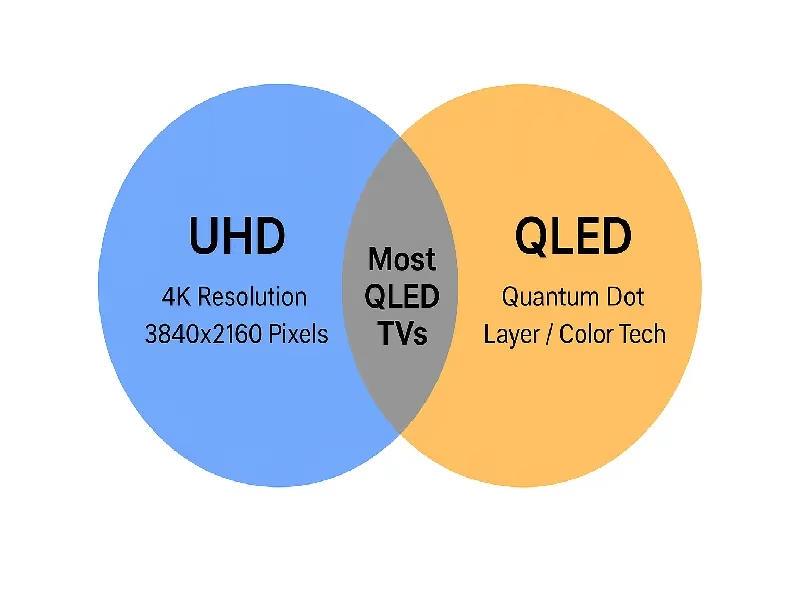
If you are researching display options for your business or home, you have likely encountered the confusing battle of acronyms. A common question we see is: what is the difference between UHD and QLED?
Here is the short, simple answer:
UHD (Ultra High Definition) refers to the resolution (the number of pixels that make up the image), whereas QLED (Quantum Dot LED) refers to the screen technology (the hardware used to create the image).
Comparing them is like comparing “High Speed” (performance) to a “V6 Engine” (hardware). They are not opposites; in fact, they often work together. Understanding this distinction is the first step to choosing the right display solution for your project.
1.1 What Does UHD Mean?
UHD stands for Ultra High Definition. In the current display market, it is most commonly synonymous with 4K resolution.
When a screen is labeled as UHD, it is strictly describing the pixel count. A standard 4K UHD display has a resolution of 3840 x 2160 pixels. This totals roughly 8.3 million pixels on the screen.
Key characteristics of UHD:
Sharpness: With four times the pixel density of standard HD (1080p), details appear incredibly crisp.
Scalability: UHD is a standard that can apply to a 50-inch TV or a massive Unifyled LED video wall.
The B2B Context: In the commercial LED world, achieving UHD resolution isn’t about buying a single panel; it involves calculating the Pixel Pitch (the distance between LED clusters) to ensure your large-scale video wall achieves that clear 4K look.
Above: UnifyLED Ulight Series UHD LED Video Wall installation delivering seamless 4K resolution at scale. Unlike fixed-size QLED panels, modular fine-pitch LED walls achieve true UHD clarity on displays of any dimension.
1.2 What is QLED Technology?
QLED stands for Quantum Dot Light Emitting Diode. Despite the fancy name, it is essentially an enhancement of traditional LCD (Liquid Crystal Display) technology.
How it works:
QLED panels rely on a backlight (usually LED) to shine light through a layer of “Quantum Dots”—microscopic particles that emit precise colors when hit by light. This allows for vibrant colors and higher brightness compared to standard LCD screens.
Key characteristics of QLED:
Color Volume: Known for producing very bright and saturated colors.
Transmissive Tech: It requires a backlight to function (unlike Direct-View LED displays used in commercial signage, which are self-emissive).
Form Factor: QLED is primarily found in fixed-size television panels (e.g., 55″, 65″, up to 98″).
1.3 Why Do People Confuse the Two?
If one is a resolution and the other is a technology, why is there so much confusion regarding the diff between UHD and QLED?
The confusion largely stems from consumer marketing. When you walk into an electronics store, you see stickers saying “UHD TV” next to “QLED TV,” making it look like an “Either/Or” choice.
The Reality:
There is no actual conflict. You don’t have to choose between them.
Most QLED TVs ARE UHD TVs.
A display can be both QLED (technology) and UHD (resolution).
However, for commercial buyers and business owners, the real decision isn’t about these acronyms. The real question is: does a standard QLED TV offer the size, brightness, and durability you need, or do you require a professional UHD LED Video Wall?
Let’s dive deeper into how these technologies perform in real-world scenarios.
2. How Do UHD LED and QLED Displays Compare in Real-World Performance?
Now that we have cleared up the definitions, let’s look at the real-world performance. This is where the difference between a consumer-grade QLED TV and a professional UHD LED display (Direct-View LED) becomes obvious.
While QLED is a fantastic technology for a living room, it often struggles to meet the demands of commercial environments. Here is how they compare in the three areas that matter most: brightness, eye comfort, and durability.
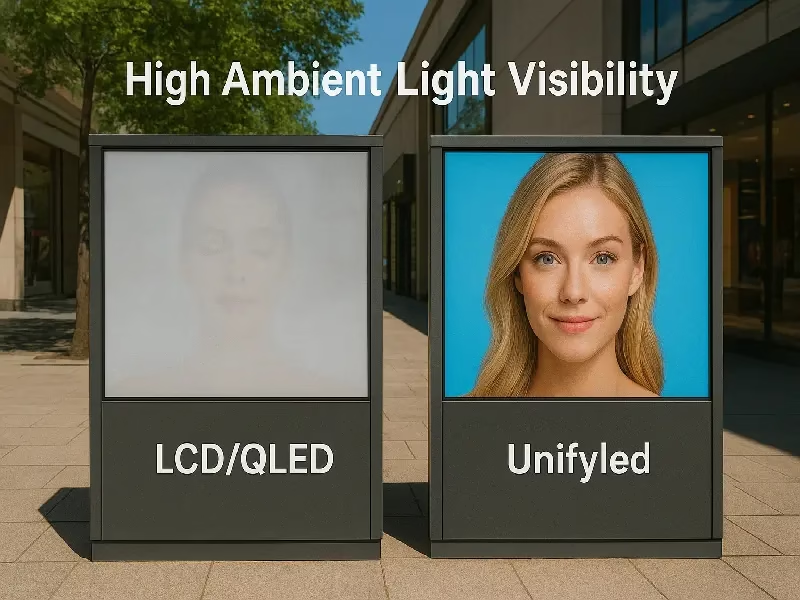
2.1 How Does Brightness Affect Your Choice? (Indoor vs. Outdoor)
Brightness is measured in nits. The amount of ambient light in your space should dictate which technology you choose.
QLED (Best for Controlled Lighting):
High-end QLED TVs typically peak between 1,000 to 2,000 nits. This is excellent for home cinemas or dimly lit offices. However, QLED panels are made of glass, which is highly reflective. If you place a QLED screen in a retail window or a bright lobby with sunlight, the glare will often wash out the image, making it unreadable.Unifyled UHD LED (Best for High Ambient Light):
This is where professional Direct-View LED shines—literally. Unifyled’s commercial LED solutions can easily reach 4,000 to 6,000+ nits (and even higher for outdoor models).
Because LED modules use matte surfaces and self-emitting pixels, they cut through direct sunlight without the mirror-like reflection of glass. If your project involves a shop window, an atrium, or outdoor signage, a standard QLED panel simply cannot compete with the visibility of a high-brightness LED wall.
2.2 Which is Better for Eyes: UHD LED or QLED?
Visual comfort is a critical factor, especially for control rooms, conference halls, or environments where people stare at screens for hours. A frequent question we receive is: uhd vs qled which is better for eyes?
The answer depends on viewing distance and refresh rates.
The “Blue Light” and Flicker Factor:
Many QLED and standard LCD screens use PWM (Pulse Width Modulation) to control brightness, which can cause invisible flickering that leads to eye strain and headaches over time.
In contrast, Unifyled’s UHD LED walls utilize high refresh rate ICs (often 3840Hz or higher). This provides a buttery-smooth, flicker-free experience that is much easier on the eyes during long viewing sessions, such as in security command centers.Viewing Distance Matters:
QLED TVs are designed for close-range viewing (2–4 meters). If you sit too close to a massive LED wall with a large pixel pitch, it might be uncomfortable. However, with Unifyled’s Fine Pitch LED (COB/SMD) technology, we can achieve UHD resolution that looks seamless and soft on the eyes from just a few meters away, offering the best of both worlds without the harsh backlight of LCDs.
2.3 How Durable Are They for 24/7 Commercial Use?
When investing in a display system for business, longevity is key. This brings us to the comparison of uhd led vs qled in terms of lifespan and maintenance.
QLED (Consumer Grade – 6-8 Hours/Day):
QLED TVs are designed for consumer usage patterns. Running a QLED TV 24/7 (as digital signage) can lead to rapid degradation of the backlight or “image retention” (ghosting) if static content is displayed too long. Furthermore, if a component fails, you usually have to replace the entire TV, which is costly and wasteful.Unifyled LED (Commercial Grade – 24/7):
Professional LED displays are built to run 24 hours a day, 7 days a week, for up to 100,000 hours.
The biggest advantage is modularity. If a single pixel or module fails on a Unifyled wall, you don’t replace the whole screen. You simply swap out a small, inexpensive LED module in seconds. This drastically lowers the Total Cost of Ownership (TCO) for businesses compared to replacing large QLED panels every few years.
3. Why the UHD vs QLED Debate Starts with a Flawed Question
Searching online often leads to conflicting information, and one of the most frequent search queries we encounter is: is ultra hd better than qled?
The reason this is a tricky question—and why it ranks so low in clarity for many buyers—is that it is based on a logical fallacy. Asking if Ultra HD is better than QLED is like asking, “Is a fast car better than a red car?”
One describes a measurable standard (speed/resolution), while the other describes a physical attribute (color/technology). To make the best purchasing decision, you need to understand why these two terms cannot be direct competitors.
3.1 Why You Can't Compare Resolution to Technology Directly
Let’s break down the logic to clear up the confusion once and for all:
UHD (Ultra High Definition) is a Format: It strictly refers to the number of pixels on the screen (3840 x 2160). It dictates how sharp the image looks. Whether the screen is made of LCD, OLED, or Unifyled’s Direct-View LED, if it has that pixel count, it is UHD.
QLED is a Hardware: It refers to the materials used to construct the screen (specifically, the Quantum Dot film layer). It dictates how vibrant and bright the colors look.
The Verdict: You cannot say one is “better” than the other because they serve different roles.
UHD makes the picture clear.
QLED makes the picture colorful.
If you have a 1080p QLED screen (rare, but possible), it might have great colors but look blurry up close. Conversely, if you have a cheap UHD LCD screen without QLED tech, it will be very sharp, but the colors might look washed out.
3.2 What Happens When You Combine Them? (UHD QLED TVs)
Since they aren’t enemies, manufacturers almost always combine them.
In today’s consumer market, almost every QLED TV you buy is also a UHD TV. Manufacturers like Samsung, TCL, and Hisense use the QLED technology to display the UHD resolution.
The Result: When you buy a “4K QLED TV,” you are getting the sharpness of UHD combined with the color volume of Quantum Dots. This is currently the gold standard for home entertainment.
But here is the catch for business buyers:
Even though a UHD QLED TV offers a great picture, it is still limited by the physics of being a “TV.” It has a fixed size (maxing out around 98 inches) and fixed aspect ratio.
What if you need UHD resolution but on a scale larger than 100 inches?
This is where the “TV” concept fails, and where Unifyled’s UHD LED Video Walls come into play. We take the sharpness of UHD and apply it to a modular, seamless canvas that can be as large as your wall allows—something a QLED TV simply cannot do.
4. When Should You Choose a UHD LED Wall Over a QLED Panel?
This is the decisive moment for project managers and business owners. While a QLED TV is an excellent “product,” it is often the wrong “solution” for professional environments.
If your project involves a massive viewing area, long viewing distances, or architectural integration, standard QLED technology hits a wall—literally. Here is why switching to a Unifyled UHD LED Video Wall is often the necessary choice.
4.1 Why QLED Has Limitations in Large Spaces
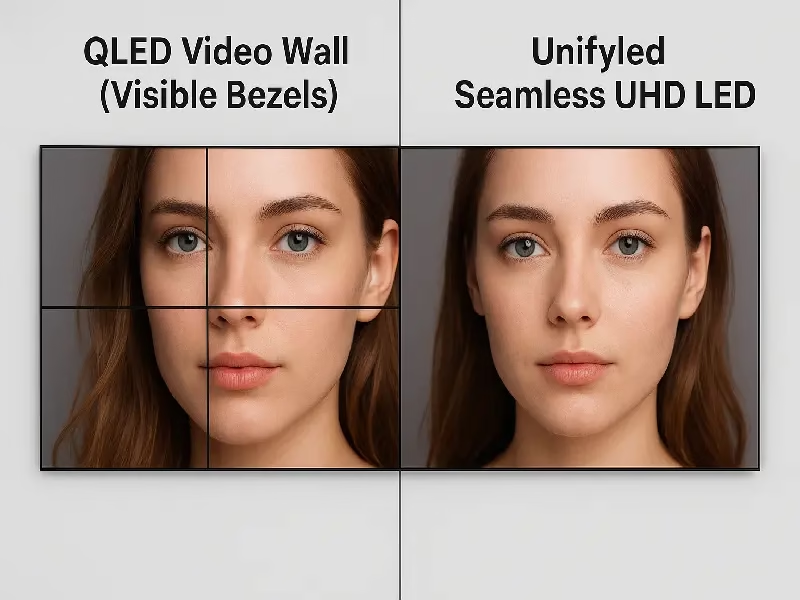
QLED technology is confined to the glass panel it is manufactured on. This creates two major problems for commercial installations: Size Limits and the “Bezel” Problem.
The Size Limit (The 98-inch Ceiling):
Currently, the largest mass-produced QLED TVs max out at around 98 inches. While impressive for a home, a 98-inch screen looks tiny in a large church sanctuary, a hotel lobby, or a conference hall. While QLED panels offer great detail, they are limited by glass substrate sizes. For massive, seamless video walls, manufacturers use a different structural approach. Learn how modular cabinets and COB technology work in our Mini LED vs QLED comparison.Logistics Nightmare: Transporting a single 98-inch glass panel is risky and often requires cranes or freight elevators that are too small. Unifyled LED walls, however, are built from small, modular cabinets, making them easy to transport and install in any space of any size.
The “Bezel” Problem (The Grid Effect):
To create a screen larger than 98 inches using QLED technology, you have to stack multiple screens together (a traditional LCD video wall). The problem? Bezels.
Even the thinnest QLED frames create a visible black grid across your image. This “grid” breaks up text, ruins facial details in videos, and destroys the immersion.
The Unifyled Solution: Our Direct-View LED technology is 100% Seamless. Whether the wall is 150 inches or 500 inches wide, there are no black lines—just one continuous, stunning UHD image.
4.2 How Unifyled Achieves UHD Resolution on Large Walls
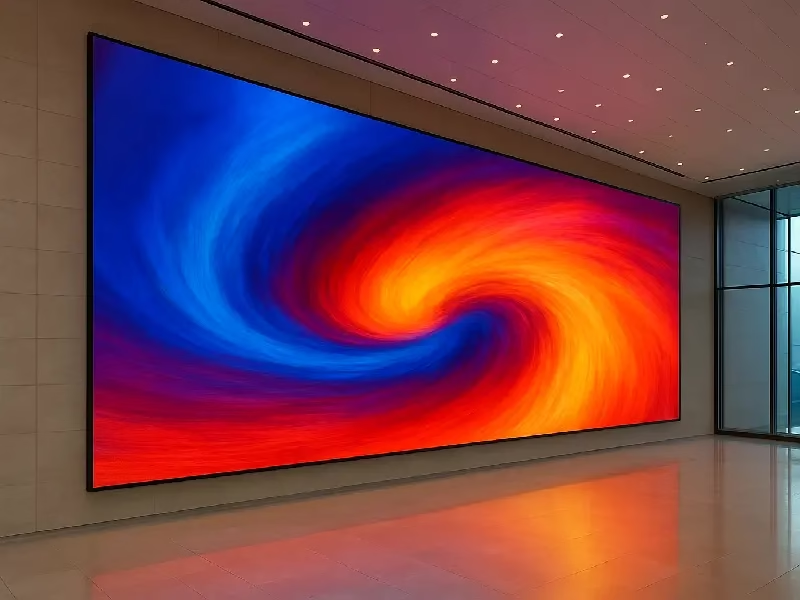
A common misconception is that LED walls are “low resolution” compared to QLED. This is outdated thinking. With modern Fine Pixel Pitch technology, we can build displays that match or exceed standard UHD resolution.
Unlike a QLED TV where the resolution is fixed, Unifyled allows you to build your resolution by choosing the right Pixel Pitch (the distance between pixels).
How to build a 4K UHD Wall:
To achieve a true 3840 x 2160 (4K UHD) resolution, we calculate the screen size based on the pitch:
P0.9 (0.9mm pitch): Achieves 4K resolution on a screen roughly 163 inches wide. (Ultra-high definition for close viewing).
P1.2 (1.2mm pitch): Achieves 4K resolution on a screen roughly 220 inches wide. (Perfect for conference rooms).
P1.5 – P2.5: Ideal for massive auditorium walls where the viewing distance is further back, providing a crystal-clear UHD perception without the high cost of finer pitches.
Above: CPS Pro Max COB LED Display with high-precision fine-pitch technology. The modular architecture allows builders to achieve UHD resolution at any scale by selecting the appropriate LED pixel pitch — from P0.9 for close-range viewing to P2.5 for large auditorium walls.
4.3 Where are UHD LED Displays Used Best?
Based on the advantages of seamlessness, high brightness, and unlimited size, here are the top scenarios where Unifyled’s LED technology beats QLED every time:
Control Rooms & Command Centers:
Security and data operators need to view complex maps and text without bezels cutting off critical information. A seamless P1.2 UHD LED wall ensures zero data loss and 24/7 reliability.Churches & Houses of Worship:
To engage a congregation of hundreds or thousands, a 98-inch QLED is invisible. Churches need massive, bright screens (often 200+ inches) to display lyrics and live feeds clearly to the back row.Flagship Retail Stores:
Brands use Unifyled displays to create “experience zones.” High-brightness LED walls can compete with shop window daylight and can be built into custom shapes (pillars, curves, corners) that rigid QLED panels simply cannot accommodate.
Above: Ultra HD LED Screen transforming live sports viewing. For stadiums and arenas requiring 24/7 operation at massive scale, UnifyLED stadium LED displays deliver the brightness and durability that consumer QLED panels cannot match.
5. UHD vs QLED: Frequently Asked Questions
No. "Crystal UHD" is Samsung’s marketing term for their entry-level standard LCD TVs. QLED is superior in almost every way: it offers much higher brightness, better color volume, and deeper contrast. Think of Crystal UHD as the "budget" option and QLED as the "performance" option.
Technically yes, but we don't recommend it. Connecting multiple QLED TVs creates a grid of visible black lines (bezels) that ruin the image. For a truly seamless experience in a large space, a Unifyled Direct-View LED wall is the only way to get a continuous picture without seams.
Standard QLED TVs are rated for about 60,000 hours of home use. However, running them 24/7 often leads to backlight failure or burn-in. In contrast, Unifyled’s commercial LED displays are engineered for 100,000+ hours of continuous operation, making them far more durable for business environments.
For dark rooms, OLED is best due to low blue light. However, in bright offices or control rooms, a High-Refresh Rate LED Wall (3840Hz+) is superior to standard QLED. It eliminates invisible flicker that causes eye strain during long shifts, whereas many QLED TVs use PWM dimming that can tire the eyes.
For home users, the downside is "blooming" (light leaking around bright objects). For business users, the main disadvantages are the size limit (max 98 inches) and the reflective glass screen, which makes the display hard to see in brightly lit shop windows or lobbies compared to matte LED walls.
Usually, yes. But QLED is just the panel tech. While most are 4K (UHD), there are now 8K QLEDs and even older 1080p models. Remember: buying "QLED" guarantees color quality, but you must check the "Resolution" spec to ensure you are getting the sharpness you need.
Can a QLED TV Match the Seamless Look of a UHD LED Video Wall?
No. A QLED TV has a fixed glass frame and a visible bezel. When multiple QLED panels are tiled to create a larger display, the resulting black grid of bezels interrupts the image, particularly noticeable in text, faces, and continuous graphics. By contrast, a professional LED screen manufacturer builds UHD LED walls from modular, bezel-less cabinets that produce one continuous, seamless image — regardless of whether the wall is 150 inches or 500 inches wide. For commercial installations where visual continuity is non-negotiable, COB LED technology further enhances seamlessness with chip-on-board encapsulation that eliminates individual pixel visibility.
What Is the Total Cost of Ownership Difference: UHD LED Wall vs QLED for Business?
While a 98-inch QLED TV costs less upfront (typically AED 8,000–25,000 depending on brand and tier), the total cost of ownership diverges sharply over a 5-year commercial deployment. QLED panels running 24/7 digital signage face backlight degradation after 2–3 years, require full-unit replacement when any component fails, and are limited by fixed sizing that cannot adapt to venue changes. A UHD LED video wall, while requiring higher initial investment, delivers 100,000+ hours of 24/7 operation, supports modular maintenance — swapping individual LED modules rather than entire screens — and can be reconfigured or expanded as venue needs evolve. For businesses operating digital signage, command centers, or event spaces, the 5-year TCO of a commercial UHD LED wall typically undercuts the replacement cycle cost of consumer QLED panels.
6. UHD vs QLED Verdict: Which Display Technology Fits Your Project?
The comparison of UHD vs QLED ultimately highlights the difference between image sharpness and color technology. While QLED TVs dominate the consumer market for home entertainment due to their color performance, they face significant physical limitations in commercial applications, specifically regarding maximum size and visible bezels.
For businesses requiring large-scale, high-impact visuals, Unifyled’s UHD LED Video Walls provide the superior alternative. By eliminating seams and offering high-brightness capabilities for 24/7 operation, Direct-View LED technology ensures content remains visible and impactful in any environment, from control rooms to bright retail windows.
Contact UnifyLED today to consult with our display experts. Let us help you design a custom, seamless UHD solution tailored specifically to your project’s architectural and performance requirements.
Refer to:
https://en.wikipedia.org/wiki/Quantum_dot_display
https://en.wikipedia.org/wiki/Ultra-high-definition_television
7. Recommend


CIOE 2026 LED Display Recap: Micro LED Moves From Lab to Production Line
CIOE 2026 LED display recap: Micro LED hits production lines — 8-inch red chips, 10,000-PPI engines, and what the 27th Shenzhen expo means for buyers.
Outdoor LED Display Power Consumption: Your Pitch Sets Your Bill (2026)
Outdoor LED display power consumption: why pitch sets your annual bill – the full 7-pitch chart from P2.5 to P10, 2026 data.
P5 vs P6 Outdoor LED Display: P6 Banks 15–20% Past 10 m (2026)
P5 vs P6 outdoor LED display: 44% lamp gap, $550-900 vs $450-800 bands, the 10-meter money line and fleet economics.