
Contact us
- Home
- »
- LED Display Technology
- »
- LED Screen Viewing Angle: The Ultimate Guide to Perfect Visibility
LED Screen Viewing Angle: The Ultimate Guide to Perfect Visibility
The LED screen viewing angle is a critical specification that effectively defines the “readable zone” of your display, determining how many people can see your content clearly without color shifts or brightness loss. While many buyers focus solely on LED screen resolution, understanding the viewing angle is essential for maximizing audience coverage and ensuring a high return on investment. Whether you are installing a high-altitude billboard or an immersive indoor stage screen, knowing the difference between the “Half Angle” and the “Full Angle”—and the technologies like SMD and COB that influence them—is the key to making an informed business decision.
Table of Contents
1. What is the Viewing Angle of an LED Screen?
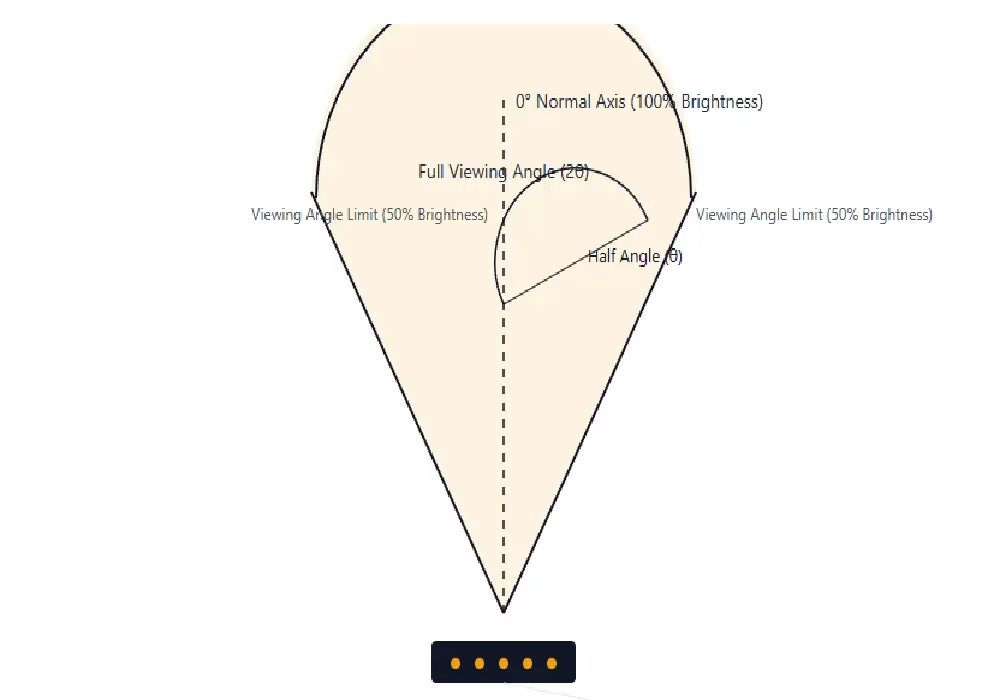
At its simplest, the LED screen viewing angle refers to the maximum range within which viewers can see the display content clearly without experiencing color shifts or a significant loss of brightness. It effectively defines the “readable zone” of your display. However, to truly understand this specification and compare products accurately, we need to look at the industry’s technical definition: The 50% Brightness Standard.
The Technical Definition: The 50% Rule
You might notice that an LED screen doesn’t just turn black the moment you step to the side. Instead, the image quality degrades gradually.
In the LED industry, the limit of the viewing angle is scientifically defined as the position where the screen’s brightness drops to 50% of its maximum center brightness (also known as on-axis brightness).
Inside this angle: The image is considered acceptable, with accurate colors and sufficient brightness.
Outside this angle: The brightness falls below 50%, and the image may appear washed out, dim, or distorted.
Full Angle vs. Half Angle (Understanding 2θ1/2)
When looking at professional datasheets, you might occasionally see the code 2θ1/2. This is the engineering notation for viewing angle. It helps distinguish between the “Half Angle” and the “Full Angle”:
Half Angle (θ): The angle measured from the center of the screen (the normal axis) to the point where brightness drops to 50% on one side (e.g., 80 degrees to the left).
Full Angle (2θ): The total viewing range from the left 50% point to the right 50% point.
What this means for you:
When UnifyLED specifies a screen with a 160° viewing angle, it technically means the brightness stays above 50% for a total span of 160 degrees (80° left + 80° right).
Horizontal vs. Vertical Viewing Angles
LED displays emit light in a cone shape, but this cone isn’t always a perfect circle. That is why we measure viewing angles in two distinct directions:
1. Horizontal Viewing Angle (H)
This measures the viewable range from side to side.
Why it matters: This is usually the most critical factor for wide audiences, such as those viewing billboards, stage backdrops, or shopping mall screens.
2. Vertical Viewing Angle (V)
This measures the viewable range from top to bottom.
Why it matters: This is crucial for screens installed high up (like highway signs or hung displays) where people are looking up from below.
A specification of 160°(H) / 120°(V) means the screen offers a super-wide 160-degree range horizontally, but a tighter 120-degree range vertically to focus light effectively where the audience is standing.
2. Why are Viewing Angles Important for an LED Display?
Choosing the right viewing angle is not just a technical formality; it is a critical business decision that directly impacts the effectiveness of your advertising and the satisfaction of your audience. If an LED screen looks brilliant from the center but fades or distorts from the side, you are essentially paying for a display that only works for 50% of your potential viewers.
Here are the three critical reasons why optimizing your viewing angle matters:
Maximizing Audience Coverage and ROI
The primary goal of any LED display—whether it is a digital billboard or a stadium screen—is to be seen by as many people as possible.
The “Prime Viewing Zone”: A wider viewing angle expands the “prime viewing zone.” For outdoor advertising, this means drivers can read your message sooner and for longer as they pass by.
Return on Investment (ROI): If your screen has a narrow angle, people standing at the edges of a plaza or sitting in the corner of a conference room will miss the content. By maximizing the viewing angle, you maximize the number of eyes on your screen, directly improving your CPM (Cost Per Thousand impressions) and overall ROI.
Preventing "Color Shift" (Beyond Just Brightness)
Many buyers mistakenly believe that a poor viewing angle just means the screen looks dimmer from the side. However, the more serious issue for high-end applications is Color Shift (or Color Cast).
As viewers move off-axis (to the side), the physics of the LED packaging technology can cause colors to distort before the brightness drops significantly.
The Risk: A white background might turn yellowish or bluish, and a brand’s signature red might appear orange.
Why it Matters: For luxury retail stores, car showrooms, or corporate lobbies, maintaining color consistency from every angle is vital for protecting brand identity. A high-quality wide-angle display ensures the colors remain true, no matter where the viewer stands.
Installation Flexibility
A screen with superior viewing angle specifications gives you more freedom in where and how you install it.
High Installations: For screens mounted high above the ground (like highway signage), a good vertical viewing angle ensures the content is readable by people on the ground.
Challenging Spaces: In wide, shallow rooms or locations with complex architecture, a wide-angle screen ensures that even viewers at extreme angles still get a premium visual experience.
3. Components of LED Screen Viewing Angle
To accurately read a specification sheet and choose the right display, it is essential to understand the specific components that make up the total viewing experience. The viewing angle is not just one number; it is a combination of directional measurements and physical properties.
(1) Horizontal Viewing Angle
This measures the effective viewing range across the X-axis (from the left side to the right side of the screen).
What it measures: The angle at which the image remains bright and color-accurate as viewers move sideways from the center.
Why it matters: This is typically the most important metric for most applications. A wider horizontal angle is essential for displays facing wide crowds, such as concert stages, shopping malls, or roadside billboards, ensuring that people walking past the screen can clearly see the content before they are directly in front of it.
(2) Vertical Viewing Angle
This measures the effective viewing range across the Y-axis (from the top to the bottom of the screen).
What it measures: The angle at which the display remains visible when viewed from above or below.
Why it matters: This is critical for installations where the screen height differs significantly from the viewer’s eye level. For example, a hanging LED scoreboard in a stadium or a high-mounted outdoor billboard requires a specific vertical angle to ensure viewers on the ground don’t see a dark or shaded image.
(3) Half-Brightness Angle (The Limit)
As defined in the industry standards, this is the specific point where the screen’s brightness output drops to 50% of its peak center brightness.
Role: It acts as the boundary line. While you can technically see the image beyond this angle, it is no longer considered “broadcast quality.” It is also important to note that this boundary is not static. As the diodes degrade over time due to heat and usage, the baseline brightness shifts. Understanding the factors that affect LED screen lifespan helps you predict how long your display will maintain its optimal viewing specifications.
(4) The Viewing Cone
While horizontal and vertical angles are measured separately, in the real world, they combine to create a three-dimensional Viewing Cone.
Visualization: Imagine a cone of light projecting outward from the screen. Viewers standing anywhere inside this 3D “sweet spot” will experience the optimal image quality. Understanding the viewing cone is vital for complex venues like amphitheaters where the audience is spread out both horizontally and vertically.
(5) LED Light Emission Pattern
This refers to the inherent physical behavior of the LED diode itself. Unlike a standard light bulb that shines in all directions, an LED emits light in a specific directional pattern.
Impact: The design of the LED package (SMD vs. DIP) and the optical lens determines how wide or narrow this emission pattern is, which ultimately dictates the final viewing angle of the screen.
4. Types of LED Screen Viewing Angles
LED screens are not “one size fits all.” Depending on the technology used (DIP, SMD, or COB) and the intended application, the viewing angle can vary significantly. Understanding these categories will help you match the right screen to your specific environment.
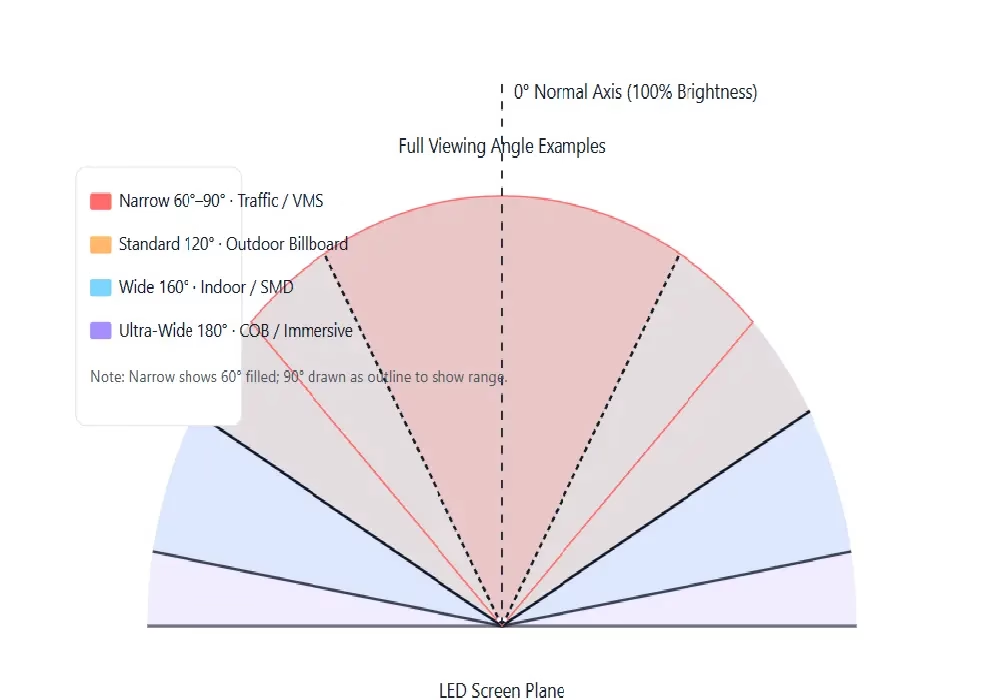
4.1 Narrow Viewing Angle (< 100°)
Range: Typically 60° to 90° Horizontal.
Technology: Often associated with specialized lens designs or older lamp-based LEDs.
Characteristics: These screens focus the light output into a tight, concentrated beam. By sacrificing side visibility, they achieve extremely high brightness levels straight ahead.
Best For: Traffic VMS (Variable Message Signs) and highway billboards. In these scenarios, the goal is to direct the message specifically to drivers in a specific lane from a long distance, rather than to people standing on the side of the road.
4.2 Standard Viewing Angle (120° – 140°)
Range: 120° Horizontal / 60°-120° Vertical.
Technology: Traditional DIP (Dual In-line Package) or earlier generations of SMD technology.
Characteristics: This offers a balanced performance. It covers a decent area but may show some brightness drop-off if viewers move to the extreme sides.
Best For: Standard outdoor fixed advertising billboards where the audience location is predictable (e.g., a screen mounted on a building facing a plaza). It is a cost-effective solution for general-purpose displays.
4.3 Wide Viewing Angle (160°)
Range: 160° Horizontal / 140°-160° Vertical.
Technology: Modern SMD (Surface Mounted Device) LED displays.
Characteristics: This is the current “Gold Standard” for most high-quality commercial screens. SMD LEDs sit flat on the board, allowing light to disperse widely without obstruction. The image remains vibrant even when viewed from sharp angles.
Best For: Indoor retail screens, rental stage screens for concerts, and shopping mall displays where crowds are moving and viewing the content from multiple directions.
4.4 Ultra-Wide Viewing Angle (170°+)
Range: Approaching 170° to 180°.
Technology: COB (Chip on Board) and Mini LED technology.
Characteristics: This represents the cutting edge of display technology. Unlike traditional screens that require plastic masks (which can block light at extreme angles), COB screens have a flat, encapsulated surface. This allows for an almost panoramic, 180-degree visibility with virtually no color shift.
Best For: Premium control rooms, immersive studios (xR stages), and luxury visual experiences where every seat in the room must have a perfect view.
5. The Physics Behind the Angle: DIP vs. SMD vs. COB
While the previous section outlined the viewing angle ranges, it is crucial to understand why these differences exist. The physical packaging of the LED—how the chip is encased and mounted—is the primary factor determining the spread of light.
5.1 DIP (Dual In-line Package): The Focused Beam
DIP is the traditional “bullet-shaped” LED. Its narrower viewing angle (typically 100°-110°) is a deliberate design choice, not a flaw.
The Structural Reason: The thick epoxy lens is shaped to focus light forward like a flashlight.
The Impact of Louvers: To protect DIP lamps from sunlight and increase contrast, manufacturers use heavy plastic “louvers” (shaders) above each row of LEDs. These physical visors block light from escaping upwards or downwards, significantly restricting the vertical viewing angle.
Verdict: Great for blasting brightness directly at highway traffic, but poor for off-axis viewing.
5.2 SMD (Surface-Mounted Device): The Balanced Spread
SMD technology revolutionized the industry by placing the Red, Green, and Blue chips into a single flat square package mounted directly on the PCB surface.
The Structural Reason: Because the light source is flatter, it emits light more evenly in all directions compared to the focused DIP lamp.
The Limitation: Although wider than DIP (typically 140°-160°), SMD screens still require a plastic mask to protect the solder joints and improve contrast. Under extreme angles, the rim of this plastic mask can slightly block the light, preventing a full 180° view.
Verdict: The perfect balance for 90% of commercial applications.
5.3 COB (Chip-on-Board): The Unobstructed View
COB is the reason why we can now achieve “Ultra-Wide” viewing angles approaching 170° to 180°.
The Structural Reason: In COB technology, the LED chips are bonded directly to the board and covered by a smooth, uniform layer of epoxy resin.
The “Mask-Free” Advantage: Crucially, COB displays do not use plastic masks or shaders between pixels. With no physical barriers protruding from the surface to block the light path, the image remains visible from almost parallel to the screen.
Verdict: The ultimate choice for immersive experiences where viewers might be seated at extreme angles relative to the screen.
6. Manufacturing Factors That Fine-Tune the Viewing Angle
While the LED technology (SMD vs. COB) sets the theoretical limit, the actual performance in the real world is determined by manufacturing precision and optical design.
Why do two SMD screens with the same specs perform differently? It comes down to these subtle but critical factors:
(1) Mask Geometry (The Height of the Louvers)
For outdoor screens, the plastic mask is the biggest variable.
The Trade-off: Manufacturers add “louvers” (plastic ridges) above pixels to block sunlight and improve contrast. However, if these louvers are too high or thick, they will physically block the LED’s light when viewed from below.
Optimization: High-quality screens use a precision-engineered mask height that blocks sunlight without cutting off the vertical viewing angle.
(2) Surface Finish (Matte vs. Glossy)
The texture of the screen surface affects how light leaves the display.
Matte Finish: Diffuses light more evenly, helping to widen the viewing angle and reduce reflections from ambient light. This is preferred for wide-angle visibility.
Glossy/Resin Finish: Often found in GOB/COB screens. While it protects the chips, poor-quality resin can act like a mirror, causing glare that limits visibility from the side. High-grade optical glue is required to minimize this refraction.
(3) Module Flatness and Assembly Precision
Even a 160° wide-angle screen will fail if it isn’t built perfectly flat.
The “Mosaic” Effect: If an LED module protrudes even 0.5mm higher than its neighbor, it casts a tiny shadow on the adjacent pixels when viewed from the side.
Impact: This creates dark lines or blocks parts of the image at extreme angles. Precision CNC cabinets and careful installation are required to ensure a seamless “gap-free” viewing experience.
(4) LED “Black Body” vs. “White Body”
For indoor screens, the color of the LED bracket matters.
Black Body LEDs: These absorb ambient light rather than reflecting it. This creates higher contrast, which tricks the human eye into perceiving a sharper, clearer image from wider angles compared to traditional white-body LEDs.
7. The Impact of Screen Shape: Flat vs. Curved Displays
Sometimes, the limitation isn’t the technology, but the shape. One of the most effective ways to physically extend the LED screen viewing angle is by changing the screen’s form factor.
Flat LED Displays
A standard flat screen relies entirely on the diode’s light dispersion. While modern SMDs offer a wide LED screen viewing angle of 160°, viewers standing at a 90° angle (the extreme side) will still miss the content.
Curved and Flexible Displays
For installations requiring true panoramic visibility, UnifyLED recommends curved solutions.
Convex Curves (Outward): By wrapping the screen around a column or building corner, you physically mechanically expand the LED screen viewing angle to cover blind spots. This is common in “3D Naked Eye” billboards.
Concave Curves (Inward): Used in control rooms or immersive gaming setups. This curve ensures that the LED screen viewing angle is optimized specifically for a central user, keeping every pixel equidistant from the eye.
8. How to Measure the Viewing Angle of an LED Screen
Accurately measuring the LED screen viewing angle is critical for verifying manufacturer claims. It involves determining the exact limit where the display remains clearly visible without significant degradation in brightness, contrast, or color accuracy.
While manufacturers use professional labs, understanding the process helps you evaluate quality. Here is the step-by-step standard procedure:
Method A: The Professional Laboratory Test
This method requires precision instruments to determine the exact technical specification (the 50% brightness point).
Step 1: Prepare the Test Environment
Dark Room: Eliminate all ambient light to prevent interference.
Setup: Secure the LED cabinet on a rotating stage. Display a full-screen white test pattern.
Distance: Place the measuring device (sensor) at a distance of approximately 3× the screen height to ensure the sensor captures the full diode output.
Step 2: Establish Baseline Brightness (L0)
Measure the luminance (brightness) directly from the center, perpendicular to the screen (0° axis).
Record this value as L0 (Maximum Brightness). This will be your 100% reference point.
Step 3: Measure the Horizontal Viewing Angle
Rotate the screen (or move the sensor) horizontally in 5° or 10° increments.
Record the brightness value at each step.
The Cut-off: Identify the angle where the recorded brightness drops to 50% of L0. This point marks the limit of the horizontal LED screen viewing angle.
Step 4: Measure the Vertical Viewing Angle
Repeat the process by tilting the screen or sensor up and down.
Note the angle where brightness hits the 50% mark. This defines the vertical LED screen viewing angle.
Step 5: Advanced Check – Color Shift (Delta E)
High-end testing goes beyond brightness. Use a Spectroradiometer to check for color distortion.
If the color difference (ΔE) exceeds 5, the image is considered “distorted” even if the brightness is still acceptable.
Method B: The "Eye Test" (Practical for Buyers)
If you don’t have a laboratory, you can estimate the LED screen viewing angle visually:
Stand directly in front of the screen.
Walk to the side while keeping your eyes on a pure white or bright red image.
Stop walking the moment you see the white turn yellowish/bluish or the image look significantly dimmer.
The angle from your standing position to the center of the screen is your practical effective viewing angle.
Essential Tools for Measurement
To perform a professional assessment of the LED screen viewing angle, the following tools are used:
Luminance Meter: Measures the brightness intensity (Nits).
Goniophotometer: A specialized device for precise angular measurement (Standard in UnifyLED labs).
Spectroradiometer: Essential for detecting color shift/chromaticity changes.
Rotation Stage: Allows for mechanical, precise adjustment of viewing angles.
Be aware that OLED or COB screens typically retain better color consistency at extreme angles compared to standard SMD screens. If you notice severe color shift during a manual test, it often indicates a lower quality LED diode or poor mask design.
9. How to Choose the Best LED Screen Viewing Angle
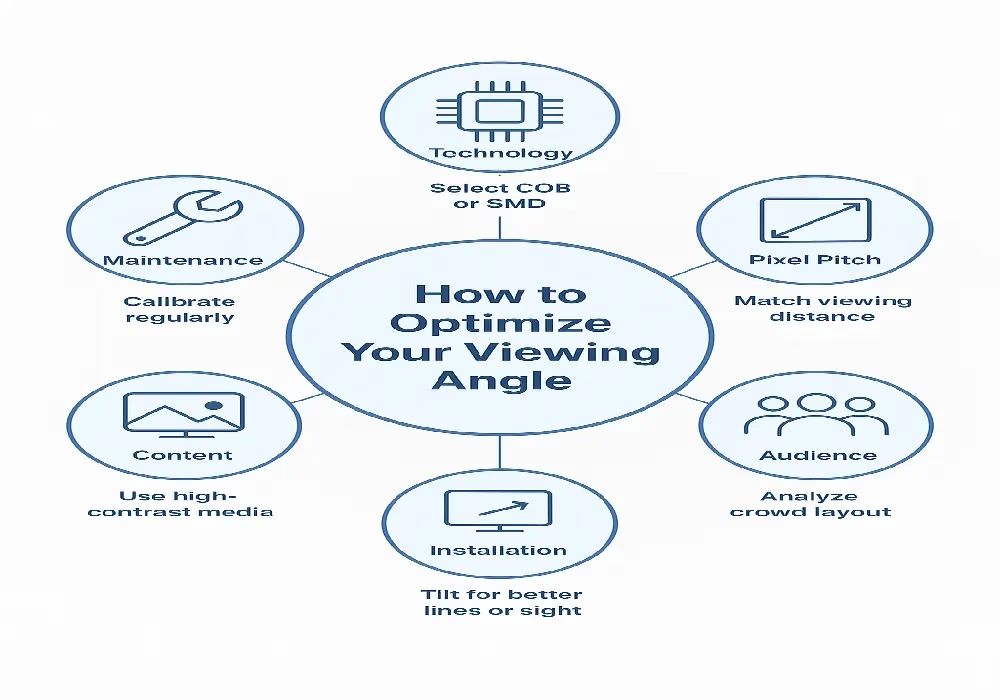
Choosing the correct LED screen viewing angle is the key to ensuring that every person in the room—or on the street—gets a clear, comfortable view. Here is how to select the optimal angle based on your specific setup requirements
(1) Select the Right LED Technology
The packaging technology sets the baseline for visibility.
COB (Chip on Board): Choose this for ultra-wide viewing angles and seamless, smooth visuals. It is the premium choice for immersive experiences.
SMD (Surface-Mounted Device): Select this for a great balance between wide angles and cost-efficiency. It remains the industry standard for most commercial displays.
(2) Balance Pixel Density
Resolution affects how the angle is perceived.
High Density: While higher pixel density improves detail, ensure it matches your viewing distance.
The Goal: Choose a density that offers sharp resolution without compromising the visual experience when viewers are standing up close.
(3) Analyze Your Audience Layout
Where are your viewers standing?
Wide Distribution: If your audience is spread out across a large area (like a shopping mall or plaza), you absolutely need a display with a wide viewing angle to cover the edges.
Focused Distribution: For specific, concentrated groups (e.g., inside a narrow conference room), a narrower or standard viewing angle can still perform perfectly well.
(4) Optimize Screen Installation
Physical positioning matters as much as the specs.
Tilting: Slightly tilting the screen downward or toward the center of the audience can significantly improve visibility for viewers located at the far edges or below the display height.
(5) Use High-Quality Content
The source material impacts the perceived quality.
Visuals: Content with high contrast, high brightness, and accurate colors will remain readable and vibrant from extreme angles much better than low-quality, washed-out visuals.
(6) Routine Maintenance and Calibration
Performance can drift over time.
Upkeep: Regularly clean the surface, adjust brightness settings, and perform color calibration. This ensures that the viewing angle performance remains consistent and the image stays sharp year after year.
10. FAQs
Technically, no. The optical LED screen viewing angle is a fixed physical property determined by the specific LED packaging (DIP/SMD/COB) and the mask structure. You cannot widen it via software settings.
However, you can improve visibility mechanically by physically tilting the cabinet structure downward or curving the screen during installation to face the audience better.
It's a common myth, but not anymore. In older technologies, focusing light into a narrow beam (like a flashlight) was the only way to get high brightness.
However, modern high-end SMD and COB chips used by UnifyLED can achieve both high peak brightness and a wide viewing angle simultaneously, ensuring excellent visibility even in direct sunlight.
This phenomenon is known as "Color Shift" or "Off-Axis Color Cast."
It happens when the structural design of the LED blocks one color (e.g., Blue) more than another (e.g., Red) at extreme angles. This is often a sign of lower-quality masking or encapsulation. UnifyLED screens use premium chips and optimized mask designs to ensure color consistency remains uniform from every angle.
11. Summary
In summary, choosing the optimal LED screen viewing angle is not just a technical formality but a strategic move to guarantee a premium visual experience for every viewer, regardless of where they stand. By selecting the right technology—such as wide-angle SMD or ultra-wide COB—and considering factors like installation height and mask geometry, you can prevent color shifts and ensure your content remains vibrant and effective. Don’t let a narrow view limit your display’s potential. Contact UnifyLED today to consult with our experts and find the perfect high-performance LED display solution tailored to your specific project needs.
12. Recommend
What Is LED Anode Cathode? How to Identify, Test & Wire It
What Is LED Anode Cathode? Anode is positive, cathode negative. Identify LED polarity, test with a multimeter, and avoid dead pixels during module repair.
How to Clean an LED Screen: The Commercial Owner’s Playbook
How to clean an LED screen the right way: safe products, a commercial SOP, cleaning frequency by environment, and the mistakes that kill walls.
Black Spots on LED Screens: Causes, Diagnosis, and Repairs That Last
Black spots on LED screens usually mean failed lamp beads, a dead module region, or moisture damage. Diagnose, fix, and prevent them with this guide.