Video Wall vs. Projector: Best Investment for Churches & Large Venues in 2026
- Home
- »
- LED Screen Buying Guides
- »
- Video Wall vs. Projector: Best Investment for Churches & Large Venues in 2026
Choosing between a video wall vs projector is the most critical tech decision for your church in 2026. Tired of your Sunday sermon looking washed out in the morning sun? This guide breaks down why modern sanctuaries are ditching projectors for LED technology, specifically comparing brightness, real-world costs, and maintenance. By reading this, you’ll discover how to stop fighting glare and finally engage your congregation with crystal-clear visuals.
If you are ready for a visual upgrade, explore our specialized church LED display solutions. Let’s find the best investment for your venue.
Table of Contents
1. Why is a Video Wall Better Than a Projector for a Brightly Lit Church Sanctuary?
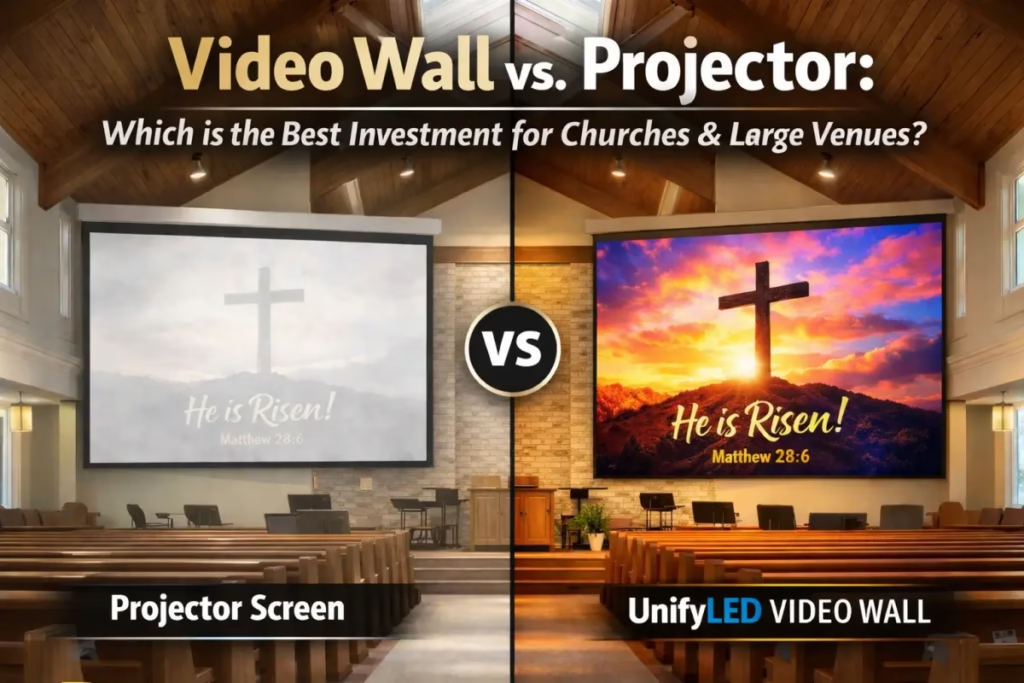
The most common reason for the video wall vs projector debate in a church sanctuary is ambient light. If your church has large windows or modern stage lighting, you’ve likely seen your projector’s image disappear as soon as the sun comes out. This happens because projectors rely on reflected light—the image travels through the air, hits a screen, and bounces back to the viewer. Any light in the room “competes” with that reflection, resulting in a washed-out mess.
An LED video wall, however, is a direct-emissive display. It doesn’t reflect light; it creates it. To understand the difference, we must look at nits (candela per square meter), which is the standard unit for measuring the brightness of a light source.
While a powerful 10,000-lumen projector might only produce about 200–300 nits once the light is spread across a large screen, UnifyLED’s indoor panels deliver a brightness of 1,000+ nits. This means an LED video wall is roughly 3 to 5 times brighter than a traditional projector setup. In a brightly lit sanctuary, this extra power ensures your scriptures and worship lyrics remain vibrant and readable, even with the curtains wide open.
2. What is the Real Cost Difference Between a Video Wall vs Projector for Church Budgets?
When evaluating a video wall vs projector, the first thing most church budgets look at is the upfront price tag. It’s true: a high-end commercial projector usually has a lower initial purchase price than a professional LED video wall. However, the “sticker price” is only half the story. To make a smart financial decision, you must consider the Total Cost of Ownership (TCO) over the next 5 to 10 years.
Projectors are essentially “consumable” technology. High-output lamps (bulbs) can cost anywhere from $500 to $1,500 each and typically need replacement every 3,000 hours. Even laser projectors, which don’t use bulbs, suffer from significant brightness degradation over time. When you factor in the cost of replacement lamps, professional cleaning, and the high electricity consumption required to run powerful cooling fans, the long-term expenses start to skyrocket.
In contrast, an LED video wall is a long-term investment. With a lifespan of 100,000 hours, a UnifyLED screen can last for over a decade of Sunday services without ever needing a “bulb” change. Because LED technology is more energy-efficient and modular, the ongoing maintenance cost is minimal. For most church budgets, the break-even point happens around year 5—after that, the LED wall effectively pays for itself by eliminating the recurring repair bills of aging projection systems.
3. How Does a Video Wall Solve the Shadow and Contrast Issues of a Church Projector?
Beyond brightness, the most noticeable difference on Sunday morning is the physical experience on stage. With a traditional projector, the light beam must travel across the room to the screen. If a pastor or worship leader stands in front of that beam, they cast large, distracting shadows over the lyrics while the projection glare hits their eyes. Because an LED video wall is a direct-view technology—meaning the screen itself emits the light—it is completely shadow-free. Your team can move freely on stage without ever blocking the message.
Furthermore, projectors often suffer from severe contrast issues. A projector creates “black” by simply trying not to shine light on a white or grey surface. However, you can’t “project” darkness. This is where contrast ratio—the ratio between the luminance of the brightest white and the darkest black—becomes critical.
While a projector’s “black” looks like a faded grey, an LED video wall achieves a near-infinite contrast ratio because each individual pixel can be turned off entirely. This results in “true black” backgrounds that make your graphics pop and ensure that scripture text remains razor-sharp for everyone in the congregation, regardless of where they are seated.
4. Is a Video Wall More Flexible and Easier to Maintain Than a Projector in a Church Setting?
Imagine it’s ten minutes before the Sunday service, and your projector bulb suddenly fails or the internal cooling fan dies. In a church setting, this means a total visual blackout for the entire congregation until a specialized technician can arrive. Because a projector is a single, closed unit, any internal hardware failure leads to total downtime.
A professional video wall eliminates this “single point of failure” through what we call Modular Maintenance. An LED wall is composed of dozens of individual panels. If a single pixel or one internal module fails, the rest of the screen continues to function perfectly. Most of our indoor screens feature front-access magnetic modules, allowing your church’s tech volunteer to swap out a faulty part in less than 60 seconds without even turning the power off.
This modular design also offers incredible creative flexibility. You aren’t stuck with a standard 16:9 rectangle; you can build pillars, curved backdrops, or panoramic displays that perfectly fit your altar’s architecture. This ruggedness and ease to maintain is a core standard at UnifyLED, featuring the same reliability found in our P10 outdoor LED modules used for high-impact roadside church signage. Transitioning to an LED video wall means you are no longer at the mercy of a single bulb; you are investing in a system designed for 24/7 reliability.
5. Final Comparison Table: Should Your Church Choose a Laser Projector or an LED Video Wall?
Deciding between a high-end laser projector and a modern LED video wall often comes down to balancing the immediate budget with long-term performance. In 2026, while projectors are still used for temporary setups, the video wall has become the gold standard for permanent church installations.
To help your committee make an informed choice, we’ve summarized the key differences below:
| Feature | High-End Laser Projector | UnifyLED Video Wall |
| Brightness | Low (Susceptible to ambient light) | High (1,000+ Nits – Sunproof) |
| Lifespan | ~20,000 Hours (Significant fading) | 100,000 Hours (Constant brightness) |
| Shadows | Yes (Person blocks light beam) | No (Shadow-free stage) |
| Contrast Ratio | Low (Grayish blacks) | Infinite (True black backgrounds) |
| Maintenance | High (Internal cleaning & filters) | Minimal (Swap modular panels) |
| Long-term ROI | Low (High replacement costs) | High (10+ years of reliability) |
6. Conclusion: Is an LED Video Wall the Right Move for Your Sanctuary?
As we have seen, the era of “dealing with” washed-out images is over. In 2026, investing in an LED video wall is no longer just a luxury—it is a strategic move to ensure your message is heard and seen clearly by every member of the congregation. Whether you are building a new church or upgrading an old auditorium, the superior brightness, zero maintenance, and high contrast of LED technology offer a much higher return on investment than any laser projector.
Ready to see the difference for yourself?
At UnifyLED, we specialize in helping houses of worship transition to world-class visual technology. Don’t settle for shadows and blurry text. Contact UnifyLED today to get a free consultation, a custom layout for your stage, and a detailed quote tailored to your specific budget. Let’s make your next Sunday service unforgettable.
7. FAQs: Video Wall vs. Projector for Modern Churches
Yes. While the upfront video wall vs projector cost is higher, you save thousands in the long run. An LED wall lasts 100,000 hours with zero bulb replacements or maintenance fees, offering a much higher ROI for any church sanctuary budget.
Absolutely. An LED video wall vs projector setup works seamlessly with ProPresenter, vMix, and Resolume. The wall acts as a standard high-definition monitor; just plug in your Mac or PC, and your worship lyrics will look sharper than ever.
No. Unlike a church projector that loses contrast when dimmed, an LED video wall is fully adjustable. You can dim it for quiet prayers while maintaining vibrant colors and "true black" backgrounds, ensuring a perfect atmosphere for any service.
If a church projector bulb fails, you have a total blackout. With a video wall vs projector, you have modular reliability. If one panel fails, the rest of the wall stays bright, and you can swap the faulty module in under a minute.
Installation is different but offers more freedom. A video wall requires a sturdy mount but eliminates the need for clear light paths. This means no more shadows from the pastor blocking the projector beam, giving you more flexibility on stage.