QLED vs Crystal UHD: Which Display Fits Your Business ROI?
- Home
- »
- LED Display Technology
- »
- QLED vs Crystal UHD: Which Display Fits Your Business ROI?
This guide provides a definitive comparison of QLED vs Crystal UHD for commercial applications. We define Crystal UHD as the cost-effective 4K choice for high-volume deployments, while QLED is the premium upgrade for superior brightness and color in well-lit spaces. Our analysis breaks down the technical differences and ROI for each technology, and explains why projects larger than 98 inches demand a professional Direct-View LED solution for a truly seamless, high-impact visual experience. Each technology excels in different scenarios, and our detailed UHD vs QLED analysis explores these nuances to help you make an informed choice.
Table of Contents
1. QLED vs Crystal UHD: Which Display Solution Is Right for Your Project?
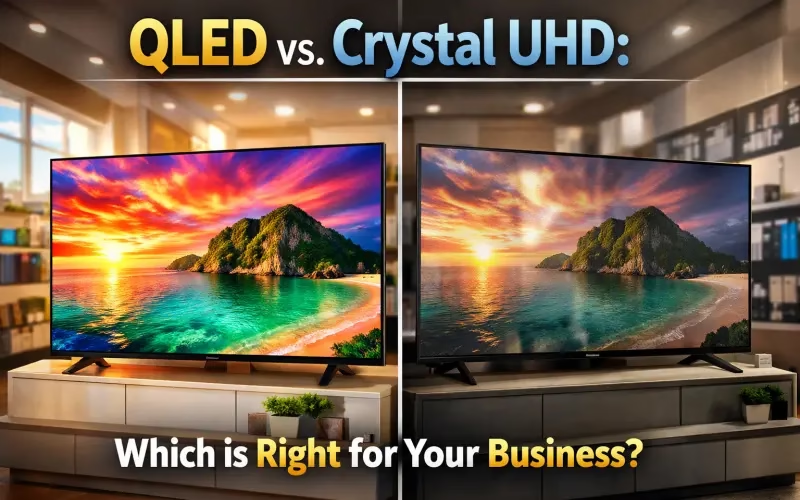
If you are evaluating QLED vs Crystal UHD for a commercial installation or professional setting, the choice depends on your specific environmental requirements and budget constraints. In the professional display industry, it is crucial to understand the baseline distinction: Crystal UHD is Samsung’s entry-level commercial-grade LCD line focusing on cost-efficiency, while QLED is the premium evolution, utilizing a Quantum Dot layer to achieve higher brightness and wider color gamuts suitable for well-lit public spaces.
While both technologies are fundamentally LCD panels with LED backlighting (distinct from direct-view LED video walls), they serve different roles in a system integration strategy. Crystal UHD provides reliable 4K clarity for standard digital signage or meeting rooms. QLED, however, is engineered for high-impact visual experiences, offering the superior contrast control and saturation needed for high-end retail or bright lobbies.
To help you decide which specification fits your commercial needs, here is the technical breakdown:
| Feature | Crystal UHD (Standard LED-LCD) | QLED (Quantum Dot LCD) |
| Panel Technology | LCD with standard Edge-Lit LED backlight | LCD with LED backlight + Quantum Dot Film |
| Color Performance | Standard color gamut; moderate brightness | 100% Color Volume; high visibility in ambient light |
| Visual Impact | Basic 4K clarity; standard contrast ratios | High Dynamic Range (HDR); deeper blacks and punchier highlights |
| Motion Handling | Typically 60Hz (Standard Content) | Up to 120Hz (Smoother motion for dynamic signage) |
| Budget Tier | Cost-effective / Volume Deployment | Mid-range to Premium / Flagship Display |
| Best Application | Small meeting rooms, menu boards, hotel rooms | Luxury retail, boardrooms, client-facing lobbies |
(Pro Tip: While these are excellent standalone displays, they still retain bezels. For seamless, large-scale visual experiences without grid lines, professionals typically recommend Direct-View LED Video Walls.)
2. What Is Crystal UHD?
You might be wondering, what is Crystal UHD? While the name sounds highly technical, it is essentially Samsung’s marketing term for their mainstream 4K televisions. In the professional display industry, it is important to clarify that these are not true LED screens (where each pixel is a self-emitting LED); rather, they are traditional LED-backlit LCDs.
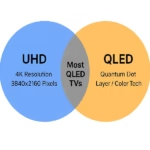
At its core, a Crystal UHD screen uses a standard LCD panel with a 4K resolution (3840 × 2160 pixels) illuminated by LED bulbs behind the screen. The “Crystal” portion of the name refers to the Crystal Processor 4K—an internal processing engine that upscales standard content to look sharper and color-maps images more effectively than older displays.
From a display engineering perspective, here is what defines Crystal UHD:
Edge-Lit Backlighting: Most of these models use edge-lit LED configurations to keep the screens thin and cost-effective. However, this lacks the contrast precision found in direct-view LED video walls.
Standard Phosphors: Unlike QLED, which uses advanced quantum dots, Crystal UHD uses standard color filters. This provides decent color accuracy for indoor consumer viewing but limits its peak brightness.
Consumer Scaling: It is an excellent, budget-friendly choice for small indoor spaces, meeting rooms, or home entertainment, ensuring text and fine details remain crisp.
In summary, Crystal UHD is a reliable entry-level consumer LCD product. However, for large-scale commercial applications or high-brightness environments, professionals typically bypass these consumer LCDs in favor of fine-pitch LED display screens.
3. What Is QLED Technology?
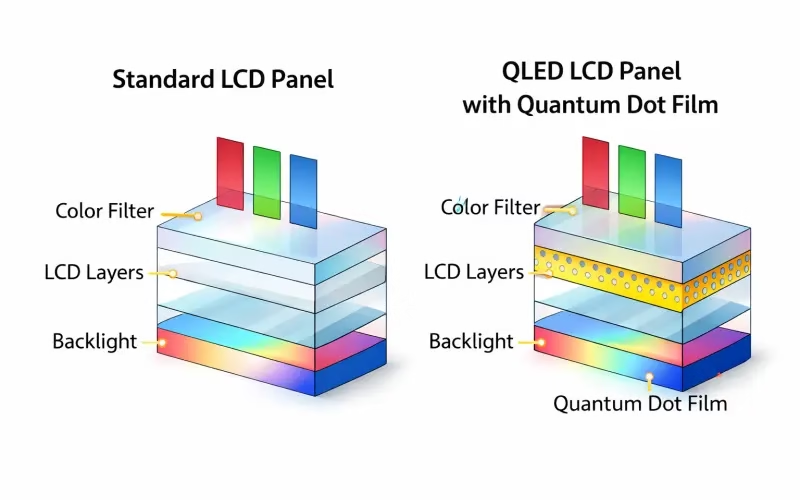
To make an informed decision, you must ask: what is QLED really? While often confused with emissive LED technologies, QLED (Quantum Dot LED) is essentially a premium tier of LCD television that utilizes a specialized nanotechnology layer to enhance performance.
Unlike standard screens, a QLED panel inserts a film of Quantum Dots—semiconductor nanocrystals—between the LED backlight and the LCD layer. When hit by light from the blue LED backlight, these dots emit incredibly precise red and green colors.
Why does this matter for commercial displays?
Superior Brightness (Nits): The quantum dot conversion process is highly efficient, allowing QLED screens to achieve significantly higher peak brightness than standard Crystal UHD models. This makes them ideal for high-ambient light environments, such as retail store windows or bright lobbies where standard screens might look washed out.
Color Volume: QLED technology can display virtually 100% of the DCI-P3 color space. For brands, this means digital signage can reproduce corporate colors and product visuals with strict accuracy.
Advanced Dimming: Commercial-grade QLEDs often feature Full Array Local Dimming (FALD). Unlike the edge-lit Crystal UHD, FALD allows zones of the backlight to dim independently, improving contrast ratios for dynamic content.
In the context of the Samsung Crystal UHD vs QLED comparison, the QLED badge signals a shift from “entry-level utility” to “high-performance visual impact.”
In practical terms, a QLED display will cut through reflections and maintain vibrancy in well-lit commercial spaces much better than a standard Crystal UHD unit. However, it is important to note that QLED is still a transmissive technology (it requires a backlight), meaning it cannot achieve the infinite contrast or seamless, bezel-free scalability of a professional Direct-View LED Video Wall.
4. How Neo QLED (Mini-LED) Changes The Equation?
When discussing QLED vs Crystal UHD, it is important to acknowledge the top-tier evolution: Neo QLED. This line represents Samsung’s integration of Mini-LED technology, positioning it as the most advanced backlit solution in their commercial and consumer catalog.
Instead of the standard edge-lit or full-array backlights found in Crystal UHD and standard QLED, Neo QLED utilizes thousands of microscopic LEDs grouped into hundreds of local dimming zones.
The Technical Advantage: This allows for precise light control. The screen can push peak brightness to extreme levels for impactful signage while keeping adjacent areas pitch black.
Commercial Application: This is particularly beneficial for high-end boardrooms or luxury retail displays where image depth and detail are non-negotiable, even under harsh overhead lighting.
While Neo QLED widens the performance gap significantly against the entry-level Crystal UHD, it remains an LCD-based technology. For professionals requiring bezel-free scalability or custom aspect ratios beyond standard 16:9, Neo QLED still faces physical limitations that only a modular Direct-View LED Video Wall can solve.
5. Samsung Crystal UHD vs QLED: Model Ranges & Size Limitations
For system integrators and procurement managers, understanding the hierarchy of these display lines is critical for budget planning.
Crystal UHD (Entry-Level Commercial/Consumer):
This line is the volume runner. It typically covers screen sizes from 43-inch to 85-inch.Use Case: Ideal for standalone menu boards, hotel guest rooms, or small meeting spaces where cost-per-unit is the primary metric. They offer basic 4K functionality but lack the brightness headroom for storefronts.
QLED & Neo QLED (Performance Tier):
QLED series extend the range, often offering sizes up to 98 inches and introducing 8K resolution options in the upper tiers.Use Case: Designed for “Hero” displays in lobbies or executive conference rooms.
The “Size Ceiling” Problem:
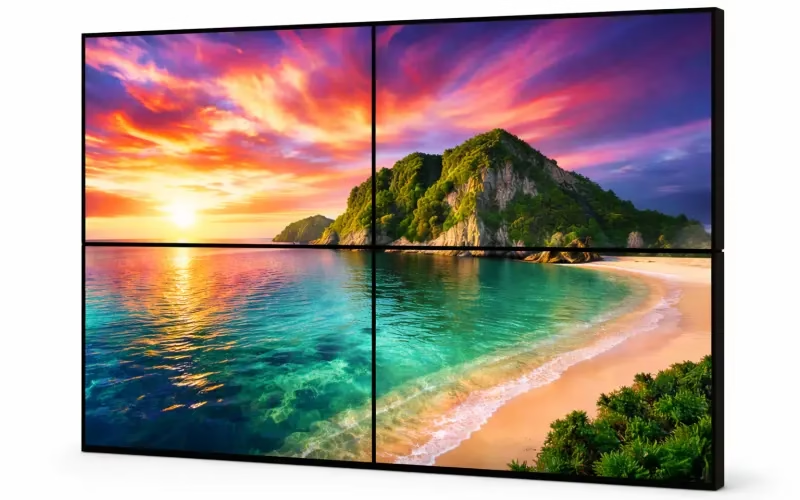
Here is where the comparison shifts for industry professionals. Both Crystal UHD and QLED are “fixed-cabinet” displays. The largest you can typically go is 98 inches.
The UnifyLED Solution: If your project requires a display larger than 100 inches or a non-standard shape, relying on Crystal UHD or QLED would require tiling multiple screens together, resulting in visible bezel grids. In these scenarios, the industry standard shifts to Fine-Pitch LED Video Walls, which offer seamless visuals at any scale.
6. Samsung Crystal UHD Price Breakdown: Is It Cost-Effective for Business?
For facility managers, the search often starts with numbers. The question isn’t just about quality, but feasibility: What is the real market cost of these displays?
The following 2025 estimates show why Crystal UHD is considered a “Commodity Display”:
| Display Class | Screen Size | Est. Market Price (USD) | Procurement Insight |
| Crystal UHD (Entry) | 43″ | ~$249 | Ideal for small huddle rooms or wayfinding. |
| Crystal UHD (Mid) | 75″ | ~$599 | Cost-effective for cafeteria menu boards. |
| Crystal UHD (Large) | 85″ | ~$899 | Common for standard meeting rooms. |
| Crystal UHD (Max) | 98″ | ~$1,699 | The limit of budget LCD technology. |
With an 85-inch screen pricing under $1,000, Crystal UHD is attractive for low-stakes environments. However, buyers must ask: Is the upfront saving worth the operational risk? As consumer-rated devices, they lack the durability for 24/7 commercial use.
7. QLED Price vs. LED Video Wall Cost: When Should You Upgrade?
As you move up the ladder to high-brightness QLED and Neo QLED (Mini-LED Backlight) models, the price structure changes drastically. The critical SEO question for integrators is: How does QLED pricing compare to a professional LED wall?
The data below reveals a “Price Cliff” as screen sizes approach 100 inches:
| Display Class | Tech Type | Size | Est. Price (USD) | UnifyLED Analysis |
| QLED Q7 Series | QLED | 75″ | ~$1,064 | Standard high-brightness option. |
| QLED Q80 Series | QLED | 98″ | ~$3,999 | Significant cost jump for size. |
| Neo QLED QN90 | Mini-LED Backlight | 85″ | ~$5,999 | High cost for better contrast. |
| Neo QLED QN90 | Mini-LED Backlight | 98″ | ~$8,999 | Approaching LED Wall pricing. |
| Neo QLED Flagship | Mini-LED Backlight | 115″ | ~$26,999 | Logistical nightmare; fragile glass. |
This table demonstrates the “Law of Diminishing Returns.” While an 85-inch TV is affordable, paying $9,000 to $27,000 for a 98-115 inch glass panel is often financially difficult to justify.
Why Professionals Choose LED Walls:
At these premium price points, the budget overlaps with Professional COB / Direct-View LED Video Walls.
QLED Restriction: Fixed aspect ratio, visible bezels if tiled, hard to transport.
LED Wall Advantage: A modular system that can be built to any size (110″, 150″, 200″+), offers a completely seamless (bezel-free) experience, and provides superior lifecycle value.
If your project needs a simple 55-85 inch screen, a Samsung TV is cost-effective. But when your requirements demand 100 inches or larger, switching to UnifyLED’s Direct-View LED solutions is the smarter financial and technical decision.
8. Crystal UHD vs QLED: Which Specification Offers Better ROI?
When making the final decision, facility managers often ask: Which display is objectively better for my business?
The answer is not about “picture quality” in a vacuum, but about Application Fitness. Choosing the most expensive screen for a back office is a waste of budget, while choosing a cheap screen for a storefront can damage brand perception.
Use the matrix below to determine the best ROI for your specific environment.
| Scenario | Recommended Display | Primary Reasoning |
| Storefronts & Bright Lobbies | QLED | High brightness is mandatory to cut through daylight and glare. Crystal UHD will look washed out. |
| Brand Color Accuracy | QLED | The Quantum Dot layer ensures corporate colors (e.g., Coca-Cola Red) are reproduced with 100% accuracy. |
| Hotel Guest Rooms (Volume) | Crystal UHD | Unbeatable cost-per-unit for large-scale deployments. Guests typically watch in controlled lighting. |
| Back-Office Dashboards | Crystal UHD | Sufficient clarity for data display; lower power consumption reduces operational expenses. |
| Longevity (24/7 Ops) | QLED | Commercial QLED series typically feature superior heat dissipation components compared to entry-level sets. |
“Better” is strictly relative to lighting conditions. In a dimly lit bar or hallway, a Crystal UHD set performs perfectly fine. However, in a glass-walled atrium or bright retail space, the extra budget for QLED is necessary to maintain image visibility and brand standards.
9. Crystal UHD vs QLED vs OLED: How Do They Compare for Signage?
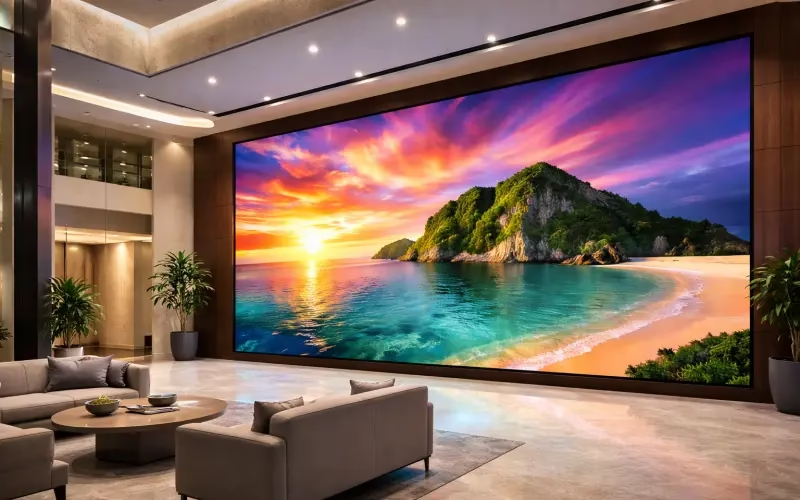
A common question from clients is: Where does OLED fit into this mix? And why should we consider Direct-View LED instead?
While OLED is famous for its perfect black levels in consumer TVs, it has significant drawbacks for commercial integration. Professional integrators must categorize these technologies based on durability and seamlessness.
Commercial Display Technology Comparison
| Feature | OLED (Organic LED) | QLED (Quantum Dot LCD) | Direct-View LED (UnifyLED COB) |
| Primary Technology | Self-Emitting Organic Pixels | LCD Panel + Backlight | Self-Emitting Inorganic Pixels |
| Contrast Ratio | Perfect (Infinite) | Good (Dependent on Dimming) | Perfect (Infinite) |
| Brightness Level | Moderate | Very High | Extreme (Daylight Visible) |
| Bezels / Seams | Thin Bezels | Visible Bezels | Seamless (Zero Bezels) |
| Major Risk Factor | Burn-In Risk (High) | Size Limit (Max 98″) | Higher Upfront Cost |
| Ideal Application | Dark, artistic video installations | Bright retail signage (Standard sizes) | Large-scale Lobbies, Boardrooms |
Why Professionals Choose Direct-View LED (COB)
If you are looking for the benefits of OLED (infinite contrast, vivid colors) but cannot risk burn-in, the professional answer is Direct-View LED (COB).
No Burn-In: Unlike OLED, UnifyLED’s inorganic COB technology can display static logos or dashboards 24/7 without degradation.
No Size Limit: Unlike QLED/LCD which stops at 98 inches, our modular system scales to 110″, 150″, 200″, or custom aspect ratios.
Seamless Experience: Eliminates the grid lines found in tiled LCD video walls for a unified visual impact.
Summary for Decision Makers
For Budget Focus: Choose Crystal UHD (Guest rooms, secondary screens).
For Standard Signage (<98″): Choose QLED (Standalone retail displays).
For Premium Impact (>100″): Upgrade to UnifyLED Direct-View Solutions for lobbies, boardrooms, and command centers where burn-in and bezels are unacceptable.
10. Is Crystal UHD Suitable for Daily Commercial Operations?
For facility managers, the question is not about “everyday viewing” but about Operational Sufficiency. Is Crystal UHD capable of handling daily business content?
The answer is Yes, but with specific caveats regarding duty cycles.
For breakroom entertainment, standard digital menu boards, or corporate messaging in hallways, a Crystal UHD model offers the key upgrade that matters most: sharp 4K text rendering and reliable scaling from PC sources. It supports basic commercial needs like screen mirroring and integration with control systems.
The Commercial Limitations:
While adequate for standard tasks, Crystal UHD reveals its weaknesses in demanding scenarios:
High-Ambient Light: In glass-walled lobbies, the screen will reflect glares, making content unreadable.
Duty Cycle: Most Crystal UHD panels are consumer-rated (6-8 hours/day). Using them 24/7 for digital signage often voids the warranty and accelerates panel failure.
Dynamic Content: Fast-moving promotional videos may experience motion blur compared to higher-end screens.
It covers “everyday needs” for non-critical information display comfortably.
11. Is the Investment in Crystal UHD Justified for Business?
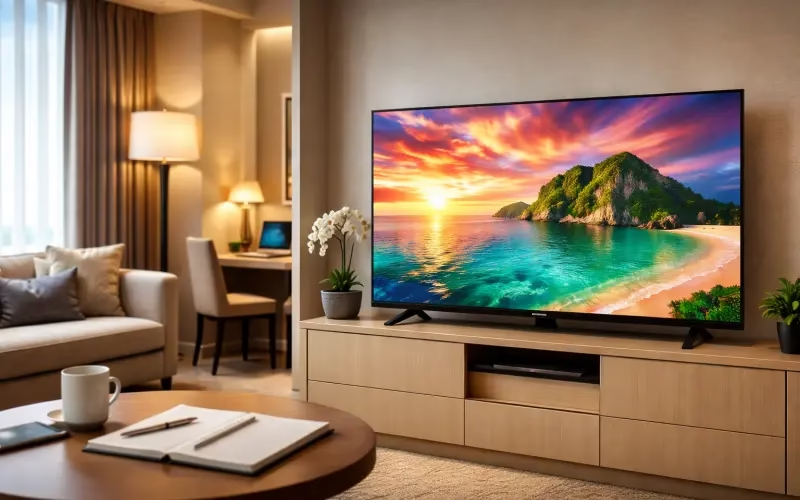
Is Samsung Crystal UHD worth buying for a commercial project? The answer is Yes, provided the goal is Volume Deployment rather than Premium Impact.
Several factors support this ROI conclusion:
Cost Efficiency: For a hotel needing 200+ screens for guest rooms, the savings per unit compared to QLED add up to significant capital preservation.
Energy Overhead: Modest peak brightness translates into lower power draw, which is a crucial metric for LEED-certified buildings or large-scale office fits.
Brand Ecosystem: Even at the entry level, these displays integrate with Samsung’s ecosystem, ensuring compatibility with standard remote management tools.
Room Suitability: Small huddle rooms and back-office monitoring stations do not require the high contrast capabilities of QLED.
Where Caution is Warranted:
If the screen is intended for a Client-Facing Zone (like a reception desk or showroom), “saving money” on Crystal UHD can backfire. A dim, washed-out screen suggests a “budget” brand image. In these cases, upgrading is necessary.
12. Does QLED Performance Justify the Commercial Premium?
Samsung QLED is clearly superior to Crystal UHD in technical performance, but for a business, the question is: Will this difference drive revenue or brand perception?
When placed side-by-side in a bright commercial showroom, the QLED advantage is objective:
High Nits (Brightness): It maintains visibility even under harsh fluorescent office lighting or direct sunlight.
Corporate Color Fidelity: The wide color gamut ensures logos and product videos look accurate, not muted.
Reflection Handling: Better anti-glare coatings reduce the “mirror effect” in bright rooms.
These differences translate into tangible value if the environment is uncontrolled (bright) or if the content represents the brand. However, for a breakroom TV that simply displays CNN, the premium for QLED is likely an unnecessary expense.
13. Price vs. Performance: The Commercial Application Matrix
Price typically separates Crystal UHD and QLED more than any single specification. For system integrators, understanding where each tier fits—and where they fail—is key to accurate bidding.
Commercial Application Guide
| Aspect | Crystal UHD (Entry Commercial) | QLED (Premium Commercial) | Direct-View LED (UnifyLED Professional) |
| Price Tier | Low (~$500 – $1,700) | Mid-High (~$1,000 – $8,000) | Project Based ($10k+) |
| Best Room Type | Hotel Rooms, Back Office | Retail Windows, Bright Lobbies | Large Auditoriums, Control Rooms |
| Best Content | Static Menus, TV Channels | Brand Videos, Digital Art | Immersive Experience, Data Walls |
| Scalability | Fixed Sizes (Max 98″) | Fixed Sizes (Max 98″) | Infinite / Seamless |
| Impact Factor | Functional | High Visibility | “Wow” Factor |
In many real-world situations, a 55-inch Crystal UHD is perfect for a meeting room. A 98-inch QLED is great for a specific signage spot.
Once you need an image larger than 98 inches, or a shape that isn’t 16:9, consumer TV technology (Crystal/QLED) hits a wall. This is where UnifyLED’s Direct-View LED becomes the only viable professional solution, offering bezel-free modularity that single-panel TVs cannot match.
14. How to Select the Right Display?
The easiest way to choose between Crystal UHD, QLED, or a Professional LED Wall is to start from the Environment, not the spec sheet.
Use this checklist for your next project:
1. Ambient Light Analysis
Low/Controlled Light: Crystal UHD is sufficient.
High/Natural Light: QLED is mandatory for visibility.
Direct Sunlight: Direct-View LED (High Brightness Series) is the only option that won’t turn black.
2. Viewing Distance & Size
Under 10ft (Small Room): Crystal UHD or QLED (43″-85″) works best.
Over 20ft (Large Venue): A TV will look too small. You need a 135″+ LED Video Wall.
3. Content Criticality
Informational (Excel/News): Crystal UHD.
Brand Critical (Logos/Ads): QLED for color accuracy.
Mission Critical (Command Center): Direct-View LED for 24/7 reliability and zero burn-in.
4. Budget Flexibility
If the budget is tight for volume (100+ units), Crystal UHD is the standard.
If the budget allows for a “Flagship” experience, bypass the TV category entirely and invest in a UnifyLED Video Wall to maximize ROI and lifespan.
15. Conclusion
Ultimately, the QLED vs Crystal UHD decision comes down to your specific application. Crystal UHD is the budget-friendly choice for controlled lighting, while QLED is essential for bright spaces where color accuracy and visibility are critical. However, both are limited by a 98-inch size ceiling and bezels. For premium projects requiring a seamless visual experience over 100 inches, upgrading to a UnifyLED Direct-View LED Video Wall is the smart choice for making a true, uncompromised impact.