
Mini LED vs QLED: Which Is Best for Commercial LED Displays?
- Home
- »
- LED Screen Buying Guides
- »
- Mini LED vs QLED: Which Is Best for Commercial LED Displays?
Table of Contents
When you search for Mini LED vs QLED to upgrade your conference room or showroom, you are likely bombarded with consumer TV reviews. However, in the professional AV sector, the conversation isn’t about screen models; it’s about display architecture. QLED remains a consumer-grade technology based on LCD panels—restricted by fragile glass substrates and inevitable bezels. Conversely, UnifyLED defines Mini LED as a superior Direct-View LED solution. Built upon precision die-cast aluminum cabinets and integrated COB modules, our system offers a seamless, industrial-grade structure designed for infinite scalability, far beyond the physical limits of a standard television.
Note: Before diving into the hardware structure, if you are also confused about how resolution works on these large-scale screens, check out our guide on UHD vs QLED: Understanding Resolution.
1. QLED vs Mini LED: Difference in Hardware Structure
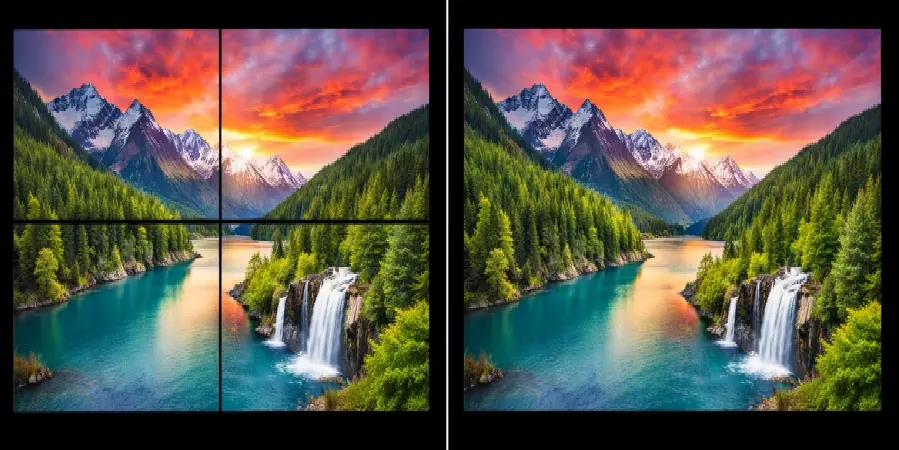
To truly understand the commercial implications of QLED vs Mini LED, we must look beneath the surface. The fundamental divergence lies not just in color performance, but in the physical construction of the display.
QLED technology, at its core, relies on a “sandwich” structure. It requires a backlight unit, a Quantum Dot film, a liquid crystal layer, and color filters, all compressed between two fragile layers of glass substrate. For professional environments, this structure presents significant limitations: glass is highly reflective under showroom lighting, heavy to transport, and impossible to customize. You are restricted to fixed, rectangular shapes manufactured at the factory.
Reference: https://en.wikipedia.org/wiki/Quantum-dot-display
In contrast, UnifyLED’s Direct-View Mini LED is a solid-state system designed for architectural integration. We eliminate the glass and liquid crystals entirely in favor of a robust, modular design:
PCB Encapsulation: LED chips are encapsulated directly onto the PCB board (often using COB technology), creating a durable, impact-resistant surface.
Module-Based Architecture: The screen is constructed from precision-engineered modules (such as our standard 150mm x 168.75mm units).
Die-Cast Cabinets: These modules magnetically attach to lightweight die-cast aluminum cabinets, allowing for seamless alignment and heat dissipation.
The conclusion is clear: A QLED TV is a pre-made consumer appliance limited by its bezel. A UnifyLED display is a versatile engineering component, allowing you to build a digital canvas of any size or shape.
2. Mini LED QLED vs QLED: The Backlight Myth vs. Direct Emitting
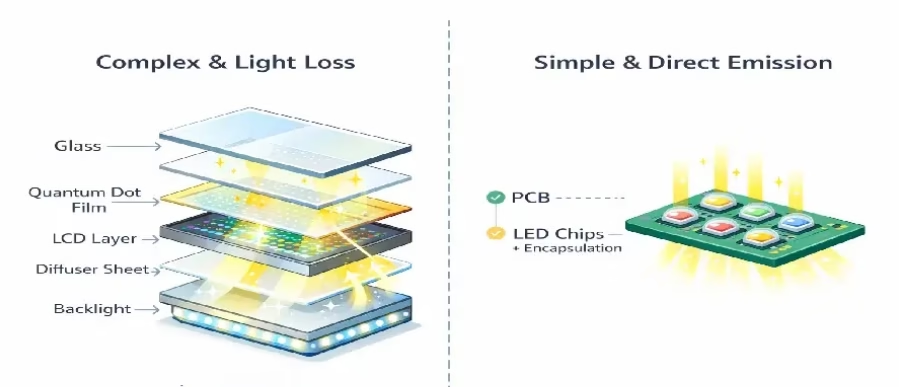
There is significant confusion in the market regarding Mini LED QLED vs QLED. Consumer brands market “Mini LED” as a TV feature, but it is critical to understand the engineering difference.
In a consumer TV (even a “QD-Mini LED” model), the Mini LED is merely a backlight. The light must fight its way through multiple layers: a diffuser, a liquid crystal shutter, and a color filter. This process results in significant light loss and restricted viewing angles. It is still, fundamentally, a transmissive LCD technology.
Reference: https://en.wikipedia.org/wiki/Backlight#Local_dimming
UnifyLED utilizes Direct-Emitting technology. In our system, the “Mini LED” is not a backlight; it is the pixel itself.
Zero Light Loss: Because there are no liquid crystals to block the path, our P1.2 or P0.9 Fine Pitch modules deliver raw, unfiltered brightness (often exceeding 1000 nits).
Pure Contrast: When a pixel is off, it is absolute black. We don’t need “local dimming zones” to simulate black; we simply turn off the specific LED chip.
Professional Spec: This is why UnifyLED screens appear vibrant from any angle in a brightly lit showroom, whereas qled vs mini led comparisons often show TVs washing out under strong ambient light.
3. The Battle of Immersion: OLED vs Mini LED vs QLED
When investing in a commercial display, visual quality is only half the story; operational longevity is the other. Comparing OLED vs Mini LED vs QLED reveals critical differences in lifespan and maintenance that directly impact your ROI.
OLED offers perfect blacks but utilizes organic materials that degrade over time, leading to significant burn-in risks—a fatal flaw for control rooms or lobbies displaying static logos 24/7. QLED is more durable but suffers from a massive maintenance liability: if a single pixel fails or the screen is damaged, the entire panel must be discarded and replaced, costing thousands of dollars.
UnifyLED’s Mini LED displays are engineered to eliminate these risks.
100,000+ Hour Lifespan: Built with industrial-grade diodes, our screens are designed for continuous 24/7 operation without burn-in.
Front Maintenance Revolution: unlike a QLED TV, our system is fully modular. If a pixel is damaged, you don’t replace the screen. Using a simple vacuum tool, a technician can remove a single magnetic module from the front in seconds, replace it, and the screen is back to perfect condition. This module-level serviceability is a game-changer for facility managers that consumer tech cannot match.
4. Why Modular Mini LED Beats QLED in Commercial LED Displays?
In large-scale installations, the limitation isn’t just technology; it’s physics. The biggest drawback in the QLED vs Mini LED comparison is the “Seam Problem.”
Even the most advanced QLED video walls rely on LCD panels that require a bezel (frame) to hold the liquid crystals. Even with “razor-thin” 0.88mm bezels, when you tile them together, you create a permanent, distracting grid pattern that breaks the content.
UnifyLED’s Direct-View advantage lies in our CNC Precision Die-Cast Cabinets.
Truly Seamless: Our cabinets are machined with 0.01mm precision, allowing modules to lock together perfectly. The result is a unified, bezel-free canvas that can span entire walls.
Limitless Scalability: While QLED is locked to a 16:9 aspect ratio, UnifyLED’s modular design allows you to build customized shapes—whether it’s a long ribbon display for a stock ticker or a curved screen for a creative studio.
Surface Protection: Utilizing GOB (Glue on Board) technology, our Mini LED modules are shock-proof and moisture-resistant, making them rugged enough for high-traffic retail environments where fragile QLED screens would shatter.
5. Brand Reality: Hisense/Samsung TV vs. UnifyLED Professional Displays
A common question from budget-conscious project managers is: “Why not just install a 100-inch Hisense or TCL TV?”
If you are comparing Mini LED vs QLED Hisense models for a home cinema or a small break room, those TVs are excellent value. However, for a commercial video wall, consumer TVs fail in three critical areas where UnifyLED specializes:
Refresh Rate & Scan Lines: Consumer TVs typically run at 60Hz or 120Hz. UnifyLED displays offer High Refresh Rates (3840Hz or 7680Hz). This is non-negotiable for broadcast studios, churches, or any venue where the screen will be photographed or filmed, ensuring no flickering or scan lines appear on camera.
Latency & Control: A TV runs on Android OS with built-in processing lag. UnifyLED systems utilize professional Sending Boxes (like Novastar) with microsecond-level latency, essential for live events and command centers.
Reflectivity: TV screens are glossy. UnifyLED modules use a specialized matte encapsulation (GOB/COB) to absorb ambient light, ensuring content is readable even under direct spotlights.
4. FAQs
In the TV world, QLED is a color filter and Mini LED is just a backlight. However, for UnifyLED, Mini LED refers to Direct-View technology (COB). Unlike QLED TVs which require a glass panel and bezels, our Direct-View Mini LED pixels emit their own light, allowing for seamless, unlimited-size video walls.
QD-Mini LED is a marketing term for high-end consumer TVs that use both Quantum Dots (for color) and Mini LED (for backlighting). While great for living rooms, they still have reflective glass screens and fixed sizes. Professional projects require UnifyLED's modular, matte-finish displays for glare-free viewing.
Direct-View Mini LED is the only professional choice. Even "frameless" QLED TVs create a visible black grid (bezels) when tiled together. UnifyLED’s modular cabinets align with 0.01mm precision, creating a 100% seamless digital canvas.
No. OLED uses organic materials that degrade. UnifyLED uses industrial-grade inorganic LEDs rated for 100,000+ hours, making them immune to burn-in and perfect for 24/7 control rooms.
5. Conclusion
The verdict on MiNi LED vs QLED depends entirely on your application.
If you need a standalone screen under 98 inches for entertainment, QLED technology is a cost-effective choice. However, if your project demands a seamless, large-scale video wall that can be customized to any shape and serviced without downtime, Direct-View Mini LED is the only viable professional solution.
Stop limiting your vision to a bezel. Contact UnifyLED today to discuss your project requirements and get a quote for our P1.2 COB Display Solutions.
6. Recommend

Why is The LED Rental Screen Philippines Your Best Event Business Investment?
Maximize ROI with our LED rental screen Philippines guide. Learn P3.91 profit secrets, labor-saving setup, and DDP shipping. Contact our factory for 2026 wholesale prices!
How to Choose Typhoon-Proof Outdoor LED Billboards for Philippine Climate
Master the market with a durable Outdoor LED billboard Philippines. 2026 technical guide on typhoon-proof design, ROI analysis & factory-direct pricing for Manila & Cebu.
How to Choose the Best Church LED Screen in the Philippines?
Upgrade your worship with a high-quality Church LED screen Philippines. Guide for PH ministries on P2.5/P3 walls, 3840Hz for Facebook Live, and factory-direct DDP shipping to Manila & Cebu.